

Homework Answers


Add Answer to:
Find the voltage gain of the amplifier given below, assuming Rj = 15 kOhm, R2 =...
+ vít) (1) The amplifier above applies different voltage gains to vi(t) and Vat) . Determine...
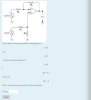 + vít) (1) The amplifier above applies different voltage gains to vi(t) and Vat) . Determine the gain applied to v2(1) R; = 13 kOhm and R, = 3 kOhm. Round your answer off to two decimal places. Answer: Check 1 + voru (1) IR Determine the amplitude of the output signal in volts if Rx = 16 kOhms, C =4 uF, and Vin(t) = 2 cos(21100t) mv. Answer: Check
Calculate the voltage gain (Av) for the loaded Common Emitter Amplifier below: BAC 200 for all...
 Calculate the voltage gain (Av) for the loaded Common Emitter Amplifier below: BAC 200 for all transistors. Assume re 15 Q for the CE Amplifier. Ignore re' for the DP Amplifier Vcc 12 V, R1 56 K, R2 10 KQ, R4 22 KQ R3 5.6 KQ, RL 8 RE(CE) 628 0, RE(CC) 330 Rc 3.5 KQ, Enter your results. No units. SR3 R1 RC C3 Vcc C1 Beta Q2a HH Vin Beta Q1 Beta Q2b C4 R4 Vs R2 C2...
USE EXACT ANALYSIS Use 4 decimal places, no commas. Given: Single-stage, voltage-divider biased, common collector amplifier...
 USE EXACT ANALYSIS Use 4 decimal places, no commas. Given: Single-stage, voltage-divider biased, common collector amplifier with a. VCC = 15V b. R1 55 kohms c. R2 15 kohms d. RE 1.5 kohms e. Rs = 14 ohms f. RL = 500 ohms g. DC Beta = 50 h, AC Beta = 100 *C1 and C2 are coupling capacitors. C3 is bypass capacitor Required: A. VTH =[a] V B. RTH =[b] kohms C. IE [c] mA D. VC =[d] V...
Calculate the power gain (Ap) for the loaded Common Collecter Amplifier below: Assume Av1, BAC-180, lanore...
 Calculate the power gain (Ap) for the loaded Common Collecter Amplifier below: Assume Av1, BAC-180, lanore re Vec-15 V R1=39 KO R2-220 KQ RE=1 KO. RL-0.8 KQ Enter your results. No units. Vcc C1 Beta Vout RL RE
The following Amplifier needs to be designed such that the voltage gain Av = 54. Assume...
 The following Amplifier needs to be designed such that the voltage gain Av = 54. Assume Vcc=10V, B=50, RL= 10 kq, RS = 100, and design for Ico= 0.48 mA and VEQ = 2V. (a) Find the values of Gm and it (b) Find the values of resistors R1, R2, RC, RE using the design procedure presented in class notes (or textbook) In the answer box write the value of Rc in ko (c) Find the Input resistance (d) Find...
Given V1 = 1 Vpp, V2 = 4 Vpp, Vout = 0.82 Vpp and Rf =...
 Given V1 = 1 Vpp, V2 = 4 Vpp, Vout = 0.82 Vpp and Rf = 2 kq and that R1, R2 and R3 are all equal, find the value of R1 Input resistor R1 = R2 = R3 = ko. (Round your answer to 2 decimal places) RF Vout OA1 R1 Sm R2 + TL081 L 1 : v2 3 R3 Use phasor techniques to determine the current supplied by the source given that V = 12 <0° v,...
Determine the voltage across R2 in the given circuit. (Calculate the direction in radians and round...
 Determine the voltage across R2 in the given circuit. (Calculate the direction in radians and round the final answer to two decimal places.) Given: Kt) = 20 cos(533.33) A, R1 = 9.2 Ω, R2 = 34 Ω, L = 15 mH, and C-117F i() 2 The voltage across R2 in the given circuit is VR2(t) = | cos (533 33 ) V
For the driven-right-leg system below along with its equivalent circuit, assume 4. R,-5M0(non-ideal input impedance of op-amp) db Rx Auxiliary op amp RL db R1 Vcm_ Vi R5 2 RF R4 Rx o v RG 0 7 RA Aux...
 For the driven-right-leg system below along with its equivalent circuit, assume 4. R,-5M0(non-ideal input impedance of op-amp) db Rx Auxiliary op amp RL db R1 Vcm_ Vi R5 2 RF R4 Rx o v RG 0 7 RA Auxiliary Amplifier O VREF 2 R2 What are the benefits of using the driven-right-leg circuit? What is the value of the common-mode voltage if resistor RRL is tied to ground instead of the auxiliary amplifier? e.
For the driven-right-leg system below along...
For the driven-right-leg system below along with its equivalent circuit, assume 4. R,-5M0(non-ideal input impedance of op-amp) db Rx Auxiliary op amp RL db R1 Vcm_ Vi R5 2 RF R4 Rx o v RG 0 7 RA Auxiliary Amplifier O VREF 2 R2 What are the benefits of using the driven-right-leg circuit? What is the value of the common-mode voltage if resistor RRL is tied to ground instead of the auxiliary amplifier? e.
For the driven-right-leg system below along...
Good morning, I need help with the following, they all relate to OP Amps. Thanks in advance. 2 value 10.00 points Problem 05.010 An op amp voltage divider Find the voltage gain vo/vs of the circ...
 Good morning, I need help with the following, they all relate to
OP Amps. Thanks in advance.
2 value 10.00 points Problem 05.010 An op amp voltage divider Find the voltage gain vo/vs of the circuit given below, where R1-18 kΩ and R2-14 k 2. 20 kΩ R1 1% R2 The voltage gain vo/vs of the circuit is Hints Referene eBook & Resources Hint#1 Check my work 3. 1000 points value Problem 05.025-Voltage follower Calculate the output voltage vo in...
Good morning, I need help with the following, they all relate to
OP Amps. Thanks in advance.
2 value 10.00 points Problem 05.010 An op amp voltage divider Find the voltage gain vo/vs of the circuit given below, where R1-18 kΩ and R2-14 k 2. 20 kΩ R1 1% R2 The voltage gain vo/vs of the circuit is Hints Referene eBook & Resources Hint#1 Check my work 3. 1000 points value Problem 05.025-Voltage follower Calculate the output voltage vo in...
Use Exact Analysis Use 4 decimal places, no commas. a. VCC = 15V b. R1 =...
Use Exact Analysis Use 4 decimal places, no commas. a. VCC = 15V b. R1 = 55 kΩ c. R2 = 15 kΩ d. RC = 2.5 kΩ e. RE = 1.5 kΩ f. RS = 15 Ω g. RL = 500 Ω h. βDC = 50 i. βac = 100 Single-stage, voltage-divider biased, common-emitter with **C1 and C2 are coupling capacitors. C3 is bypass capacitor Given: A. VB = [a] V ; B. VE = [b] V ; C....
 + vít) (1) The amplifier above applies different voltage gains to vi(t) and Vat) . Determine the gain applied to v2(1) R; = 13 kOhm and R, = 3 kOhm. Round your answer off to two decimal places. Answer: Check 1 + voru (1) IR Determine the amplitude of the output signal in volts if Rx = 16 kOhms, C =4 uF, and Vin(t) = 2 cos(21100t) mv. Answer: Check
 Calculate the voltage gain (Av) for the loaded Common Emitter Amplifier below: BAC 200 for all transistors. Assume re 15 Q for the CE Amplifier. Ignore re' for the DP Amplifier Vcc 12 V, R1 56 K, R2 10 KQ, R4 22 KQ R3 5.6 KQ, RL 8 RE(CE) 628 0, RE(CC) 330 Rc 3.5 KQ, Enter your results. No units. SR3 R1 RC C3 Vcc C1 Beta Q2a HH Vin Beta Q1 Beta Q2b C4 R4 Vs R2 C2...
 USE EXACT ANALYSIS Use 4 decimal places, no commas. Given: Single-stage, voltage-divider biased, common collector amplifier with a. VCC = 15V b. R1 55 kohms c. R2 15 kohms d. RE 1.5 kohms e. Rs = 14 ohms f. RL = 500 ohms g. DC Beta = 50 h, AC Beta = 100 *C1 and C2 are coupling capacitors. C3 is bypass capacitor Required: A. VTH =[a] V B. RTH =[b] kohms C. IE [c] mA D. VC =[d] V...
 Calculate the power gain (Ap) for the loaded Common Collecter Amplifier below: Assume Av1, BAC-180, lanore re Vec-15 V R1=39 KO R2-220 KQ RE=1 KO. RL-0.8 KQ Enter your results. No units. Vcc C1 Beta Vout RL RE
 The following Amplifier needs to be designed such that the voltage gain Av = 54. Assume Vcc=10V, B=50, RL= 10 kq, RS = 100, and design for Ico= 0.48 mA and VEQ = 2V. (a) Find the values of Gm and it (b) Find the values of resistors R1, R2, RC, RE using the design procedure presented in class notes (or textbook) In the answer box write the value of Rc in ko (c) Find the Input resistance (d) Find...
 Given V1 = 1 Vpp, V2 = 4 Vpp, Vout = 0.82 Vpp and Rf = 2 kq and that R1, R2 and R3 are all equal, find the value of R1 Input resistor R1 = R2 = R3 = ko. (Round your answer to 2 decimal places) RF Vout OA1 R1 Sm R2 + TL081 L 1 : v2 3 R3 Use phasor techniques to determine the current supplied by the source given that V = 12 <0° v,...
 Determine the voltage across R2 in the given circuit. (Calculate the direction in radians and round the final answer to two decimal places.) Given: Kt) = 20 cos(533.33) A, R1 = 9.2 Ω, R2 = 34 Ω, L = 15 mH, and C-117F i() 2 The voltage across R2 in the given circuit is VR2(t) = | cos (533 33 ) V
 For the driven-right-leg system below along with its equivalent circuit, assume 4. R,-5M0(non-ideal input impedance of op-amp) db Rx Auxiliary op amp RL db R1 Vcm_ Vi R5 2 RF R4 Rx o v RG 0 7 RA Auxiliary Amplifier O VREF 2 R2 What are the benefits of using the driven-right-leg circuit? What is the value of the common-mode voltage if resistor RRL is tied to ground instead of the auxiliary amplifier? e.
For the driven-right-leg system below along...
For the driven-right-leg system below along with its equivalent circuit, assume 4. R,-5M0(non-ideal input impedance of op-amp) db Rx Auxiliary op amp RL db R1 Vcm_ Vi R5 2 RF R4 Rx o v RG 0 7 RA Auxiliary Amplifier O VREF 2 R2 What are the benefits of using the driven-right-leg circuit? What is the value of the common-mode voltage if resistor RRL is tied to ground instead of the auxiliary amplifier? e.
For the driven-right-leg system below along...
 Good morning, I need help with the following, they all relate to
OP Amps. Thanks in advance.
2 value 10.00 points Problem 05.010 An op amp voltage divider Find the voltage gain vo/vs of the circuit given below, where R1-18 kΩ and R2-14 k 2. 20 kΩ R1 1% R2 The voltage gain vo/vs of the circuit is Hints Referene eBook & Resources Hint#1 Check my work 3. 1000 points value Problem 05.025-Voltage follower Calculate the output voltage vo in...
Good morning, I need help with the following, they all relate to
OP Amps. Thanks in advance.
2 value 10.00 points Problem 05.010 An op amp voltage divider Find the voltage gain vo/vs of the circuit given below, where R1-18 kΩ and R2-14 k 2. 20 kΩ R1 1% R2 The voltage gain vo/vs of the circuit is Hints Referene eBook & Resources Hint#1 Check my work 3. 1000 points value Problem 05.025-Voltage follower Calculate the output voltage vo in...
Most questions answered within 3 hours.
-
Where is the error in this code sequence?
String s1 = "Hello";
String s2 = "ello";...
asked 10 months ago -
Financial data for Joel de Paris, Inc., for last year
follow:
Joel de Paris, Inc.
Balance...
asked 10 months ago -
Consider this reaction:
Al2(SO4)3 (aq)+ BaCl3
(aq) Al2Cl6 (aq)- +
3BaSO4(s) . What is the...
asked 10 months ago -
Suppose that Savneet is considering increasing her
recent random sample from 20 car rentals to 40...
asked 10 months ago -
Trucks arrive at an unloading terminal at an average rate of 120
per hour.
Trucks arrive...
asked 10 months ago -
Why are methanol and ethanol completely soluble in water while
octanol is not very little soluble....
asked 10 months ago -
A facilities manager at a university reads in a research report
that the mean amount of...
asked 10 months ago -
When the CuSO4 is rehydrated by adding water to the anhydrous
compound, is this an endothermic...
asked 10 months ago -
A ray of sunlight is passing from diamond into crown glass; the
angle of incidence is...
asked 10 months ago -
A block of mass 0.249 kg is placed on top of a light, vertical
spring of...
asked 10 months ago -
how do the kidneys compensate in the presences of acidosis
a) trigger hyperventilate
b) reserve acid...
asked 10 months ago -
Question 501 pts
The rental rate of capital to the firm increases. Which of the
following...
asked 10 months ago