
Homework Answers

 please
find the attached. If you have any doubt mention it in the comments
section.
please
find the attached. If you have any doubt mention it in the comments
section.
Add Answer to:
In the p < a region of the coaxial cable given in the figure below, the...
4. (12 points) Ampere's law in cylindrical coordinates (p,p,z.) An infinitely long coaxial cable is given in the fi...
 4. (12 points) Ampere's law in cylindrical coordinates (p,p,z.) An infinitely long coaxial cable is given in the figure below. The inner conductor has a radius of R1 = 1.00cm. The outer conductor has a radius R2 = 2.00cm and has negligible thickness. The inner conductor has a current density given by J 2.00A p (TR1) flowing out of the page (positive z direction), where ρ is the radial direction. The outer conductor has a current 1 of 1.00 Amperes...
2. A portion of a long, cylindrical coaxial cable is shown in the figure below. A...
 2. A portion of a long, cylindrical coaxial cable is shown in the figure below. A current I flows down the center conductor, and this current is returned in the outer conductor. Determine the magnetic field in all regions of space if the current density in both conductors is uniformly distributed across each cross-sectional area. Activ Go to
Calculate the self-inductance per unit length for a coaxial cable. As a model for the cable,...
Calculate the self-inductance per unit length for a coaxial cable. As a model for the cable, assume that current flows uniformly through a circular cross-section off radius R, and then returns along the surface of the cable (so that there is no magnetic field outside the cable). You can neglect the thin insulator that separates the current from the return current in your calculations.
wire in a coaxial cable carries current 2.00 A in one direc- tion, and the sheath...
 wire in a coaxial cable carries current 2.00 A in one direc- tion, and the sheath around it carries current 2.00 A in the opposite direction. What magnetic field does the cable cre- e at points outside the cable? A lona, culindrical conductor of radius R carries a cur- t I as shown in Figure-P30.36. The current-density J, however, is net- unform over the cross section of the con- ductor but rather is a function of the radius according to...
3.The shorted coax Imagine a coaxial cable made out of two concentric conductors of radius rı...
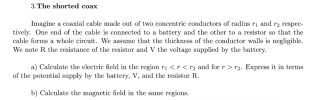 3.The shorted coax Imagine a coaxial cable made out of two concentric conductors of radius rı and r2 respec tively. One end of the cable is connected to a battery and the other to a resistor so that the cable forms a whole circuit. We assume that the thickness of the conductor walls is negligible. We note R the resistance of the resistor and V the voltage supplied by the battery. a) Calculate the electric field in the region ri...
This coaxial cable consists of a solid inner conductor of radius ?1 and a very thin...
This coaxial cable consists of a solid inner conductor of radius ?1 and a very thin outer conductor of radius ?2. The two cables carry equal currents ?, but in the opposite direction. The current density is uniformly distributed within each conductor. a) Find expressions for the magnetic field (B-field) in three regions: i) within the inner conductor ii) in the space between the conductors iii) outside the outer conductor. b) Draw a graph of B vrsus the cylindrical radius...
A coaxial cable is constructed from a central cylindrical conductor of radius r'a = 1.30 cm...
 A coaxial cable is constructed from a central cylindrical conductor of radius r'a = 1.30 cm carrying current 1a = 7.20 A in the positive x direction and a concentric conducting cylindrical shell with inner radius 18 = 14.0 cm and outer radius rc = 15.0 cm with a current of 13.0 A in the negative x direction (see Figure below). What are the magnitude and direction of the magnetic field at the following points? 18 69 fc Y 0...
2. A modified coaxial cable consists of a solid cylinder (radius 'a') with a uniform current...
 2. A modified coaxial cable consists of a solid cylinder (radius 'a') with a uniform current density and a concentric cylindrical conducting thin shell (radius 'b'). The outer and inner current have an equal magnitude, but are opposite in direction. Io (along outside) (along the axis) (off-axis view) In terms of radial distance 'r', and the relevant parameters in the diagram above, A) Derive an expression for the magnetic field inside the solid cylinder (r <a) B) Derive an expression...
6. (3 points) A coaxial cable consists of a solid inner conductor of radius Ri, surrounded...
 6. (3 points) A coaxial cable consists of a solid inner conductor of radius Ri, surrounded by a concentric cylindrical tube of inner radius R2 and outer radius Rs (called the shield) as shown in Figure 8. The conductors carry equal and opposite currents, I, distributed uniformly across their cross sections. Determine the magnetic field at a distance r from the axis for: (a) r< Ri (b) Ri < R2 Page 2 (c) R2<r<Rs (d) R3 (e) Plot the magnitude...
4. (12 points) A coaxial cable consists of a central conducting wire of radius a and...
 4. (12 points) A coaxial cable consists of a central conducting wire of radius a and a surrounding conducting cylindrical shell of inner radius b and outer radius c. Suppose the central wire carries a current I and the outer shell carries a uniform current 21 in the same direction. Use Ampere's Law to find the magnitude of the magnetic field (a) (3 points) in the region between the wire and outer shell a <r <b, (b) (6 points) inside...
 4. (12 points) Ampere's law in cylindrical coordinates (p,p,z.) An infinitely long coaxial cable is given in the figure below. The inner conductor has a radius of R1 = 1.00cm. The outer conductor has a radius R2 = 2.00cm and has negligible thickness. The inner conductor has a current density given by J 2.00A p (TR1) flowing out of the page (positive z direction), where ρ is the radial direction. The outer conductor has a current 1 of 1.00 Amperes...
 2. A portion of a long, cylindrical coaxial cable is shown in the figure below. A current I flows down the center conductor, and this current is returned in the outer conductor. Determine the magnetic field in all regions of space if the current density in both conductors is uniformly distributed across each cross-sectional area. Activ Go to
 wire in a coaxial cable carries current 2.00 A in one direc- tion, and the sheath around it carries current 2.00 A in the opposite direction. What magnetic field does the cable cre- e at points outside the cable? A lona, culindrical conductor of radius R carries a cur- t I as shown in Figure-P30.36. The current-density J, however, is net- unform over the cross section of the con- ductor but rather is a function of the radius according to...
 3.The shorted coax Imagine a coaxial cable made out of two concentric conductors of radius rı and r2 respec tively. One end of the cable is connected to a battery and the other to a resistor so that the cable forms a whole circuit. We assume that the thickness of the conductor walls is negligible. We note R the resistance of the resistor and V the voltage supplied by the battery. a) Calculate the electric field in the region ri...
 A coaxial cable is constructed from a central cylindrical conductor of radius r'a = 1.30 cm carrying current 1a = 7.20 A in the positive x direction and a concentric conducting cylindrical shell with inner radius 18 = 14.0 cm and outer radius rc = 15.0 cm with a current of 13.0 A in the negative x direction (see Figure below). What are the magnitude and direction of the magnetic field at the following points? 18 69 fc Y 0...
 2. A modified coaxial cable consists of a solid cylinder (radius 'a') with a uniform current density and a concentric cylindrical conducting thin shell (radius 'b'). The outer and inner current have an equal magnitude, but are opposite in direction. Io (along outside) (along the axis) (off-axis view) In terms of radial distance 'r', and the relevant parameters in the diagram above, A) Derive an expression for the magnetic field inside the solid cylinder (r <a) B) Derive an expression...
 6. (3 points) A coaxial cable consists of a solid inner conductor of radius Ri, surrounded by a concentric cylindrical tube of inner radius R2 and outer radius Rs (called the shield) as shown in Figure 8. The conductors carry equal and opposite currents, I, distributed uniformly across their cross sections. Determine the magnetic field at a distance r from the axis for: (a) r< Ri (b) Ri < R2 Page 2 (c) R2<r<Rs (d) R3 (e) Plot the magnitude...
 4. (12 points) A coaxial cable consists of a central conducting wire of radius a and a surrounding conducting cylindrical shell of inner radius b and outer radius c. Suppose the central wire carries a current I and the outer shell carries a uniform current 21 in the same direction. Use Ampere's Law to find the magnitude of the magnetic field (a) (3 points) in the region between the wire and outer shell a <r <b, (b) (6 points) inside...
Most questions answered within 3 hours.
-
Where is the error in this code sequence?
String s1 = "Hello";
String s2 = "ello";...
asked 11 months ago -
Financial data for Joel de Paris, Inc., for last year
follow:
Joel de Paris, Inc.
Balance...
asked 11 months ago -
Consider this reaction:
Al2(SO4)3 (aq)+ BaCl3
(aq) Al2Cl6 (aq)- +
3BaSO4(s) . What is the...
asked 11 months ago -
Suppose that Savneet is considering increasing her
recent random sample from 20 car rentals to 40...
asked 11 months ago -
Trucks arrive at an unloading terminal at an average rate of 120
per hour.
Trucks arrive...
asked 11 months ago -
Why are methanol and ethanol completely soluble in water while
octanol is not very little soluble....
asked 11 months ago -
A facilities manager at a university reads in a research report
that the mean amount of...
asked 11 months ago -
When the CuSO4 is rehydrated by adding water to the anhydrous
compound, is this an endothermic...
asked 11 months ago -
A ray of sunlight is passing from diamond into crown glass; the
angle of incidence is...
asked 11 months ago -
A block of mass 0.249 kg is placed on top of a light, vertical
spring of...
asked 11 months ago -
how do the kidneys compensate in the presences of acidosis
a) trigger hyperventilate
b) reserve acid...
asked 11 months ago -
Question 501 pts
The rental rate of capital to the firm increases. Which of the
following...
asked 11 months ago