
Homework Answers
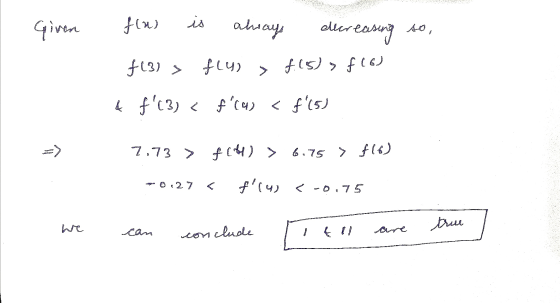
Only I and II are true
Add Answer to:
No calculator is allowed on this question. The function f(a) is defined for all real numbers...
Suppose that the function f is defined, for all real numbers, as follows. f(x) = x-2...
 Suppose that the function f is defined, for all real numbers, as follows. f(x) = x-2 ifx#2 4 if x=2 Find f(-3), f(2), and f(5). s(-3) = 0 s(2) = 0 r(s) = 1 Suppose that the function g is defined, for all real numbers, as follows. if x -2 8(x)= 1-4 if x=-2 Find g(-5), g(-2), and g(4). $(-5) = 0 DO s(-2) = 1 8(4) = 1
Functions f and g are defined for all real numbers. The function f has zeroes at...
Functions f and g are defined for all real numbers. The function f has zeroes at -2, 3, and 7; and the function g has zeroes at -3, -1, 4, and 7. How many distinct zeroes dose the product function f * g have? Explain and show your answer.
23. Let be a function defined and continuous on the closed interval (a,b). If f has...
 23. Let be a function defined and continuous on the closed interval (a,b). If f has a relative maximum at cand a<c<b, which of the following statements must be true? 1. f'(c) exists. II. If f'(c) exists, then f'(c)= 0. III. If f'(c) exists, then f"(c)<0. (A) II only (B) III only (C) I and II only (D) I and III only (E) II and III only
3. 21-1 Suppose the function F is defined by F(x)= (- d for all real numbers...
 3. 21-1 Suppose the function F is defined by F(x)= (- d for all real numbers x 20. (a) Evaluate F(1) (b) Evaluate F(1) (C) Find an equation for the langent line to the graph of F at the point where x-1. (d) On what intervals is the function Fincreasing? Justify your answer.
(g) The function f is defined for all real numbers except -7 and 3 and has the following properti...
 (g) The function f is defined for all real numbers except -7 and 3 and has the following properties. i·f(-2)=1 10 AT 2010, Section 012 April 7, 2019 -20(x + 2) 3 1. vii, lim f(x)=-oo Sketch the graph of the function f, showing » The line tangent to f at the point (-2,1), intervals of increase and decrease. ● concavity, and » all asymptotes
(g) The function f is defined for all real numbers except -7 and 3 and...
(g) The function f is defined for all real numbers except -7 and 3 and has the following properties. i·f(-2)=1 10 AT 2010, Section 012 April 7, 2019 -20(x + 2) 3 1. vii, lim f(x)=-oo Sketch the graph of the function f, showing » The line tangent to f at the point (-2,1), intervals of increase and decrease. ● concavity, and » all asymptotes
(g) The function f is defined for all real numbers except -7 and 3 and...
Suppose that f(x) is a continuous function over all real numbers, f'(- 10) = 0, and...
 Suppose that f(x) is a continuous function over all real numbers, f'(- 10) = 0, and f''( - 10) = 24 Which of the following is true? (Hint: 2nd derivative test) Which of the following is true? (Hint: 2nd derivative test) O A. f(x) has a relative minimum at x = - 10 W O B. f(x) is decreasing when x = - 10 O C. f(x) is increasing when x = - 10 O D. f(x) has a relative...
1. Suppose that a function f, defined for all real numbers, satisfies the property that, for...
 1. Suppose that a function f, defined for all real numbers, satisfies the property that, for all x and y, f(x + y) = f(x) + f(y). (*) (a) (2 points) Name a function that satisfies property (*). Name another that doesn't. Justify your answers. (b) (3 points) Prove that any function that satisfies property (*) also satisfies f(3x) = 3f(x). (c) (5 points) Prove that any function that satisfies property (*) also satisfies f(x - y) = f(x) –...
1. Suppose that a function f, defined for all real numbers, satisfies the property that, for...
 1. Suppose that a function f, defined for all real numbers, satisfies the property that, for all x and y, f(x + y) = f(x) + f(y). (*) (a) (2 points) Name a function that satisfies property (*). Name another that doesn't. Justify your answers. (b) (3 points) Prove that any function that satisfies property (*) also satisfies f(3x) = 3f(x). (c) (5 points) Prove that any function that satisfies property (*) also satisfies f(x - y) = f(x) –...
In this problem we consider only functions defined on the real numbers R. A function f is close to a function g if 3x E R s.t. Vy E R, A function f visits a function g when Vz E R, R s.t. a<y and...
 In this problem we consider only functions defined on the real numbers R. A function f is close to a function g if 3x E R s.t. Vy E R, A function f visits a function g when Vz E R, R s.t. a<y and f() -g) For a given function f and n E N, let us denote by n the following function: n(x)-f(x)+2" Below are three claims. Which ones are true and which ones are false? If a...
In this problem we consider only functions defined on the real numbers R. A function f is close to a function g if 3r E R s.t. Vy R, A function f visits a function g when Vz E R,3y E R s.t. < y...
In this problem we consider only functions defined on the real numbers R. A function f is close to a function g if 3r E R s.t. Vy R, A function f visits a function g when Vz E R,3y E R s.t. < y and lf(y)-g(y)| < We were unable to transcribe this imageBelow are three claims. Which ones are true and which ones are false? If a claim is true, prove it. If a claim is false, show...
 Suppose that the function f is defined, for all real numbers, as follows. f(x) = x-2 ifx#2 4 if x=2 Find f(-3), f(2), and f(5). s(-3) = 0 s(2) = 0 r(s) = 1 Suppose that the function g is defined, for all real numbers, as follows. if x -2 8(x)= 1-4 if x=-2 Find g(-5), g(-2), and g(4). $(-5) = 0 DO s(-2) = 1 8(4) = 1
 23. Let be a function defined and continuous on the closed interval (a,b). If f has a relative maximum at cand a<c<b, which of the following statements must be true? 1. f'(c) exists. II. If f'(c) exists, then f'(c)= 0. III. If f'(c) exists, then f"(c)<0. (A) II only (B) III only (C) I and II only (D) I and III only (E) II and III only
 3. 21-1 Suppose the function F is defined by F(x)= (- d for all real numbers x 20. (a) Evaluate F(1) (b) Evaluate F(1) (C) Find an equation for the langent line to the graph of F at the point where x-1. (d) On what intervals is the function Fincreasing? Justify your answer.
 (g) The function f is defined for all real numbers except -7 and 3 and has the following properties. i·f(-2)=1 10 AT 2010, Section 012 April 7, 2019 -20(x + 2) 3 1. vii, lim f(x)=-oo Sketch the graph of the function f, showing » The line tangent to f at the point (-2,1), intervals of increase and decrease. ● concavity, and » all asymptotes
(g) The function f is defined for all real numbers except -7 and 3 and...
(g) The function f is defined for all real numbers except -7 and 3 and has the following properties. i·f(-2)=1 10 AT 2010, Section 012 April 7, 2019 -20(x + 2) 3 1. vii, lim f(x)=-oo Sketch the graph of the function f, showing » The line tangent to f at the point (-2,1), intervals of increase and decrease. ● concavity, and » all asymptotes
(g) The function f is defined for all real numbers except -7 and 3 and...
 Suppose that f(x) is a continuous function over all real numbers, f'(- 10) = 0, and f''( - 10) = 24 Which of the following is true? (Hint: 2nd derivative test) Which of the following is true? (Hint: 2nd derivative test) O A. f(x) has a relative minimum at x = - 10 W O B. f(x) is decreasing when x = - 10 O C. f(x) is increasing when x = - 10 O D. f(x) has a relative...
 1. Suppose that a function f, defined for all real numbers, satisfies the property that, for all x and y, f(x + y) = f(x) + f(y). (*) (a) (2 points) Name a function that satisfies property (*). Name another that doesn't. Justify your answers. (b) (3 points) Prove that any function that satisfies property (*) also satisfies f(3x) = 3f(x). (c) (5 points) Prove that any function that satisfies property (*) also satisfies f(x - y) = f(x) –...
 1. Suppose that a function f, defined for all real numbers, satisfies the property that, for all x and y, f(x + y) = f(x) + f(y). (*) (a) (2 points) Name a function that satisfies property (*). Name another that doesn't. Justify your answers. (b) (3 points) Prove that any function that satisfies property (*) also satisfies f(3x) = 3f(x). (c) (5 points) Prove that any function that satisfies property (*) also satisfies f(x - y) = f(x) –...
 In this problem we consider only functions defined on the real numbers R. A function f is close to a function g if 3x E R s.t. Vy E R, A function f visits a function g when Vz E R, R s.t. a<y and f() -g) For a given function f and n E N, let us denote by n the following function: n(x)-f(x)+2" Below are three claims. Which ones are true and which ones are false? If a...
Most questions answered within 3 hours.
-
Where is the error in this code sequence?
String s1 = "Hello";
String s2 = "ello";...
asked 10 months ago -
Financial data for Joel de Paris, Inc., for last year
follow:
Joel de Paris, Inc.
Balance...
asked 10 months ago -
Consider this reaction:
Al2(SO4)3 (aq)+ BaCl3
(aq) Al2Cl6 (aq)- +
3BaSO4(s) . What is the...
asked 10 months ago -
Suppose that Savneet is considering increasing her
recent random sample from 20 car rentals to 40...
asked 10 months ago -
Trucks arrive at an unloading terminal at an average rate of 120
per hour.
Trucks arrive...
asked 10 months ago -
Why are methanol and ethanol completely soluble in water while
octanol is not very little soluble....
asked 10 months ago -
A facilities manager at a university reads in a research report
that the mean amount of...
asked 10 months ago -
When the CuSO4 is rehydrated by adding water to the anhydrous
compound, is this an endothermic...
asked 10 months ago -
A ray of sunlight is passing from diamond into crown glass; the
angle of incidence is...
asked 10 months ago -
A block of mass 0.249 kg is placed on top of a light, vertical
spring of...
asked 10 months ago -
how do the kidneys compensate in the presences of acidosis
a) trigger hyperventilate
b) reserve acid...
asked 10 months ago -
Question 501 pts
The rental rate of capital to the firm increases. Which of the
following...
asked 10 months ago