
Homework Answers
Add Answer to:
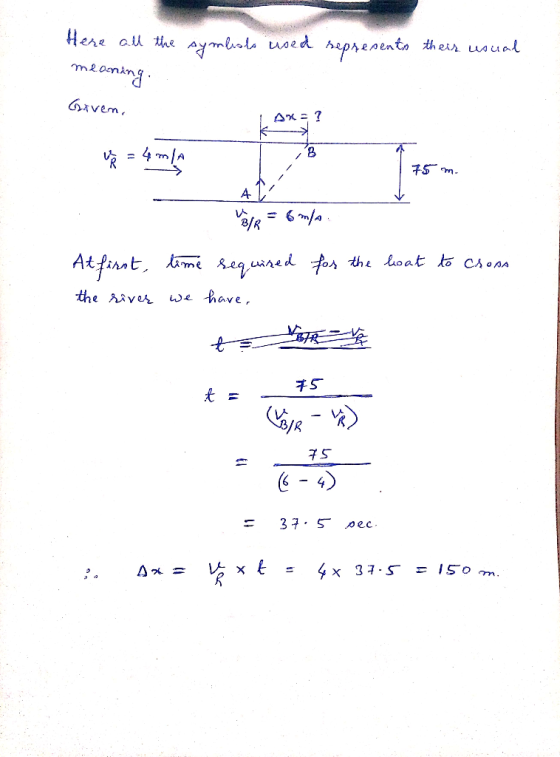
2. A boat crosses a river. The river is flowing at 4 m/s. The boat starts...
A river flows due east at 1. 50 m/s. A boat crosses the river from the...
A river flows due east at 1. 50 m/s. A boat crosses the river from the south shore to the north shore by maintaining a constant velocity of 10.0 m/s due north relative to the water. (a) What is the velocity of the boat relative to the shore? (b) If the river is 300 m wide, how far downstream has the boat moved by the time it reaches the north shore?
A river flows due east at 2.69 m/s. A boat crosses the river from the south...
A river flows due east at 2.69 m/s. A boat crosses the river from the south shore to the north shore by maintaining a constant velocity of 12.2 m/s due north relative to the water. What is (a) the magnitude (m/s) and (b) the direction (degrees east of north) of the boat’s velocity relative to shore? (c) If the river is 324 m wide, how far (m) downstream has the boat moved by the time it reaches the north shore?
An athlete crosses a 24.2 m wide river by swimming perpendicular to the water current at...
An athlete crosses a 24.2 m wide river by swimming perpendicular to the water current at a speed of 0.4 m/s relative to the water. He reaches the opposite side at a distance of 45.3 m downstream from his starting point. How fast is the water in the river flowing with respect to the ground?
D | Question 13 5 pts A river flows due east at 3.0 m/s. A boat...
 D | Question 13 5 pts A river flows due east at 3.0 m/s. A boat crosses the 300-m-wide river by maintaining a constant velocity of 10 m/s due north-east relative to the water. If no correction is made for the current, how far does the boat move by the time it reaches the far shore? O 173 m, upstream O 346 m, downstream O 45 m, upstream O 90 m, downstream
(2) A boat with a maximum speed with a width d. The river is flowing with...
 (2) A boat with a maximum speed with a width d. The river is flowing with speed V. (a) Traveling in a straight line (i.e perpendicular to the shore) how long does it take the boat to et to a point directly across? (b) What is the fastest possible crossing time to any point on the opposite shore? [20 pts] v (relative to the water) is on one shore of a river
3. A boat travels at 3.5 m/s with respect to the water in a river, while...
3. A boat travels at 3.5 m/s with respect to the water in a river, while the velocity of the river itself is 1.2 m/s. The boat starts at a point on one shore and travels to a point directly across on the opposite shore. If the river is 62 m wide, how long does it take the boat to cross?
An athlete crosses a 21 m wide river by swimming perpendicular to the water current at...
An athlete crosses a 21 m wide river by swimming perpendicular to the water current at a speed of 0.35 m/s relative to the water. He reaches the opposite side at a distance 38 m downstream from his starting point. a) How fast is the water in the river flowing with respect to the ground in m/s? b) What is the speed of the swimmer with respect to a friend at rest on the ground in m/s?
A boat moving 5.1 m/s with respect to the water crosses a river moving at 4.7...
A boat moving 5.1 m/s with respect to the water crosses a river moving at 4.7 m/s with respect to the shore. The river is 71 m wide. Determine (a) the resultant velocity, (b) time to cross the river and (c) distance downstream.
Problem 4.20 needs to row her boat across a 120 m-wide river that is flowing Mary...
 Problem 4.20 needs to row her boat across a 120 m-wide river that is flowing Mary to the east at a speed of 1 4 m/s Mary can row with a speed of 21 m/s Part A If Mary points her boat due north, how far from her intended landing- spot will she be when she reaches the opposite shore? Express your answer in meters. WA 8 : meters downstream Submit RequestAnswer Part B What is her speed with respect...
A certain river is 0.5 mi wide, and flows due east at 2.7 mi/h relative to...
A certain river is 0.5 mi wide, and flows due east at 2.7 mi/h relative to the shore. A boat attempts to cross the river straight from one shore to the other. If the boat travels due north at 1.7 mi/h relative to the river, (a) what is the speed of the boat relative to the shore? (b) how far downstream is the boat when it reaches the opposite shore?
 D | Question 13 5 pts A river flows due east at 3.0 m/s. A boat crosses the 300-m-wide river by maintaining a constant velocity of 10 m/s due north-east relative to the water. If no correction is made for the current, how far does the boat move by the time it reaches the far shore? O 173 m, upstream O 346 m, downstream O 45 m, upstream O 90 m, downstream
 (2) A boat with a maximum speed with a width d. The river is flowing with speed V. (a) Traveling in a straight line (i.e perpendicular to the shore) how long does it take the boat to et to a point directly across? (b) What is the fastest possible crossing time to any point on the opposite shore? [20 pts] v (relative to the water) is on one shore of a river
 Problem 4.20 needs to row her boat across a 120 m-wide river that is flowing Mary to the east at a speed of 1 4 m/s Mary can row with a speed of 21 m/s Part A If Mary points her boat due north, how far from her intended landing- spot will she be when she reaches the opposite shore? Express your answer in meters. WA 8 : meters downstream Submit RequestAnswer Part B What is her speed with respect...
Most questions answered within 3 hours.
-
Where is the error in this code sequence?
String s1 = "Hello";
String s2 = "ello";...
asked 11 months ago -
Financial data for Joel de Paris, Inc., for last year
follow:
Joel de Paris, Inc.
Balance...
asked 11 months ago -
Consider this reaction:
Al2(SO4)3 (aq)+ BaCl3
(aq) Al2Cl6 (aq)- +
3BaSO4(s) . What is the...
asked 11 months ago -
Suppose that Savneet is considering increasing her
recent random sample from 20 car rentals to 40...
asked 11 months ago -
Trucks arrive at an unloading terminal at an average rate of 120
per hour.
Trucks arrive...
asked 11 months ago -
Why are methanol and ethanol completely soluble in water while
octanol is not very little soluble....
asked 11 months ago -
A facilities manager at a university reads in a research report
that the mean amount of...
asked 11 months ago -
When the CuSO4 is rehydrated by adding water to the anhydrous
compound, is this an endothermic...
asked 11 months ago -
A ray of sunlight is passing from diamond into crown glass; the
angle of incidence is...
asked 11 months ago -
A block of mass 0.249 kg is placed on top of a light, vertical
spring of...
asked 11 months ago -
how do the kidneys compensate in the presences of acidosis
a) trigger hyperventilate
b) reserve acid...
asked 11 months ago -
Question 501 pts
The rental rate of capital to the firm increases. Which of the
following...
asked 11 months ago