how to show they are equivalent?

Homework Answers

Add Answer to:
how to show they are equivalent?
3. (No R Required) Cook's distance has the equivalent formulae...
2. (a) State, without proof, the compound angle formulae for sin(a + β) and sin(α-β). 2 marks (b)...
 2. (a) State, without proof, the compound angle formulae for sin(a + β) and sin(α-β). 2 marks (b) Let θ be a fixed real number with 0 < θ < π. Show that, for all real x, sin(z+θ)- sin(z-Asin(z + φ) where φ (π + θ)/2 and A-2 sin(θ/2) (Hint: use part (a) above). 10 marks] (c) Determine φ if A = V2 and if A = V3. [9 marks] The physical interpretation of the result in part (b) above...
How do you show the following propositions are logically equivalent? (a) [(p → q) → r]...
How do you show the following propositions are logically equivalent? (a) [(p → q) → r] ⊕ (p ∧ q ∧ r) and (p ∨ r) ⊕ (p ∧ q) (b) ¬∃x {P(x) → ∃y [Q(x, y) ⊕ R(x, y)] } and (∀x P(x)) ∧ [∀x ∀y(Q(x, y) ↔ R(x, y))] (c) Does [(p → q) ∧ (q → r)] → r implies (p → r) → r?
Show that: (b) (p → q) → r and p →(q → r) are not logically equivalent.
6. Maximum score 3 ( 1 per part).Show that:(b) (p → q) → r and p →(q → r) are not logically equivalent.(c) p ↔ q and ¬ p ↔ ¬ q are logically equivalent.
Have to get an idea of how i am doing on this problem. Whould be nice...
 Have to get an idea of how i am doing on this problem. Whould be
nice to get a good explaination for each part of the problem. d1
and d2 is the two different metrics, p ,Y.
Problem 2. Consider first the following definition: Definition. Let X be a set and let pand be two metrics on X. We say that p and are equivalent if the open balls in (X, p) and (x,y) are "nested". More precisely, p and...
Have to get an idea of how i am doing on this problem. Whould be
nice to get a good explaination for each part of the problem. d1
and d2 is the two different metrics, p ,Y.
Problem 2. Consider first the following definition: Definition. Let X be a set and let pand be two metrics on X. We say that p and are equivalent if the open balls in (X, p) and (x,y) are "nested". More precisely, p and...
3. [3 marks] Show that for a plane curve described by r = c(t)i + y(t)j,...
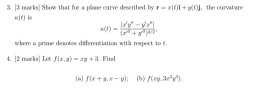 3. [3 marks] Show that for a plane curve described by r = c(t)i + y(t)j, the curvature k(t) is I'Y' - YX| (x2 + y2)3/27 where a prime denotes differentiation with respect to t. 4. [2 marks] Let f(x, y) = xy +3. Find (a) f(x + y, x - y); (b) f(xy, 3.22y).
(1) Evaluate the integral (r-1) min(a, y) dy dr, Jo Jo where min(x, y) is the minimum value of r ...
 q2 please
(1) Evaluate the integral (r-1) min(a, y) dy dr, Jo Jo where min(x, y) is the minimum value of r and y. (2) Let f,g : R → R be functions of one variable such that f" and g" are continuous. Show that (f"(x)-g"(y)) dydx = f(0) + g(0)-f(2)-9(2) + 2f'(2) + 2g'(0). o Jo (3) Let a > 0. In spherical coordinates, a surface is defined by r = 2acos φ for 0 φ 1. Find the...
q2 please
(1) Evaluate the integral (r-1) min(a, y) dy dr, Jo Jo where min(x, y) is the minimum value of r and y. (2) Let f,g : R → R be functions of one variable such that f" and g" are continuous. Show that (f"(x)-g"(y)) dydx = f(0) + g(0)-f(2)-9(2) + 2f'(2) + 2g'(0). o Jo (3) Let a > 0. In spherical coordinates, a surface is defined by r = 2acos φ for 0 φ 1. Find the...
Consider the multiple regression model y = X3 + €, with E(€)=0 and var(€)=oʻI. Problem 1...
 Consider the multiple regression model y = X3 + €, with E(€)=0 and var(€)=oʻI. Problem 1 Gauss-Mrkov theorem (revisited). We already know that E = B and var() = '(X'X)". Consider now another unbiased estimator of 3, say b = AY. Since we are assuming that b is unbiased we reach the conclusion that AX = I (why?). The Gauss-Markov theorem claims that var(b) - var() is positive semi-definite which asks that we investigate q' var(b) - var() q. Show...
3. Let f: R+R be a function. (a) Assume that f is Riemann integrable on [a,...
 3. Let f: R+R be a function. (a) Assume that f is Riemann integrable on [a, b] by some a < b in R. Does there always exist a differentiable function F:RR such that F' = f? Provide either a counterexample or a proof. (b) Assume that f is differentiable, f'(x) > 1 for every x ER, f(0) = 0. Show that f(x) > x for every x > 0. (c) Assume that f(x) = 2:13 + x. Show that...
4) Consider the inner product space P2(R), with inner product (a) Use the Gram-Schmidt process to...
 4) Consider the inner product space P2(R), with inner product (a) Use the Gram-Schmidt process to construct an orthonormal basis from the basis (b) Using your answer to part (a), give the least squares approximation in P2(R) to the function f(x)on the interval [0, 1. Hint: You may use the following result without proof f Ine* dr = (-1)"(ane-n!), where ao = 1, an- | n. + | , for n-1, 2, ).
4) Consider the inner product space P2(R),...
4) Consider the inner product space P2(R), with inner product (a) Use the Gram-Schmidt process to construct an orthonormal basis from the basis (b) Using your answer to part (a), give the least squares approximation in P2(R) to the function f(x)on the interval [0, 1. Hint: You may use the following result without proof f Ine* dr = (-1)"(ane-n!), where ao = 1, an- | n. + | , for n-1, 2, ).
4) Consider the inner product space P2(R),...
 2. (a) State, without proof, the compound angle formulae for sin(a + β) and sin(α-β). 2 marks (b) Let θ be a fixed real number with 0 < θ < π. Show that, for all real x, sin(z+θ)- sin(z-Asin(z + φ) where φ (π + θ)/2 and A-2 sin(θ/2) (Hint: use part (a) above). 10 marks] (c) Determine φ if A = V2 and if A = V3. [9 marks] The physical interpretation of the result in part (b) above...
 Have to get an idea of how i am doing on this problem. Whould be
nice to get a good explaination for each part of the problem. d1
and d2 is the two different metrics, p ,Y.
Problem 2. Consider first the following definition: Definition. Let X be a set and let pand be two metrics on X. We say that p and are equivalent if the open balls in (X, p) and (x,y) are "nested". More precisely, p and...
Have to get an idea of how i am doing on this problem. Whould be
nice to get a good explaination for each part of the problem. d1
and d2 is the two different metrics, p ,Y.
Problem 2. Consider first the following definition: Definition. Let X be a set and let pand be two metrics on X. We say that p and are equivalent if the open balls in (X, p) and (x,y) are "nested". More precisely, p and...
 3. [3 marks] Show that for a plane curve described by r = c(t)i + y(t)j, the curvature k(t) is I'Y' - YX| (x2 + y2)3/27 where a prime denotes differentiation with respect to t. 4. [2 marks] Let f(x, y) = xy +3. Find (a) f(x + y, x - y); (b) f(xy, 3.22y).
 q2 please
(1) Evaluate the integral (r-1) min(a, y) dy dr, Jo Jo where min(x, y) is the minimum value of r and y. (2) Let f,g : R → R be functions of one variable such that f" and g" are continuous. Show that (f"(x)-g"(y)) dydx = f(0) + g(0)-f(2)-9(2) + 2f'(2) + 2g'(0). o Jo (3) Let a > 0. In spherical coordinates, a surface is defined by r = 2acos φ for 0 φ 1. Find the...
q2 please
(1) Evaluate the integral (r-1) min(a, y) dy dr, Jo Jo where min(x, y) is the minimum value of r and y. (2) Let f,g : R → R be functions of one variable such that f" and g" are continuous. Show that (f"(x)-g"(y)) dydx = f(0) + g(0)-f(2)-9(2) + 2f'(2) + 2g'(0). o Jo (3) Let a > 0. In spherical coordinates, a surface is defined by r = 2acos φ for 0 φ 1. Find the...
 Consider the multiple regression model y = X3 + €, with E(€)=0 and var(€)=oʻI. Problem 1 Gauss-Mrkov theorem (revisited). We already know that E = B and var() = '(X'X)". Consider now another unbiased estimator of 3, say b = AY. Since we are assuming that b is unbiased we reach the conclusion that AX = I (why?). The Gauss-Markov theorem claims that var(b) - var() is positive semi-definite which asks that we investigate q' var(b) - var() q. Show...
 3. Let f: R+R be a function. (a) Assume that f is Riemann integrable on [a, b] by some a < b in R. Does there always exist a differentiable function F:RR such that F' = f? Provide either a counterexample or a proof. (b) Assume that f is differentiable, f'(x) > 1 for every x ER, f(0) = 0. Show that f(x) > x for every x > 0. (c) Assume that f(x) = 2:13 + x. Show that...
 4) Consider the inner product space P2(R), with inner product (a) Use the Gram-Schmidt process to construct an orthonormal basis from the basis (b) Using your answer to part (a), give the least squares approximation in P2(R) to the function f(x)on the interval [0, 1. Hint: You may use the following result without proof f Ine* dr = (-1)"(ane-n!), where ao = 1, an- | n. + | , for n-1, 2, ).
4) Consider the inner product space P2(R),...
4) Consider the inner product space P2(R), with inner product (a) Use the Gram-Schmidt process to construct an orthonormal basis from the basis (b) Using your answer to part (a), give the least squares approximation in P2(R) to the function f(x)on the interval [0, 1. Hint: You may use the following result without proof f Ine* dr = (-1)"(ane-n!), where ao = 1, an- | n. + | , for n-1, 2, ).
4) Consider the inner product space P2(R),...
Most questions answered within 3 hours.
-
Where is the error in this code sequence?
String s1 = "Hello";
String s2 = "ello";...
asked 10 months ago -
Financial data for Joel de Paris, Inc., for last year
follow:
Joel de Paris, Inc.
Balance...
asked 10 months ago -
Consider this reaction:
Al2(SO4)3 (aq)+ BaCl3
(aq) Al2Cl6 (aq)- +
3BaSO4(s) . What is the...
asked 10 months ago -
Suppose that Savneet is considering increasing her
recent random sample from 20 car rentals to 40...
asked 10 months ago -
Trucks arrive at an unloading terminal at an average rate of 120
per hour.
Trucks arrive...
asked 10 months ago -
Why are methanol and ethanol completely soluble in water while
octanol is not very little soluble....
asked 10 months ago -
A facilities manager at a university reads in a research report
that the mean amount of...
asked 10 months ago -
When the CuSO4 is rehydrated by adding water to the anhydrous
compound, is this an endothermic...
asked 10 months ago -
A ray of sunlight is passing from diamond into crown glass; the
angle of incidence is...
asked 10 months ago -
A block of mass 0.249 kg is placed on top of a light, vertical
spring of...
asked 10 months ago -
how do the kidneys compensate in the presences of acidosis
a) trigger hyperventilate
b) reserve acid...
asked 10 months ago -
Question 501 pts
The rental rate of capital to the firm increases. Which of the
following...
asked 10 months ago