
Homework Answers
Add Answer to:
please answer and explai thanks
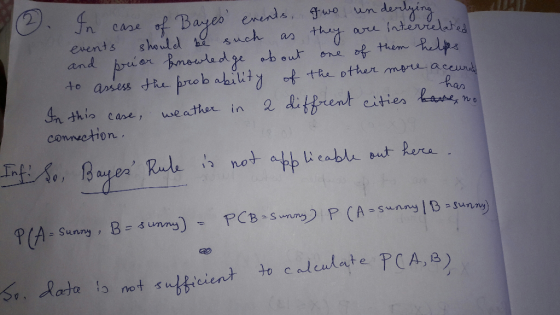
city B P(city B cityA) B = sunny B = Rain...
Recall Bayes' Rule P(AIB) = P(A)P(B|A) PB) Suppose 1 in 100 birds is a duck. 1...
 Recall Bayes' Rule P(AIB) = P(A)P(B|A) PB) Suppose 1 in 100 birds is a duck. 1 in 10 birds walks and talks like a duck (for instance, some geese walk and talk like ducks despite not being ducks) 9 out of 10 ducks walk and talk like a duck (some ducks refuse to conform. Here I am saying that the bird walks and talks like a duck, given that the bird is a duck) The probability that a bird is...
4. Basic Computation: Addition Rule Given P(A) = 0.7 and P(B) = 0,4 (a) Can events...
 4. Basic Computation: Addition Rule Given P(A) = 0.7 and P(B) = 0,4 (a) Can events A and B be mutually exclusive? Explain. | (b) If P(A and B) = 0.2, compute P(A or B). 3. Basic Computation: Multiplication Rule Given P(A) = 0.2 and P(B) = 0.4: (a) If A and B are independent events, compute P(A and B). (b) If P(AIB) = 0.1, compute P(A and B). 6. Basic Computation: Multiplicat (a) If A and B, are independent...
To save on expenses, Rona and Jerry agreed to form a carpool for traveling to and...
 To save on expenses, Rona and Jerry agreed to form a carpool for traveling to and from work. Rona prefers to use the somewhat longer but more consistent Queen City Avenue. Although Jerry prefers the quicker expressway, he agreed with Rona that they should take Queen City Avenue if the expressway has a traffic jam. The following payoff table provides the one-way time estimate in minutes for traveling to or from work: State of Nature Expressway Open Expressway Jammed Decision...
Please answer all the questions and with the given hint. Thanks 2. An ad hoc committee...
 Please answer all the questions and with the given hint.
Thanks
2. An ad hoc committee of three is selected randomly from a pool of 10 students consisting of 3 seniors, 3 juniors, 2 sophomores and 2 freshmen students. Let X be the number of seniors and Y be the number of juniors selected. The joint pmf of (X,Y) is, (*)(3)(3-6-v. px,y(x,y) = \* -2-y!, for x = 0,1,2,3, and y = 0,1,2,3 such that I +y < 3 =...
Please answer all the questions and with the given hint.
Thanks
2. An ad hoc committee of three is selected randomly from a pool of 10 students consisting of 3 seniors, 3 juniors, 2 sophomores and 2 freshmen students. Let X be the number of seniors and Y be the number of juniors selected. The joint pmf of (X,Y) is, (*)(3)(3-6-v. px,y(x,y) = \* -2-y!, for x = 0,1,2,3, and y = 0,1,2,3 such that I +y < 3 =...
Question # B.2 In Fig.B.2 below, suppose C denotes cancerous state and the marginal (prior) proba...
 WRITE LEGIBLY OR TYPE THE ANSWERS WITH EXPLANATIONS
THANKS!!!
Question # B.2 In Fig.B.2 below, suppose C denotes cancerous state and the marginal (prior) probability of occurrence of C is: P(C) 0.01; and, C denotes the non-cancerous state Further, if the medical treatment is pursued, it is denoted by the state, T; and, when the medical treatment is not administered, it denotes the state. T In relevant medical diagnostic and treatment procedures, there are two possible errors that may occur...
WRITE LEGIBLY OR TYPE THE ANSWERS WITH EXPLANATIONS
THANKS!!!
Question # B.2 In Fig.B.2 below, suppose C denotes cancerous state and the marginal (prior) probability of occurrence of C is: P(C) 0.01; and, C denotes the non-cancerous state Further, if the medical treatment is pursued, it is denoted by the state, T; and, when the medical treatment is not administered, it denotes the state. T In relevant medical diagnostic and treatment procedures, there are two possible errors that may occur...
DO NOT COPY ANSWER FROM SOMEWHERE ELSE OR YOU WILL GET A THUMBS DOWN. ONLY ANSWER IF YOU KNOW THE...
 DO NOT COPY ANSWER FROM SOMEWHERE ELSE OR YOU WILL GET A
THUMBS DOWN. ONLY ANSWER IF YOU KNOW THE ANSWER. Thank
you.
Stochastic models:
In Fig.B.2 below, suppose C denotes cancerous state and the marginal (prior) probability of occurrence of C is: P(C)-0.01; and, С denotes the non-cancerous state. Further, if the medical treatment is pursued, it is denoted by the state, T; and, when the medical treatment is not administered, it denotes the state, T In relevant medical...
DO NOT COPY ANSWER FROM SOMEWHERE ELSE OR YOU WILL GET A
THUMBS DOWN. ONLY ANSWER IF YOU KNOW THE ANSWER. Thank
you.
Stochastic models:
In Fig.B.2 below, suppose C denotes cancerous state and the marginal (prior) probability of occurrence of C is: P(C)-0.01; and, С denotes the non-cancerous state. Further, if the medical treatment is pursued, it is denoted by the state, T; and, when the medical treatment is not administered, it denotes the state, T In relevant medical...
Background The notation P(AlB) is read as "the probability of A, given B, has occurred." So...
 Background The notation P(AlB) is read as "the probability of A,
given B, has occurred." So the "" symbol is read as "given."
Formally, A and B are called events and P(AB) is a conditional
probability Bayes' rule is a very useful way of relating
conditional and unconditional probabilities. According to this
rule, for any two events A and B, we have: P(B) Let's use "T+" to
denote the event "the screening test concludes that the condition
(disease, pregnancy, etc,)...
Background The notation P(AlB) is read as "the probability of A,
given B, has occurred." So the "" symbol is read as "given."
Formally, A and B are called events and P(AB) is a conditional
probability Bayes' rule is a very useful way of relating
conditional and unconditional probabilities. According to this
rule, for any two events A and B, we have: P(B) Let's use "T+" to
denote the event "the screening test concludes that the condition
(disease, pregnancy, etc,)...
Question # B.2 In Fig.B.2 below, suppose C denotes cancerous state and the marginal (prior) proba...
 Question # B.2 In Fig.B.2 below, suppose C denotes cancerous state and the marginal (prior) probability of occurrence of C is: P(C,-0.01; and, C denotes the non-cancerous state Further, if the medical treatment is pursued, it is denoted by the state, T; and, when the medical treatment is not administered, it denotes the state, T In relevant medical diagnostic and treatment procedures, there are two possible errors that may occur: Type I and Type II errors and their corresponding conditional...
Please answer 9.5 from Networks by Mark Newman tion 9.3.3 for Internet data 9.5 The false positive rate B defined in Se...
 Please answer 9.5 from Networks by Mark Newman
tion 9.3.3 for Internet data 9.5 The false positive rate B defined in Section 9.3.5 is the probability of erroneously observing an edge where none exists. Arguably a more useful measure, however, is the false discovery rate, which is the probability that an actual observed edge is itself a false positive, which is not the same thing. Suppose we measure a network once, producing an observed adjacency matrix O with elements Oij....
Please answer 9.5 from Networks by Mark Newman
tion 9.3.3 for Internet data 9.5 The false positive rate B defined in Section 9.3.5 is the probability of erroneously observing an edge where none exists. Arguably a more useful measure, however, is the false discovery rate, which is the probability that an actual observed edge is itself a false positive, which is not the same thing. Suppose we measure a network once, producing an observed adjacency matrix O with elements Oij....
8. Read problem 3.15 (pages 67-68) and then answer the questions below. a. What proportion in...
 8. Read problem 3.15 (pages 67-68) and then answer the questions below. a. What proportion in the sample had a culture test? What proportion had the Strep A OIA test? What are the probabilities of outcomes in the sample for those with the Culture test? What are the probabilities of outcomes in the sample for those with the Strep A OIA test? Make a tree to illustrate the probabilities in a-b-c. b. c. d. Use numbers in the tree to...
 Recall Bayes' Rule P(AIB) = P(A)P(B|A) PB) Suppose 1 in 100 birds is a duck. 1 in 10 birds walks and talks like a duck (for instance, some geese walk and talk like ducks despite not being ducks) 9 out of 10 ducks walk and talk like a duck (some ducks refuse to conform. Here I am saying that the bird walks and talks like a duck, given that the bird is a duck) The probability that a bird is...
 4. Basic Computation: Addition Rule Given P(A) = 0.7 and P(B) = 0,4 (a) Can events A and B be mutually exclusive? Explain. | (b) If P(A and B) = 0.2, compute P(A or B). 3. Basic Computation: Multiplication Rule Given P(A) = 0.2 and P(B) = 0.4: (a) If A and B are independent events, compute P(A and B). (b) If P(AIB) = 0.1, compute P(A and B). 6. Basic Computation: Multiplicat (a) If A and B, are independent...
 To save on expenses, Rona and Jerry agreed to form a carpool for traveling to and from work. Rona prefers to use the somewhat longer but more consistent Queen City Avenue. Although Jerry prefers the quicker expressway, he agreed with Rona that they should take Queen City Avenue if the expressway has a traffic jam. The following payoff table provides the one-way time estimate in minutes for traveling to or from work: State of Nature Expressway Open Expressway Jammed Decision...
 Please answer all the questions and with the given hint.
Thanks
2. An ad hoc committee of three is selected randomly from a pool of 10 students consisting of 3 seniors, 3 juniors, 2 sophomores and 2 freshmen students. Let X be the number of seniors and Y be the number of juniors selected. The joint pmf of (X,Y) is, (*)(3)(3-6-v. px,y(x,y) = \* -2-y!, for x = 0,1,2,3, and y = 0,1,2,3 such that I +y < 3 =...
Please answer all the questions and with the given hint.
Thanks
2. An ad hoc committee of three is selected randomly from a pool of 10 students consisting of 3 seniors, 3 juniors, 2 sophomores and 2 freshmen students. Let X be the number of seniors and Y be the number of juniors selected. The joint pmf of (X,Y) is, (*)(3)(3-6-v. px,y(x,y) = \* -2-y!, for x = 0,1,2,3, and y = 0,1,2,3 such that I +y < 3 =...
 WRITE LEGIBLY OR TYPE THE ANSWERS WITH EXPLANATIONS
THANKS!!!
Question # B.2 In Fig.B.2 below, suppose C denotes cancerous state and the marginal (prior) probability of occurrence of C is: P(C) 0.01; and, C denotes the non-cancerous state Further, if the medical treatment is pursued, it is denoted by the state, T; and, when the medical treatment is not administered, it denotes the state. T In relevant medical diagnostic and treatment procedures, there are two possible errors that may occur...
WRITE LEGIBLY OR TYPE THE ANSWERS WITH EXPLANATIONS
THANKS!!!
Question # B.2 In Fig.B.2 below, suppose C denotes cancerous state and the marginal (prior) probability of occurrence of C is: P(C) 0.01; and, C denotes the non-cancerous state Further, if the medical treatment is pursued, it is denoted by the state, T; and, when the medical treatment is not administered, it denotes the state. T In relevant medical diagnostic and treatment procedures, there are two possible errors that may occur...
 DO NOT COPY ANSWER FROM SOMEWHERE ELSE OR YOU WILL GET A
THUMBS DOWN. ONLY ANSWER IF YOU KNOW THE ANSWER. Thank
you.
Stochastic models:
In Fig.B.2 below, suppose C denotes cancerous state and the marginal (prior) probability of occurrence of C is: P(C)-0.01; and, С denotes the non-cancerous state. Further, if the medical treatment is pursued, it is denoted by the state, T; and, when the medical treatment is not administered, it denotes the state, T In relevant medical...
DO NOT COPY ANSWER FROM SOMEWHERE ELSE OR YOU WILL GET A
THUMBS DOWN. ONLY ANSWER IF YOU KNOW THE ANSWER. Thank
you.
Stochastic models:
In Fig.B.2 below, suppose C denotes cancerous state and the marginal (prior) probability of occurrence of C is: P(C)-0.01; and, С denotes the non-cancerous state. Further, if the medical treatment is pursued, it is denoted by the state, T; and, when the medical treatment is not administered, it denotes the state, T In relevant medical...
 Background The notation P(AlB) is read as "the probability of A,
given B, has occurred." So the "" symbol is read as "given."
Formally, A and B are called events and P(AB) is a conditional
probability Bayes' rule is a very useful way of relating
conditional and unconditional probabilities. According to this
rule, for any two events A and B, we have: P(B) Let's use "T+" to
denote the event "the screening test concludes that the condition
(disease, pregnancy, etc,)...
Background The notation P(AlB) is read as "the probability of A,
given B, has occurred." So the "" symbol is read as "given."
Formally, A and B are called events and P(AB) is a conditional
probability Bayes' rule is a very useful way of relating
conditional and unconditional probabilities. According to this
rule, for any two events A and B, we have: P(B) Let's use "T+" to
denote the event "the screening test concludes that the condition
(disease, pregnancy, etc,)...
 Question # B.2 In Fig.B.2 below, suppose C denotes cancerous state and the marginal (prior) probability of occurrence of C is: P(C,-0.01; and, C denotes the non-cancerous state Further, if the medical treatment is pursued, it is denoted by the state, T; and, when the medical treatment is not administered, it denotes the state, T In relevant medical diagnostic and treatment procedures, there are two possible errors that may occur: Type I and Type II errors and their corresponding conditional...
 Please answer 9.5 from Networks by Mark Newman
tion 9.3.3 for Internet data 9.5 The false positive rate B defined in Section 9.3.5 is the probability of erroneously observing an edge where none exists. Arguably a more useful measure, however, is the false discovery rate, which is the probability that an actual observed edge is itself a false positive, which is not the same thing. Suppose we measure a network once, producing an observed adjacency matrix O with elements Oij....
Please answer 9.5 from Networks by Mark Newman
tion 9.3.3 for Internet data 9.5 The false positive rate B defined in Section 9.3.5 is the probability of erroneously observing an edge where none exists. Arguably a more useful measure, however, is the false discovery rate, which is the probability that an actual observed edge is itself a false positive, which is not the same thing. Suppose we measure a network once, producing an observed adjacency matrix O with elements Oij....
 8. Read problem 3.15 (pages 67-68) and then answer the questions below. a. What proportion in the sample had a culture test? What proportion had the Strep A OIA test? What are the probabilities of outcomes in the sample for those with the Culture test? What are the probabilities of outcomes in the sample for those with the Strep A OIA test? Make a tree to illustrate the probabilities in a-b-c. b. c. d. Use numbers in the tree to...
Most questions answered within 3 hours.
-
Where is the error in this code sequence?
String s1 = "Hello";
String s2 = "ello";...
asked 10 months ago -
Financial data for Joel de Paris, Inc., for last year
follow:
Joel de Paris, Inc.
Balance...
asked 10 months ago -
Consider this reaction:
Al2(SO4)3 (aq)+ BaCl3
(aq) Al2Cl6 (aq)- +
3BaSO4(s) . What is the...
asked 10 months ago -
Suppose that Savneet is considering increasing her
recent random sample from 20 car rentals to 40...
asked 10 months ago -
Trucks arrive at an unloading terminal at an average rate of 120
per hour.
Trucks arrive...
asked 10 months ago -
Why are methanol and ethanol completely soluble in water while
octanol is not very little soluble....
asked 10 months ago -
A facilities manager at a university reads in a research report
that the mean amount of...
asked 10 months ago -
When the CuSO4 is rehydrated by adding water to the anhydrous
compound, is this an endothermic...
asked 10 months ago -
A ray of sunlight is passing from diamond into crown glass; the
angle of incidence is...
asked 10 months ago -
A block of mass 0.249 kg is placed on top of a light, vertical
spring of...
asked 10 months ago -
how do the kidneys compensate in the presences of acidosis
a) trigger hyperventilate
b) reserve acid...
asked 10 months ago -
Question 501 pts
The rental rate of capital to the firm increases. Which of the
following...
asked 10 months ago