
Homework Answers
Add Answer to:
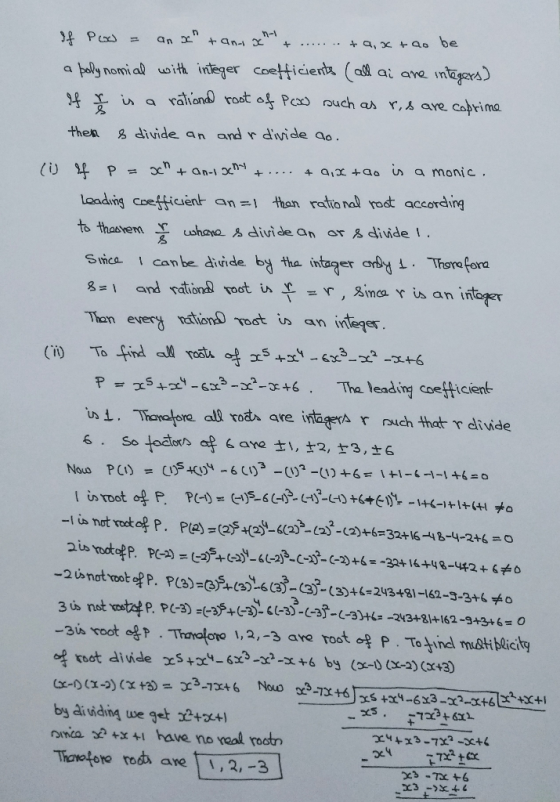
Theorem. Let p(x) = anr" + … + ao be a polynomial with integer coefficients, i,...
5. Prove the Rational Roots Theorem: Let p(x)=ataiェ+ +anz" be a polynomial with integer coefficients (that...
 5. Prove the Rational Roots Theorem: Let p(x)=ataiェ+ +anz" be a polynomial with integer coefficients (that is, each aj is an integer). If t rls (oherer and s are nonzero integers and t is written in lowest terms, that is, gcd(Irl'ls!) = 1) is a non-zero Tational root orp(r), that is, if tメ0 and p(t) 0, then rao and slan. (Hint: Plug in t a t in the polynomial equation p(t) - o. Clear the fractions, then use a combination...
The Fibonacci Sequence F1, F2, ... of integers is defined recursively by F1=F2=1 and Fn=Fn-1+Fn-2 for each integer . Pro...
 The Fibonacci Sequence F1, F2, ... of
integers is defined recursively by F1=F2=1
and Fn=Fn-1+Fn-2 for each integer
. Prove
that (picture) Just the top one( not
7.23)
n 3 Chapter 7 Reviewing Proof Techniques 196 an-2 for every integer and an ao, a1, a2,... is a sequence of rational numbers such that ao = n > 2, then for every positive integer n, an- 3F nif n is even 2Fn+1 an = 2 Fn+ 1 if n is odd....
The Fibonacci Sequence F1, F2, ... of
integers is defined recursively by F1=F2=1
and Fn=Fn-1+Fn-2 for each integer
. Prove
that (picture) Just the top one( not
7.23)
n 3 Chapter 7 Reviewing Proof Techniques 196 an-2 for every integer and an ao, a1, a2,... is a sequence of rational numbers such that ao = n > 2, then for every positive integer n, an- 3F nif n is even 2Fn+1 an = 2 Fn+ 1 if n is odd....
Write a function that takes a list L = [a0,a1,....,an] of coefficients of a polynomial p(x)...
Write a function that takes a list L = [a0,a1,....,an] of coefficients of a polynomial p(x) = a0xn+a1xn-1+...+ an as a single argument, factors the free coefficient , and prints all integer roots or an empty list if there is no integer roots in Python
Please prove the theorems, thank you 6.1 Theorem. Let anx+an-1- +ag he a polynomial of degree...
 Please prove the theorems,
thank you
6.1 Theorem. Let anx+an-1- +ag he a polynomial of degree n0 with integer coefficients and assume an0. Then an integer r is a Poot of (x) if and only if there exists a polynomlal g(x) of degree n - with integer coeficients such that f(x) (x)g(x). This next theorem is very similar to the one above, but in this case (xr)g(x) is not quite equal to f(x), but is the same except for the...
Please prove the theorems,
thank you
6.1 Theorem. Let anx+an-1- +ag he a polynomial of degree n0 with integer coefficients and assume an0. Then an integer r is a Poot of (x) if and only if there exists a polynomlal g(x) of degree n - with integer coeficients such that f(x) (x)g(x). This next theorem is very similar to the one above, but in this case (xr)g(x) is not quite equal to f(x), but is the same except for the...
7.23 Theorem. Let p be a prime congruent to 3 modulo 4. Let a be a natural number with 1 a< p-1. Then a is a quadrut...
 7.23 Theorem. Let p be a prime congruent to 3 modulo 4. Let a be a natural number with 1 a< p-1. Then a is a quadrutic residue modulo pif and only ifp-a is a quadratic non-residue modulo p. 7.24 Theorem. Let p be a prime of the form p odd prime. Then p 3 (mod 4). 241 where q is an The next theorem describes the symmetry between primitive roots and quadratic residues for primes arising from odd Sophie...
Find a polynomial with integer coefficients, with leading coefficient 1, degree 5, zeros i and 3...
 Find a polynomial with integer coefficients, with leading coefficient 1, degree 5, zeros i and 3 – i, and passing through the origin. P(x) =
Theorem 16.1. Let p be a prime number. Suppose r is a Gaussian integer satisfying N(r)...
 Theorem 16.1. Let p be a prime number. Suppose r is a Gaussian integer satisfying N(r) = p. Then r is irreducible in Z[i]. In particular, if a and b are integers such that a² +62 = p, then the Gaussian integers Ea – bi and £b£ai are irreducible. Exercise 16.1. Prove Theorem 16.1. (Hint: For the first part, suppose st is a factorization of r. You must show that this factorization is trivial. Apply the norm to obtain p=...
2. (10) Let p be an odd prime. Let f(x) E Q(x) be an irreducible polynomial of degree p whose Galois group is the dihed...
 2. (10) Let p be an odd prime. Let f(x) E Q(x) be an irreducible polynomial of degree p whose Galois group is the dihedral group D2p of a regular p-gon. Prove that f(x) has either all real roots precisely one real root or
2. (10) Let p be an odd prime. Let f(x) E Q(x) be an irreducible polynomial of degree p whose Galois group is the dihedral group D2p of a regular p-gon. Prove that f(x) has either...
2. (10) Let p be an odd prime. Let f(x) E Q(x) be an irreducible polynomial of degree p whose Galois group is the dihedral group D2p of a regular p-gon. Prove that f(x) has either all real roots precisely one real root or
2. (10) Let p be an odd prime. Let f(x) E Q(x) be an irreducible polynomial of degree p whose Galois group is the dihedral group D2p of a regular p-gon. Prove that f(x) has either...
3.11 Theorem. Suppose f(x)-a"x" + an-lx"-+ + ao is a poly- nomial of degree n > 0 and suppose an > 0. Then there is an integer k such that ifx >k, then f(x)> 0. Note: We are o...
 3.11 Theorem. Suppose f(x)-a"x" + an-lx"-+ + ao is a poly- nomial of degree n > 0 and suppose an > 0. Then there is an integer k such that ifx >k, then f(x)> 0. Note: We are only assuming that the leading coefficient an is greater than zero. The other coefficients may be positive or negative or zero. The next theorem extends the idea that polynomials get positive and roughly states that not only do they get positive, but...
Q9 6. Define Euclidean domain. 7. Let FCK be fields. Let a € K be a...
 Q9
6. Define Euclidean domain. 7. Let FCK be fields. Let a € K be a root of an irreducible polynomial pa) EFE. Define the near 8. Let p() be an irreducible polynomial with coefficients in the field F. Describe how to construct a field K containing a root of p(x) and what that root is. 9. State the Fundamental Theorem of Algebra. 10. Let G be a group and HCG. State what is required in order that H be...
Q9
6. Define Euclidean domain. 7. Let FCK be fields. Let a € K be a root of an irreducible polynomial pa) EFE. Define the near 8. Let p() be an irreducible polynomial with coefficients in the field F. Describe how to construct a field K containing a root of p(x) and what that root is. 9. State the Fundamental Theorem of Algebra. 10. Let G be a group and HCG. State what is required in order that H be...
 5. Prove the Rational Roots Theorem: Let p(x)=ataiェ+ +anz" be a polynomial with integer coefficients (that is, each aj is an integer). If t rls (oherer and s are nonzero integers and t is written in lowest terms, that is, gcd(Irl'ls!) = 1) is a non-zero Tational root orp(r), that is, if tメ0 and p(t) 0, then rao and slan. (Hint: Plug in t a t in the polynomial equation p(t) - o. Clear the fractions, then use a combination...
 The Fibonacci Sequence F1, F2, ... of
integers is defined recursively by F1=F2=1
and Fn=Fn-1+Fn-2 for each integer
. Prove
that (picture) Just the top one( not
7.23)
n 3 Chapter 7 Reviewing Proof Techniques 196 an-2 for every integer and an ao, a1, a2,... is a sequence of rational numbers such that ao = n > 2, then for every positive integer n, an- 3F nif n is even 2Fn+1 an = 2 Fn+ 1 if n is odd....
The Fibonacci Sequence F1, F2, ... of
integers is defined recursively by F1=F2=1
and Fn=Fn-1+Fn-2 for each integer
. Prove
that (picture) Just the top one( not
7.23)
n 3 Chapter 7 Reviewing Proof Techniques 196 an-2 for every integer and an ao, a1, a2,... is a sequence of rational numbers such that ao = n > 2, then for every positive integer n, an- 3F nif n is even 2Fn+1 an = 2 Fn+ 1 if n is odd....
 Please prove the theorems,
thank you
6.1 Theorem. Let anx+an-1- +ag he a polynomial of degree n0 with integer coefficients and assume an0. Then an integer r is a Poot of (x) if and only if there exists a polynomlal g(x) of degree n - with integer coeficients such that f(x) (x)g(x). This next theorem is very similar to the one above, but in this case (xr)g(x) is not quite equal to f(x), but is the same except for the...
Please prove the theorems,
thank you
6.1 Theorem. Let anx+an-1- +ag he a polynomial of degree n0 with integer coefficients and assume an0. Then an integer r is a Poot of (x) if and only if there exists a polynomlal g(x) of degree n - with integer coeficients such that f(x) (x)g(x). This next theorem is very similar to the one above, but in this case (xr)g(x) is not quite equal to f(x), but is the same except for the...
 7.23 Theorem. Let p be a prime congruent to 3 modulo 4. Let a be a natural number with 1 a< p-1. Then a is a quadrutic residue modulo pif and only ifp-a is a quadratic non-residue modulo p. 7.24 Theorem. Let p be a prime of the form p odd prime. Then p 3 (mod 4). 241 where q is an The next theorem describes the symmetry between primitive roots and quadratic residues for primes arising from odd Sophie...
 Find a polynomial with integer coefficients, with leading coefficient 1, degree 5, zeros i and 3 – i, and passing through the origin. P(x) =
 Theorem 16.1. Let p be a prime number. Suppose r is a Gaussian integer satisfying N(r) = p. Then r is irreducible in Z[i]. In particular, if a and b are integers such that a² +62 = p, then the Gaussian integers Ea – bi and £b£ai are irreducible. Exercise 16.1. Prove Theorem 16.1. (Hint: For the first part, suppose st is a factorization of r. You must show that this factorization is trivial. Apply the norm to obtain p=...
 2. (10) Let p be an odd prime. Let f(x) E Q(x) be an irreducible polynomial of degree p whose Galois group is the dihedral group D2p of a regular p-gon. Prove that f(x) has either all real roots precisely one real root or
2. (10) Let p be an odd prime. Let f(x) E Q(x) be an irreducible polynomial of degree p whose Galois group is the dihedral group D2p of a regular p-gon. Prove that f(x) has either...
2. (10) Let p be an odd prime. Let f(x) E Q(x) be an irreducible polynomial of degree p whose Galois group is the dihedral group D2p of a regular p-gon. Prove that f(x) has either all real roots precisely one real root or
2. (10) Let p be an odd prime. Let f(x) E Q(x) be an irreducible polynomial of degree p whose Galois group is the dihedral group D2p of a regular p-gon. Prove that f(x) has either...
 3.11 Theorem. Suppose f(x)-a"x" + an-lx"-+ + ao is a poly- nomial of degree n > 0 and suppose an > 0. Then there is an integer k such that ifx >k, then f(x)> 0. Note: We are only assuming that the leading coefficient an is greater than zero. The other coefficients may be positive or negative or zero. The next theorem extends the idea that polynomials get positive and roughly states that not only do they get positive, but...
 Q9
6. Define Euclidean domain. 7. Let FCK be fields. Let a € K be a root of an irreducible polynomial pa) EFE. Define the near 8. Let p() be an irreducible polynomial with coefficients in the field F. Describe how to construct a field K containing a root of p(x) and what that root is. 9. State the Fundamental Theorem of Algebra. 10. Let G be a group and HCG. State what is required in order that H be...
Q9
6. Define Euclidean domain. 7. Let FCK be fields. Let a € K be a root of an irreducible polynomial pa) EFE. Define the near 8. Let p() be an irreducible polynomial with coefficients in the field F. Describe how to construct a field K containing a root of p(x) and what that root is. 9. State the Fundamental Theorem of Algebra. 10. Let G be a group and HCG. State what is required in order that H be...
Most questions answered within 3 hours.
-
Where is the error in this code sequence?
String s1 = "Hello";
String s2 = "ello";...
asked 10 months ago -
Financial data for Joel de Paris, Inc., for last year
follow:
Joel de Paris, Inc.
Balance...
asked 10 months ago -
Consider this reaction:
Al2(SO4)3 (aq)+ BaCl3
(aq) Al2Cl6 (aq)- +
3BaSO4(s) . What is the...
asked 10 months ago -
Suppose that Savneet is considering increasing her
recent random sample from 20 car rentals to 40...
asked 10 months ago -
Trucks arrive at an unloading terminal at an average rate of 120
per hour.
Trucks arrive...
asked 10 months ago -
Why are methanol and ethanol completely soluble in water while
octanol is not very little soluble....
asked 10 months ago -
A facilities manager at a university reads in a research report
that the mean amount of...
asked 10 months ago -
When the CuSO4 is rehydrated by adding water to the anhydrous
compound, is this an endothermic...
asked 10 months ago -
A ray of sunlight is passing from diamond into crown glass; the
angle of incidence is...
asked 10 months ago -
A block of mass 0.249 kg is placed on top of a light, vertical
spring of...
asked 10 months ago -
how do the kidneys compensate in the presences of acidosis
a) trigger hyperventilate
b) reserve acid...
asked 10 months ago -
Question 501 pts
The rental rate of capital to the firm increases. Which of the
following...
asked 10 months ago