
Homework Answers
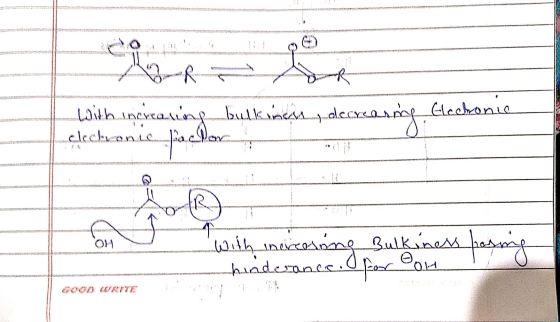
In the mechanism of this basic hydrolysis the rate is dependent on two factors the electronic factor and the steric factor. The bulky group is increasing the electronic factor by increasing resonance of oxygen atom with carbonyl group and steric hindrance is added for the approaching nucleophile with increasing size of alkyl attached to oxygen atom . Thus making attack the difficult and decreasing the rate in this fashion.
Add Answer to:
Q9: The following reactivity order in the attachment below has been observed for the hydrolysis reaction...
Arrange the following in order of decreasing reactivity towards hydrolysis using aqueous NaOH and explain this...
 Arrange the following in order of decreasing reactivity towards hydrolysis using aqueous NaOH and explain this trend. (1.5) (a) CH3CO2CH3 (b) CH3COCI (c) CH3CON(CH3)2 (d) CH3CO2COCH3
1.) What is the order of reactivity of the following reagents under SN1 conditions? Under SN2...
1.) What is the order of reactivity of the following reagents under SN1 conditions? Under SN2 conditions? Draw the structures of each using the bond line method and explain your answers. 1-methyl-1-bromocyclohexane, 1-bromopropane, 2-bromohexane 2.) What is the order of reactivity of the following reagents under SN1 conditions? Under SN2 conditions? Explain your answers. CH3CH=CHBr, CH3CH=CHCH2Br, CH3CH2CH2Br 3.) We did not use crotyl chloride in this experiment. However, based on your knowledge of SN1 and SN2 predict the behavior of...
3. (5 pts) Rank the following alkyl bromides in order of reactivity using numbers 1-5 (1...
 3. (5 pts) Rank the following alkyl bromides in order of reactivity using numbers 1-5 (1 - most reactive: 5 least reactive) in an Sy2 reaction where the alkyl bromide is converted to the corresponding nitrile: NaCN R-Br R-CN + NaBr acetone 4. (5 pts) Rank the following alkyl bromides in order of reactivity using numbers 1-5 (1 = most reactive; 5 - least reactive) in an Syl reaction where the alkyl bromide is converted to the corresponding alcohol: R-Br...
(2) Diels-Alder reactions of a diene with a dienophile are known to undergo a concerted reaction....
 (2) Diels-Alder reactions of a diene with a dienophile are known to undergo a concerted reaction. However, 2,3-Di- tert-1,3-butadene does not undergo Diels-Aider reactions. Explain 2,3-di-tert-1,3-butadiene (4) Propose mechanisms for the following steps 1 and 2. Slep 1 Step 2 Bry Br NaBH CH acetic acid (I) Using> as a symbol, rank the following alkyl bromides in order of decreasing reactivity. (6 pts) Br Cн,Br -Br (a) For hydrolysis by an Sy1 mechanism (b) For hydrolysis by an S,2 mechanism...
5. Rank the reactivity of the following alkyl halides (A-E) for an SN2 reaction from the...
 5. Rank the reactivity of the following alkyl halides (A-E) for an SN2 reaction from the fastest (1) to the slowest (5) and explain your ranking. (10 pts) H3C-Br Br Ci
Select the order that has the following nucleophiles correctly arranged with respect to increasing reactivity tow...
 Select the order that has the following nucleophiles correctly arranged with respect to increasing reactivity tow following substitution reaction Question 4 Nu: Nu Br DMF CHCоо CH3O CHзон 2 3 3 12 2 1 3 1 2 3 1 3 2 2 3 1 3 2 1 B increasing reactivity increasing C increasing reactivity increasing A increasing reactivity increasing D reactivity reactivity reactivity Ов O F Enter Your Answer: A D Choose the major product(s) of the following reaction Question...
6. (a) Rank the reactivity of the following alkyl halides (A-E) for an Syl reaction from...
 6. (a) Rank the reactivity of the following alkyl halides (A-E) for an Syl reaction from the slowest (1) to the fastest(5) (b) Explain your ranking, (10 Pts Total) Cl CH3-Cl CH3 H,C
1. (3p) Draw the mechanism and the expected reaction product for the following reaction: xo 2....
 1. (3p) Draw the mechanism and the expected reaction product for the following reaction: xo 2. (3p) Draw the mechanism and the expected Nucleophilic Substitution Reaction Product for the following reaction: 3. (3p) What reagent is necessary in the hydrolysis of carboxylic acid derivatives? Rank these derivatives in order of their reactivity. 4. (3p) Write the product for the following reaction: NaOH CHO 5. (3p) Propose a synthesis for the following compound by using a Witting reaction:
Rank (slowest to fastest) the following compounds in order of reactivity with respect to an SN2...
Rank (slowest to fastest) the following compounds in order of reactivity with respect to an SN2 reaction. Explain your reasoning for the ranking you propose. The compounds are 1-bromo-3-methylbutane, 1-bromo-2,2-dimethylpropane and 2-bromo-2-methylbutane.
Rank the following alkyl bromides in order of decreasing reactivity to S2 substitution, by entering a...
 Rank the following alkyl bromides in order of decreasing reactivity to S2 substitution, by entering a ranking number (1-4) next to each structure (1=most reactive). Br-CHE Rank the following carbocations in order of decreasing stability, by entering a ranking number (1-3) in the space next to the structure (1-most stable). We were unable to transcribe this imageRank the following nucleophiles in decreasing order of nucleophilicity (most reactive first) in an aprotic solvent, by entering a ranking number (1-4) next to...
 Arrange the following in order of decreasing reactivity towards hydrolysis using aqueous NaOH and explain this trend. (1.5) (a) CH3CO2CH3 (b) CH3COCI (c) CH3CON(CH3)2 (d) CH3CO2COCH3
 3. (5 pts) Rank the following alkyl bromides in order of reactivity using numbers 1-5 (1 - most reactive: 5 least reactive) in an Sy2 reaction where the alkyl bromide is converted to the corresponding nitrile: NaCN R-Br R-CN + NaBr acetone 4. (5 pts) Rank the following alkyl bromides in order of reactivity using numbers 1-5 (1 = most reactive; 5 - least reactive) in an Syl reaction where the alkyl bromide is converted to the corresponding alcohol: R-Br...
 (2) Diels-Alder reactions of a diene with a dienophile are known to undergo a concerted reaction. However, 2,3-Di- tert-1,3-butadene does not undergo Diels-Aider reactions. Explain 2,3-di-tert-1,3-butadiene (4) Propose mechanisms for the following steps 1 and 2. Slep 1 Step 2 Bry Br NaBH CH acetic acid (I) Using> as a symbol, rank the following alkyl bromides in order of decreasing reactivity. (6 pts) Br Cн,Br -Br (a) For hydrolysis by an Sy1 mechanism (b) For hydrolysis by an S,2 mechanism...
 5. Rank the reactivity of the following alkyl halides (A-E) for an SN2 reaction from the fastest (1) to the slowest (5) and explain your ranking. (10 pts) H3C-Br Br Ci
 Select the order that has the following nucleophiles correctly arranged with respect to increasing reactivity tow following substitution reaction Question 4 Nu: Nu Br DMF CHCоо CH3O CHзон 2 3 3 12 2 1 3 1 2 3 1 3 2 2 3 1 3 2 1 B increasing reactivity increasing C increasing reactivity increasing A increasing reactivity increasing D reactivity reactivity reactivity Ов O F Enter Your Answer: A D Choose the major product(s) of the following reaction Question...
 6. (a) Rank the reactivity of the following alkyl halides (A-E) for an Syl reaction from the slowest (1) to the fastest(5) (b) Explain your ranking, (10 Pts Total) Cl CH3-Cl CH3 H,C
 1. (3p) Draw the mechanism and the expected reaction product for the following reaction: xo 2. (3p) Draw the mechanism and the expected Nucleophilic Substitution Reaction Product for the following reaction: 3. (3p) What reagent is necessary in the hydrolysis of carboxylic acid derivatives? Rank these derivatives in order of their reactivity. 4. (3p) Write the product for the following reaction: NaOH CHO 5. (3p) Propose a synthesis for the following compound by using a Witting reaction:
 Rank the following alkyl bromides in order of decreasing reactivity to S2 substitution, by entering a ranking number (1-4) next to each structure (1=most reactive). Br-CHE Rank the following carbocations in order of decreasing stability, by entering a ranking number (1-3) in the space next to the structure (1-most stable). We were unable to transcribe this imageRank the following nucleophiles in decreasing order of nucleophilicity (most reactive first) in an aprotic solvent, by entering a ranking number (1-4) next to...
Most questions answered within 3 hours.
-
Where is the error in this code sequence?
String s1 = "Hello";
String s2 = "ello";...
asked 10 months ago -
Financial data for Joel de Paris, Inc., for last year
follow:
Joel de Paris, Inc.
Balance...
asked 10 months ago -
Consider this reaction:
Al2(SO4)3 (aq)+ BaCl3
(aq) Al2Cl6 (aq)- +
3BaSO4(s) . What is the...
asked 10 months ago -
Suppose that Savneet is considering increasing her
recent random sample from 20 car rentals to 40...
asked 10 months ago -
Trucks arrive at an unloading terminal at an average rate of 120
per hour.
Trucks arrive...
asked 10 months ago -
Why are methanol and ethanol completely soluble in water while
octanol is not very little soluble....
asked 10 months ago -
A facilities manager at a university reads in a research report
that the mean amount of...
asked 10 months ago -
When the CuSO4 is rehydrated by adding water to the anhydrous
compound, is this an endothermic...
asked 10 months ago -
A ray of sunlight is passing from diamond into crown glass; the
angle of incidence is...
asked 10 months ago -
A block of mass 0.249 kg is placed on top of a light, vertical
spring of...
asked 10 months ago -
how do the kidneys compensate in the presences of acidosis
a) trigger hyperventilate
b) reserve acid...
asked 10 months ago -
Question 501 pts
The rental rate of capital to the firm increases. Which of the
following...
asked 10 months ago