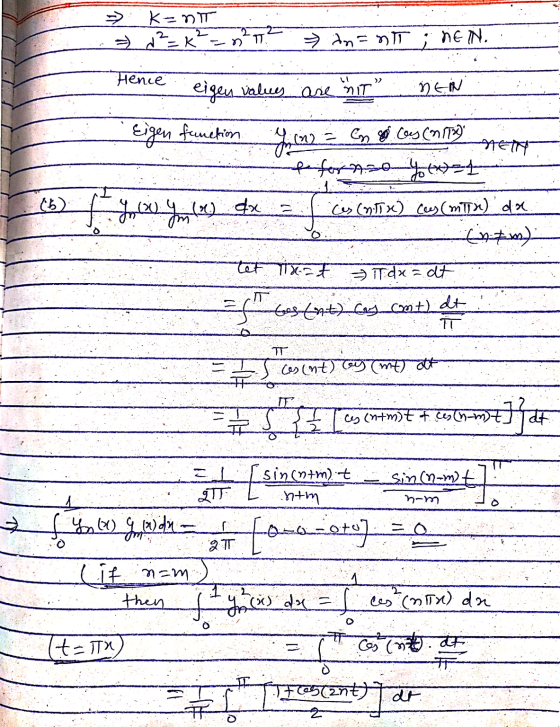
Please answer all parts of the question and clearly label them.
Thanks in advance for all the help.
Homework Answers

![Tot + Sin2mt) ㅠ 4n ]。 | | 프+0 - = = insticission hen mm 1이게 일](http://img.homeworklib.com/questions/71a02a80-4708-11eb-9fbe-43aada1f39c3.png?x-oss-process=image/resize,w_560)

Add Answer to:
Please answer all parts of the question and clearly label them.
Thanks in advance for all...
please solve all 3 Differential Equation problems 3.8.7 Question Help Consider the following eigenvalue problem for which all of its eigenvalues are nonnegative y',thy-0; y(0)-0, y(1) + y'(1)...
 please solve all 3 Differential Equation problems
3.8.7 Question Help Consider the following eigenvalue problem for which all of its eigenvalues are nonnegative y',thy-0; y(0)-0, y(1) + y'(1)-0 (a) Show that λ =0 is not an eigenvalue (b) Show that the eigenfunctions are the functions {sin α11,o, where αη įs the nth positive root of the equation tan z -z (c) Draw a sketch indicating the roots as the points of intersection of the curves y tan z and y...
please solve all 3 Differential Equation problems
3.8.7 Question Help Consider the following eigenvalue problem for which all of its eigenvalues are nonnegative y',thy-0; y(0)-0, y(1) + y'(1)-0 (a) Show that λ =0 is not an eigenvalue (b) Show that the eigenfunctions are the functions {sin α11,o, where αη įs the nth positive root of the equation tan z -z (c) Draw a sketch indicating the roots as the points of intersection of the curves y tan z and y...
(1 point) Determine the values of (eigenvalues) for which the boundary-value problem g” + y =...
 (1 point) Determine the values of (eigenvalues) for which the boundary-value problem g” + y = 0, 0 < x < 4 y(0) = 0, y' (4) = 0 has a non-trivial solution. An = a , n=1,2,3,... Your formula should give the eigenvalues in increasing order. The eigenfunctions to the eigenvalue in are Yn = Cn* sin(n*pi/2*x) where On is an arbitrary constant.
please help. please be clear and neat Consider the following BVP day dy + + \y...
 please help. please be clear and neat
Consider the following BVP day dy + + \y = 0, y(0) = y(2) = 0. d.x2 dac (a) Find eigenvalues and eigenfunctions of the problem; (b) Put the equation in self-adjoint form, and give an orthogonality relation; (c) Show that each eigenfunction of the problem can not correspond to two different eigenvalues.
please help. please be clear and neat
Consider the following BVP day dy + + \y = 0, y(0) = y(2) = 0. d.x2 dac (a) Find eigenvalues and eigenfunctions of the problem; (b) Put the equation in self-adjoint form, and give an orthogonality relation; (c) Show that each eigenfunction of the problem can not correspond to two different eigenvalues.
(1 point) Determine the values of a (eigenvalues) for which the boundary-value problem y + y...
 (1 point) Determine the values of a (eigenvalues) for which the boundary-value problem y + y = 0, 0 < x < 8 y(0) = 0, y'(8) = 0 has a non-trivial solution. = an ((2n-1)^2pi^2)/256 ,n= 1, 2, 3, ... Your formula should give the eigenvalues in increasing order. The eigenfunctions to the eigenvalue an are Yn = Cn* sin ((2n-1) pi n/16) where Cn is an arbitrary cons
1. Consider the non-Sturm-Liouville differential equation Multiply this equation by H(x). Determi...
 #2 ONLY PLEASE
1. Consider the non-Sturm-Liouville differential equation Multiply this equation by H(x). Determine H(x) such that the equation may be reduced to the standard Sturm-Liouville form: do Given a(z), 3(2), and 7(2), what are p(x), σ(x), and q(x) 2. Consider the eigenvalue problem (a) Use the result from the previous problem to put this in Sturm-Liouville form (b) Using the Rayleigh quotient, show that λ > 0. (c) Solve this equation subject to the boundary conditions and determine...
#2 ONLY PLEASE
1. Consider the non-Sturm-Liouville differential equation Multiply this equation by H(x). Determine H(x) such that the equation may be reduced to the standard Sturm-Liouville form: do Given a(z), 3(2), and 7(2), what are p(x), σ(x), and q(x) 2. Consider the eigenvalue problem (a) Use the result from the previous problem to put this in Sturm-Liouville form (b) Using the Rayleigh quotient, show that λ > 0. (c) Solve this equation subject to the boundary conditions and determine...
Please show working! If unsure of the answer please leave for someone else. Consider the Sturm-Louiville problem d2 y +...
 Please show working! If unsure of the answer please leave for
someone else.
Consider the Sturm-Louiville problem d2 y +2y 0 dr2 (0)0, y(3) 0. With n defined as taking values n 1, 2,3, ..., complete the following. (a) Enter the eigenvalues. An = (b) Enter the eigenfunctions Yn
Consider the Sturm-Louiville problem d2 y +2y 0 dr2 (0)0, y(3) 0. With n defined as taking values n 1, 2,3, ..., complete the following. (a) Enter the eigenvalues. An =...
Please show working! If unsure of the answer please leave for
someone else.
Consider the Sturm-Louiville problem d2 y +2y 0 dr2 (0)0, y(3) 0. With n defined as taking values n 1, 2,3, ..., complete the following. (a) Enter the eigenvalues. An = (b) Enter the eigenfunctions Yn
Consider the Sturm-Louiville problem d2 y +2y 0 dr2 (0)0, y(3) 0. With n defined as taking values n 1, 2,3, ..., complete the following. (a) Enter the eigenvalues. An =...
Please answer number 8 l Verizon LTE 9:53 PM 100%,--+ Close Physical Chemistry ll Spring...1 DOCX-149...
 Please answer number 8
l Verizon LTE 9:53 PM 100%,--+ Close Physical Chemistry ll Spring...1 DOCX-149 KB (e) none of the above 7. A free particle is inside a one dimentional box from 0 to a/2, (a is a constant). If the particle is in the first excited states with eigenfunction, y Nsin (4px/a) (a) Determine the normalization constant. (b) Calculate the probability in between a/4 and a/2 8. What is the degree of the degeneracy if the three quantum...
Please answer number 8
l Verizon LTE 9:53 PM 100%,--+ Close Physical Chemistry ll Spring...1 DOCX-149 KB (e) none of the above 7. A free particle is inside a one dimentional box from 0 to a/2, (a is a constant). If the particle is in the first excited states with eigenfunction, y Nsin (4px/a) (a) Determine the normalization constant. (b) Calculate the probability in between a/4 and a/2 8. What is the degree of the degeneracy if the three quantum...
3. Consider the follo 2 lu The boundary conditions are: u(0,y, t) - u(x, 0,t) - 0, ou (a, y, t) =...
 *Note: Please answer all parts, and explain all workings. Thank
you!
3. Consider the follo 2 lu The boundary conditions are: u(0,y, t) - u(x, 0,t) - 0, ou (a, y, t) = (x, b, t) = 0 ay The initial conditions are: at t-0,11-4 (x,y)--Yo(x,y) . ot a) Assume u(x,y,t) - X(x)Y(y)T(t), derive the eigenvalue problems: a) Apply the boundary conditions and derive all the possible eigenvalues for λι, λ2 and corresponding eigen-functions, Xm,Yn b) for any combination of...
*Note: Please answer all parts, and explain all workings. Thank
you!
3. Consider the follo 2 lu The boundary conditions are: u(0,y, t) - u(x, 0,t) - 0, ou (a, y, t) = (x, b, t) = 0 ay The initial conditions are: at t-0,11-4 (x,y)--Yo(x,y) . ot a) Assume u(x,y,t) - X(x)Y(y)T(t), derive the eigenvalue problems: a) Apply the boundary conditions and derive all the possible eigenvalues for λι, λ2 and corresponding eigen-functions, Xm,Yn b) for any combination of...
Answer ALL the questions. Some or all of them shall be marked. Question 1. Consider the...
 Answer ALL the questions. Some or all of them shall be marked. Question 1. Consider the following system of differential equations: P.(D) [x] + P (D)) -(0) Px(D) [x] + P (D) x = f(t). (1) How do we determine the correct number of arbitrary constants in a general solution of the above system. (0) Explain briefly the difference between the operator method and the method of triangu- larization when used for solving the above system. Question 2. Determine whether...
2. Consider the initial-boundary value problem 0 0, t >0 Uz uェェ, Uz(0, t) _ u(0, t) = 0. a(z, 0...
 PDE questions. Please show all
steps in detail.
2. Consider the initial-boundary value problem 0
PDE questions. Please show all
steps in detail.
2. Consider the initial-boundary value problem 0
 please solve all 3 Differential Equation problems
3.8.7 Question Help Consider the following eigenvalue problem for which all of its eigenvalues are nonnegative y',thy-0; y(0)-0, y(1) + y'(1)-0 (a) Show that λ =0 is not an eigenvalue (b) Show that the eigenfunctions are the functions {sin α11,o, where αη įs the nth positive root of the equation tan z -z (c) Draw a sketch indicating the roots as the points of intersection of the curves y tan z and y...
please solve all 3 Differential Equation problems
3.8.7 Question Help Consider the following eigenvalue problem for which all of its eigenvalues are nonnegative y',thy-0; y(0)-0, y(1) + y'(1)-0 (a) Show that λ =0 is not an eigenvalue (b) Show that the eigenfunctions are the functions {sin α11,o, where αη įs the nth positive root of the equation tan z -z (c) Draw a sketch indicating the roots as the points of intersection of the curves y tan z and y...
 (1 point) Determine the values of (eigenvalues) for which the boundary-value problem g” + y = 0, 0 < x < 4 y(0) = 0, y' (4) = 0 has a non-trivial solution. An = a , n=1,2,3,... Your formula should give the eigenvalues in increasing order. The eigenfunctions to the eigenvalue in are Yn = Cn* sin(n*pi/2*x) where On is an arbitrary constant.
 please help. please be clear and neat
Consider the following BVP day dy + + \y = 0, y(0) = y(2) = 0. d.x2 dac (a) Find eigenvalues and eigenfunctions of the problem; (b) Put the equation in self-adjoint form, and give an orthogonality relation; (c) Show that each eigenfunction of the problem can not correspond to two different eigenvalues.
please help. please be clear and neat
Consider the following BVP day dy + + \y = 0, y(0) = y(2) = 0. d.x2 dac (a) Find eigenvalues and eigenfunctions of the problem; (b) Put the equation in self-adjoint form, and give an orthogonality relation; (c) Show that each eigenfunction of the problem can not correspond to two different eigenvalues.
 (1 point) Determine the values of a (eigenvalues) for which the boundary-value problem y + y = 0, 0 < x < 8 y(0) = 0, y'(8) = 0 has a non-trivial solution. = an ((2n-1)^2pi^2)/256 ,n= 1, 2, 3, ... Your formula should give the eigenvalues in increasing order. The eigenfunctions to the eigenvalue an are Yn = Cn* sin ((2n-1) pi n/16) where Cn is an arbitrary cons
 #2 ONLY PLEASE
1. Consider the non-Sturm-Liouville differential equation Multiply this equation by H(x). Determine H(x) such that the equation may be reduced to the standard Sturm-Liouville form: do Given a(z), 3(2), and 7(2), what are p(x), σ(x), and q(x) 2. Consider the eigenvalue problem (a) Use the result from the previous problem to put this in Sturm-Liouville form (b) Using the Rayleigh quotient, show that λ > 0. (c) Solve this equation subject to the boundary conditions and determine...
#2 ONLY PLEASE
1. Consider the non-Sturm-Liouville differential equation Multiply this equation by H(x). Determine H(x) such that the equation may be reduced to the standard Sturm-Liouville form: do Given a(z), 3(2), and 7(2), what are p(x), σ(x), and q(x) 2. Consider the eigenvalue problem (a) Use the result from the previous problem to put this in Sturm-Liouville form (b) Using the Rayleigh quotient, show that λ > 0. (c) Solve this equation subject to the boundary conditions and determine...
 Please show working! If unsure of the answer please leave for
someone else.
Consider the Sturm-Louiville problem d2 y +2y 0 dr2 (0)0, y(3) 0. With n defined as taking values n 1, 2,3, ..., complete the following. (a) Enter the eigenvalues. An = (b) Enter the eigenfunctions Yn
Consider the Sturm-Louiville problem d2 y +2y 0 dr2 (0)0, y(3) 0. With n defined as taking values n 1, 2,3, ..., complete the following. (a) Enter the eigenvalues. An =...
Please show working! If unsure of the answer please leave for
someone else.
Consider the Sturm-Louiville problem d2 y +2y 0 dr2 (0)0, y(3) 0. With n defined as taking values n 1, 2,3, ..., complete the following. (a) Enter the eigenvalues. An = (b) Enter the eigenfunctions Yn
Consider the Sturm-Louiville problem d2 y +2y 0 dr2 (0)0, y(3) 0. With n defined as taking values n 1, 2,3, ..., complete the following. (a) Enter the eigenvalues. An =...
 Please answer number 8
l Verizon LTE 9:53 PM 100%,--+ Close Physical Chemistry ll Spring...1 DOCX-149 KB (e) none of the above 7. A free particle is inside a one dimentional box from 0 to a/2, (a is a constant). If the particle is in the first excited states with eigenfunction, y Nsin (4px/a) (a) Determine the normalization constant. (b) Calculate the probability in between a/4 and a/2 8. What is the degree of the degeneracy if the three quantum...
Please answer number 8
l Verizon LTE 9:53 PM 100%,--+ Close Physical Chemistry ll Spring...1 DOCX-149 KB (e) none of the above 7. A free particle is inside a one dimentional box from 0 to a/2, (a is a constant). If the particle is in the first excited states with eigenfunction, y Nsin (4px/a) (a) Determine the normalization constant. (b) Calculate the probability in between a/4 and a/2 8. What is the degree of the degeneracy if the three quantum...
 *Note: Please answer all parts, and explain all workings. Thank
you!
3. Consider the follo 2 lu The boundary conditions are: u(0,y, t) - u(x, 0,t) - 0, ou (a, y, t) = (x, b, t) = 0 ay The initial conditions are: at t-0,11-4 (x,y)--Yo(x,y) . ot a) Assume u(x,y,t) - X(x)Y(y)T(t), derive the eigenvalue problems: a) Apply the boundary conditions and derive all the possible eigenvalues for λι, λ2 and corresponding eigen-functions, Xm,Yn b) for any combination of...
*Note: Please answer all parts, and explain all workings. Thank
you!
3. Consider the follo 2 lu The boundary conditions are: u(0,y, t) - u(x, 0,t) - 0, ou (a, y, t) = (x, b, t) = 0 ay The initial conditions are: at t-0,11-4 (x,y)--Yo(x,y) . ot a) Assume u(x,y,t) - X(x)Y(y)T(t), derive the eigenvalue problems: a) Apply the boundary conditions and derive all the possible eigenvalues for λι, λ2 and corresponding eigen-functions, Xm,Yn b) for any combination of...
 Answer ALL the questions. Some or all of them shall be marked. Question 1. Consider the following system of differential equations: P.(D) [x] + P (D)) -(0) Px(D) [x] + P (D) x = f(t). (1) How do we determine the correct number of arbitrary constants in a general solution of the above system. (0) Explain briefly the difference between the operator method and the method of triangu- larization when used for solving the above system. Question 2. Determine whether...
 PDE questions. Please show all
steps in detail.
2. Consider the initial-boundary value problem 0
PDE questions. Please show all
steps in detail.
2. Consider the initial-boundary value problem 0
Most questions answered within 3 hours.
-
Where is the error in this code sequence?
String s1 = "Hello";
String s2 = "ello";...
asked 11 months ago -
Financial data for Joel de Paris, Inc., for last year
follow:
Joel de Paris, Inc.
Balance...
asked 11 months ago -
Consider this reaction:
Al2(SO4)3 (aq)+ BaCl3
(aq) Al2Cl6 (aq)- +
3BaSO4(s) . What is the...
asked 11 months ago -
Suppose that Savneet is considering increasing her
recent random sample from 20 car rentals to 40...
asked 11 months ago -
Trucks arrive at an unloading terminal at an average rate of 120
per hour.
Trucks arrive...
asked 11 months ago -
Why are methanol and ethanol completely soluble in water while
octanol is not very little soluble....
asked 11 months ago -
A facilities manager at a university reads in a research report
that the mean amount of...
asked 11 months ago -
When the CuSO4 is rehydrated by adding water to the anhydrous
compound, is this an endothermic...
asked 11 months ago -
A ray of sunlight is passing from diamond into crown glass; the
angle of incidence is...
asked 11 months ago -
A block of mass 0.249 kg is placed on top of a light, vertical
spring of...
asked 11 months ago -
how do the kidneys compensate in the presences of acidosis
a) trigger hyperventilate
b) reserve acid...
asked 11 months ago -
Question 501 pts
The rental rate of capital to the firm increases. Which of the
following...
asked 11 months ago