
Homework Answers

Add Answer to:
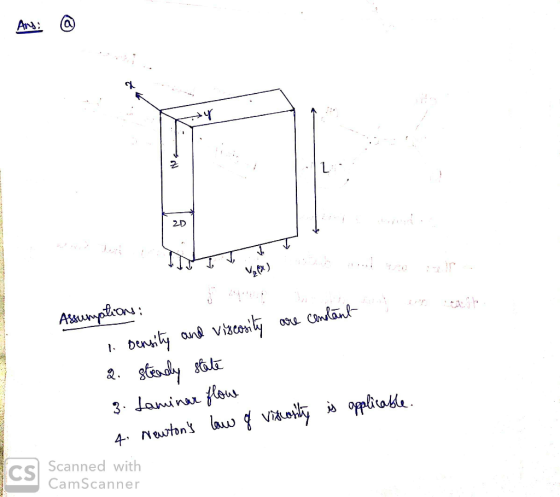
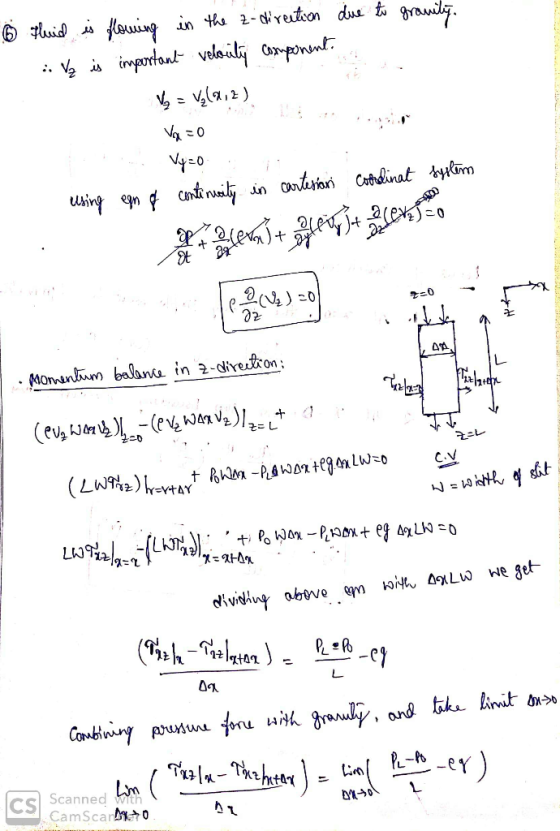
12. A liquid flows in a slit in the z-direction down a vertical plane, between 2...
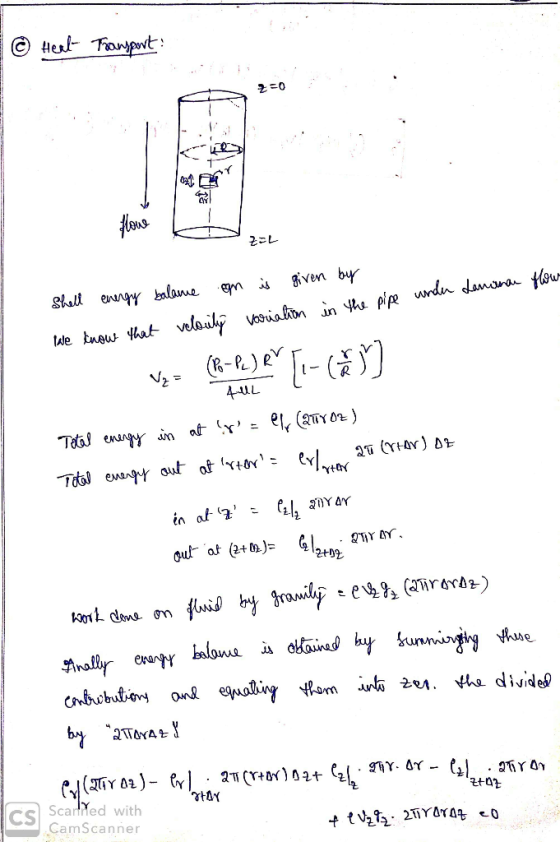
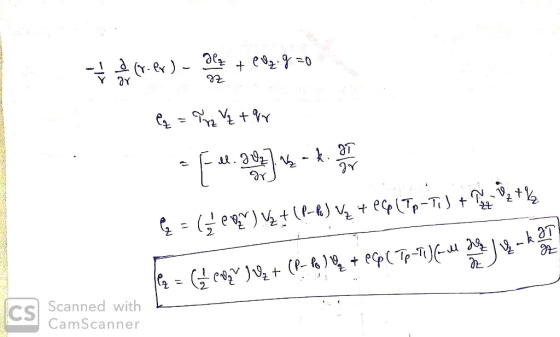
12. The temperature at the inner and outer surfaces of a hollow cylindrical pipe with wall...
 12. The temperature at the inner and outer surfaces of a hollow cylindrical pipe with wall thickness L are held at constant values of T and T, respectively, where T, <To. The wall material has thermal conductivity that varies linearly according to k = k,(1 +BT), where k, and ß are constants. Draw a schematic of the system. Define and label a coordinate system. State assumptions and boundary conditions. b. Derive the governing differential equation for the heat transport and...
An important problem in chemical engineering separation equipment involves thin liquid films flowing down vertical walls...
 An important problem in chemical engineering separation equipment involves thin liquid films flowing down vertical walls due to gravity, as shown in this figure yV A. Assume that the wall is long and wide compared to the film thickness, with steady flow that is laminar and fully developed: u= v=0 and w w(x). Using a force balance on a rectangular differential element, derive an expression relating g, p, and τΧΖ . Use τΧΖ-n(-_ +--) for a Newtonian fluid to convert...
An important problem in chemical engineering separation equipment involves thin liquid films flow...
 An important problem in chemical engineering separation equipment involves thin liquid films flowing down vertical walls due to gravity, as shown in this figure yV A. Assume that the wall is long and wide compared to the film thickness, with steady flow that is laminar and fully developed: u= v=0 and w w(x). Using a force balance on a rectangular differential element, derive an expression relating g, p, and τΧΖ . Use τΧΖ-n(-_ +--) for a Newtonian fluid to convert...
Problem #2 A solid cylinder of radius R is rotating in a counter clockwise direction at...
 Problem #2 A solid cylinder of radius R is rotating in a counter clockwise direction at an angular velocity w in an unbounded quiescent fluid of viscosity u and density p. (a) Write down the governing equations and boundary conditions for the fluid motion (neglect gravity). (b) Solve the governing equation for the velocity v(r), and draw the velocity profile. (e) Determine the torque acting on the cylinder.
Problem 2. An incompressible, Newtonian fluid flows downwards between two vertical parallel plates that are a...
 Problem 2. An incompressible, Newtonian fluid flows downwards between two vertical parallel plates that are a distance 2h away from each other. The flow is fully developed (i.e. steady) and the entirety of the velocity is the in vertical direction and due to gravity. Assuming there is no pressure gradient, solve for this velocity, w, as a function of 2. (3 points) Figure 1: Flow between two vertical parallel plates due to gravity.
19 A vertical moving belt drags an incompressible liquid film of thickness h, density P, and...
 19 A vertical moving belt drags an incompressible liquid film of thickness h, density P, and viscosity , as shown. Gravity tends to make the liquid drain down, but the movement of the belt at speed U, keeps the liquid from running off completely. u Assume that the flow is full developed and stead. State the boundary conditions Write the continuity equation for the flow and solve for v, the horizontal component of velocity. Solve for the velocity profile u(y)...
A. In the table below, identify which of the circled terms of the governing equations can...
 A. In the table below, identify which of the circled terms of
the governing equations can be neglected
by the given assumption. Write the number of the term in the table.
Some assumptions relate
to multiple terms, include them all.
B. Write the mathematical equations describing the
appropriate boundary conditions and identify
them in words.
C. Applying the appropriate boundary conditions,
solve the differential equation remaining after
appropriate terms have been neglected to determine the velocity
profile in the film: d^2(w)/dx^2 =...
A. In the table below, identify which of the circled terms of
the governing equations can be neglected
by the given assumption. Write the number of the term in the table.
Some assumptions relate
to multiple terms, include them all.
B. Write the mathematical equations describing the
appropriate boundary conditions and identify
them in words.
C. Applying the appropriate boundary conditions,
solve the differential equation remaining after
appropriate terms have been neglected to determine the velocity
profile in the film: d^2(w)/dx^2 =...
An incompressible fluid flows between two porous, parallel flat plates as shown in the Figure below....
 An incompressible fluid flows between two porous, parallel flat plates as shown in the Figure below. An identical fluid is injected at a constant speed V through the bottom plate and simultaneously extracted from the upper plate at the same velocity. There is no gravity force in x and y directions (g-g,-0). Assume the flow to be steady, fully-developed, 2D, and the pressure gradient in the x direction to be a constant P = constant). (a) Write the continuity equation...
Problem 3 (30 Points) Consider a specific application where a synthetic engine oil is used as...
 Problem 3 (30 Points) Consider a specific application where a synthetic engine oil is used as a working fluid in a journal bearing with a gap between the top & bottom surfaces of L=0.6 mm. Here, the top surface moves to the left with a constant velocity (Vr) of 16 m/s, while at the same time the bottom surface moves to the right with a constant velocity (Vb) of 9 m/s. The top surface is isothermal as it is maintained...
1. Fluid between parallel plates down an inclined plane (gravity setler). Fluid is flowing between parallel...
 1. Fluid between parallel plates down an inclined plane (gravity setler). Fluid is flowing between parallel plates, at an angle of β to the vertical. Assume δ<<w, L. th a momentum balance on a differential shell, and using the notation shown below, derive: i. the velocity distribution in the fluid, v,-f(x/b), and sketch result ii. the shear stress distribution in the fluid, -f(x/ö), and sketch result. iii. the volumetric flow rate iv. the maximum velocity, and the position x where...
 12. The temperature at the inner and outer surfaces of a hollow cylindrical pipe with wall thickness L are held at constant values of T and T, respectively, where T, <To. The wall material has thermal conductivity that varies linearly according to k = k,(1 +BT), where k, and ß are constants. Draw a schematic of the system. Define and label a coordinate system. State assumptions and boundary conditions. b. Derive the governing differential equation for the heat transport and...
 An important problem in chemical engineering separation equipment involves thin liquid films flowing down vertical walls due to gravity, as shown in this figure yV A. Assume that the wall is long and wide compared to the film thickness, with steady flow that is laminar and fully developed: u= v=0 and w w(x). Using a force balance on a rectangular differential element, derive an expression relating g, p, and τΧΖ . Use τΧΖ-n(-_ +--) for a Newtonian fluid to convert...
 An important problem in chemical engineering separation equipment involves thin liquid films flowing down vertical walls due to gravity, as shown in this figure yV A. Assume that the wall is long and wide compared to the film thickness, with steady flow that is laminar and fully developed: u= v=0 and w w(x). Using a force balance on a rectangular differential element, derive an expression relating g, p, and τΧΖ . Use τΧΖ-n(-_ +--) for a Newtonian fluid to convert...
 Problem #2 A solid cylinder of radius R is rotating in a counter clockwise direction at an angular velocity w in an unbounded quiescent fluid of viscosity u and density p. (a) Write down the governing equations and boundary conditions for the fluid motion (neglect gravity). (b) Solve the governing equation for the velocity v(r), and draw the velocity profile. (e) Determine the torque acting on the cylinder.
 Problem 2. An incompressible, Newtonian fluid flows downwards between two vertical parallel plates that are a distance 2h away from each other. The flow is fully developed (i.e. steady) and the entirety of the velocity is the in vertical direction and due to gravity. Assuming there is no pressure gradient, solve for this velocity, w, as a function of 2. (3 points) Figure 1: Flow between two vertical parallel plates due to gravity.
 19 A vertical moving belt drags an incompressible liquid film of thickness h, density P, and viscosity , as shown. Gravity tends to make the liquid drain down, but the movement of the belt at speed U, keeps the liquid from running off completely. u Assume that the flow is full developed and stead. State the boundary conditions Write the continuity equation for the flow and solve for v, the horizontal component of velocity. Solve for the velocity profile u(y)...
 A. In the table below, identify which of the circled terms of
the governing equations can be neglected
by the given assumption. Write the number of the term in the table.
Some assumptions relate
to multiple terms, include them all.
B. Write the mathematical equations describing the
appropriate boundary conditions and identify
them in words.
C. Applying the appropriate boundary conditions,
solve the differential equation remaining after
appropriate terms have been neglected to determine the velocity
profile in the film: d^2(w)/dx^2 =...
A. In the table below, identify which of the circled terms of
the governing equations can be neglected
by the given assumption. Write the number of the term in the table.
Some assumptions relate
to multiple terms, include them all.
B. Write the mathematical equations describing the
appropriate boundary conditions and identify
them in words.
C. Applying the appropriate boundary conditions,
solve the differential equation remaining after
appropriate terms have been neglected to determine the velocity
profile in the film: d^2(w)/dx^2 =...
 An incompressible fluid flows between two porous, parallel flat plates as shown in the Figure below. An identical fluid is injected at a constant speed V through the bottom plate and simultaneously extracted from the upper plate at the same velocity. There is no gravity force in x and y directions (g-g,-0). Assume the flow to be steady, fully-developed, 2D, and the pressure gradient in the x direction to be a constant P = constant). (a) Write the continuity equation...
 Problem 3 (30 Points) Consider a specific application where a synthetic engine oil is used as a working fluid in a journal bearing with a gap between the top & bottom surfaces of L=0.6 mm. Here, the top surface moves to the left with a constant velocity (Vr) of 16 m/s, while at the same time the bottom surface moves to the right with a constant velocity (Vb) of 9 m/s. The top surface is isothermal as it is maintained...
 1. Fluid between parallel plates down an inclined plane (gravity setler). Fluid is flowing between parallel plates, at an angle of β to the vertical. Assume δ<<w, L. th a momentum balance on a differential shell, and using the notation shown below, derive: i. the velocity distribution in the fluid, v,-f(x/b), and sketch result ii. the shear stress distribution in the fluid, -f(x/ö), and sketch result. iii. the volumetric flow rate iv. the maximum velocity, and the position x where...
Most questions answered within 3 hours.
-
Where is the error in this code sequence?
String s1 = "Hello";
String s2 = "ello";...
asked 10 months ago -
Financial data for Joel de Paris, Inc., for last year
follow:
Joel de Paris, Inc.
Balance...
asked 10 months ago -
Consider this reaction:
Al2(SO4)3 (aq)+ BaCl3
(aq) Al2Cl6 (aq)- +
3BaSO4(s) . What is the...
asked 10 months ago -
Suppose that Savneet is considering increasing her
recent random sample from 20 car rentals to 40...
asked 10 months ago -
Trucks arrive at an unloading terminal at an average rate of 120
per hour.
Trucks arrive...
asked 10 months ago -
Why are methanol and ethanol completely soluble in water while
octanol is not very little soluble....
asked 10 months ago -
A facilities manager at a university reads in a research report
that the mean amount of...
asked 10 months ago -
When the CuSO4 is rehydrated by adding water to the anhydrous
compound, is this an endothermic...
asked 10 months ago -
A ray of sunlight is passing from diamond into crown glass; the
angle of incidence is...
asked 10 months ago -
A block of mass 0.249 kg is placed on top of a light, vertical
spring of...
asked 10 months ago -
how do the kidneys compensate in the presences of acidosis
a) trigger hyperventilate
b) reserve acid...
asked 10 months ago -
Question 501 pts
The rental rate of capital to the firm increases. Which of the
following...
asked 10 months ago