C++ Programming
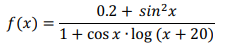
determine the roots of the equation with errors of less than 0.1%
for x values between -5 and 5. you MUST NOT use the "if" statement
in your code.
Homework Answers
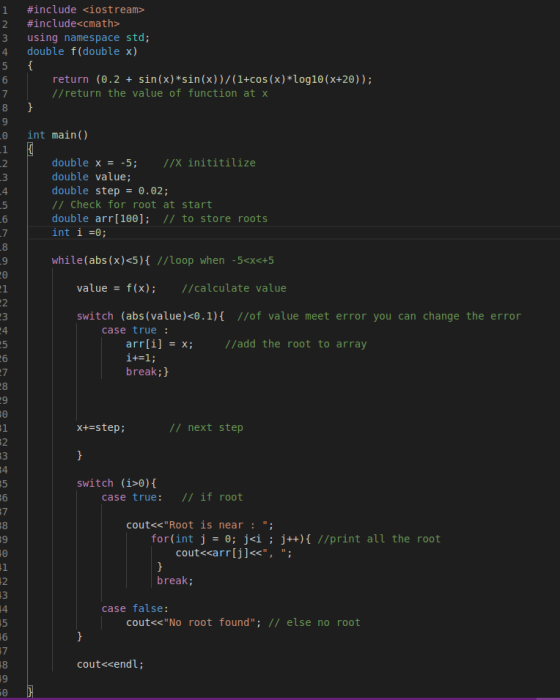
Copy pastable code :
#include <iostream>
#include<cmath>
using namespace std;
double f(double x)
{
return (0.2 + sin(x)*sin(x))/(1+cos(x)*log10(x+20));
}
int main()
{
double x = -5;
double value;
double step = 0.2;
double arr[100];
int i =0;
while(abs(x)<5){
value = f(x);
switch (abs(value)<0.1){
case true :
arr[i] = x;
i+=1;
break;
}
x+=step;
}
switch (i>0){
case true:
cout<<"Root is near : ";
for(int j = 0; j<i ; j++){
cout<<arr[j]<<", ";
}
break;
case false:
cout<<"No root found";
}
cout<<endl;
}
Code Snippet :
Output of the code :

Add Answer to:
C++ Programming
determine the roots of the equation with errors of less than 0.1%
for x...
Java Programming Question. I am writing a code to calculate the roots of the quadratic equation...
Java Programming Question. I am writing a code to calculate the roots of the quadratic equation based on the values of the coefficients A, B, and C. I am supposed to enter 5 values for each coefficient, and the output should be five different answers (see example) using a for loop and if else statements. However, when I run my code, I am only able to enter one value for each coefficient and the output is one answer repeated five...
Use Bairstow’s method to determine the roots of (a) f(x) = -2 + 6.2x -4x^2 +...
Use Bairstow’s method to determine the roots of (a) f(x) = -2 + 6.2x -4x^2 + 0.7x^3 b) f(x) = 9.34 - 21.97x +16.3x^2- 3.704x^3 (c) f(x) = x^4- 2x^3 + 6x^2- 2x + 5 I need the the solution for above equation in excel programming.
The following procedure can be used to determine the roots of a cubic equation a_3x^3 +...
 The following procedure can be used to determine the roots of a cubic equation a_3x^3 + a_2x^2 + a_1x + a_0 = 0: Set: A =a_2/a_3, B = a_1/a_3, and C = a_0/a_3 Calculate: D = Q^3 + R^2 where Q = (3B - A^2)/9 and R = (9AB - 27C - 2A^3)/54. If D > 0, the equation has complex roots. It D = 0, all roots are real and at least two are equal. The roots are given...
C programming!!C programming!!C programming!!C programming!!C programming!! C programming!!C programming!!C programming!!C programming!!C programming!! C programming!!C programming!!C programming!!C...
C programming!!C programming!!C programming!!C programming!!C programming!! C programming!!C programming!!C programming!!C programming!!C programming!! C programming!!C programming!!C programming!!C programming!!C programming!! Q2 (20 marks): remembering state, conditions, functions Write a function that takes two arguments an array and the size of the array and returns a count of all of the numbers between 2 and 5 inclusive. The code below shows how your function will be called. int main(void) { int values[6]={1,2,4,5,3,6}; int size=6; printf("There are %d values between 2 and 5 (inclusive)\n",...
Using matlab and if/else statement please! Write a function that determines the real roots of a...
 Using matlab and if/else statement please!
Write a function that determines the real roots of a quadratic equation ax2 + bx + c = 0. To calculate the roots of the equation, the function calculates the discriminant D, given by: D = b2-4ac If D> 0, the code should display "The equation has two roots" and print the values on a new line. If D 0, the code should display "The equation has one root.", and print the value on...
Using matlab and if/else statement please!
Write a function that determines the real roots of a quadratic equation ax2 + bx + c = 0. To calculate the roots of the equation, the function calculates the discriminant D, given by: D = b2-4ac If D> 0, the code should display "The equation has two roots" and print the values on a new line. If D 0, the code should display "The equation has one root.", and print the value on...
Please Solve in C programming. Please Use “ f(x) = e^(-x^2) “ for thus question. Thank You
 Please Solve in C programming. Please Use “ f(x) = e^(-x^2) “
for thus question.
Thank You
rite computer code in any programming language or mathematical software to estimate he following derivatives. Then calculate the absolute and relative errors for each: I, f"(1.5) for f(z) in Question 3 above using the three-point formula. Use h 0.5
rite computer code in any programming language or mathematical software to estimate he following derivatives. Then calculate the absolute and relative errors for each:...
Please Solve in C programming. Please Use “ f(x) = e^(-x^2) “
for thus question.
Thank You
rite computer code in any programming language or mathematical software to estimate he following derivatives. Then calculate the absolute and relative errors for each: I, f"(1.5) for f(z) in Question 3 above using the three-point formula. Use h 0.5
rite computer code in any programming language or mathematical software to estimate he following derivatives. Then calculate the absolute and relative errors for each:...
2. The roots of the quadratic $a x^2 + b x + c$ are given by...
2. The roots of the quadratic $a x^2 + b x + c$ are given by $$\frac{-b \pm \sqrt{b^2-4ac}}{2a}$$ If $b^2-4ac <0$, the quadratic has no real roots. Write a function to calculate the real roots of a quadratic. The function should have 3 arguments, *a*, *b* and *c*. If $b^2-4ac <0$, the function should print "quadratic has no real roots", and then return(NULL). Otherwise, the function should return a vector of length 2, those being the real roots (which...
#6 Write a Matlab program that finds numerically all the roots (or the zeros) of the...
#6 Write a Matlab program that finds numerically all the roots (or the zeros) of the algebraic equation below in the interval 1.0 <=x<=3.0: sqrt(log(x^2+1))=x^2*sin(e^x)+2 Part a) Prompt the user to enter a positive integer number n, defined the range 2<=n<=15, and then verify if the number entered lies within the specifications. Your program must allow the user to reenter the number without the need to rerun the program. Part b) Create a user-defined function for the bisection method(see details...
Need help with number 3, thanks! isplays l itnuml is less than num2. 2. (50+30- 80...
 Need help with number 3, thanks!
isplays l itnuml is less than num2. 2. (50+30- 80 Points) Write a MATLAB function numcomp502 (numl, num2) that takes two numbers numl and as input and returns num3 as output, such that num3 is equal to 0, 1, and-1 depending on whether numl is equal to, greater than or less than num2 respectively. Test your code with the pairs (10, 5), (-3,-3), and (2, 10) as input. Attach a screen-shot. 3. 80 Points...
Need help with number 3, thanks!
isplays l itnuml is less than num2. 2. (50+30- 80 Points) Write a MATLAB function numcomp502 (numl, num2) that takes two numbers numl and as input and returns num3 as output, such that num3 is equal to 0, 1, and-1 depending on whether numl is equal to, greater than or less than num2 respectively. Test your code with the pairs (10, 5), (-3,-3), and (2, 10) as input. Attach a screen-shot. 3. 80 Points...
2) (15 points) a) Determine the roots of f(x)=-12 – 21x +18r? - 2,75x' graphically. In...
 2) (15 points) a) Determine the roots of f(x)=-12 – 21x +18r? - 2,75x' graphically. In addition, determine the first root of the function with b) bisection and c) false-position. For (b) and (c), use initial guesses of x, =-land x, = 0, and a stopping criterion of 1%. 3) (25 points) Determine the highest real root of f(x) = 2x – 11,7x² +17,7x-5 a) Graphically, b) Fixed-point iteration method (three iterations, x, = 3) c) Newton-Raphson method (three iterations,...
 The following procedure can be used to determine the roots of a cubic equation a_3x^3 + a_2x^2 + a_1x + a_0 = 0: Set: A =a_2/a_3, B = a_1/a_3, and C = a_0/a_3 Calculate: D = Q^3 + R^2 where Q = (3B - A^2)/9 and R = (9AB - 27C - 2A^3)/54. If D > 0, the equation has complex roots. It D = 0, all roots are real and at least two are equal. The roots are given...
 Using matlab and if/else statement please!
Write a function that determines the real roots of a quadratic equation ax2 + bx + c = 0. To calculate the roots of the equation, the function calculates the discriminant D, given by: D = b2-4ac If D> 0, the code should display "The equation has two roots" and print the values on a new line. If D 0, the code should display "The equation has one root.", and print the value on...
Using matlab and if/else statement please!
Write a function that determines the real roots of a quadratic equation ax2 + bx + c = 0. To calculate the roots of the equation, the function calculates the discriminant D, given by: D = b2-4ac If D> 0, the code should display "The equation has two roots" and print the values on a new line. If D 0, the code should display "The equation has one root.", and print the value on...
 Please Solve in C programming. Please Use “ f(x) = e^(-x^2) “
for thus question.
Thank You
rite computer code in any programming language or mathematical software to estimate he following derivatives. Then calculate the absolute and relative errors for each: I, f"(1.5) for f(z) in Question 3 above using the three-point formula. Use h 0.5
rite computer code in any programming language or mathematical software to estimate he following derivatives. Then calculate the absolute and relative errors for each:...
Please Solve in C programming. Please Use “ f(x) = e^(-x^2) “
for thus question.
Thank You
rite computer code in any programming language or mathematical software to estimate he following derivatives. Then calculate the absolute and relative errors for each: I, f"(1.5) for f(z) in Question 3 above using the three-point formula. Use h 0.5
rite computer code in any programming language or mathematical software to estimate he following derivatives. Then calculate the absolute and relative errors for each:...
 Need help with number 3, thanks!
isplays l itnuml is less than num2. 2. (50+30- 80 Points) Write a MATLAB function numcomp502 (numl, num2) that takes two numbers numl and as input and returns num3 as output, such that num3 is equal to 0, 1, and-1 depending on whether numl is equal to, greater than or less than num2 respectively. Test your code with the pairs (10, 5), (-3,-3), and (2, 10) as input. Attach a screen-shot. 3. 80 Points...
Need help with number 3, thanks!
isplays l itnuml is less than num2. 2. (50+30- 80 Points) Write a MATLAB function numcomp502 (numl, num2) that takes two numbers numl and as input and returns num3 as output, such that num3 is equal to 0, 1, and-1 depending on whether numl is equal to, greater than or less than num2 respectively. Test your code with the pairs (10, 5), (-3,-3), and (2, 10) as input. Attach a screen-shot. 3. 80 Points...
 2) (15 points) a) Determine the roots of f(x)=-12 – 21x +18r? - 2,75x' graphically. In addition, determine the first root of the function with b) bisection and c) false-position. For (b) and (c), use initial guesses of x, =-land x, = 0, and a stopping criterion of 1%. 3) (25 points) Determine the highest real root of f(x) = 2x – 11,7x² +17,7x-5 a) Graphically, b) Fixed-point iteration method (three iterations, x, = 3) c) Newton-Raphson method (three iterations,...
Most questions answered within 3 hours.
-
Where is the error in this code sequence?
String s1 = "Hello";
String s2 = "ello";...
asked 10 months ago -
Financial data for Joel de Paris, Inc., for last year
follow:
Joel de Paris, Inc.
Balance...
asked 10 months ago -
Consider this reaction:
Al2(SO4)3 (aq)+ BaCl3
(aq) Al2Cl6 (aq)- +
3BaSO4(s) . What is the...
asked 10 months ago -
Suppose that Savneet is considering increasing her
recent random sample from 20 car rentals to 40...
asked 10 months ago -
Trucks arrive at an unloading terminal at an average rate of 120
per hour.
Trucks arrive...
asked 10 months ago -
Why are methanol and ethanol completely soluble in water while
octanol is not very little soluble....
asked 10 months ago -
A facilities manager at a university reads in a research report
that the mean amount of...
asked 10 months ago -
When the CuSO4 is rehydrated by adding water to the anhydrous
compound, is this an endothermic...
asked 10 months ago -
A ray of sunlight is passing from diamond into crown glass; the
angle of incidence is...
asked 10 months ago -
A block of mass 0.249 kg is placed on top of a light, vertical
spring of...
asked 10 months ago -
how do the kidneys compensate in the presences of acidosis
a) trigger hyperventilate
b) reserve acid...
asked 10 months ago -
Question 501 pts
The rental rate of capital to the firm increases. Which of the
following...
asked 10 months ago