 In the textbook used
in class the specific
enthalpy in the state
is correct for 160bar
In the textbook used
in class the specific
enthalpy in the state
is correct for 160bar
Homework Answers
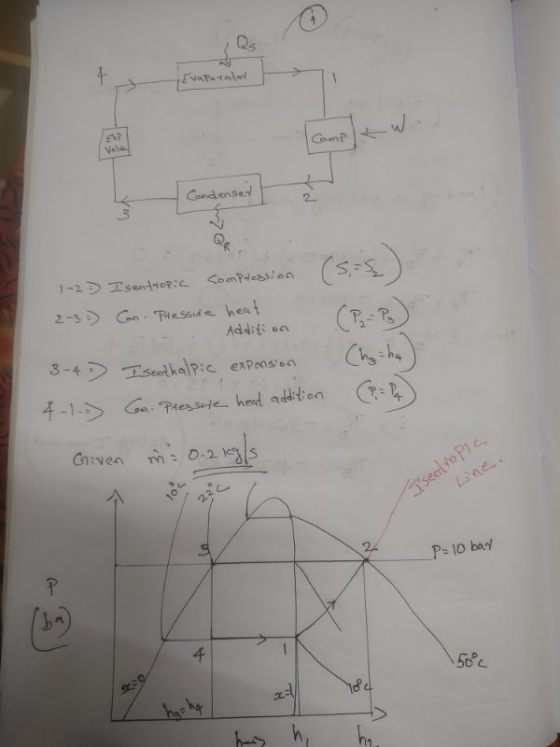
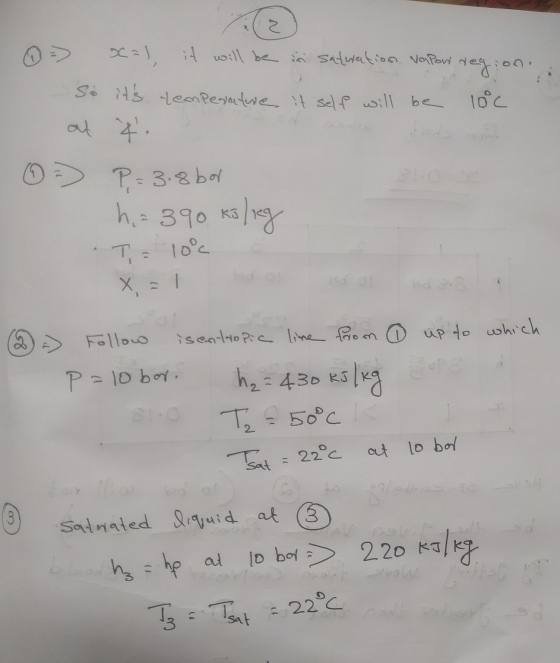
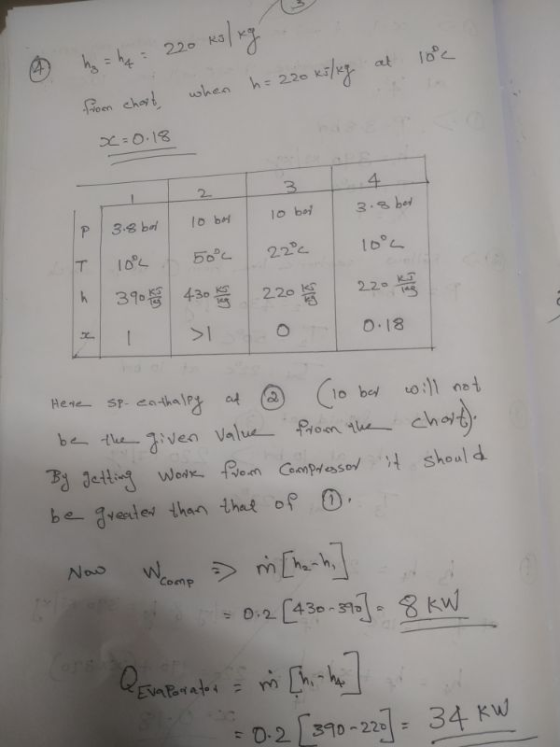
![0.2 [430-225] = 42 kW Compressed Evaporatory Ennalle Condensat 42kw 34kW 8kW 9 COP> Boom 4.25 Coen From the available chait o](http://img.homeworklib.com/questions/d89f4c20-473b-11eb-8b75-c5e43ced00c5.png?x-oss-process=image/resize,w_560)
Add Answer to:
In the textbook used
in class the specific
enthalpy in the state
is correct for 160bar...
2. MULTIPLE EVAPORATOR/ EXPANSION VALVE A refrigeration installation using Freon 12, comprises one compressor, one condenser...
 2. MULTIPLE EVAPORATOR/ EXPANSION VALVE A refrigeration installation using Freon 12, comprises one compressor, one condenser and three evaporators of 10 tonnes, 20 tonnes, and 30 tonnes capacities maintained at 10 C, 5 C and -10 C respectively. The system comprises multiple expansion valves and back pressure check valves. The condenser pressure is 9.609 bar (saturation temp. 40 C). The vapours leaving the evaporator are dry saturated. The liquid refrigerant is sub-cooled by 10 C in the condenser sub-cooler. Assume...
A Refrigeration System Using R-134A In a refrigeration system, the refrigerant R-134A begins as s...
 A Refrigeration System Using R-134A In a refrigeration system, the refrigerant R-134A begins as saturated vapor at -15°(State 1). It then goes through a reversible adiabatic compressor to reach State 2. After flowing through the condenser (a heat exchanger), the refrigerant exits as saturated liquid at 70°C (State 3). It is then throttled by going through an expansion valve, to reach State 4. It finishes the cycle by going through another heat exchanger (the evaporator), to return to State 1....
120; = ? 2 (P2 = 1000 kPa; T2 = 65 °C) Problem 5. A compression...
 120; = ? 2 (P2 = 1000 kPa; T2 = 65 °C) Problem 5. A compression refrigeration cycle (see Figure) has R-134a as the refrigerant. The mass flow rate is 3 kg/min. The refrigerant goes through isothermal evaporation in the evaporator and leaves the evaporator at -20 °C as saturated vapor. It enters the condenser with a pressure of 1 MPa and a temperature of 65 °C. Assume no losses in the pipelines connecting different components. Also assume steady state...
4. (10 points) An ideal vapor-compression refrigeration cycle is modified to include a counter- f...
 4. (10 points) An ideal vapor-compression refrigeration cycle is modified to include a counter- flow heat exchanger, as shown below.Ammonia leaves the evaporator as saturated vapor at 1.0 bar and is heated at constant pressure to S "C before entering the compressor. Following isentropic compression to 18 bar, the refrigerant passes through the condenser, exiting at 40 18 bar. The liquid then passes through the heat exchanger, entering the expansion valve at 18 bar. If the mass flow rate of...
015) A1 a) Define volumetric efficlency and indicate ts significance on the design of refrigeration systems. List h...
 015) A1 a) Define volumetric efficlency and indicate ts significance on the design of refrigeration systems. List he most important factors that infuence the volumetric efficiency of reciprocating refrigeration compressors [20%) est of an ammonia refrigeration plant employing a twin cytinder single acting compressor, running at 320 rpm, the following data were obtained Refrigerant temperatures Ater expansion valve, entering brine cooling evaporator Entering compressor Entering condenser Entering expansion valve -24 "С -8℃ 134 ℃ 30"С Others: 0.793 mng Specific volume...
Please also draw the T-S diagrams and PH diagrams to facilitate understanding. Thank you. 5. The refrigeration system s...
 Please also draw the T-S diagrams and PH diagrams to facilitate
understanding. Thank you.
5. The refrigeration system shown below is another variation of the basic vapor compression refrigeration system which attempts to reduce the compression work. In this system, a heat exchanger is used to superheat the vapor entering the compressor while sub-cooling the liquid exiting from the condenser Consider a system of this type that uses refrigerant-134a as its refrigerant and operates the evaporator at -10°C, and the...
Please also draw the T-S diagrams and PH diagrams to facilitate
understanding. Thank you.
5. The refrigeration system shown below is another variation of the basic vapor compression refrigeration system which attempts to reduce the compression work. In this system, a heat exchanger is used to superheat the vapor entering the compressor while sub-cooling the liquid exiting from the condenser Consider a system of this type that uses refrigerant-134a as its refrigerant and operates the evaporator at -10°C, and the...
Problem #4 (20 points) A commercial refrigerator with refrigerant-134a as the working fluid is used to...
 Problem #4 (20 points) A commercial refrigerator with refrigerant-134a as the working fluid is used to keep the refrigerated space at -30°C by rejecting its waste heat to cooling water that enters the condenser at 18°C at a rate of 0.25 kg/s and leaves at 26°C. The refrigerant enters the condenser at 1.2 MPa and 65°C and leaves at 42°C. The inlet state of the compressor is 60 kPa and-34°Cand the compressor is estimated to gain a net heat of...
2. (10 points) An ideal vapor-compression refrigeration cycle is modified to include a counter- flow heat...
 2. (10 points) An ideal vapor-compression refrigeration cycle is modified to include a counter- flow heat exchanger, as shown below. Ammonia leaves the evaporator as saturated vapor at 1.0 bar and is heated at constant pressure to 5 "C before entering the compressor. Following isentropic compression to 18 bar, the refrigerant passes through the condenser, exiting at 40 C, 18 bar. The liquid then passes through the heat exchanger, entering the expansion valve at 18 bar. If the mass flow...
ycles 1. A refrigeration system operates with a superheated cycle using R134a. The required refrigerating capacity...
 ycles 1. A refrigeration system operates with a superheated cycle using R134a. The required refrigerating capacity is 30 TR. The evaporator works at -10 Cand the condenser pressure is 1 MPa. The refrigerant is superheated by 10°C before entering to the compressor. Assume isentropic compression in the compressor and isenthalpic expansion in the expansion valve. Answering the following questions using the ph diagram. and the c Sion in the ring to a) Sketch the process in the p-h diagram and...
5-6 Figure 5-6 shows the schematic diagram for a two-stage cascade refrigeration system. Each stage operates...
 5-6 Figure 5-6 shows the schematic diagram for a two-stage cascade refrigeration system. Each stage operates on an ideal vapor-compression refrigeration cycle with refrigerant- 134a as the working fluid. All the important data and refrigerant phases are given in the schematic diagrams. By referring to the diagrams, determine: (a) The ratio of mass flow rate of the system and draw a T-s diagram complete with the data given. Enthalpy values for each states. Compressor power input for Cycle A and...
 2. MULTIPLE EVAPORATOR/ EXPANSION VALVE A refrigeration installation using Freon 12, comprises one compressor, one condenser and three evaporators of 10 tonnes, 20 tonnes, and 30 tonnes capacities maintained at 10 C, 5 C and -10 C respectively. The system comprises multiple expansion valves and back pressure check valves. The condenser pressure is 9.609 bar (saturation temp. 40 C). The vapours leaving the evaporator are dry saturated. The liquid refrigerant is sub-cooled by 10 C in the condenser sub-cooler. Assume...
 A Refrigeration System Using R-134A In a refrigeration system, the refrigerant R-134A begins as saturated vapor at -15°(State 1). It then goes through a reversible adiabatic compressor to reach State 2. After flowing through the condenser (a heat exchanger), the refrigerant exits as saturated liquid at 70°C (State 3). It is then throttled by going through an expansion valve, to reach State 4. It finishes the cycle by going through another heat exchanger (the evaporator), to return to State 1....
 120; = ? 2 (P2 = 1000 kPa; T2 = 65 °C) Problem 5. A compression refrigeration cycle (see Figure) has R-134a as the refrigerant. The mass flow rate is 3 kg/min. The refrigerant goes through isothermal evaporation in the evaporator and leaves the evaporator at -20 °C as saturated vapor. It enters the condenser with a pressure of 1 MPa and a temperature of 65 °C. Assume no losses in the pipelines connecting different components. Also assume steady state...
 4. (10 points) An ideal vapor-compression refrigeration cycle is modified to include a counter- flow heat exchanger, as shown below.Ammonia leaves the evaporator as saturated vapor at 1.0 bar and is heated at constant pressure to S "C before entering the compressor. Following isentropic compression to 18 bar, the refrigerant passes through the condenser, exiting at 40 18 bar. The liquid then passes through the heat exchanger, entering the expansion valve at 18 bar. If the mass flow rate of...
 015) A1 a) Define volumetric efficlency and indicate ts significance on the design of refrigeration systems. List he most important factors that infuence the volumetric efficiency of reciprocating refrigeration compressors [20%) est of an ammonia refrigeration plant employing a twin cytinder single acting compressor, running at 320 rpm, the following data were obtained Refrigerant temperatures Ater expansion valve, entering brine cooling evaporator Entering compressor Entering condenser Entering expansion valve -24 "С -8℃ 134 ℃ 30"С Others: 0.793 mng Specific volume...
 Please also draw the T-S diagrams and PH diagrams to facilitate
understanding. Thank you.
5. The refrigeration system shown below is another variation of the basic vapor compression refrigeration system which attempts to reduce the compression work. In this system, a heat exchanger is used to superheat the vapor entering the compressor while sub-cooling the liquid exiting from the condenser Consider a system of this type that uses refrigerant-134a as its refrigerant and operates the evaporator at -10°C, and the...
Please also draw the T-S diagrams and PH diagrams to facilitate
understanding. Thank you.
5. The refrigeration system shown below is another variation of the basic vapor compression refrigeration system which attempts to reduce the compression work. In this system, a heat exchanger is used to superheat the vapor entering the compressor while sub-cooling the liquid exiting from the condenser Consider a system of this type that uses refrigerant-134a as its refrigerant and operates the evaporator at -10°C, and the...
 Problem #4 (20 points) A commercial refrigerator with refrigerant-134a as the working fluid is used to keep the refrigerated space at -30°C by rejecting its waste heat to cooling water that enters the condenser at 18°C at a rate of 0.25 kg/s and leaves at 26°C. The refrigerant enters the condenser at 1.2 MPa and 65°C and leaves at 42°C. The inlet state of the compressor is 60 kPa and-34°Cand the compressor is estimated to gain a net heat of...
 2. (10 points) An ideal vapor-compression refrigeration cycle is modified to include a counter- flow heat exchanger, as shown below. Ammonia leaves the evaporator as saturated vapor at 1.0 bar and is heated at constant pressure to 5 "C before entering the compressor. Following isentropic compression to 18 bar, the refrigerant passes through the condenser, exiting at 40 C, 18 bar. The liquid then passes through the heat exchanger, entering the expansion valve at 18 bar. If the mass flow...
 ycles 1. A refrigeration system operates with a superheated cycle using R134a. The required refrigerating capacity is 30 TR. The evaporator works at -10 Cand the condenser pressure is 1 MPa. The refrigerant is superheated by 10°C before entering to the compressor. Assume isentropic compression in the compressor and isenthalpic expansion in the expansion valve. Answering the following questions using the ph diagram. and the c Sion in the ring to a) Sketch the process in the p-h diagram and...
 5-6 Figure 5-6 shows the schematic diagram for a two-stage cascade refrigeration system. Each stage operates on an ideal vapor-compression refrigeration cycle with refrigerant- 134a as the working fluid. All the important data and refrigerant phases are given in the schematic diagrams. By referring to the diagrams, determine: (a) The ratio of mass flow rate of the system and draw a T-s diagram complete with the data given. Enthalpy values for each states. Compressor power input for Cycle A and...
Most questions answered within 3 hours.
-
Where is the error in this code sequence?
String s1 = "Hello";
String s2 = "ello";...
asked 10 months ago -
Financial data for Joel de Paris, Inc., for last year
follow:
Joel de Paris, Inc.
Balance...
asked 10 months ago -
Consider this reaction:
Al2(SO4)3 (aq)+ BaCl3
(aq) Al2Cl6 (aq)- +
3BaSO4(s) . What is the...
asked 10 months ago -
Suppose that Savneet is considering increasing her
recent random sample from 20 car rentals to 40...
asked 10 months ago -
Trucks arrive at an unloading terminal at an average rate of 120
per hour.
Trucks arrive...
asked 10 months ago -
Why are methanol and ethanol completely soluble in water while
octanol is not very little soluble....
asked 10 months ago -
A facilities manager at a university reads in a research report
that the mean amount of...
asked 10 months ago -
When the CuSO4 is rehydrated by adding water to the anhydrous
compound, is this an endothermic...
asked 10 months ago -
A ray of sunlight is passing from diamond into crown glass; the
angle of incidence is...
asked 10 months ago -
A block of mass 0.249 kg is placed on top of a light, vertical
spring of...
asked 10 months ago -
how do the kidneys compensate in the presences of acidosis
a) trigger hyperventilate
b) reserve acid...
asked 10 months ago -
Question 501 pts
The rental rate of capital to the firm increases. Which of the
following...
asked 10 months ago