Data on 14 randomly selected athletes was obtained concerning their cardiovascular fitness (measured by time to exhaustion running on a treadmill) and performance in a 20-km ski race. Both variables were measured in minutes and a regression analysis was performed.
Ski = 89 -2*Treadmill
| Coefficients | Estimate | Std. Error |
| (Intercept) | 89 | 0.38 |
| Treadmill | -2 | 0.699 |
Is there sufficient evidence to conclude that there is a linear relationship between cardiovascular fitness and ski race performance?
The test statistic is
The p-value is between and
At the 5% significance level, we Select an answer reject do not
reject the null hypothesis and conclude that there is
Select an answer insufficient sufficient evidence to conclude that
there is a linear relationship between cardiovascular fitness and
ski race performance.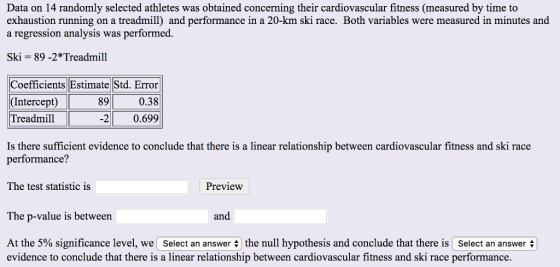
Homework Answers


Add Answer to:
Data on 14 randomly selected athletes was obtained concerning
their cardiovascular fitness (measured by time to...
Data on 10 randomly selected athletes was obtained concerning their cardiovascular fitness (measured by time to...
 Data on 10 randomly selected athletes was obtained concerning their cardiovascular fitness (measured by time to exhaustion running on a treadmill and performance in a 20-km ski race. Both variables were measured in minutes and a regression analysis was performed. Ski- 86-2.5*Treadmill Coefficients Estimate Std. Error (Intercept)860.88 Treadmill 2.51.055 Is there sufficient evidence to conclude that there is a linear relationship between cardiovascular fitness and ski race performance? Round your answers to three decimal places. (a). The test statistic is...
thletes are constantly seeking measures of the degree of their cardiovascular fitness prior to the major...
thletes are constantly seeking measures of the degree of their cardiovascular fitness prior to the major race. Athletes want to know when their training is at a level which will produce a peak performance. One such measure of fitness is the time to exhaustion from running on a treadmill at a specified (?)angle and speed. The important question is then “Does this measure of cardiovascular fitness translates into performance in a 10-km running race?” (?)Twenty experienced distances runners who professed...
Q1 (30 points) Consider Problem 11.45, Page 637. Please note that for this problem the data...
 Q1 (30 points) Consider Problem 11.45, Page 637. Please note that for this problem the data will be entered in R as follows: #Enter data on x = Dose Level of Drug, and y = Potency of Drug (Problem 11.45, page 637) x<-c(2, 2, 2, 4, 4, 8, 8, 16, 16, 16, 32, 32, 64, 64, 64) y<-c(5, 7, 3, 10, 14, 15, 17, 20, 21, 19, 23, 29, 28, 31, 30) For this problem, answer the following questions. In...
accompanying data represent the total compensation for 12 randomly selected chief executive officers (CEOs) and the...
accompanying data represent the total compensation for 12 randomly selected chief executive officers (CEOs) and the company's stock performance. Use the data to complete parts (a) through (d). beta 0β0 and beta 1β1. The estimate of beta 1β1 is? (Round to three decimal places as needed.) Data Table of Compensation and Stock Performance Company Compensation (millions of dollars) Stock Return (%) A 15.98 77.34 B 4.17 67.65 C 6.18 140.24 D 1.16 32.11 E 1.85 10.43 F 2.24 29.52 G...
What is the relationship between the amount of time statistics students study per week and their...
What is the relationship between the amount of time statistics students study per week and their test scores? The results of the survey are shown below. Time 16 14 15 6 14 15 6 Score 100 89 100 68 99 100 78 x-values y-values Find the correlation coefficient: r=r= Round to 2 decimal places. The null and alternative hypotheses for correlation are: H0:H0: ? ρ r μ == 0 H1:H1: ? μ r ρ ≠≠ 0 The p-value is: (Round to four decimal...
the questions for the table for number 14 was added For questions 13-16: Light exposure in...
 the questions for the table for number 14 was added
For questions 13-16: Light exposure in mice Studies show that night-time light exposure is hamful to human health. A recent 6-week study randomly assigned lab mice to one of three conditions: LD (Group 1) had a standard light/dark cycle cach 24-hour period; (Group 2) LL had bright light all the time, and (Group 3) DM had dim light when there nomally would have been darkness. The rescarchers hoped to investigate...
the questions for the table for number 14 was added
For questions 13-16: Light exposure in mice Studies show that night-time light exposure is hamful to human health. A recent 6-week study randomly assigned lab mice to one of three conditions: LD (Group 1) had a standard light/dark cycle cach 24-hour period; (Group 2) LL had bright light all the time, and (Group 3) DM had dim light when there nomally would have been darkness. The rescarchers hoped to investigate...
 Data on 10 randomly selected athletes was obtained concerning their cardiovascular fitness (measured by time to exhaustion running on a treadmill and performance in a 20-km ski race. Both variables were measured in minutes and a regression analysis was performed. Ski- 86-2.5*Treadmill Coefficients Estimate Std. Error (Intercept)860.88 Treadmill 2.51.055 Is there sufficient evidence to conclude that there is a linear relationship between cardiovascular fitness and ski race performance? Round your answers to three decimal places. (a). The test statistic is...
 Q1 (30 points) Consider Problem 11.45, Page 637. Please note that for this problem the data will be entered in R as follows: #Enter data on x = Dose Level of Drug, and y = Potency of Drug (Problem 11.45, page 637) x<-c(2, 2, 2, 4, 4, 8, 8, 16, 16, 16, 32, 32, 64, 64, 64) y<-c(5, 7, 3, 10, 14, 15, 17, 20, 21, 19, 23, 29, 28, 31, 30) For this problem, answer the following questions. In...
 the questions for the table for number 14 was added
For questions 13-16: Light exposure in mice Studies show that night-time light exposure is hamful to human health. A recent 6-week study randomly assigned lab mice to one of three conditions: LD (Group 1) had a standard light/dark cycle cach 24-hour period; (Group 2) LL had bright light all the time, and (Group 3) DM had dim light when there nomally would have been darkness. The rescarchers hoped to investigate...
the questions for the table for number 14 was added
For questions 13-16: Light exposure in mice Studies show that night-time light exposure is hamful to human health. A recent 6-week study randomly assigned lab mice to one of three conditions: LD (Group 1) had a standard light/dark cycle cach 24-hour period; (Group 2) LL had bright light all the time, and (Group 3) DM had dim light when there nomally would have been darkness. The rescarchers hoped to investigate...
Most questions answered within 3 hours.
-
Where is the error in this code sequence?
String s1 = "Hello";
String s2 = "ello";...
asked 10 months ago -
Financial data for Joel de Paris, Inc., for last year
follow:
Joel de Paris, Inc.
Balance...
asked 10 months ago -
Consider this reaction:
Al2(SO4)3 (aq)+ BaCl3
(aq) Al2Cl6 (aq)- +
3BaSO4(s) . What is the...
asked 10 months ago -
Suppose that Savneet is considering increasing her
recent random sample from 20 car rentals to 40...
asked 10 months ago -
Trucks arrive at an unloading terminal at an average rate of 120
per hour.
Trucks arrive...
asked 10 months ago -
Why are methanol and ethanol completely soluble in water while
octanol is not very little soluble....
asked 10 months ago -
A facilities manager at a university reads in a research report
that the mean amount of...
asked 10 months ago -
When the CuSO4 is rehydrated by adding water to the anhydrous
compound, is this an endothermic...
asked 10 months ago -
A ray of sunlight is passing from diamond into crown glass; the
angle of incidence is...
asked 10 months ago -
A block of mass 0.249 kg is placed on top of a light, vertical
spring of...
asked 10 months ago -
how do the kidneys compensate in the presences of acidosis
a) trigger hyperventilate
b) reserve acid...
asked 10 months ago -
Question 501 pts
The rental rate of capital to the firm increases. Which of the
following...
asked 10 months ago