
Homework Answers
Solution:
Given that
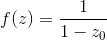
![[\because \frac{1}{1-z_{0}}=\frac{1}{1-z}]](http://img.homeworklib.com/questions/9dc9c050-4797-11eb-a73a-23db4388bc8d.png?x-oss-process=image/resize,w_560)

Here, it has the laurent series representation about point i.e,

Now,


![\therefore \left | \frac{1}{z-i} \right |<1]](http://img.homeworklib.com/questions/9f9e49a0-4797-11eb-9e81-2bd75e47cae4.png?x-oss-process=image/resize,w_560)
 The series
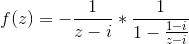
![f(z)=-\frac{1}{z-i}*[1-(\frac{1-i}{z-i})]^{-1}](http://img.homeworklib.com/questions/a0ae0c20-4797-11eb-8c69-75a00bac571e.png?x-oss-process=image/resize,w_560)
![f(z)=-\frac{1}{z-i}*[1+(\frac{1-i}{z-i})+(\frac{1-i}{z-i})^{2}+........]](http://img.homeworklib.com/questions/a0fdc2b0-4797-11eb-95cd-49e6f7a7f58a.png?x-oss-process=image/resize,w_560)

![\therefore \left [ \left | \frac{1}{z-i} \right |<1 \right ]](http://img.homeworklib.com/questions/a1b11250-4797-11eb-809e-556d857e1632.png?x-oss-process=image/resize,w_560)
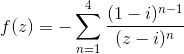
Hence,
we proved that
 |
(valid for  )
)
Add Answer to:
= t a r has a Laurent series representation about the 2. Show that f(s) =...
(b) Determine the largest R such that the Laurent series of 2+1 f(z) = z 1 + (z-iT)(z+T) converges for 0< z-1|<R (b) Determine the largest R such that the Laurent series of 2+1 f(z) = z 1...
 (b) Determine the largest R such that the Laurent series of 2+1 f(z) = z 1 + (z-iT)(z+T) converges for 0< z-1|<R
(b) Determine the largest R such that the Laurent series of 2+1 f(z) = z 1 + (z-iT)(z+T) converges for 0
(b) Determine the largest R such that the Laurent series of 2+1 f(z) = z 1 + (z-iT)(z+T) converges for 0< z-1|<R
(b) Determine the largest R such that the Laurent series of 2+1 f(z) = z 1 + (z-iT)(z+T) converges for 0
evaluate the following integrals. please show procedure. Develop g(z)= 1/(z-1)(z-2) into a laurent series that is...
 evaluate the following integrals. please show procedure.
Develop g(z)= 1/(z-1)(z-2) into a laurent series that is valid
for the following anular domains.
4) 23. 01/22 dz Y a) r=1121=5), bydle-il-24 Sol: Ti r = {12-21 = 2 3 4 Sol: Ti 1 5) S dz 23(2-1) 4 r 6) J ze² z ²-1 dz 8=2 Izl=2) Sol: 2li cash (1) Y 9) 0시레시 (o) 0 12-2[J.
evaluate the following integrals. please show procedure.
Develop g(z)= 1/(z-1)(z-2) into a laurent series that is valid
for the following anular domains.
4) 23. 01/22 dz Y a) r=1121=5), bydle-il-24 Sol: Ti r = {12-21 = 2 3 4 Sol: Ti 1 5) S dz 23(2-1) 4 r 6) J ze² z ²-1 dz 8=2 Izl=2) Sol: 2li cash (1) Y 9) 0시레시 (o) 0 12-2[J.
Q3: 5 marks (A) Expand f(z) (2-1)(2-3) in a Laurent series valid for (i) Iz -...
 Q3: 5 marks (A) Expand f(z) (2-1)(2-3) in a Laurent series valid for (i) Iz - 11 < 2, and (ii) Iz - 31 < 2. 1.5 marks each part (B) Use Laurent series to find the residue of f(2)= e (x - 2)-2 at its pole z = 2. 2 marks
A) B) C) 1 Find the Laurent series for 22 +22 for 0 < 121 <...
 A)
B)
C)
1 Find the Laurent series for 22 +22 for 0 < 121 < 2 Find the Laurent series for (z+2)}(3-2) for 2 – 3) > 5 1 Find the Laurent series for z2(z-i) for 1 < 12 – 11 < V2
A)
B)
C)
1 Find the Laurent series for 22 +22 for 0 < 121 < 2 Find the Laurent series for (z+2)}(3-2) for 2 – 3) > 5 1 Find the Laurent series for z2(z-i) for 1 < 12 – 11 < V2
question 5c 5. Find the Laurent series expansion of: (a) f(x) = 2*1 about i, (b)...
 question 5c
5. Find the Laurent series expansion of: (a) f(x) = 2*1 about i, (b) f(x) = 22 + 1-2, convergent on {2 < 121 <4}, (c)* f(x) = 2,2-33+2, convergent on {j < lz - 11 < 1}.
question 5c
5. Find the Laurent series expansion of: (a) f(x) = 2*1 about i, (b) f(x) = 22 + 1-2, convergent on {2 < 121 <4}, (c)* f(x) = 2,2-33+2, convergent on {j < lz - 11 < 1}.
2. Find three different Laurent series representations (about 0) for the function 3 f(z) 2. Find three different L...
 2. Find three different Laurent series representations (about 0) for the function 3 f(z)
2. Find three different Laurent series representations (about 0) for the function 3 f(z)
2. Find three different Laurent series representations (about 0) for the function 3 f(z)
1 9. Expand f(z) = (2-1)-(2-6) as a Laurent series a) for 12-11 > R. R=?...
 1 9. Expand f(z) = (2-1)-(2-6) as a Laurent series a) for 12-11 > R. R=? (Note: Pay attention, it is for >R, NOT <R.) b) for 12 - 41 <K. K=?
(C)!!!!! 5. Find the Laurent series expansion of: 1 (a) f(x) = 1 about i, (b)...
 (C)!!!!!
5. Find the Laurent series expansion of: 1 (a) f(x) = 1 about i, (b) f(x) = 22 + atz, convergent on {2< 121 < 4}, (c)* f(x) = 273-33+2, convergent on {{ < \z – 11 <1}.
(C)!!!!!
5. Find the Laurent series expansion of: 1 (a) f(x) = 1 about i, (b) f(x) = 22 + atz, convergent on {2< 121 < 4}, (c)* f(x) = 273-33+2, convergent on {{ < \z – 11 <1}.
complex anaylsis f(2)= 22 2z 2²+1 For each annulus region below, find the Laurent series of...
 complex anaylsis
f(2)= 22 2z 2²+1 For each annulus region below, find the Laurent series of fiz) convergent convergent in the region (i) OC/Z-il<2 12IZI
complex anaylsis
f(2)= 22 2z 2²+1 For each annulus region below, find the Laurent series of fiz) convergent convergent in the region (i) OC/Z-il<2 12IZI
Do Task 212 Task 211 (C). Find the Laurent series of exp z exp-, and exp-2...
 Do Task 212
Task 211 (C). Find the Laurent series of exp z exp-, and exp-2 at zo = 0. From the definition of the coefficients for the Laurent series off at zo, we see that a-1 = Res(f, zo). Sometimes it is easier to find the Laurent series than the residue directly Task 212 (C). Using the results of Task 211, find Res (exp 1,0), Res(-exp z,0), and Res(exp "In fact, given a function f(z) that is holomorphic on...
Do Task 212
Task 211 (C). Find the Laurent series of exp z exp-, and exp-2 at zo = 0. From the definition of the coefficients for the Laurent series off at zo, we see that a-1 = Res(f, zo). Sometimes it is easier to find the Laurent series than the residue directly Task 212 (C). Using the results of Task 211, find Res (exp 1,0), Res(-exp z,0), and Res(exp "In fact, given a function f(z) that is holomorphic on...
 (b) Determine the largest R such that the Laurent series of 2+1 f(z) = z 1 + (z-iT)(z+T) converges for 0< z-1|<R
(b) Determine the largest R such that the Laurent series of 2+1 f(z) = z 1 + (z-iT)(z+T) converges for 0
(b) Determine the largest R such that the Laurent series of 2+1 f(z) = z 1 + (z-iT)(z+T) converges for 0< z-1|<R
(b) Determine the largest R such that the Laurent series of 2+1 f(z) = z 1 + (z-iT)(z+T) converges for 0
 evaluate the following integrals. please show procedure.
Develop g(z)= 1/(z-1)(z-2) into a laurent series that is valid
for the following anular domains.
4) 23. 01/22 dz Y a) r=1121=5), bydle-il-24 Sol: Ti r = {12-21 = 2 3 4 Sol: Ti 1 5) S dz 23(2-1) 4 r 6) J ze² z ²-1 dz 8=2 Izl=2) Sol: 2li cash (1) Y 9) 0시레시 (o) 0 12-2[J.
evaluate the following integrals. please show procedure.
Develop g(z)= 1/(z-1)(z-2) into a laurent series that is valid
for the following anular domains.
4) 23. 01/22 dz Y a) r=1121=5), bydle-il-24 Sol: Ti r = {12-21 = 2 3 4 Sol: Ti 1 5) S dz 23(2-1) 4 r 6) J ze² z ²-1 dz 8=2 Izl=2) Sol: 2li cash (1) Y 9) 0시레시 (o) 0 12-2[J.
 Q3: 5 marks (A) Expand f(z) (2-1)(2-3) in a Laurent series valid for (i) Iz - 11 < 2, and (ii) Iz - 31 < 2. 1.5 marks each part (B) Use Laurent series to find the residue of f(2)= e (x - 2)-2 at its pole z = 2. 2 marks
 A)
B)
C)
1 Find the Laurent series for 22 +22 for 0 < 121 < 2 Find the Laurent series for (z+2)}(3-2) for 2 – 3) > 5 1 Find the Laurent series for z2(z-i) for 1 < 12 – 11 < V2
A)
B)
C)
1 Find the Laurent series for 22 +22 for 0 < 121 < 2 Find the Laurent series for (z+2)}(3-2) for 2 – 3) > 5 1 Find the Laurent series for z2(z-i) for 1 < 12 – 11 < V2
 question 5c
5. Find the Laurent series expansion of: (a) f(x) = 2*1 about i, (b) f(x) = 22 + 1-2, convergent on {2 < 121 <4}, (c)* f(x) = 2,2-33+2, convergent on {j < lz - 11 < 1}.
question 5c
5. Find the Laurent series expansion of: (a) f(x) = 2*1 about i, (b) f(x) = 22 + 1-2, convergent on {2 < 121 <4}, (c)* f(x) = 2,2-33+2, convergent on {j < lz - 11 < 1}.
 2. Find three different Laurent series representations (about 0) for the function 3 f(z)
2. Find three different Laurent series representations (about 0) for the function 3 f(z)
2. Find three different Laurent series representations (about 0) for the function 3 f(z)
 1 9. Expand f(z) = (2-1)-(2-6) as a Laurent series a) for 12-11 > R. R=? (Note: Pay attention, it is for >R, NOT <R.) b) for 12 - 41 <K. K=?
 (C)!!!!!
5. Find the Laurent series expansion of: 1 (a) f(x) = 1 about i, (b) f(x) = 22 + atz, convergent on {2< 121 < 4}, (c)* f(x) = 273-33+2, convergent on {{ < \z – 11 <1}.
(C)!!!!!
5. Find the Laurent series expansion of: 1 (a) f(x) = 1 about i, (b) f(x) = 22 + atz, convergent on {2< 121 < 4}, (c)* f(x) = 273-33+2, convergent on {{ < \z – 11 <1}.
 complex anaylsis
f(2)= 22 2z 2²+1 For each annulus region below, find the Laurent series of fiz) convergent convergent in the region (i) OC/Z-il<2 12IZI
complex anaylsis
f(2)= 22 2z 2²+1 For each annulus region below, find the Laurent series of fiz) convergent convergent in the region (i) OC/Z-il<2 12IZI
 Do Task 212
Task 211 (C). Find the Laurent series of exp z exp-, and exp-2 at zo = 0. From the definition of the coefficients for the Laurent series off at zo, we see that a-1 = Res(f, zo). Sometimes it is easier to find the Laurent series than the residue directly Task 212 (C). Using the results of Task 211, find Res (exp 1,0), Res(-exp z,0), and Res(exp "In fact, given a function f(z) that is holomorphic on...
Do Task 212
Task 211 (C). Find the Laurent series of exp z exp-, and exp-2 at zo = 0. From the definition of the coefficients for the Laurent series off at zo, we see that a-1 = Res(f, zo). Sometimes it is easier to find the Laurent series than the residue directly Task 212 (C). Using the results of Task 211, find Res (exp 1,0), Res(-exp z,0), and Res(exp "In fact, given a function f(z) that is holomorphic on...
Most questions answered within 3 hours.
-
Where is the error in this code sequence?
String s1 = "Hello";
String s2 = "ello";...
asked 10 months ago -
Financial data for Joel de Paris, Inc., for last year
follow:
Joel de Paris, Inc.
Balance...
asked 10 months ago -
Consider this reaction:
Al2(SO4)3 (aq)+ BaCl3
(aq) Al2Cl6 (aq)- +
3BaSO4(s) . What is the...
asked 10 months ago -
Suppose that Savneet is considering increasing her
recent random sample from 20 car rentals to 40...
asked 10 months ago -
Trucks arrive at an unloading terminal at an average rate of 120
per hour.
Trucks arrive...
asked 10 months ago -
Why are methanol and ethanol completely soluble in water while
octanol is not very little soluble....
asked 10 months ago -
A facilities manager at a university reads in a research report
that the mean amount of...
asked 10 months ago -
When the CuSO4 is rehydrated by adding water to the anhydrous
compound, is this an endothermic...
asked 10 months ago -
A ray of sunlight is passing from diamond into crown glass; the
angle of incidence is...
asked 10 months ago -
A block of mass 0.249 kg is placed on top of a light, vertical
spring of...
asked 10 months ago -
how do the kidneys compensate in the presences of acidosis
a) trigger hyperventilate
b) reserve acid...
asked 10 months ago -
Question 501 pts
The rental rate of capital to the firm increases. Which of the
following...
asked 10 months ago