
Homework Answers
Ans)
Given 
The steady state error is given as

For step input R(s)=1/s



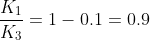

From the denominator of transfer function i.e  comparing with standard second order equation i.e



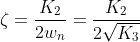
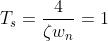
Given settling time


Given overshoot


using 


Now using


Add Answer to:
③ The transfer function T(s): represents a GPI> System with a unit slep response of 25%overshoot...
A unity feedback system with the forward transfer function G(s)=K/(s+1)(s+3)(s+6) is operating wi...
 A unity feedback system with the forward transfer function
G(s)=K/(s+1)(s+3)(s+6) is operating with a closed-loop step
response that has 15% overshoot. Do the following:
a) Evaluate the steady-state error for a unit step input
b) Design a PI control to reduce the steady-state error to zero
without affecting its transient response
c) Evaluate the steady-state error and overshoot for a unit step
input to your compensated system
A unity feedback system with the forward transfer function G(s) is operating with...
A unity feedback system with the forward transfer function
G(s)=K/(s+1)(s+3)(s+6) is operating with a closed-loop step
response that has 15% overshoot. Do the following:
a) Evaluate the steady-state error for a unit step input
b) Design a PI control to reduce the steady-state error to zero
without affecting its transient response
c) Evaluate the steady-state error and overshoot for a unit step
input to your compensated system
A unity feedback system with the forward transfer function G(s) is operating with...
The transfer function of the given physical system is 2500 Gp(s)-T-1000 Part 3 1. Frequency response (a) Draw the bode...
 The transfer function of the given physical system is 2500 Gp(s)-T-1000 Part 3 1. Frequency response (a) Draw the bode plot of open-loop transfer function when K (b) Use bode plot of open-loop transfer function to determine the type of system (do not use transfer function) (c) For what input the system will have constant steady-state error (d) for the unit input in item (c) calculate the constant steady-state error.(Use bode plot to calculate the error.) (e) Design a lead...
Question three The figure below shows a unit step response of a second order system. From...
 Question three The figure below shows a unit step response of a second order system. From the graph of response find: 1- The rise timet, 2- The peak timet, 3- The maximum overshoot Mp 4- The damped natural frequency w 5. The transfer function. Hence find the damping ratio ζ and the natural frequency ah-Find also the transfer function of the system. r 4 02 15 25 35 45 Question Four For the control system shown in the figure below,...
PROBLEM: A unity feedback system with the forward transfer function K G(s) s(s+7) is operating with...
 PROBLEM: A unity feedback system with the forward transfer function K G(s) s(s+7) is operating with a closed-loop step response that has 15% overshoot. Do the following: a. Evaluate the steady-state error for a unit ramp input. b. Design a lag compensator to improve the steady-state error by a factor of 20. c. Evaluate the steady-state error for a unit ramp input to your compensated system. d. Evaluate how much improvement in steady-state error was realized.
muibliam 5(20%). The closed-loop system is given below. Controller (a) (S%) Find the system transfer function and discuss the range of Ko to make the eystom stuibie assuming K (t)(S%) Find the...
 muibliam 5(20%). The closed-loop system is given below. Controller (a) (S%) Find the system transfer function and discuss the range of Ko to make the eystom stuibie assuming K (t)(S%) Find the percentage of overshoot and stendy state error to the unit ramp input as a function of your design parameter Ke assuming K4 ( d) 5%) Find hed sagn parameters Ko and Kr such that the damping ratio of the closed- lonp system is O15 and the steady state...
The open loop transfer function of a unity negative feedback system is given by : G(s)...
 3. The open loop transfer function of a unity feedback system is given by \(G(S)=\frac{K}{S(1+S T)}\) Where Tand \(\mathrm{K}\) are constants having positive values. By what factor the amplifier gain be reduced so that (a) peak overshoot of unit step response of the system is reduced from \(75 \%\) to \(25 \% .\) b) The damping ratio increases from \(0.1\) to \(0.6\).
A unity feedback system with the forward transfer function G (s) = s(s+2)(s15) is operating with ...
 A unity feedback system with the forward transfer function G (s) = s(s+2)(s15) is operating with a closed-loop step response that has 15% overshoot. Do the following: a) Evaluate the settling time for a unit step input b) Design a PD control to yield a 15% overshoot but with a threefold reduction in settling time; c) Evaluate the settling time, overshoot, and steady-state error with the PD control.
A unity feedback system with the forward transfer function G (s) =...
A unity feedback system with the forward transfer function G (s) = s(s+2)(s15) is operating with a closed-loop step response that has 15% overshoot. Do the following: a) Evaluate the settling time for a unit step input b) Design a PD control to yield a 15% overshoot but with a threefold reduction in settling time; c) Evaluate the settling time, overshoot, and steady-state error with the PD control.
A unity feedback system with the forward transfer function G (s) =...
A unity feedback system with the forward transfer function G)2)(s +5) is operating with a closed-...
 A unity feedback system with the forward transfer function G)2)(s +5) is operating with a closed-loop step response that has 15% overshoot. Do the following: a) Evaluate the settling time for a unit step input; b) Design a PD control to yield a 15% overshoot but with a threefold reduction in settling time; c) Evaluate the settling time, overshoot, and steady-state error with the PD control.
A unity feedback system with the forward transfer function G)2)(s +5) is operating with...
A unity feedback system with the forward transfer function G)2)(s +5) is operating with a closed-loop step response that has 15% overshoot. Do the following: a) Evaluate the settling time for a unit step input; b) Design a PD control to yield a 15% overshoot but with a threefold reduction in settling time; c) Evaluate the settling time, overshoot, and steady-state error with the PD control.
A unity feedback system with the forward transfer function G)2)(s +5) is operating with...
Consider the closed loop system defined by the following block diagram. a) Compute the transfer function...
 Consider the closed loop system defined by the following block diagram. a) Compute the transfer function E(s)/R(s). b) Determine the steady state error for a unit-step 1. Controller ant Itly Ro- +- HI- 4단Toy , c) d) e) reference input signal. Determine the steady state error response for a unit-ramp reference input signal. Determine the locations of the closed loop poles of the system. Select system parameters kp and ki in terms of k so that damping coefficient V2/2 and...
4. A unity feedback system has the following forward transfer function G(s) = s(s+a) (a) Determin...
 4. A unity feedback system has the following forward transfer function G(s) = s(s+a) (a) Determine K and ath Answer: K 831,000 and a 832 (b) Determine K and a that gives ess-001 and a 10% overshoot Answer: K14000 and a 140
4. A unity feedback system has the following forward transfer function G(s) = s(s+a) (a) Determine K and ath Answer: K 831,000 and a 832 (b) Determine K and a that gives ess-001 and a 10% overshoot Answer:...
4. A unity feedback system has the following forward transfer function G(s) = s(s+a) (a) Determine K and ath Answer: K 831,000 and a 832 (b) Determine K and a that gives ess-001 and a 10% overshoot Answer: K14000 and a 140
4. A unity feedback system has the following forward transfer function G(s) = s(s+a) (a) Determine K and ath Answer: K 831,000 and a 832 (b) Determine K and a that gives ess-001 and a 10% overshoot Answer:...
 A unity feedback system with the forward transfer function
G(s)=K/(s+1)(s+3)(s+6) is operating with a closed-loop step
response that has 15% overshoot. Do the following:
a) Evaluate the steady-state error for a unit step input
b) Design a PI control to reduce the steady-state error to zero
without affecting its transient response
c) Evaluate the steady-state error and overshoot for a unit step
input to your compensated system
A unity feedback system with the forward transfer function G(s) is operating with...
A unity feedback system with the forward transfer function
G(s)=K/(s+1)(s+3)(s+6) is operating with a closed-loop step
response that has 15% overshoot. Do the following:
a) Evaluate the steady-state error for a unit step input
b) Design a PI control to reduce the steady-state error to zero
without affecting its transient response
c) Evaluate the steady-state error and overshoot for a unit step
input to your compensated system
A unity feedback system with the forward transfer function G(s) is operating with...
 The transfer function of the given physical system is 2500 Gp(s)-T-1000 Part 3 1. Frequency response (a) Draw the bode plot of open-loop transfer function when K (b) Use bode plot of open-loop transfer function to determine the type of system (do not use transfer function) (c) For what input the system will have constant steady-state error (d) for the unit input in item (c) calculate the constant steady-state error.(Use bode plot to calculate the error.) (e) Design a lead...
 Question three The figure below shows a unit step response of a second order system. From the graph of response find: 1- The rise timet, 2- The peak timet, 3- The maximum overshoot Mp 4- The damped natural frequency w 5. The transfer function. Hence find the damping ratio ζ and the natural frequency ah-Find also the transfer function of the system. r 4 02 15 25 35 45 Question Four For the control system shown in the figure below,...
 PROBLEM: A unity feedback system with the forward transfer function K G(s) s(s+7) is operating with a closed-loop step response that has 15% overshoot. Do the following: a. Evaluate the steady-state error for a unit ramp input. b. Design a lag compensator to improve the steady-state error by a factor of 20. c. Evaluate the steady-state error for a unit ramp input to your compensated system. d. Evaluate how much improvement in steady-state error was realized.
 muibliam 5(20%). The closed-loop system is given below. Controller (a) (S%) Find the system transfer function and discuss the range of Ko to make the eystom stuibie assuming K (t)(S%) Find the percentage of overshoot and stendy state error to the unit ramp input as a function of your design parameter Ke assuming K4 ( d) 5%) Find hed sagn parameters Ko and Kr such that the damping ratio of the closed- lonp system is O15 and the steady state...
 3. The open loop transfer function of a unity feedback system is given by \(G(S)=\frac{K}{S(1+S T)}\) Where Tand \(\mathrm{K}\) are constants having positive values. By what factor the amplifier gain be reduced so that (a) peak overshoot of unit step response of the system is reduced from \(75 \%\) to \(25 \% .\) b) The damping ratio increases from \(0.1\) to \(0.6\).
 A unity feedback system with the forward transfer function G (s) = s(s+2)(s15) is operating with a closed-loop step response that has 15% overshoot. Do the following: a) Evaluate the settling time for a unit step input b) Design a PD control to yield a 15% overshoot but with a threefold reduction in settling time; c) Evaluate the settling time, overshoot, and steady-state error with the PD control.
A unity feedback system with the forward transfer function G (s) =...
A unity feedback system with the forward transfer function G (s) = s(s+2)(s15) is operating with a closed-loop step response that has 15% overshoot. Do the following: a) Evaluate the settling time for a unit step input b) Design a PD control to yield a 15% overshoot but with a threefold reduction in settling time; c) Evaluate the settling time, overshoot, and steady-state error with the PD control.
A unity feedback system with the forward transfer function G (s) =...
 A unity feedback system with the forward transfer function G)2)(s +5) is operating with a closed-loop step response that has 15% overshoot. Do the following: a) Evaluate the settling time for a unit step input; b) Design a PD control to yield a 15% overshoot but with a threefold reduction in settling time; c) Evaluate the settling time, overshoot, and steady-state error with the PD control.
A unity feedback system with the forward transfer function G)2)(s +5) is operating with...
A unity feedback system with the forward transfer function G)2)(s +5) is operating with a closed-loop step response that has 15% overshoot. Do the following: a) Evaluate the settling time for a unit step input; b) Design a PD control to yield a 15% overshoot but with a threefold reduction in settling time; c) Evaluate the settling time, overshoot, and steady-state error with the PD control.
A unity feedback system with the forward transfer function G)2)(s +5) is operating with...
 Consider the closed loop system defined by the following block diagram. a) Compute the transfer function E(s)/R(s). b) Determine the steady state error for a unit-step 1. Controller ant Itly Ro- +- HI- 4단Toy , c) d) e) reference input signal. Determine the steady state error response for a unit-ramp reference input signal. Determine the locations of the closed loop poles of the system. Select system parameters kp and ki in terms of k so that damping coefficient V2/2 and...
 4. A unity feedback system has the following forward transfer function G(s) = s(s+a) (a) Determine K and ath Answer: K 831,000 and a 832 (b) Determine K and a that gives ess-001 and a 10% overshoot Answer: K14000 and a 140
4. A unity feedback system has the following forward transfer function G(s) = s(s+a) (a) Determine K and ath Answer: K 831,000 and a 832 (b) Determine K and a that gives ess-001 and a 10% overshoot Answer:...
4. A unity feedback system has the following forward transfer function G(s) = s(s+a) (a) Determine K and ath Answer: K 831,000 and a 832 (b) Determine K and a that gives ess-001 and a 10% overshoot Answer: K14000 and a 140
4. A unity feedback system has the following forward transfer function G(s) = s(s+a) (a) Determine K and ath Answer: K 831,000 and a 832 (b) Determine K and a that gives ess-001 and a 10% overshoot Answer:...
Most questions answered within 3 hours.
-
Where is the error in this code sequence?
String s1 = "Hello";
String s2 = "ello";...
asked 10 months ago -
Financial data for Joel de Paris, Inc., for last year
follow:
Joel de Paris, Inc.
Balance...
asked 10 months ago -
Consider this reaction:
Al2(SO4)3 (aq)+ BaCl3
(aq) Al2Cl6 (aq)- +
3BaSO4(s) . What is the...
asked 10 months ago -
Suppose that Savneet is considering increasing her
recent random sample from 20 car rentals to 40...
asked 10 months ago -
Trucks arrive at an unloading terminal at an average rate of 120
per hour.
Trucks arrive...
asked 10 months ago -
Why are methanol and ethanol completely soluble in water while
octanol is not very little soluble....
asked 10 months ago -
A facilities manager at a university reads in a research report
that the mean amount of...
asked 10 months ago -
When the CuSO4 is rehydrated by adding water to the anhydrous
compound, is this an endothermic...
asked 10 months ago -
A ray of sunlight is passing from diamond into crown glass; the
angle of incidence is...
asked 10 months ago -
A block of mass 0.249 kg is placed on top of a light, vertical
spring of...
asked 10 months ago -
how do the kidneys compensate in the presences of acidosis
a) trigger hyperventilate
b) reserve acid...
asked 10 months ago -
Question 501 pts
The rental rate of capital to the firm increases. Which of the
following...
asked 10 months ago