
Homework Answers

Add Answer to:
Derive in detailed step by step the standard deviation Ox corresponding to the exponential density function....
The probability density function of X is given by 0 elsewhere Find the probability density function...
 The probability density function of X is given by
0 elsewhere
Find the probability density function of Y = X3
f(r)-(62(1-x)for0 < x < 1
The probability density function of X is given by
0 elsewhere
Find the probability density function of Y = X3
f(r)-(62(1-x)for0 < x < 1
Q 2. The probability density function of the continuous random variable X is given by Shell,...
 Q 2. The probability density function of the continuous random variable X is given by Shell, -<< 0. elsewhere. f(x) = {&e*, -40<3<20 (a) Derive the moment generating function of the continuous random variable X. (b) Use the moment generating function in (a) to find the mean and variance of X.
The probability density function of random variable X is The standard deviation is a) .5 b)...
 The probability density function of random variable X is
The standard deviation is
a) .5
b) .25
c) 2
d) 4
Please show work and explain.
0.5e*, r> 0 /(r) = { 0, otherwise
The probability density function of random variable X is
The standard deviation is
a) .5
b) .25
c) 2
d) 4
Please show work and explain.
0.5e*, r> 0 /(r) = { 0, otherwise
If the probability density function of X is given by n2 for 1<x< 2 fx )...
 If the probability density function of X is given by n2 for 1<x< 2 fx ) = 10 elsewhere (a) Find, E[X], E[X2], and E[X3] (b) Use your answer to part (a) to find E[X3 + 3X2 - 2x + 5)
4. Let X and Y have joint density function le-x 0 < y < x <...
 4. Let X and Y have joint density function le-x 0 < y < x < 0 Jxy(x, y) = lo elsewhere Another random variable of interest is U=X–Y. Find the probability density function for U.
PART V: Recall that for scalar > 0, the probability density function of an "exponential" random...
 PART V: Recall that for scalar > 0, the probability density function of an "exponential" random variable with parameter , is P2; 1) = exp(-x). We have n independent samples 11,..., Ir. Each 21, ..., Iris a scalar. Each ris an "exponential" random variable with parameter A. for which 12) (1 point] What is the maximum likelihood estimator? In other words, what is the value of the derivative of (D;) with respect to X is zero? Show all the steps...
7. Show that if the joint probability density function of X and Y is if 0...
 7. Show that if the joint probability density function of X and Y is if 0 < x <.. =sin(x + y) f(x, y) = { VI fres 9 Line + »» Hosszž, osys elsewhere, then there exists no linear relation between X and Y.
QUESTION6 (a) The three-parameter gamma distribution has the probability density function x (r)- exp (r-c)-1,x> Derive...
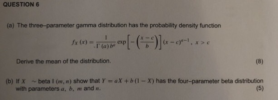 QUESTION6 (a) The three-parameter gamma distribution has the probability density function x (r)- exp (r-c)-1,x> Derive the mean of the distribution. (b) Ifx beta I (m, n) show thatY ax +b(l-X) has the four-parameter beta distribution with parameters a, b, m and n.
The Rayleigh density function is given by 2y) -y2 е ө y >0 f(y) = --{@...
 The Rayleigh density function is given by 2y) -y2 е ө y >0 f(y) = --{@ elsewhere The quantity Y? has an exponential distribution with mean o. If Yı, Y2, ..., Yn denotes a random sample from a Rayleigh distribution, show that Wn = ?=1 Y/? is a consistent estimator for e.
Assume that the density function for a continuous random variable, Y, is defined as fY(y) =...
 Assume that the density function for a continuous random variable, Y, is defined as fY(y) = 9y. exp(-3y) for (y>0) and f'(y) = 0 elsewhere. Given Y = y, the conditional C.D.F. for X is FX\Y (x\Y) =P[X 5 X Y = y) = 1 – exp(-x •y) for (x > 0). Questions below are related to the marginal distribution for X. 1. Derive the density, f* (x). 2. Evaluate the expectation, E(X)
 The probability density function of X is given by
0 elsewhere
Find the probability density function of Y = X3
f(r)-(62(1-x)for0 < x < 1
The probability density function of X is given by
0 elsewhere
Find the probability density function of Y = X3
f(r)-(62(1-x)for0 < x < 1
 Q 2. The probability density function of the continuous random variable X is given by Shell, -<< 0. elsewhere. f(x) = {&e*, -40<3<20 (a) Derive the moment generating function of the continuous random variable X. (b) Use the moment generating function in (a) to find the mean and variance of X.
 The probability density function of random variable X is
The standard deviation is
a) .5
b) .25
c) 2
d) 4
Please show work and explain.
0.5e*, r> 0 /(r) = { 0, otherwise
The probability density function of random variable X is
The standard deviation is
a) .5
b) .25
c) 2
d) 4
Please show work and explain.
0.5e*, r> 0 /(r) = { 0, otherwise
 If the probability density function of X is given by n2 for 1<x< 2 fx ) = 10 elsewhere (a) Find, E[X], E[X2], and E[X3] (b) Use your answer to part (a) to find E[X3 + 3X2 - 2x + 5)
 4. Let X and Y have joint density function le-x 0 < y < x < 0 Jxy(x, y) = lo elsewhere Another random variable of interest is U=X–Y. Find the probability density function for U.
 PART V: Recall that for scalar > 0, the probability density function of an "exponential" random variable with parameter , is P2; 1) = exp(-x). We have n independent samples 11,..., Ir. Each 21, ..., Iris a scalar. Each ris an "exponential" random variable with parameter A. for which 12) (1 point] What is the maximum likelihood estimator? In other words, what is the value of the derivative of (D;) with respect to X is zero? Show all the steps...
 7. Show that if the joint probability density function of X and Y is if 0 < x <.. =sin(x + y) f(x, y) = { VI fres 9 Line + »» Hosszž, osys elsewhere, then there exists no linear relation between X and Y.
 QUESTION6 (a) The three-parameter gamma distribution has the probability density function x (r)- exp (r-c)-1,x> Derive the mean of the distribution. (b) Ifx beta I (m, n) show thatY ax +b(l-X) has the four-parameter beta distribution with parameters a, b, m and n.
 The Rayleigh density function is given by 2y) -y2 е ө y >0 f(y) = --{@ elsewhere The quantity Y? has an exponential distribution with mean o. If Yı, Y2, ..., Yn denotes a random sample from a Rayleigh distribution, show that Wn = ?=1 Y/? is a consistent estimator for e.
 Assume that the density function for a continuous random variable, Y, is defined as fY(y) = 9y. exp(-3y) for (y>0) and f'(y) = 0 elsewhere. Given Y = y, the conditional C.D.F. for X is FX\Y (x\Y) =P[X 5 X Y = y) = 1 – exp(-x •y) for (x > 0). Questions below are related to the marginal distribution for X. 1. Derive the density, f* (x). 2. Evaluate the expectation, E(X)
Most questions answered within 3 hours.
-
Where is the error in this code sequence?
String s1 = "Hello";
String s2 = "ello";...
asked 10 months ago -
Financial data for Joel de Paris, Inc., for last year
follow:
Joel de Paris, Inc.
Balance...
asked 10 months ago -
Consider this reaction:
Al2(SO4)3 (aq)+ BaCl3
(aq) Al2Cl6 (aq)- +
3BaSO4(s) . What is the...
asked 10 months ago -
Suppose that Savneet is considering increasing her
recent random sample from 20 car rentals to 40...
asked 10 months ago -
Trucks arrive at an unloading terminal at an average rate of 120
per hour.
Trucks arrive...
asked 10 months ago -
Why are methanol and ethanol completely soluble in water while
octanol is not very little soluble....
asked 10 months ago -
A facilities manager at a university reads in a research report
that the mean amount of...
asked 10 months ago -
When the CuSO4 is rehydrated by adding water to the anhydrous
compound, is this an endothermic...
asked 10 months ago -
A ray of sunlight is passing from diamond into crown glass; the
angle of incidence is...
asked 10 months ago -
A block of mass 0.249 kg is placed on top of a light, vertical
spring of...
asked 10 months ago -
how do the kidneys compensate in the presences of acidosis
a) trigger hyperventilate
b) reserve acid...
asked 10 months ago -
Question 501 pts
The rental rate of capital to the firm increases. Which of the
following...
asked 10 months ago