The following orbital diagram (Image) represents a substance a) dimagnetic b) paramagnetic In the previous case,...

Homework Answers

Add Answer to:
The
following orbital diagram
(Image)
represents a substance a) dimagnetic b)
paramagnetic
In the previous case,...
Draw the molecular orbital diagram shown to determine which of the following is paramagnetic. N22+ B22+...
Draw the molecular orbital diagram shown to determine which of the following is paramagnetic. N22+ B22+ B22- B2 C22-
[6] (a) Write an orbital diagram for the ground state of Magnesium (Mg) and Phosphorous (P). (Marks = 1) [6] (b) Which of the following elements would be expected to be paramagnetic or diamagnetic and...
 [6] (a) Write an orbital
diagram for the ground state of Magnesium (Mg) and Phosphorous (P).
(Marks = 1) [6] (b) Which of the following elements would be
expected to be paramagnetic or diamagnetic and why? (Marks = 1)
Magnesium (Mg) and Phosphorous (P)
[6] (a) Write an orbital diagram for the ground state of Magnesium (Mg) and Phosphorous (P) Marks-I) [6] (b) Which of the following elements would be expected to be paramagnetic or diamagnetic and why? (Marks 1)...
[6] (a) Write an orbital
diagram for the ground state of Magnesium (Mg) and Phosphorous (P).
(Marks = 1) [6] (b) Which of the following elements would be
expected to be paramagnetic or diamagnetic and why? (Marks = 1)
Magnesium (Mg) and Phosphorous (P)
[6] (a) Write an orbital diagram for the ground state of Magnesium (Mg) and Phosphorous (P) Marks-I) [6] (b) Which of the following elements would be expected to be paramagnetic or diamagnetic and why? (Marks 1)...
Using the molecular orbital diagram below, which of the following are paramagnetic? op 2P Energy 0...
 Using the molecular orbital diagram below, which of the following are paramagnetic? op 2P Energy 0 O A. Li2 0 OB. N2 C. F2 OD.CO OE. O2 2- OF. CN- OG. All of the above OH. None of the above
Molecular Orbital Model 3. Draw the molecular orbital energy level diagram for the following substances, and com...
 Molecular Orbital Model 3. Draw the molecular orbital energy level diagram for the following substances, and complete the tables. Write the ground state molecular orbital electron contiguration | Molecule Enetsy Level Diagram including each atom's energy levels) Molecular orbital clectron contig Bond Order include calculation Paramagnetic or diamagnetic b. N: Molecular orbital electron config Bond Order Paramagnetic or diamagnetic C. Based on the bond orders of N, and N.*, which has the stronger bond? 251 d. Ne Molecular orbital electron...
Consider the Molecular Orbital diagram for the ion O22+. Predict the bond order. 3.0 1.5 2.0...
 Consider the Molecular Orbital diagram for the ion O22+. Predict the bond order. 3.0 1.5 2.0 2.5 0 1.0 0 Submit AnswerIncorrect. Tries 1/2 Previous Tries Consider the following statements. Which type of orbital will be the highest occupied molecular orbital (HOMO)? Will the ion be paramagnetic or diamagnetic? Which type of orbital will be the lowest unoccupied molecular orbital (LUMO)? s 0/2 paramagnetic diamagnetic PT (P pi) PTt* (P pi star) Pơ (P sigma) Pa* (P sigma star)
Is the following diatomic molecular ion paramagnetic or diamagnetic? 0,2 Diamagnetic Paramagnetic • Previous Next
 Is the following diatomic molecular ion paramagnetic or diamagnetic? 0,2 Diamagnetic Paramagnetic • Previous Next
Magnetic properties (diamagnetic or paramagnetic behavior) of different chemicals are predicted b... Magnetic properties (diamagnetic or...
Magnetic properties (diamagnetic or paramagnetic behavior) of different chemicals are predicted b... Magnetic properties (diamagnetic or paramagnetic behavior) of different chemicals are predicted based on the absence of presence of unpaired electrons. For diatomic covalent species, the MO theory should be used. For polyatomic molecules and molecular ions, Lewis structures should be used. For atomic ions and ionic solids that include them, electronic configurations should be used. Label each of the following species as diamagnetic or paramagnetic and indicate if...
16) Choose the valence orbital diagram that represents the ground state of Se2-.
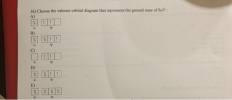 16) Choose the valence orbital diagram that represents the ground state of Se2-.
The molecular orbital energy diagram for the valence orbitals of the NO– ion is shown below....
 The molecular orbital energy diagram for the valence orbitals of
the NO– ion is shown below. Use this diagram to answer the
following questions.
a) What is the bond order in NO– ? b) Is NO– diamagnetic, or is
it paramagnetic? How can you tell? c) Which has the larger bond
distance, NO– or NO?
* O2p T2p T2p G2s
The molecular orbital energy diagram for the valence orbitals of
the NO– ion is shown below. Use this diagram to answer the
following questions.
a) What is the bond order in NO– ? b) Is NO– diamagnetic, or is
it paramagnetic? How can you tell? c) Which has the larger bond
distance, NO– or NO?
* O2p T2p T2p G2s
Consider the Molecular Orbital diagram for the ion O_2^+. Predict the bond order. 3.0 2.5 2.0...
 Consider the Molecular Orbital diagram for the ion O_2^+. Predict the bond order. 3.0 2.5 2.0 1.5 1.0 Consider the following statements. Which type of orbital will be the lowest unoccupied molecular orbital (LUMO)? Which type of orbital will be the highest occupied molecular orbital (HOMO)? Will the ion be paramagnetic or diamagnetic?
 [6] (a) Write an orbital
diagram for the ground state of Magnesium (Mg) and Phosphorous (P).
(Marks = 1) [6] (b) Which of the following elements would be
expected to be paramagnetic or diamagnetic and why? (Marks = 1)
Magnesium (Mg) and Phosphorous (P)
[6] (a) Write an orbital diagram for the ground state of Magnesium (Mg) and Phosphorous (P) Marks-I) [6] (b) Which of the following elements would be expected to be paramagnetic or diamagnetic and why? (Marks 1)...
[6] (a) Write an orbital
diagram for the ground state of Magnesium (Mg) and Phosphorous (P).
(Marks = 1) [6] (b) Which of the following elements would be
expected to be paramagnetic or diamagnetic and why? (Marks = 1)
Magnesium (Mg) and Phosphorous (P)
[6] (a) Write an orbital diagram for the ground state of Magnesium (Mg) and Phosphorous (P) Marks-I) [6] (b) Which of the following elements would be expected to be paramagnetic or diamagnetic and why? (Marks 1)...
 Using the molecular orbital diagram below, which of the following are paramagnetic? op 2P Energy 0 O A. Li2 0 OB. N2 C. F2 OD.CO OE. O2 2- OF. CN- OG. All of the above OH. None of the above
 Molecular Orbital Model 3. Draw the molecular orbital energy level diagram for the following substances, and complete the tables. Write the ground state molecular orbital electron contiguration | Molecule Enetsy Level Diagram including each atom's energy levels) Molecular orbital clectron contig Bond Order include calculation Paramagnetic or diamagnetic b. N: Molecular orbital electron config Bond Order Paramagnetic or diamagnetic C. Based on the bond orders of N, and N.*, which has the stronger bond? 251 d. Ne Molecular orbital electron...
 Consider the Molecular Orbital diagram for the ion O22+. Predict the bond order. 3.0 1.5 2.0 2.5 0 1.0 0 Submit AnswerIncorrect. Tries 1/2 Previous Tries Consider the following statements. Which type of orbital will be the highest occupied molecular orbital (HOMO)? Will the ion be paramagnetic or diamagnetic? Which type of orbital will be the lowest unoccupied molecular orbital (LUMO)? s 0/2 paramagnetic diamagnetic PT (P pi) PTt* (P pi star) Pơ (P sigma) Pa* (P sigma star)
 Is the following diatomic molecular ion paramagnetic or diamagnetic? 0,2 Diamagnetic Paramagnetic • Previous Next
 16) Choose the valence orbital diagram that represents the ground state of Se2-.
 The molecular orbital energy diagram for the valence orbitals of
the NO– ion is shown below. Use this diagram to answer the
following questions.
a) What is the bond order in NO– ? b) Is NO– diamagnetic, or is
it paramagnetic? How can you tell? c) Which has the larger bond
distance, NO– or NO?
* O2p T2p T2p G2s
The molecular orbital energy diagram for the valence orbitals of
the NO– ion is shown below. Use this diagram to answer the
following questions.
a) What is the bond order in NO– ? b) Is NO– diamagnetic, or is
it paramagnetic? How can you tell? c) Which has the larger bond
distance, NO– or NO?
* O2p T2p T2p G2s
 Consider the Molecular Orbital diagram for the ion O_2^+. Predict the bond order. 3.0 2.5 2.0 1.5 1.0 Consider the following statements. Which type of orbital will be the lowest unoccupied molecular orbital (LUMO)? Which type of orbital will be the highest occupied molecular orbital (HOMO)? Will the ion be paramagnetic or diamagnetic?
Most questions answered within 3 hours.
-
Where is the error in this code sequence?
String s1 = "Hello";
String s2 = "ello";...
asked 10 months ago -
Financial data for Joel de Paris, Inc., for last year
follow:
Joel de Paris, Inc.
Balance...
asked 10 months ago -
Consider this reaction:
Al2(SO4)3 (aq)+ BaCl3
(aq) Al2Cl6 (aq)- +
3BaSO4(s) . What is the...
asked 10 months ago -
Suppose that Savneet is considering increasing her
recent random sample from 20 car rentals to 40...
asked 10 months ago -
Trucks arrive at an unloading terminal at an average rate of 120
per hour.
Trucks arrive...
asked 10 months ago -
Why are methanol and ethanol completely soluble in water while
octanol is not very little soluble....
asked 10 months ago -
A facilities manager at a university reads in a research report
that the mean amount of...
asked 10 months ago -
When the CuSO4 is rehydrated by adding water to the anhydrous
compound, is this an endothermic...
asked 10 months ago -
A ray of sunlight is passing from diamond into crown glass; the
angle of incidence is...
asked 10 months ago -
A block of mass 0.249 kg is placed on top of a light, vertical
spring of...
asked 10 months ago -
how do the kidneys compensate in the presences of acidosis
a) trigger hyperventilate
b) reserve acid...
asked 10 months ago -
Question 501 pts
The rental rate of capital to the firm increases. Which of the
following...
asked 10 months ago