Suppose you are faced with choosing between two mutually exclusive projects. Your boss asked you to...
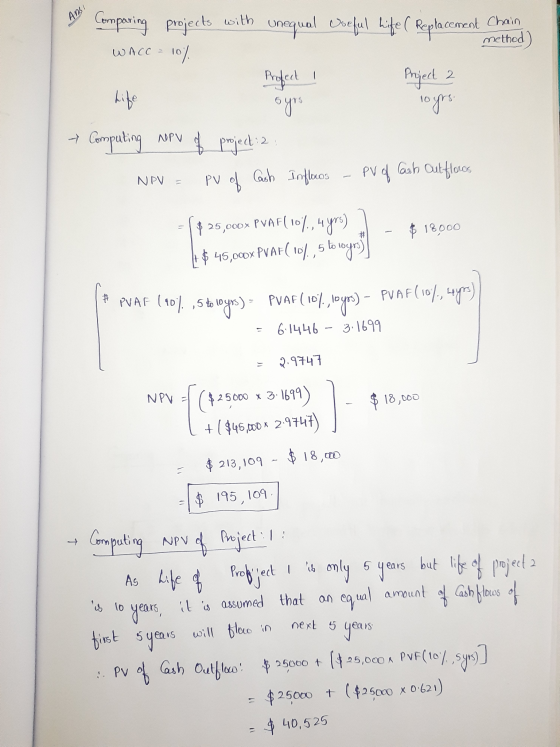
Suppose you are faced with choosing between two mutually exclusive projects. Your boss asked you to use the Replacement Chain method. The first project offers cash flows of $15,000 in years one and two, and $20,000 in years three, four, and five. It has an initial cost of $25,000. The second project offers cash flows of $25,000 per year for four years, and then $45,000 per year for six additional years (total project life of 10 years). It has an initial cost of $18,000. The firm has a weighted average cost of capital of 10%. Which project should the firm accept?
Homework Answers

Add Answer to:
Suppose you are faced with choosing between two mutually
exclusive projects. Your boss asked you to...
Choosing Between two Mutually Exclusive Projects Question 2: A company can cither invest in project A,...
 Choosing Between two Mutually Exclusive Projects Question 2: A company can cither invest in project A, project B, or neither (the projects are mutually exclusive and the company has no other investment options). Project A requires an initial investment of $1,000,000 and provides cash flows of $300,000 a year for six years. The project will also return $200,000 in capital back to the company in year six. Project B requires a $375,000 investment and will have cash flows of $200,000...
Suppose your firm is considering two mutually exclusive, required projects with the cash flows shown below....
 Suppose your firm is considering two mutually exclusive, required projects with the cash flows shown below. The required rate of return on projects of both of their risk class is 8 percent, and that the maximum allowable payback and discounted payback statistic for the projects are 2 and 3 years, respectively. Time: 0123 Project -35,000 25,000 45,000 16,000 A Cash Flow Project -45,000 25,000 35,000 B Cash Flow Use the NPV decision rule to evaluate these projects; which one(s) should...
4. Unequal project lives Galaxy Corp. has to choose between two mutually exclusive projects. If it...
 4. Unequal project lives Galaxy Corp. has to choose between two mutually exclusive projects. If it chooses project A, Galaxy Corp. will have the opportunity to make a similar investment in three years. However, if it chooses project B, it will not have the opportunity to make a second investment. The following table lists the cash flows for these projects. If the firm uses the replacement chain (common life) approach, what will be the difference between the net present value...
9. Unequal project lives Globex Corp. has to choose between two mutually exclusive projects. If it...
 9. Unequal project lives Globex Corp. has to choose between two mutually exclusive projects. If it chooses project A, Globex Corp. will have the opportunity to make a similar investment in three years. However, if it chooses project B, it will not have the opportunity to make a second investment. The following table lists the cash flows for these projects. If the firm uses the replacement chain (common life) approach, what will be the difference between the net present value...
Suppose your firm is considering two mutually exclusive, required projects with the cash flows shown below....
Suppose your firm is considering two mutually exclusive, required projects with the cash flows shown below. The required rate of return on projects of both of their risk class is 8 percent, and that the maximum allowable payback and discounted payback statistic for the projects are 2 and 3 years, respectively. Time: 0 1 2 3 Project A Cash Flow -35,000 25,000 45,000 16,000 Project B Cash Flow -45,000 25,000 35,000 65,000 Use the PI decision rule to evaluate these...
Newtown Corp. has to choose between two mutually exclusive projects. If it chooses project A, Newtown...
Newtown Corp. has to choose between two mutually exclusive projects. If it chooses project A, Newtown Corp. will have the opportunity to make a similar investment in three years. However, if it chooses project B, it will not have the opportunity to make a second investment. The following table lists the cash flows for these projects. If the firm uses the replacement chain (common life) approach, what will be the difference between the net present value (NPV) of project A...
do not use excel. by hand. 2. You are evaluating two mutually exclusive projects. The cash...
 do not use excel. by hand.
2. You are evaluating two mutually exclusive projects. The cash flows for each are: Year 0 Year 1 Year 2 Year 3 Year 4 Year 5 Year 6 Project A ($50,000) $25,000 $35,000 $20,000 Project B ($75,000) $24,000 $25,000 $30,000 $25,000 $15,000 $15,000 Assume that, if needed, each project is repeatable with no change in cash flows. Your cost of capital is 14%. a. Using the replacement chain approach, which project would you chose...
do not use excel. by hand.
2. You are evaluating two mutually exclusive projects. The cash flows for each are: Year 0 Year 1 Year 2 Year 3 Year 4 Year 5 Year 6 Project A ($50,000) $25,000 $35,000 $20,000 Project B ($75,000) $24,000 $25,000 $30,000 $25,000 $15,000 $15,000 Assume that, if needed, each project is repeatable with no change in cash flows. Your cost of capital is 14%. a. Using the replacement chain approach, which project would you chose...
Suppose your firm is considering two mutually exclusive, required projects with the cash flows shown below....
Suppose your firm is considering two mutually exclusive, required projects with the cash flows shown below. The required rate of return on projects of both of their risk class is 10 percent, and that the maximum allowable payback and discounted payback statistic for the projects are 2 and 3 years, respectively. Time: 0 1 2 3 Project A Cash Flow -37,000 27,000 47,000 18,000 Project B Cash Flow -47,000 27,000 37,000 67,000 Use the NPV decision rule to evaluate these...
Your boss hands you the following information for a pair of mutually exclusive projects and asks...
 Your boss hands you the following information for a pair of mutually exclusive projects and asks for your recommendation. What should you do? Project Cost of Capital 13% 13% IRR 18% 28% Year 0 - $10,000 - $10,000 Cash Flows Year 1 Year 2 $7000 $4000 $2500 $7000 Year 3 $2000 $8000 The NPV of project A is $ , and the NPV of project B is $ (Round to two decimal places as needed.) . Using the NPV rule,...
A firm has a WACC of 10% and is deciding between two mutually exclusive projects. Project...
 A firm has a WACC of 10% and is deciding between two mutually exclusive projects. Project A has an initial investment of $63. The additional cash flows for project A are: year 1 - $17.year 2 - $35 year 3 - $67. Project B has an initial investment of $73.The cash flows for project Bare: year 1 =$51. year 2-$41. year 3 - $26. Calculate the payback and NPV for each project. (Show all answers to 2 decimals) Payback for...
 Choosing Between two Mutually Exclusive Projects Question 2: A company can cither invest in project A, project B, or neither (the projects are mutually exclusive and the company has no other investment options). Project A requires an initial investment of $1,000,000 and provides cash flows of $300,000 a year for six years. The project will also return $200,000 in capital back to the company in year six. Project B requires a $375,000 investment and will have cash flows of $200,000...
 Suppose your firm is considering two mutually exclusive, required projects with the cash flows shown below. The required rate of return on projects of both of their risk class is 8 percent, and that the maximum allowable payback and discounted payback statistic for the projects are 2 and 3 years, respectively. Time: 0123 Project -35,000 25,000 45,000 16,000 A Cash Flow Project -45,000 25,000 35,000 B Cash Flow Use the NPV decision rule to evaluate these projects; which one(s) should...
 4. Unequal project lives Galaxy Corp. has to choose between two mutually exclusive projects. If it chooses project A, Galaxy Corp. will have the opportunity to make a similar investment in three years. However, if it chooses project B, it will not have the opportunity to make a second investment. The following table lists the cash flows for these projects. If the firm uses the replacement chain (common life) approach, what will be the difference between the net present value...
 9. Unequal project lives Globex Corp. has to choose between two mutually exclusive projects. If it chooses project A, Globex Corp. will have the opportunity to make a similar investment in three years. However, if it chooses project B, it will not have the opportunity to make a second investment. The following table lists the cash flows for these projects. If the firm uses the replacement chain (common life) approach, what will be the difference between the net present value...
 do not use excel. by hand.
2. You are evaluating two mutually exclusive projects. The cash flows for each are: Year 0 Year 1 Year 2 Year 3 Year 4 Year 5 Year 6 Project A ($50,000) $25,000 $35,000 $20,000 Project B ($75,000) $24,000 $25,000 $30,000 $25,000 $15,000 $15,000 Assume that, if needed, each project is repeatable with no change in cash flows. Your cost of capital is 14%. a. Using the replacement chain approach, which project would you chose...
do not use excel. by hand.
2. You are evaluating two mutually exclusive projects. The cash flows for each are: Year 0 Year 1 Year 2 Year 3 Year 4 Year 5 Year 6 Project A ($50,000) $25,000 $35,000 $20,000 Project B ($75,000) $24,000 $25,000 $30,000 $25,000 $15,000 $15,000 Assume that, if needed, each project is repeatable with no change in cash flows. Your cost of capital is 14%. a. Using the replacement chain approach, which project would you chose...
 Your boss hands you the following information for a pair of mutually exclusive projects and asks for your recommendation. What should you do? Project Cost of Capital 13% 13% IRR 18% 28% Year 0 - $10,000 - $10,000 Cash Flows Year 1 Year 2 $7000 $4000 $2500 $7000 Year 3 $2000 $8000 The NPV of project A is $ , and the NPV of project B is $ (Round to two decimal places as needed.) . Using the NPV rule,...
 A firm has a WACC of 10% and is deciding between two mutually exclusive projects. Project A has an initial investment of $63. The additional cash flows for project A are: year 1 - $17.year 2 - $35 year 3 - $67. Project B has an initial investment of $73.The cash flows for project Bare: year 1 =$51. year 2-$41. year 3 - $26. Calculate the payback and NPV for each project. (Show all answers to 2 decimals) Payback for...
Most questions answered within 3 hours.
-
Where is the error in this code sequence?
String s1 = "Hello";
String s2 = "ello";...
asked 10 months ago -
Financial data for Joel de Paris, Inc., for last year
follow:
Joel de Paris, Inc.
Balance...
asked 10 months ago -
Consider this reaction:
Al2(SO4)3 (aq)+ BaCl3
(aq) Al2Cl6 (aq)- +
3BaSO4(s) . What is the...
asked 10 months ago -
Suppose that Savneet is considering increasing her
recent random sample from 20 car rentals to 40...
asked 10 months ago -
Trucks arrive at an unloading terminal at an average rate of 120
per hour.
Trucks arrive...
asked 10 months ago -
Why are methanol and ethanol completely soluble in water while
octanol is not very little soluble....
asked 10 months ago -
A facilities manager at a university reads in a research report
that the mean amount of...
asked 10 months ago -
When the CuSO4 is rehydrated by adding water to the anhydrous
compound, is this an endothermic...
asked 10 months ago -
A ray of sunlight is passing from diamond into crown glass; the
angle of incidence is...
asked 10 months ago -
A block of mass 0.249 kg is placed on top of a light, vertical
spring of...
asked 10 months ago -
how do the kidneys compensate in the presences of acidosis
a) trigger hyperventilate
b) reserve acid...
asked 10 months ago -
Question 501 pts
The rental rate of capital to the firm increases. Which of the
following...
asked 10 months ago