
Homework Answers
write in comment box in case of any doubt and please rate the answer if correct
Add Answer to:
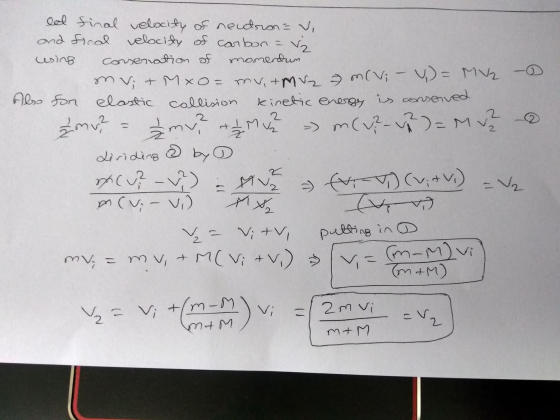
3. A neutron of mass m and speed v collides elastically with a carbon nucleus of...
A neutron collides elastically with a helium nucleus (at rest initially) whose mass is four times...
A neutron collides elastically with a helium nucleus (at rest initially) whose mass is four times that of the neutron. The helium nucleus is observed to move off at an angle θ′2=45∘. The neutron's initial speed is 6.0×10⁵ m/s . Determine the angle of the neutron, θ′1, after the collision. Determine the speeds of the two particles, v′n and v′He, after the collision
A neutron collides elastically with a helium nucleus (at rest initially) whose mass is four times...
A neutron collides elastically with a helium nucleus (at rest initially) whose mass is four times that of the neutron. The helium nucleus is observed to move off at an angle θ′2=45∘. The neutron's initial speed is 4.2×10⁵ m/s . Determine the speeds of the two particles, v′n and v′He, after the collision. Express your answers using two significant figures. Enter your answers numerically separated by a comma.
Constants Periodic Table Correct A neutron colides elastically with a helium nucleus (at rest initially) whose...
 Constants Periodic Table Correct A neutron colides elastically with a helium nucleus (at rest initially) whose mass is four times that of the neutron. The helium nucleus is observed to move off at an anglo 0-45. The neutron's initial speed is 3.3x10 m/s Part B Determine the speeds of the two particles, v, and after the colision Express your answers using two significant figures. Enter your answers numerically separated by a comma. VE ΑΣΦ + + Submit Previous Anuwe Begres...
A neutron collides elastically with a helium nucleus (at rest initially) whose mass is four times...
A neutron collides elastically with a helium nucleus (at rest initially) whose mass is four times that of the neutron. The helium nucleus is observed to rebound at an angle x = 43° from the neutron's initial direction. The neutron's initial speed is 6.4*10^5 m/s. Determine the angle at which the neutron rebounds, measured from its initial direction. I have been trying to answer this question for days. Below are the answers I have tried plugging in, but it was...
10) A proton moving at 2.44x10⁵ m/s elastically collides with a helium nucleus that is initially...
 10) A proton moving at 2.44x10⁵ m/s elastically collides with a
helium nucleus that is initially at rest. Assume that all of the
motion is in one dimension. Determine the speed and direction of
motion of each body after the collision.
Note: Mass of a hydrogen nucleus is approximately 1.0 u Mass of a
helium nucleus is approximately 4.0 u
Please post both the equation and the final answer. thank
you
10) A proton moving at 2.44x 10³ m/s clastically...
10) A proton moving at 2.44x10⁵ m/s elastically collides with a
helium nucleus that is initially at rest. Assume that all of the
motion is in one dimension. Determine the speed and direction of
motion of each body after the collision.
Note: Mass of a hydrogen nucleus is approximately 1.0 u Mass of a
helium nucleus is approximately 4.0 u
Please post both the equation and the final answer. thank
you
10) A proton moving at 2.44x 10³ m/s clastically...
On a frictionless surface. a block of mass M moving at speed v collides elastically with...
 On a frictionless surface. a block of mass M moving at speed v collides elastically with another block of the same mass that is initially at rest. After the collision, the first block moves at an angle θ to its initial direction and has a speed U/2. The second block's speed after the collision is 3 4 (B) 2 2 U) (E) ut cose
A deuteron ( nucleus of deuterium atom consisting of a proton and a neutron ) withspeed 14.9 km / s collides elastically with a neutron at rest . Use the approximationthat the deuteron is twice the mass of the neutron . ( a ) If the deuteron is scatteredt
A deuteron ( nucleus of deuterium atom consisting of a proton and a neutron ) withspeed 14.9 km / s collides elastically with a neutron at rest . Use the approximationthat the deuteron is twice the mass of the neutron . ( a ) If the deuteron is scatteredthrough a LAB angle = 10 , what are the final speeds of the deuteron and neutron ? ( b ) What is the LAB scattering angle of the neutron ? (...
12 6. In a nuclear reaction carbon nucleus, C collides elastically in a head on collision...
 12 6. In a nuclear reaction carbon nucleus, C collides elastically in a head on collision with an unknown nucleus. The initial speed of the carbon nucleus is 110 km/h and the speed of the unknown nucleus is 400km/h. After the collision the carbon nucleus moves in opposite direction to its original direction with a speed of 145km/h. i) Determine the ratio of the mass of Carbon nucleus and the unknown nucleus. ii) What is the velocity of the unknown...
Mass 1 of 8 kg is initially moving at 10 m/s in the +x direction and it collides perfectly elastically with mass 2 of 3 kg initially at rest.
Mass 1 of 8 kg is initially moving at 10 m/s in the +x direction and it collides perfectly elastically with mass 2 of 3 kg initially at rest. What is the final velocity of mass 2 after the collision in m/s? (Note: the masses are not needed to answer this question.) _______
A particle of mass 2.0 kg moving at 15.0 m/s to the right collides elastically with...
A particle of mass 2.0 kg moving at 15.0 m/s to the right collides elastically with a particle of mass 1.0 kg moving to the right at 9.0 m/s. What are the velocities of the particles after the collision?
 Constants Periodic Table Correct A neutron colides elastically with a helium nucleus (at rest initially) whose mass is four times that of the neutron. The helium nucleus is observed to move off at an anglo 0-45. The neutron's initial speed is 3.3x10 m/s Part B Determine the speeds of the two particles, v, and after the colision Express your answers using two significant figures. Enter your answers numerically separated by a comma. VE ΑΣΦ + + Submit Previous Anuwe Begres...
 10) A proton moving at 2.44x10⁵ m/s elastically collides with a
helium nucleus that is initially at rest. Assume that all of the
motion is in one dimension. Determine the speed and direction of
motion of each body after the collision.
Note: Mass of a hydrogen nucleus is approximately 1.0 u Mass of a
helium nucleus is approximately 4.0 u
Please post both the equation and the final answer. thank
you
10) A proton moving at 2.44x 10³ m/s clastically...
10) A proton moving at 2.44x10⁵ m/s elastically collides with a
helium nucleus that is initially at rest. Assume that all of the
motion is in one dimension. Determine the speed and direction of
motion of each body after the collision.
Note: Mass of a hydrogen nucleus is approximately 1.0 u Mass of a
helium nucleus is approximately 4.0 u
Please post both the equation and the final answer. thank
you
10) A proton moving at 2.44x 10³ m/s clastically...
 On a frictionless surface. a block of mass M moving at speed v collides elastically with another block of the same mass that is initially at rest. After the collision, the first block moves at an angle θ to its initial direction and has a speed U/2. The second block's speed after the collision is 3 4 (B) 2 2 U) (E) ut cose
 12 6. In a nuclear reaction carbon nucleus, C collides elastically in a head on collision with an unknown nucleus. The initial speed of the carbon nucleus is 110 km/h and the speed of the unknown nucleus is 400km/h. After the collision the carbon nucleus moves in opposite direction to its original direction with a speed of 145km/h. i) Determine the ratio of the mass of Carbon nucleus and the unknown nucleus. ii) What is the velocity of the unknown...
Most questions answered within 3 hours.
-
Where is the error in this code sequence?
String s1 = "Hello";
String s2 = "ello";...
asked 11 months ago -
Financial data for Joel de Paris, Inc., for last year
follow:
Joel de Paris, Inc.
Balance...
asked 11 months ago -
Consider this reaction:
Al2(SO4)3 (aq)+ BaCl3
(aq) Al2Cl6 (aq)- +
3BaSO4(s) . What is the...
asked 11 months ago -
Suppose that Savneet is considering increasing her
recent random sample from 20 car rentals to 40...
asked 11 months ago -
Trucks arrive at an unloading terminal at an average rate of 120
per hour.
Trucks arrive...
asked 11 months ago -
Why are methanol and ethanol completely soluble in water while
octanol is not very little soluble....
asked 11 months ago -
A facilities manager at a university reads in a research report
that the mean amount of...
asked 11 months ago -
When the CuSO4 is rehydrated by adding water to the anhydrous
compound, is this an endothermic...
asked 11 months ago -
A ray of sunlight is passing from diamond into crown glass; the
angle of incidence is...
asked 11 months ago -
A block of mass 0.249 kg is placed on top of a light, vertical
spring of...
asked 11 months ago -
how do the kidneys compensate in the presences of acidosis
a) trigger hyperventilate
b) reserve acid...
asked 11 months ago -
Question 501 pts
The rental rate of capital to the firm increases. Which of the
following...
asked 11 months ago