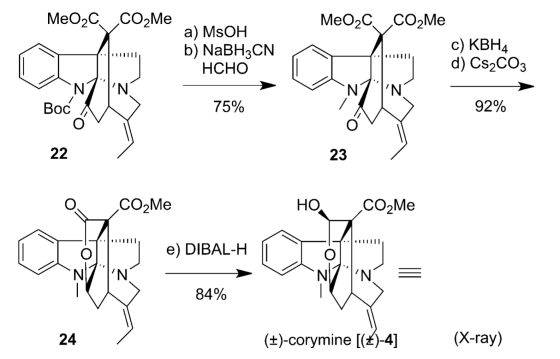
Draw the full arrow-pushing mechanism for the completion steps of the synthesis of Corymine
Homework Answers

Add Answer to:
Draw the full arrow-pushing mechanism for the completion steps
of the synthesis of Corymine
MeOC CO2Me...
1. Draw a detailed arrow pushing mechanism for the following 2. Provide a reasonable synthesis for...
 1. Draw a detailed arrow pushing mechanism for the
following
2. Provide a reasonable synthesis for the following
1. Draw a detailed arrow pushing mechanism for the following: (6 pts) pTSA + HS SH 2. Provide a reasonable synthesis for the following: (4 pts) or On
1. Draw a detailed arrow pushing mechanism for the
following
2. Provide a reasonable synthesis for the following
1. Draw a detailed arrow pushing mechanism for the following: (6 pts) pTSA + HS SH 2. Provide a reasonable synthesis for the following: (4 pts) or On
What is the full arrow pushing mechanism for the following transformation? Hint: Remember, show all steps...
 What is the full arrow pushing mechanism for the following
transformation?
Hint: Remember, show all steps to convert the starting material
into the product. Do not skip steps for full credit. You have to
show how ALL bonds are breaking and forming for this transformation
to occur.
What is the full arrow pushing mechanism for the following transformation? Hint: Remember, show all steps to convert the starting material into the product. Do not skip steps for full credit. You have...
What is the full arrow pushing mechanism for the following
transformation?
Hint: Remember, show all steps to convert the starting material
into the product. Do not skip steps for full credit. You have to
show how ALL bonds are breaking and forming for this transformation
to occur.
What is the full arrow pushing mechanism for the following transformation? Hint: Remember, show all steps to convert the starting material into the product. Do not skip steps for full credit. You have...
Draw the full arrow-pushing mechanism for the reaction of t-pentanol with HCl.
Draw the full arrow-pushing mechanism for the reaction of t-pentanol with HCl.
1. Draw a detailed arrow pushing mechanism for the following: (5 pts) le mono e com...
 1. Draw a detailed arrow pushing mechanism for the following: (5 pts) le mono e com OH + HO 2. Provide a reasonable synthesis for the following: (5 pts)
Draw the mechanism for the hydration reaction including arrow pushing and electrons H PO, HO
 Draw the mechanism for the hydration reaction including arrow
pushing and electrons
H PO, HO
Draw the mechanism for the hydration reaction including arrow
pushing and electrons
H PO, HO
Draw the mechanism for the hydration reaction including arrow pushing and electrons H,SO HO
 Draw the mechanism for the hydration reaction including arrow
pushing and electrons
H,SO HO
Draw the mechanism for the hydration reaction including arrow
pushing and electrons
H,SO HO
Show FULL arrow pushing mechanism for this reaction, and explain it step by step. Reagent used...
 Show FULL arrow pushing mechanism for this reaction, and explain
it step by step. Reagent used was c) K2CO3, MeOH, room temp., 1 h
(quant.).
(please disregard BOTH arrows on s11, as this only one step of a
multi-step synthesis)
Label all chiral centers on s12 and draw its enantiomer
ОН OH C Y і 0 (97 : 3) Л s11 Л s12
Show FULL arrow pushing mechanism for this reaction, and explain
it step by step. Reagent used was c) K2CO3, MeOH, room temp., 1 h
(quant.).
(please disregard BOTH arrows on s11, as this only one step of a
multi-step synthesis)
Label all chiral centers on s12 and draw its enantiomer
ОН OH C Y і 0 (97 : 3) Л s11 Л s12
Draw the full arrow-pushing mechanism of the reduction of (+)-D-camphor. Briefly address the expected stereochemical outcome...
Draw the full arrow-pushing mechanism of the reduction of (+)-D-camphor. Briefly address the expected stereochemical outcome of the reaction
3. Draw the arrow-pushing mechanism of the reaction, including all proton transfer steps. 4. Below is...
 3. Draw the arrow-pushing mechanism of the reaction, including all proton transfer steps. 4. Below is the structure of your product, benzocaine, with protons labelled A-E. The 'H NMR spectrum is provided on the next page. Describe the multiplicity (with J values) and integration you would expect to observe for each of the protons. Which peak would you expect to have a higher chemical shift, C or D? Draw resonance OSO structures of benzocaine to explain your reasoning. NH2E
8. (15 pts) Draw a complete arrow pushing mechanism(s) for the reaction below. Please draw every...
 8. (15 pts) Draw a complete arrow pushing mechanism(s) for the reaction below. Please draw every arrow, every bond broken or formed, and the resulting regiochemistry and/or stereochemistry if there is any. 1. N ܂ H I 2. H OH Н. H H
 1. Draw a detailed arrow pushing mechanism for the
following
2. Provide a reasonable synthesis for the following
1. Draw a detailed arrow pushing mechanism for the following: (6 pts) pTSA + HS SH 2. Provide a reasonable synthesis for the following: (4 pts) or On
1. Draw a detailed arrow pushing mechanism for the
following
2. Provide a reasonable synthesis for the following
1. Draw a detailed arrow pushing mechanism for the following: (6 pts) pTSA + HS SH 2. Provide a reasonable synthesis for the following: (4 pts) or On
 What is the full arrow pushing mechanism for the following
transformation?
Hint: Remember, show all steps to convert the starting material
into the product. Do not skip steps for full credit. You have to
show how ALL bonds are breaking and forming for this transformation
to occur.
What is the full arrow pushing mechanism for the following transformation? Hint: Remember, show all steps to convert the starting material into the product. Do not skip steps for full credit. You have...
What is the full arrow pushing mechanism for the following
transformation?
Hint: Remember, show all steps to convert the starting material
into the product. Do not skip steps for full credit. You have to
show how ALL bonds are breaking and forming for this transformation
to occur.
What is the full arrow pushing mechanism for the following transformation? Hint: Remember, show all steps to convert the starting material into the product. Do not skip steps for full credit. You have...
 1. Draw a detailed arrow pushing mechanism for the following: (5 pts) le mono e com OH + HO 2. Provide a reasonable synthesis for the following: (5 pts)
 Draw the mechanism for the hydration reaction including arrow
pushing and electrons
H PO, HO
Draw the mechanism for the hydration reaction including arrow
pushing and electrons
H PO, HO
 Draw the mechanism for the hydration reaction including arrow
pushing and electrons
H,SO HO
Draw the mechanism for the hydration reaction including arrow
pushing and electrons
H,SO HO
 Show FULL arrow pushing mechanism for this reaction, and explain
it step by step. Reagent used was c) K2CO3, MeOH, room temp., 1 h
(quant.).
(please disregard BOTH arrows on s11, as this only one step of a
multi-step synthesis)
Label all chiral centers on s12 and draw its enantiomer
ОН OH C Y і 0 (97 : 3) Л s11 Л s12
Show FULL arrow pushing mechanism for this reaction, and explain
it step by step. Reagent used was c) K2CO3, MeOH, room temp., 1 h
(quant.).
(please disregard BOTH arrows on s11, as this only one step of a
multi-step synthesis)
Label all chiral centers on s12 and draw its enantiomer
ОН OH C Y і 0 (97 : 3) Л s11 Л s12
 3. Draw the arrow-pushing mechanism of the reaction, including all proton transfer steps. 4. Below is the structure of your product, benzocaine, with protons labelled A-E. The 'H NMR spectrum is provided on the next page. Describe the multiplicity (with J values) and integration you would expect to observe for each of the protons. Which peak would you expect to have a higher chemical shift, C or D? Draw resonance OSO structures of benzocaine to explain your reasoning. NH2E
 8. (15 pts) Draw a complete arrow pushing mechanism(s) for the reaction below. Please draw every arrow, every bond broken or formed, and the resulting regiochemistry and/or stereochemistry if there is any. 1. N ܂ H I 2. H OH Н. H H
Most questions answered within 3 hours.
-
Where is the error in this code sequence?
String s1 = "Hello";
String s2 = "ello";...
asked 10 months ago -
Financial data for Joel de Paris, Inc., for last year
follow:
Joel de Paris, Inc.
Balance...
asked 10 months ago -
Consider this reaction:
Al2(SO4)3 (aq)+ BaCl3
(aq) Al2Cl6 (aq)- +
3BaSO4(s) . What is the...
asked 10 months ago -
Suppose that Savneet is considering increasing her
recent random sample from 20 car rentals to 40...
asked 10 months ago -
Trucks arrive at an unloading terminal at an average rate of 120
per hour.
Trucks arrive...
asked 10 months ago -
Why are methanol and ethanol completely soluble in water while
octanol is not very little soluble....
asked 10 months ago -
A facilities manager at a university reads in a research report
that the mean amount of...
asked 10 months ago -
When the CuSO4 is rehydrated by adding water to the anhydrous
compound, is this an endothermic...
asked 10 months ago -
A ray of sunlight is passing from diamond into crown glass; the
angle of incidence is...
asked 10 months ago -
A block of mass 0.249 kg is placed on top of a light, vertical
spring of...
asked 10 months ago -
how do the kidneys compensate in the presences of acidosis
a) trigger hyperventilate
b) reserve acid...
asked 10 months ago -
Question 501 pts
The rental rate of capital to the firm increases. Which of the
following...
asked 10 months ago