
Homework Answers
Add Answer to:
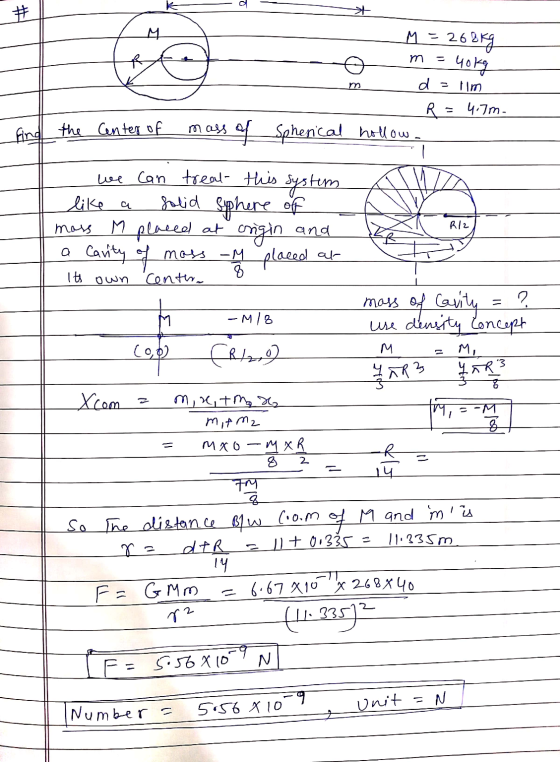
The figure shows a spherical hollow inside a lead sphere of radius R = 4.7 m;...
MESSAGE HY INSTRUCTOR FALSCREEN PRINTER VERSION HACK Chapter 13, Problem 013 The figure shows a spherical...
 MESSAGE HY INSTRUCTOR FALSCREEN PRINTER VERSION HACK Chapter 13, Problem 013 The figure shows a spherical hollow inside a lead sphere of radius R=4.5 m; the surface of the hollow passes through the center of the sphere and touches the right side of the sphere. The mass of the sphere before hollowing was M - 392 kg. With what gravitational force does the hollowed-out lead sphere attract a small sphere of mass m-23 kg that lies at a distance d...
please walk me throught problem 013 problem 052, I've been trying to divide stress by...
 please walk me throught problem 013
problem 052, I've been trying to divide stress by
strain and the number that writen on part c says its incorrect, Im
a missing something
Chapter 13, Problem 013 Your answer is partially correct. Try again. The figure shows a spherical hollow inside a lead sphere of radius R - 2.5 m, the surface of the hollow passes through the center of the sphere and touches" the right side of the sphere. The...
please walk me throught problem 013
problem 052, I've been trying to divide stress by
strain and the number that writen on part c says its incorrect, Im
a missing something
Chapter 13, Problem 013 Your answer is partially correct. Try again. The figure shows a spherical hollow inside a lead sphere of radius R - 2.5 m, the surface of the hollow passes through the center of the sphere and touches" the right side of the sphere. The...
please do correct and ASAP Problem 6.74 4 of 9 Constants Periodic Table Part A A...
 please do correct and ASAP
Problem 6.74 4 of 9 Constants Periodic Table Part A A uniform sphere has mass M, and radius r. A spherical cavity (no mass) of radius r/2 is then carved within this sphere as shown in the figure(Figure 1)(the cavity's surface passes through the sphere's center and just touches the sphere's outer surface). The centers of the original sphere and the cavity lie on a straight line, which defines the 3 axis. With what gravitational...
please do correct and ASAP
Problem 6.74 4 of 9 Constants Periodic Table Part A A uniform sphere has mass M, and radius r. A spherical cavity (no mass) of radius r/2 is then carved within this sphere as shown in the figure(Figure 1)(the cavity's surface passes through the sphere's center and just touches the sphere's outer surface). The centers of the original sphere and the cavity lie on a straight line, which defines the 3 axis. With what gravitational...
A solid lead sphere of radius 10 m (about 66 feet across!) has a mass of...
A solid lead sphere of radius 10 m (about 66 feet across!) has a mass of about 57 million kg. If two of these spheres are floating right next to each other (centers 20 m apart) in deep space, the gravitational attraction between the spheres is only 540 N (about 100 pounds). How large would this gravitational force be if the distance between the centers of the two spheres were doubled?
A solid lead sphere of radius 10 m (about 66 feet across!) has a mass of...
A solid lead sphere of radius 10 m (about 66 feet across!) has a mass of about 57 million kg. If two of these spheres are floating right next to each other (centers 20 m apart) in deep space, the gravitational attraction between the spheres is only 540 N (about 100 pounds). How large would this gravitational force be if the distance between the centers of the two spheres were doubled???? please and thank you!!
A solid copper sphere of mass M and radius R has a cavity of radius ½...
 A solid copper sphere of mass M and radius R
has a cavity of radius ½ R. Inside the cavity a particle
of mass m placed a distance d > R
from the center of the sphere along the line connecting the centers
of the sphere and the cavity. Find the gravitational force on
m.
р
A solid copper sphere of mass M and radius R
has a cavity of radius ½ R. Inside the cavity a particle
of mass m placed a distance d > R
from the center of the sphere along the line connecting the centers
of the sphere and the cavity. Find the gravitational force on
m.
р
The figure shows, in cross section, two solid spheres with uniformly distributed charge throughout their volumes....
 The figure shows, in cross section, two solid spheres with uniformly distributed charge throughout their volumes. Each has radius R. Point P lies on a line connecting the centers of the spheres, at radial distance R/6 from the center of sphere 1. If the net electric field at point is zero, what is the ratio 92/Q1 of the total charge q2 in sphere 2 to the total charge q1 in sphere 1? Number the tolerance is +/-2% Click if you...
A solid lead sphere of radius10 m about 66 ft across has a mass of about...
A solid lead sphere of radius10 m about 66 ft across has a mass of about 57 million kg if two of these spheres are floating in deep space with the centers 20 m apart the gravitational attraction between the spheres is only 540 N (about 120 lb) then how large would the gravitational force be if the distance between the centers of the two spheres were tripled?
1) A mass of 10 kg is inside a large hollow spherical mass (m = 2.0...
1) A mass of 10 kg is inside a large hollow spherical mass (m = 2.0 x 1024 kg, r = 3.0 x 10⁶ m). Its position is halfway between the center and the edge of the shell. Recall that G= 6.67 x 10⁻¹¹ N m2 / kg2. Determine the gravitational force each exerts on the other. A.148 N B. 83 N C. 74 N D. 0 N 2) A mass of 10 kg is inside a large solid uniform...
A hollow sphere and uniform sphere of the same mass m and radius R roll down...
 A hollow sphere and uniform sphere of the same mass m and radius R roll down an inclined plane from the same height H without slipping (Figure 9-59). Each is moving horizontally as it leaves the ramp. When the spheres | hit the ground, the range of the hollow sphere is L. Find the range L' of the uniform sphere. FIGURE Uniform Hollow sphere sphere
 MESSAGE HY INSTRUCTOR FALSCREEN PRINTER VERSION HACK Chapter 13, Problem 013 The figure shows a spherical hollow inside a lead sphere of radius R=4.5 m; the surface of the hollow passes through the center of the sphere and touches the right side of the sphere. The mass of the sphere before hollowing was M - 392 kg. With what gravitational force does the hollowed-out lead sphere attract a small sphere of mass m-23 kg that lies at a distance d...
 please walk me throught problem 013
problem 052, I've been trying to divide stress by
strain and the number that writen on part c says its incorrect, Im
a missing something
Chapter 13, Problem 013 Your answer is partially correct. Try again. The figure shows a spherical hollow inside a lead sphere of radius R - 2.5 m, the surface of the hollow passes through the center of the sphere and touches" the right side of the sphere. The...
please walk me throught problem 013
problem 052, I've been trying to divide stress by
strain and the number that writen on part c says its incorrect, Im
a missing something
Chapter 13, Problem 013 Your answer is partially correct. Try again. The figure shows a spherical hollow inside a lead sphere of radius R - 2.5 m, the surface of the hollow passes through the center of the sphere and touches" the right side of the sphere. The...
 please do correct and ASAP
Problem 6.74 4 of 9 Constants Periodic Table Part A A uniform sphere has mass M, and radius r. A spherical cavity (no mass) of radius r/2 is then carved within this sphere as shown in the figure(Figure 1)(the cavity's surface passes through the sphere's center and just touches the sphere's outer surface). The centers of the original sphere and the cavity lie on a straight line, which defines the 3 axis. With what gravitational...
please do correct and ASAP
Problem 6.74 4 of 9 Constants Periodic Table Part A A uniform sphere has mass M, and radius r. A spherical cavity (no mass) of radius r/2 is then carved within this sphere as shown in the figure(Figure 1)(the cavity's surface passes through the sphere's center and just touches the sphere's outer surface). The centers of the original sphere and the cavity lie on a straight line, which defines the 3 axis. With what gravitational...
 A solid copper sphere of mass M and radius R
has a cavity of radius ½ R. Inside the cavity a particle
of mass m placed a distance d > R
from the center of the sphere along the line connecting the centers
of the sphere and the cavity. Find the gravitational force on
m.
р
A solid copper sphere of mass M and radius R
has a cavity of radius ½ R. Inside the cavity a particle
of mass m placed a distance d > R
from the center of the sphere along the line connecting the centers
of the sphere and the cavity. Find the gravitational force on
m.
р
 The figure shows, in cross section, two solid spheres with uniformly distributed charge throughout their volumes. Each has radius R. Point P lies on a line connecting the centers of the spheres, at radial distance R/6 from the center of sphere 1. If the net electric field at point is zero, what is the ratio 92/Q1 of the total charge q2 in sphere 2 to the total charge q1 in sphere 1? Number the tolerance is +/-2% Click if you...
 A hollow sphere and uniform sphere of the same mass m and radius R roll down an inclined plane from the same height H without slipping (Figure 9-59). Each is moving horizontally as it leaves the ramp. When the spheres | hit the ground, the range of the hollow sphere is L. Find the range L' of the uniform sphere. FIGURE Uniform Hollow sphere sphere
Most questions answered within 3 hours.
-
Where is the error in this code sequence?
String s1 = "Hello";
String s2 = "ello";...
asked 10 months ago -
Financial data for Joel de Paris, Inc., for last year
follow:
Joel de Paris, Inc.
Balance...
asked 10 months ago -
Consider this reaction:
Al2(SO4)3 (aq)+ BaCl3
(aq) Al2Cl6 (aq)- +
3BaSO4(s) . What is the...
asked 10 months ago -
Suppose that Savneet is considering increasing her
recent random sample from 20 car rentals to 40...
asked 10 months ago -
Trucks arrive at an unloading terminal at an average rate of 120
per hour.
Trucks arrive...
asked 10 months ago -
Why are methanol and ethanol completely soluble in water while
octanol is not very little soluble....
asked 10 months ago -
A facilities manager at a university reads in a research report
that the mean amount of...
asked 10 months ago -
When the CuSO4 is rehydrated by adding water to the anhydrous
compound, is this an endothermic...
asked 10 months ago -
A ray of sunlight is passing from diamond into crown glass; the
angle of incidence is...
asked 10 months ago -
A block of mass 0.249 kg is placed on top of a light, vertical
spring of...
asked 10 months ago -
how do the kidneys compensate in the presences of acidosis
a) trigger hyperventilate
b) reserve acid...
asked 10 months ago -
Question 501 pts
The rental rate of capital to the firm increases. Which of the
following...
asked 10 months ago