
Homework Answers

Add Answer to:
An overaged, precipitation-hardenable alloy has a yield strength of 500 MPa. Estimate the interparticle spacing in...
A brass alloy is known to have a yield strength of 275 MPa (40,000 psi), a...
A brass alloy is known to have a yield strength of 275 MPa (40,000 psi), a tensile strength of 380 MPa (55,000 psi), and an elastic modulus of 103 GPa (15.0×10⁶ psi). A cylindrical specimen of this alloy 9.0 mm (0.35 in.) in diameter and 245 mm (9.65 in.) long is stressed in tension and found to elongate 9.0 mm (0.35 in.). A) What is the yield strain? B) What is the test strain?
For a certain steel alloy, the yield strength is 560 MPa and the Young’s modulus is...
For a certain steel alloy, the yield strength is 560 MPa and the Young’s modulus is 200 GPa. What is the maximum load that may be applied to a specimen with a cross sectional area of without plastic deformation?
For a certain alloy, the yield strength is (1.03x10^2) MPa and the modulus of elasticity is...
For a certain alloy, the yield strength is (1.03x10^2) MPa and the modulus of elasticity is (1.765x10^2) GPa. If a wire specimen of this alloy is pulled in tension, how much change in length can be achieved (in mm) without causing plastic deformation? The original length is (7.799x10^2) mm. As always, use scientific notation in the form X.YZ x 10^n
6. An alloy rod is used in an application involving wide temperature changes. The alloy has the following properties: (1) elastic modulus of 70 GPa, (2) yield strength of 40 MPa, (3) fracture strengt...
 6. An alloy rod is used in an application involving wide temperature changes. The alloy has the following properties: (1) elastic modulus of 70 GPa, (2) yield strength of 40 MPa, (3) fracture strength of 100 MPa, and (4) thermal expansion coefficient of 24x10-6 °c-1. The rod is 10 cm long and mechanically constrained. Note that the initial temperature is 20°C prior to any use. What is the temperature in [°C] to which the rod may be subjected without significant...
The yield strength for an alloy that has an average grain diameter of 5.7 × 10⁻²...
 The yield strength for an alloy that has an average grain
diameter of 5.7 × 10⁻² mm is 140 MPa. At a
grain diameter of 7.3 × 10⁻³ mm, the yield
strength increases to 277 MPa. At what grain diameter, in mm, will
the yield strength be 228 MPa?
d =
mm
We were unable to transcribe this imageThe yield strength for an alloy that has an average grain diameter of 5.7 x 10⁻² mm is 140 MPa. At a...
The yield strength for an alloy that has an average grain
diameter of 5.7 × 10⁻² mm is 140 MPa. At a
grain diameter of 7.3 × 10⁻³ mm, the yield
strength increases to 277 MPa. At what grain diameter, in mm, will
the yield strength be 228 MPa?
d =
mm
We were unable to transcribe this imageThe yield strength for an alloy that has an average grain diameter of 5.7 x 10⁻² mm is 140 MPa. At a...
The C-clamp shown is made of an alloy that has a yield strength of 324 MPa...
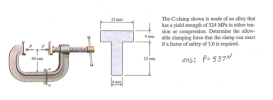 The C-clamp shown is made of an alloy that has a yield strength of 324 MPa in either ten- sion or compression. Determine the allow- able clamping force that the clamp can exert if a factor of safety of 3.0 is required. 12 mm 4mm 40 mm 2 mm ansi P- 537M
o (MPa) 750 If the yield strength of aluminium alloy (450 MPa) that is used for...
 o (MPa) 750 If the yield strength of aluminium alloy (450 MPa) that is used for making aircraft parts increases to 600 MPa after strain hardening, find B F 600 ofy = 450 parallel 300 150 a) the Elastic modulus and b) the modulus of resilience both before and after strain hardening. 0 C D € (mm/mm) 0.01 0.02 0.03 0.04 0.006 0.023 COC y Eoc=plastic strain
Problem 4 (20 pts): An alloy was subjected to age hardening test at different precipitation heat...
 Problem 4 (20 pts): An alloy was subjected to age hardening test at different precipitation heat treatment temperatures. Consider the graph shown below, relating the variation of yield strength of the tested alloy with the precipitation heat treatment durations. 1 min 1 h 1 day 1 month 1 year 70 121°C (250°F) 400 60 50 300 40 149°C (300°F) Yield strength (MPa) Yield strength (ksi) 200 30 204°C (400°F) 20 260°C (500°F) 10 100 0 SS 0 10-2 1 103...
(2) Is it possible to produce a precipitation hardened 2014 aluminium alloy having a minimum yield...
 (2) Is it possible to produce a precipitation hardened 2014 aluminium alloy having a minimum yield strength of 350MPa and a ductility of at least 15%EL? If so, specify the precipitation heat treatment. Explain why. (Figure QB2 shows that the precipitation hardening characteristics of a 2014 aluminium alloy at different aging temperatures: (a) yield strength, and (b) ductility (%EL)) [7marks] 1 min 1 h 1 day 1 month 1 year 1210 300 1490 Yield strength (MP) 200 2040 100 2600...
1. AA 6061, a high-strength aluminum alloy, has a 0.2% offset yield strength of 37,500-psi and...
 1. AA 6061, a high-strength aluminum alloy, has a 0.2% offset yield strength of 37,500-psi and a plane strain fracture toughness (Kic) 26,400-psi (inch) At a service stress equivalent to 80% of the yield strength, will this structure fracture if it contains an edge crack of length 2.24-inches. Assume that the geometric factor, f, is 1.12. 2. A steel alloy, which has a plane strain fracture toughness (Kle) of 49-MPa(m) is exposed to a service stress of 1010-MPa. Is fracture...
 6. An alloy rod is used in an application involving wide temperature changes. The alloy has the following properties: (1) elastic modulus of 70 GPa, (2) yield strength of 40 MPa, (3) fracture strength of 100 MPa, and (4) thermal expansion coefficient of 24x10-6 °c-1. The rod is 10 cm long and mechanically constrained. Note that the initial temperature is 20°C prior to any use. What is the temperature in [°C] to which the rod may be subjected without significant...
 The yield strength for an alloy that has an average grain
diameter of 5.7 × 10⁻² mm is 140 MPa. At a
grain diameter of 7.3 × 10⁻³ mm, the yield
strength increases to 277 MPa. At what grain diameter, in mm, will
the yield strength be 228 MPa?
d =
mm
We were unable to transcribe this imageThe yield strength for an alloy that has an average grain diameter of 5.7 x 10⁻² mm is 140 MPa. At a...
The yield strength for an alloy that has an average grain
diameter of 5.7 × 10⁻² mm is 140 MPa. At a
grain diameter of 7.3 × 10⁻³ mm, the yield
strength increases to 277 MPa. At what grain diameter, in mm, will
the yield strength be 228 MPa?
d =
mm
We were unable to transcribe this imageThe yield strength for an alloy that has an average grain diameter of 5.7 x 10⁻² mm is 140 MPa. At a...
 The C-clamp shown is made of an alloy that has a yield strength of 324 MPa in either ten- sion or compression. Determine the allow- able clamping force that the clamp can exert if a factor of safety of 3.0 is required. 12 mm 4mm 40 mm 2 mm ansi P- 537M
 o (MPa) 750 If the yield strength of aluminium alloy (450 MPa) that is used for making aircraft parts increases to 600 MPa after strain hardening, find B F 600 ofy = 450 parallel 300 150 a) the Elastic modulus and b) the modulus of resilience both before and after strain hardening. 0 C D € (mm/mm) 0.01 0.02 0.03 0.04 0.006 0.023 COC y Eoc=plastic strain
 Problem 4 (20 pts): An alloy was subjected to age hardening test at different precipitation heat treatment temperatures. Consider the graph shown below, relating the variation of yield strength of the tested alloy with the precipitation heat treatment durations. 1 min 1 h 1 day 1 month 1 year 70 121°C (250°F) 400 60 50 300 40 149°C (300°F) Yield strength (MPa) Yield strength (ksi) 200 30 204°C (400°F) 20 260°C (500°F) 10 100 0 SS 0 10-2 1 103...
 (2) Is it possible to produce a precipitation hardened 2014 aluminium alloy having a minimum yield strength of 350MPa and a ductility of at least 15%EL? If so, specify the precipitation heat treatment. Explain why. (Figure QB2 shows that the precipitation hardening characteristics of a 2014 aluminium alloy at different aging temperatures: (a) yield strength, and (b) ductility (%EL)) [7marks] 1 min 1 h 1 day 1 month 1 year 1210 300 1490 Yield strength (MP) 200 2040 100 2600...
 1. AA 6061, a high-strength aluminum alloy, has a 0.2% offset yield strength of 37,500-psi and a plane strain fracture toughness (Kic) 26,400-psi (inch) At a service stress equivalent to 80% of the yield strength, will this structure fracture if it contains an edge crack of length 2.24-inches. Assume that the geometric factor, f, is 1.12. 2. A steel alloy, which has a plane strain fracture toughness (Kle) of 49-MPa(m) is exposed to a service stress of 1010-MPa. Is fracture...
Most questions answered within 3 hours.
-
Where is the error in this code sequence?
String s1 = "Hello";
String s2 = "ello";...
asked 10 months ago -
Financial data for Joel de Paris, Inc., for last year
follow:
Joel de Paris, Inc.
Balance...
asked 10 months ago -
Consider this reaction:
Al2(SO4)3 (aq)+ BaCl3
(aq) Al2Cl6 (aq)- +
3BaSO4(s) . What is the...
asked 10 months ago -
Suppose that Savneet is considering increasing her
recent random sample from 20 car rentals to 40...
asked 10 months ago -
Trucks arrive at an unloading terminal at an average rate of 120
per hour.
Trucks arrive...
asked 10 months ago -
Why are methanol and ethanol completely soluble in water while
octanol is not very little soluble....
asked 10 months ago -
A facilities manager at a university reads in a research report
that the mean amount of...
asked 10 months ago -
When the CuSO4 is rehydrated by adding water to the anhydrous
compound, is this an endothermic...
asked 10 months ago -
A ray of sunlight is passing from diamond into crown glass; the
angle of incidence is...
asked 10 months ago -
A block of mass 0.249 kg is placed on top of a light, vertical
spring of...
asked 10 months ago -
how do the kidneys compensate in the presences of acidosis
a) trigger hyperventilate
b) reserve acid...
asked 10 months ago -
Question 501 pts
The rental rate of capital to the firm increases. Which of the
following...
asked 10 months ago