
Homework Answers

Add Answer to:
help pls 3
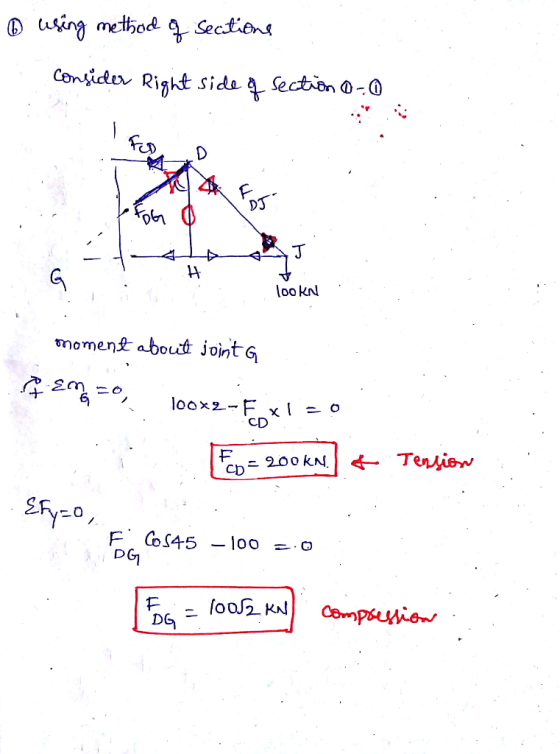
Problem 3. The truss supports a 100 kN load at J. The horizontal...
The truss supports a 100-kN load at J. The Horizontal members are each 1 m in...
 The truss supports a 100-kN load at J. The Horizontal members
are each 1 m in length.
a) Use the method of joints to determine the axial force in
member DG
b) Use the method of sections to determine the axial force in
member DG
(HINT: you can solve both a and b without solving for the
reactions at A and E.
PLEASE HELP!!
The truss supports a 100-kN load at J. The horizontal members are each 1 m in...
The truss supports a 100-kN load at J. The Horizontal members
are each 1 m in length.
a) Use the method of joints to determine the axial force in
member DG
b) Use the method of sections to determine the axial force in
member DG
(HINT: you can solve both a and b without solving for the
reactions at A and E.
PLEASE HELP!!
The truss supports a 100-kN load at J. The horizontal members are each 1 m in...
For truss shown below a vertical load of 25 KN and Horizontal Load of 30 KN...
 For truss shown below a vertical load of 25 KN and Horizontal
Load of 30 KN applied at Node 3 ( Use FEM Nodal displacement,
Direct stiffness method)
1). Calculate clearly the member length and distance between
members A = 5 x 10^-4 m^2 and E = 200 GPa
2). Determine the member and global stiffness matrix and show
the calculation fot Sinθ and Cosθ clearly
3). determine the displacement and
member forces
All Load and dimensions are in meter...
For truss shown below a vertical load of 25 KN and Horizontal
Load of 30 KN applied at Node 3 ( Use FEM Nodal displacement,
Direct stiffness method)
1). Calculate clearly the member length and distance between
members A = 5 x 10^-4 m^2 and E = 200 GPa
2). Determine the member and global stiffness matrix and show
the calculation fot Sinθ and Cosθ clearly
3). determine the displacement and
member forces
All Load and dimensions are in meter...
(a) Warren truss (b) Howe truss (c) Pratt truss (d) Baltimore truss (e) Parker truss Figure...
 (a) Warren truss (b) Howe truss (c) Pratt truss (d) Baltimore truss (e) Parker truss Figure 2: Truss Types (Nielson Text) The truss bridge has the following properties/characteristics: 1. Span length (bottom chord): 168 ft 2. 14 panels (12 ft length per panel) 3. All diagonals are 45 degrees 4. Simple truss (all members are pin-connected and loads are only applied at the joints) 5. Simply-supported (pin at one end, roller at the other) 6. 13 ft width between trusses...
static Question 1. The walkway exerts vertical 42 kN loads on the Warren truss at B,...
 static
Question 1. The walkway exerts vertical 42 kN loads on the Warren truss at B, D, F, and H. Use the method of sections to determine the axial force in member FH. The section must cut 3 members. Find the reaction force at both ends. IM Examine an appropriate section to cut, draw the FBD. 2M Produce equation of equilibrium SM, SFx and SFy. IM Solve the axial force in member FH. IM [5 Marks] B D F Н...
static
Question 1. The walkway exerts vertical 42 kN loads on the Warren truss at B, D, F, and H. Use the method of sections to determine the axial force in member FH. The section must cut 3 members. Find the reaction force at both ends. IM Examine an appropriate section to cut, draw the FBD. 2M Produce equation of equilibrium SM, SFx and SFy. IM Solve the axial force in member FH. IM [5 Marks] B D F Н...
7. d For the truss below using method of sections to complete part 'a' Determine the loads in mem...
 7. d For the truss below using method of sections to complete part 'a' Determine the loads in members GF, GD, CD and GC Briefly explain why a zero force member might be required in a truss a. b. Notes: Truss linear dimensions are symmetrical 74 KN 30o 10 m 8 Im 5 7 kN Roller Question3-23 modified from 'Structural Analysis' by R.C Hibbeler
7. d For the truss below using method of sections to complete part 'a' Determine the...
7. d For the truss below using method of sections to complete part 'a' Determine the loads in members GF, GD, CD and GC Briefly explain why a zero force member might be required in a truss a. b. Notes: Truss linear dimensions are symmetrical 74 KN 30o 10 m 8 Im 5 7 kN Roller Question3-23 modified from 'Structural Analysis' by R.C Hibbeler
7. d For the truss below using method of sections to complete part 'a' Determine the...
-:37 PM Wed Oct 30 2 KN I KN 2 KN TIN DE 8 3. Determine...
 -:37 PM Wed Oct 30 2 KN I KN 2 KN TIN DE 8 3. Determine the force in members DF, DG, and EG using method of sections. Determine the force in member DE using method of joints. State whether the members are in tension or compression. C 12 m2 m2 m2 m2 m2 m
The horizontal members of the truss are each 1 m in length. Determine the axial forces...
 The horizontal members of the truss are each 1 m in length. Determine the axial forces in members CD. CJ, and U. 100 kN
For the truss shown, determine the axial load in members BC and BE. Indicate whether the...
 For the truss shown, determine the axial load in members BC and BE. Indicate whether the mem- bers are in tension (T) or compression (C). Use both method of sections and method of joints. 2 m 2 m 3 m
QUESTION 3 The truss shown in the Figure 3 is having hinged supports at A and B, assuming that the EA is constant for a...
 QUESTION 3 The truss shown in the Figure 3 is having hinged supports at A and B, assuming that the EA is constant for all the members. Use a flexibility method to determine the forces in each member and reactions at the supports. 80 kN 5 m 5 m 5 m 5 m Figure 3 130 marks) Total Marks [100
QUESTION 3 The truss shown in the Figure 3 is having hinged supports at A and B, assuming that the...
QUESTION 3 The truss shown in the Figure 3 is having hinged supports at A and B, assuming that the EA is constant for all the members. Use a flexibility method to determine the forces in each member and reactions at the supports. 80 kN 5 m 5 m 5 m 5 m Figure 3 130 marks) Total Marks [100
QUESTION 3 The truss shown in the Figure 3 is having hinged supports at A and B, assuming that the...
An externally applied load P of 26 kN is applied to a steel truss as shown...
 An externally applied load P of 26 kN is applied to a steel
truss as shown below. The cross-sectional area of truss member EF
is 2,840 mm2. Dimension "X" is 4 m. Dimension "Y" is 8 m and
dimension "Z" is 8 m. Approximate the total decrease in length, in
mm, for truss member EF due to the applied loads shown and a
temperature drop of 38 oC. If necessary, use Appendix G for any
mechanical properties of steel that...
An externally applied load P of 26 kN is applied to a steel
truss as shown below. The cross-sectional area of truss member EF
is 2,840 mm2. Dimension "X" is 4 m. Dimension "Y" is 8 m and
dimension "Z" is 8 m. Approximate the total decrease in length, in
mm, for truss member EF due to the applied loads shown and a
temperature drop of 38 oC. If necessary, use Appendix G for any
mechanical properties of steel that...
 The truss supports a 100-kN load at J. The Horizontal members
are each 1 m in length.
a) Use the method of joints to determine the axial force in
member DG
b) Use the method of sections to determine the axial force in
member DG
(HINT: you can solve both a and b without solving for the
reactions at A and E.
PLEASE HELP!!
The truss supports a 100-kN load at J. The horizontal members are each 1 m in...
The truss supports a 100-kN load at J. The Horizontal members
are each 1 m in length.
a) Use the method of joints to determine the axial force in
member DG
b) Use the method of sections to determine the axial force in
member DG
(HINT: you can solve both a and b without solving for the
reactions at A and E.
PLEASE HELP!!
The truss supports a 100-kN load at J. The horizontal members are each 1 m in...
 For truss shown below a vertical load of 25 KN and Horizontal
Load of 30 KN applied at Node 3 ( Use FEM Nodal displacement,
Direct stiffness method)
1). Calculate clearly the member length and distance between
members A = 5 x 10^-4 m^2 and E = 200 GPa
2). Determine the member and global stiffness matrix and show
the calculation fot Sinθ and Cosθ clearly
3). determine the displacement and
member forces
All Load and dimensions are in meter...
For truss shown below a vertical load of 25 KN and Horizontal
Load of 30 KN applied at Node 3 ( Use FEM Nodal displacement,
Direct stiffness method)
1). Calculate clearly the member length and distance between
members A = 5 x 10^-4 m^2 and E = 200 GPa
2). Determine the member and global stiffness matrix and show
the calculation fot Sinθ and Cosθ clearly
3). determine the displacement and
member forces
All Load and dimensions are in meter...
 (a) Warren truss (b) Howe truss (c) Pratt truss (d) Baltimore truss (e) Parker truss Figure 2: Truss Types (Nielson Text) The truss bridge has the following properties/characteristics: 1. Span length (bottom chord): 168 ft 2. 14 panels (12 ft length per panel) 3. All diagonals are 45 degrees 4. Simple truss (all members are pin-connected and loads are only applied at the joints) 5. Simply-supported (pin at one end, roller at the other) 6. 13 ft width between trusses...
 static
Question 1. The walkway exerts vertical 42 kN loads on the Warren truss at B, D, F, and H. Use the method of sections to determine the axial force in member FH. The section must cut 3 members. Find the reaction force at both ends. IM Examine an appropriate section to cut, draw the FBD. 2M Produce equation of equilibrium SM, SFx and SFy. IM Solve the axial force in member FH. IM [5 Marks] B D F Н...
static
Question 1. The walkway exerts vertical 42 kN loads on the Warren truss at B, D, F, and H. Use the method of sections to determine the axial force in member FH. The section must cut 3 members. Find the reaction force at both ends. IM Examine an appropriate section to cut, draw the FBD. 2M Produce equation of equilibrium SM, SFx and SFy. IM Solve the axial force in member FH. IM [5 Marks] B D F Н...
 7. d For the truss below using method of sections to complete part 'a' Determine the loads in members GF, GD, CD and GC Briefly explain why a zero force member might be required in a truss a. b. Notes: Truss linear dimensions are symmetrical 74 KN 30o 10 m 8 Im 5 7 kN Roller Question3-23 modified from 'Structural Analysis' by R.C Hibbeler
7. d For the truss below using method of sections to complete part 'a' Determine the...
7. d For the truss below using method of sections to complete part 'a' Determine the loads in members GF, GD, CD and GC Briefly explain why a zero force member might be required in a truss a. b. Notes: Truss linear dimensions are symmetrical 74 KN 30o 10 m 8 Im 5 7 kN Roller Question3-23 modified from 'Structural Analysis' by R.C Hibbeler
7. d For the truss below using method of sections to complete part 'a' Determine the...
 -:37 PM Wed Oct 30 2 KN I KN 2 KN TIN DE 8 3. Determine the force in members DF, DG, and EG using method of sections. Determine the force in member DE using method of joints. State whether the members are in tension or compression. C 12 m2 m2 m2 m2 m2 m
 The horizontal members of the truss are each 1 m in length. Determine the axial forces in members CD. CJ, and U. 100 kN
 For the truss shown, determine the axial load in members BC and BE. Indicate whether the mem- bers are in tension (T) or compression (C). Use both method of sections and method of joints. 2 m 2 m 3 m
 QUESTION 3 The truss shown in the Figure 3 is having hinged supports at A and B, assuming that the EA is constant for all the members. Use a flexibility method to determine the forces in each member and reactions at the supports. 80 kN 5 m 5 m 5 m 5 m Figure 3 130 marks) Total Marks [100
QUESTION 3 The truss shown in the Figure 3 is having hinged supports at A and B, assuming that the...
QUESTION 3 The truss shown in the Figure 3 is having hinged supports at A and B, assuming that the EA is constant for all the members. Use a flexibility method to determine the forces in each member and reactions at the supports. 80 kN 5 m 5 m 5 m 5 m Figure 3 130 marks) Total Marks [100
QUESTION 3 The truss shown in the Figure 3 is having hinged supports at A and B, assuming that the...
 An externally applied load P of 26 kN is applied to a steel
truss as shown below. The cross-sectional area of truss member EF
is 2,840 mm2. Dimension "X" is 4 m. Dimension "Y" is 8 m and
dimension "Z" is 8 m. Approximate the total decrease in length, in
mm, for truss member EF due to the applied loads shown and a
temperature drop of 38 oC. If necessary, use Appendix G for any
mechanical properties of steel that...
An externally applied load P of 26 kN is applied to a steel
truss as shown below. The cross-sectional area of truss member EF
is 2,840 mm2. Dimension "X" is 4 m. Dimension "Y" is 8 m and
dimension "Z" is 8 m. Approximate the total decrease in length, in
mm, for truss member EF due to the applied loads shown and a
temperature drop of 38 oC. If necessary, use Appendix G for any
mechanical properties of steel that...
Most questions answered within 3 hours.
-
Where is the error in this code sequence?
String s1 = "Hello";
String s2 = "ello";...
asked 10 months ago -
Financial data for Joel de Paris, Inc., for last year
follow:
Joel de Paris, Inc.
Balance...
asked 10 months ago -
Consider this reaction:
Al2(SO4)3 (aq)+ BaCl3
(aq) Al2Cl6 (aq)- +
3BaSO4(s) . What is the...
asked 10 months ago -
Suppose that Savneet is considering increasing her
recent random sample from 20 car rentals to 40...
asked 10 months ago -
Trucks arrive at an unloading terminal at an average rate of 120
per hour.
Trucks arrive...
asked 10 months ago -
Why are methanol and ethanol completely soluble in water while
octanol is not very little soluble....
asked 10 months ago -
A facilities manager at a university reads in a research report
that the mean amount of...
asked 10 months ago -
When the CuSO4 is rehydrated by adding water to the anhydrous
compound, is this an endothermic...
asked 10 months ago -
A ray of sunlight is passing from diamond into crown glass; the
angle of incidence is...
asked 10 months ago -
A block of mass 0.249 kg is placed on top of a light, vertical
spring of...
asked 10 months ago -
how do the kidneys compensate in the presences of acidosis
a) trigger hyperventilate
b) reserve acid...
asked 10 months ago -
Question 501 pts
The rental rate of capital to the firm increases. Which of the
following...
asked 10 months ago