
Homework Answers

Add Answer to:
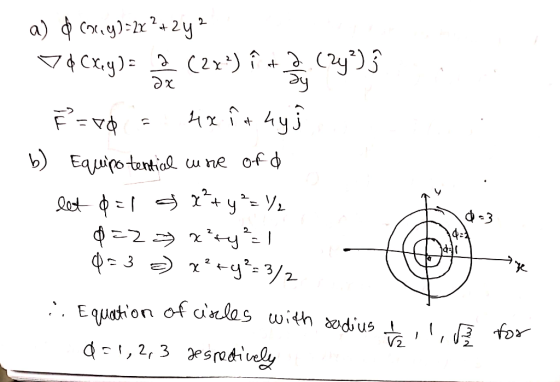
Consider the following potential function. a. Find the associated gradient field F =Vo. b. Sketch three...
Consider the following potential function and the graph of its equipotential curves to the right. Then...
 Consider the following potential function and the graph of its
equipotential curves to the right. Then answer parts a through
d.
phiφ(x,y)equals=2 e Superscript x minus y
Consider the following potential function and the graph of its equipotential curves to the right. Then answer parts a through d. 4(x.y)=2*-y a. Find the associated gradient field F = V p. F=CD b. Show that the vector field is orthogonal to the curve at the point (1,1). What is the first step?...
Consider the following potential function and the graph of its
equipotential curves to the right. Then answer parts a through
d.
phiφ(x,y)equals=2 e Superscript x minus y
Consider the following potential function and the graph of its equipotential curves to the right. Then answer parts a through d. 4(x.y)=2*-y a. Find the associated gradient field F = V p. F=CD b. Show that the vector field is orthogonal to the curve at the point (1,1). What is the first step?...
Section 15.1 Worksheet Find the gradient field F = νφ for the potential function φ. Sketch a few level curves of φ and a few vectors of F. φ(x, y)-yx2+ y2 for x2 + y2 2. 9, (x, y) # (0,0) Sectio...
 Section 15.1 Worksheet Find the gradient field F = νφ for the potential function φ. Sketch a few level curves of φ and a few vectors of F. φ(x, y)-yx2+ y2 for x2 + y2 2. 9, (x, y) # (0,0)
Section 15.1 Worksheet Find the gradient field F = νφ for the potential function φ. Sketch a few level curves of φ and a few vectors of F. φ(x, y)-yx2+ y2 for x2 + y2 2. 9, (x, y)...
Section 15.1 Worksheet Find the gradient field F = νφ for the potential function φ. Sketch a few level curves of φ and a few vectors of F. φ(x, y)-yx2+ y2 for x2 + y2 2. 9, (x, y) # (0,0)
Section 15.1 Worksheet Find the gradient field F = νφ for the potential function φ. Sketch a few level curves of φ and a few vectors of F. φ(x, y)-yx2+ y2 for x2 + y2 2. 9, (x, y)...
Show that vector field F(x,y) = 2x cos yi + (1 - zsiny) is a gradient...
 Show that vector field F(x,y) = 2x cos yi + (1 - zsiny) is a gradient field and then find the function f(x,y) such that F = VS. Use it to evaluate line integral SF. dr where the curve C is the arc of the circle 12 + y2 = 4 from (2,0) to (0,2)
1. Sketch the vector field F x, y+(y-x)j F(x, y x, y f 2. Find the gradient vector field of f(r, y)-xe" 1. Sketch the vector field F x, y+(y-x)j F(x, y x, y f 2. Find the gradient vector...
 1. Sketch the vector field F x, y+(y-x)j F(x, y x, y f 2. Find the gradient vector field of f(r, y)-xe"
1. Sketch the vector field F x, y+(y-x)j F(x, y x, y f 2. Find the gradient vector field of f(r, y)-xe"
1. Sketch the vector field F x, y+(y-x)j F(x, y x, y f 2. Find the gradient vector field of f(r, y)-xe"
please answer asap (it is all the professor asked) (5) Consider the gradient vector field F ▽f where f(x,y) = cos(2x-3y). Find curves G and C2 that are not closed such that JG F·dr = 0 and 1, F . dr-...
 please answer asap (it is all the professor asked)
(5) Consider the gradient vector field F ▽f where f(x,y) = cos(2x-3y). Find curves G and C2 that are not closed such that JG F·dr = 0 and 1, F . dr-1. Explain why you pick the curve you do, and how you know the integrals have the correct values. (Hint: Try picking a straight line between the origin and some simple point (a, b) that you choose later.)
(5) Consider...
please answer asap (it is all the professor asked)
(5) Consider the gradient vector field F ▽f where f(x,y) = cos(2x-3y). Find curves G and C2 that are not closed such that JG F·dr = 0 and 1, F . dr-1. Explain why you pick the curve you do, and how you know the integrals have the correct values. (Hint: Try picking a straight line between the origin and some simple point (a, b) that you choose later.)
(5) Consider...
13) Consider the function f(, y)-4x2 +y a) Sketch a graph of level curves for fox.y)-4,8 and 16 (they should be ellipses) in xa-plare b) Calculate the gradient of f at the point (1,2). c) Find a d...
 13) Consider the function f(, y)-4x2 +y a) Sketch a graph of level curves for fox.y)-4,8 and 16 (they should be ellipses) in xa-plare b) Calculate the gradient of f at the point (1,2). c) Find a direction (expressed as a unit vector) for which the directional derivative at the point (1,2) is 0.
13) Consider the function f(, y)-4x2 +y a) Sketch a graph of level curves for fox.y)-4,8 and 16 (they should be ellipses) in xa-plare b) Calculate...
13) Consider the function f(, y)-4x2 +y a) Sketch a graph of level curves for fox.y)-4,8 and 16 (they should be ellipses) in xa-plare b) Calculate the gradient of f at the point (1,2). c) Find a direction (expressed as a unit vector) for which the directional derivative at the point (1,2) is 0.
13) Consider the function f(, y)-4x2 +y a) Sketch a graph of level curves for fox.y)-4,8 and 16 (they should be ellipses) in xa-plare b) Calculate...
Decide whether or not the vector field is a gradient field (i.e. is conservative). If it is conservative, find a potential function. (ii) F(x,y)-6ญ่-12xVJ (iv) F(x, y, z)-< ye", e + z,y >...
 Decide whether or not the vector field is a gradient field (i.e. is conservative). If it is conservative, find a potential function. (ii) F(x,y)-6ญ่-12xVJ (iv) F(x, y, z)-< ye", e + z,y >
Decide whether or not the vector field is a gradient field (i.e. is conservative). If it is conservative, find a potential function. (ii) F(x,y)-6ญ่-12xVJ (iv) F(x, y, z)-
Decide whether or not the vector field is a gradient field (i.e. is conservative). If it is conservative, find a potential function. (ii) F(x,y)-6ญ่-12xVJ (iv) F(x, y, z)-< ye", e + z,y >
Decide whether or not the vector field is a gradient field (i.e. is conservative). If it is conservative, find a potential function. (ii) F(x,y)-6ญ่-12xVJ (iv) F(x, y, z)-
MA330 Homework #4 1. This exercise concerns the function its gradient vector field F-vo See the p...
 the excercise concerns the function (x^2 + y^2)* e^(1-x^2 -
y^2)
please do all parts
MA330 Homework #4 1. This exercise concerns the function its gradient vector field F-vo See the plots of each below. a) Compute the partial derivatives os and ty to find the gradient field vo. (b) In MA231, learned 1, you learned that mixed second-order partial derivatives of reasonable functions Verity that here by computing day and dys and checking that they are the same. should...
the excercise concerns the function (x^2 + y^2)* e^(1-x^2 -
y^2)
please do all parts
MA330 Homework #4 1. This exercise concerns the function its gradient vector field F-vo See the plots of each below. a) Compute the partial derivatives os and ty to find the gradient field vo. (b) In MA231, learned 1, you learned that mixed second-order partial derivatives of reasonable functions Verity that here by computing day and dys and checking that they are the same. should...
Question 7 (8 points) Let vf(x,y) denote the gradient field for the function f(x, y) =...
 Question 7 (8 points) Let vf(x,y) denote the gradient field for the function f(x, y) = x2 - y. Sketch a level curve and two gradient field vectors on the level curve.
Answer All Questions. (9) Let f(x,y) = 1+ 4- y2. Evaluate f(3,1), find and sketch the...
 Answer All Questions.
(9) Let f(x,y) = 1+ 4- y2. Evaluate f(3,1), find and sketch the domain of f. (10) A thin metal plate, located in the xy-plane, has temperature T(x,y) at the point (x,y). The level curves of T are called isothermals because at all points on such a curve the temperature is the same. Sketch some isothermals if the temperature function is given by 100 T(x, y) = 1 + x2 + 2y2 (11) Show that lim (z2...
Answer All Questions.
(9) Let f(x,y) = 1+ 4- y2. Evaluate f(3,1), find and sketch the domain of f. (10) A thin metal plate, located in the xy-plane, has temperature T(x,y) at the point (x,y). The level curves of T are called isothermals because at all points on such a curve the temperature is the same. Sketch some isothermals if the temperature function is given by 100 T(x, y) = 1 + x2 + 2y2 (11) Show that lim (z2...
 Consider the following potential function and the graph of its
equipotential curves to the right. Then answer parts a through
d.
phiφ(x,y)equals=2 e Superscript x minus y
Consider the following potential function and the graph of its equipotential curves to the right. Then answer parts a through d. 4(x.y)=2*-y a. Find the associated gradient field F = V p. F=CD b. Show that the vector field is orthogonal to the curve at the point (1,1). What is the first step?...
Consider the following potential function and the graph of its
equipotential curves to the right. Then answer parts a through
d.
phiφ(x,y)equals=2 e Superscript x minus y
Consider the following potential function and the graph of its equipotential curves to the right. Then answer parts a through d. 4(x.y)=2*-y a. Find the associated gradient field F = V p. F=CD b. Show that the vector field is orthogonal to the curve at the point (1,1). What is the first step?...
 Section 15.1 Worksheet Find the gradient field F = νφ for the potential function φ. Sketch a few level curves of φ and a few vectors of F. φ(x, y)-yx2+ y2 for x2 + y2 2. 9, (x, y) # (0,0)
Section 15.1 Worksheet Find the gradient field F = νφ for the potential function φ. Sketch a few level curves of φ and a few vectors of F. φ(x, y)-yx2+ y2 for x2 + y2 2. 9, (x, y)...
Section 15.1 Worksheet Find the gradient field F = νφ for the potential function φ. Sketch a few level curves of φ and a few vectors of F. φ(x, y)-yx2+ y2 for x2 + y2 2. 9, (x, y) # (0,0)
Section 15.1 Worksheet Find the gradient field F = νφ for the potential function φ. Sketch a few level curves of φ and a few vectors of F. φ(x, y)-yx2+ y2 for x2 + y2 2. 9, (x, y)...
 Show that vector field F(x,y) = 2x cos yi + (1 - zsiny) is a gradient field and then find the function f(x,y) such that F = VS. Use it to evaluate line integral SF. dr where the curve C is the arc of the circle 12 + y2 = 4 from (2,0) to (0,2)
 1. Sketch the vector field F x, y+(y-x)j F(x, y x, y f 2. Find the gradient vector field of f(r, y)-xe"
1. Sketch the vector field F x, y+(y-x)j F(x, y x, y f 2. Find the gradient vector field of f(r, y)-xe"
1. Sketch the vector field F x, y+(y-x)j F(x, y x, y f 2. Find the gradient vector field of f(r, y)-xe"
 please answer asap (it is all the professor asked)
(5) Consider the gradient vector field F ▽f where f(x,y) = cos(2x-3y). Find curves G and C2 that are not closed such that JG F·dr = 0 and 1, F . dr-1. Explain why you pick the curve you do, and how you know the integrals have the correct values. (Hint: Try picking a straight line between the origin and some simple point (a, b) that you choose later.)
(5) Consider...
please answer asap (it is all the professor asked)
(5) Consider the gradient vector field F ▽f where f(x,y) = cos(2x-3y). Find curves G and C2 that are not closed such that JG F·dr = 0 and 1, F . dr-1. Explain why you pick the curve you do, and how you know the integrals have the correct values. (Hint: Try picking a straight line between the origin and some simple point (a, b) that you choose later.)
(5) Consider...
 13) Consider the function f(, y)-4x2 +y a) Sketch a graph of level curves for fox.y)-4,8 and 16 (they should be ellipses) in xa-plare b) Calculate the gradient of f at the point (1,2). c) Find a direction (expressed as a unit vector) for which the directional derivative at the point (1,2) is 0.
13) Consider the function f(, y)-4x2 +y a) Sketch a graph of level curves for fox.y)-4,8 and 16 (they should be ellipses) in xa-plare b) Calculate...
13) Consider the function f(, y)-4x2 +y a) Sketch a graph of level curves for fox.y)-4,8 and 16 (they should be ellipses) in xa-plare b) Calculate the gradient of f at the point (1,2). c) Find a direction (expressed as a unit vector) for which the directional derivative at the point (1,2) is 0.
13) Consider the function f(, y)-4x2 +y a) Sketch a graph of level curves for fox.y)-4,8 and 16 (they should be ellipses) in xa-plare b) Calculate...
 Decide whether or not the vector field is a gradient field (i.e. is conservative). If it is conservative, find a potential function. (ii) F(x,y)-6ญ่-12xVJ (iv) F(x, y, z)-< ye", e + z,y >
Decide whether or not the vector field is a gradient field (i.e. is conservative). If it is conservative, find a potential function. (ii) F(x,y)-6ญ่-12xVJ (iv) F(x, y, z)-
Decide whether or not the vector field is a gradient field (i.e. is conservative). If it is conservative, find a potential function. (ii) F(x,y)-6ญ่-12xVJ (iv) F(x, y, z)-< ye", e + z,y >
Decide whether or not the vector field is a gradient field (i.e. is conservative). If it is conservative, find a potential function. (ii) F(x,y)-6ญ่-12xVJ (iv) F(x, y, z)-
 the excercise concerns the function (x^2 + y^2)* e^(1-x^2 -
y^2)
please do all parts
MA330 Homework #4 1. This exercise concerns the function its gradient vector field F-vo See the plots of each below. a) Compute the partial derivatives os and ty to find the gradient field vo. (b) In MA231, learned 1, you learned that mixed second-order partial derivatives of reasonable functions Verity that here by computing day and dys and checking that they are the same. should...
the excercise concerns the function (x^2 + y^2)* e^(1-x^2 -
y^2)
please do all parts
MA330 Homework #4 1. This exercise concerns the function its gradient vector field F-vo See the plots of each below. a) Compute the partial derivatives os and ty to find the gradient field vo. (b) In MA231, learned 1, you learned that mixed second-order partial derivatives of reasonable functions Verity that here by computing day and dys and checking that they are the same. should...
 Question 7 (8 points) Let vf(x,y) denote the gradient field for the function f(x, y) = x2 - y. Sketch a level curve and two gradient field vectors on the level curve.
 Answer All Questions.
(9) Let f(x,y) = 1+ 4- y2. Evaluate f(3,1), find and sketch the domain of f. (10) A thin metal plate, located in the xy-plane, has temperature T(x,y) at the point (x,y). The level curves of T are called isothermals because at all points on such a curve the temperature is the same. Sketch some isothermals if the temperature function is given by 100 T(x, y) = 1 + x2 + 2y2 (11) Show that lim (z2...
Answer All Questions.
(9) Let f(x,y) = 1+ 4- y2. Evaluate f(3,1), find and sketch the domain of f. (10) A thin metal plate, located in the xy-plane, has temperature T(x,y) at the point (x,y). The level curves of T are called isothermals because at all points on such a curve the temperature is the same. Sketch some isothermals if the temperature function is given by 100 T(x, y) = 1 + x2 + 2y2 (11) Show that lim (z2...
Most questions answered within 3 hours.
-
Where is the error in this code sequence?
String s1 = "Hello";
String s2 = "ello";...
asked 11 months ago -
Financial data for Joel de Paris, Inc., for last year
follow:
Joel de Paris, Inc.
Balance...
asked 11 months ago -
Consider this reaction:
Al2(SO4)3 (aq)+ BaCl3
(aq) Al2Cl6 (aq)- +
3BaSO4(s) . What is the...
asked 11 months ago -
Suppose that Savneet is considering increasing her
recent random sample from 20 car rentals to 40...
asked 11 months ago -
Trucks arrive at an unloading terminal at an average rate of 120
per hour.
Trucks arrive...
asked 11 months ago -
Why are methanol and ethanol completely soluble in water while
octanol is not very little soluble....
asked 11 months ago -
A facilities manager at a university reads in a research report
that the mean amount of...
asked 11 months ago -
When the CuSO4 is rehydrated by adding water to the anhydrous
compound, is this an endothermic...
asked 11 months ago -
A ray of sunlight is passing from diamond into crown glass; the
angle of incidence is...
asked 11 months ago -
A block of mass 0.249 kg is placed on top of a light, vertical
spring of...
asked 11 months ago -
how do the kidneys compensate in the presences of acidosis
a) trigger hyperventilate
b) reserve acid...
asked 11 months ago -
Question 501 pts
The rental rate of capital to the firm increases. Which of the
following...
asked 11 months ago