
Homework Answers
Add Answer to:
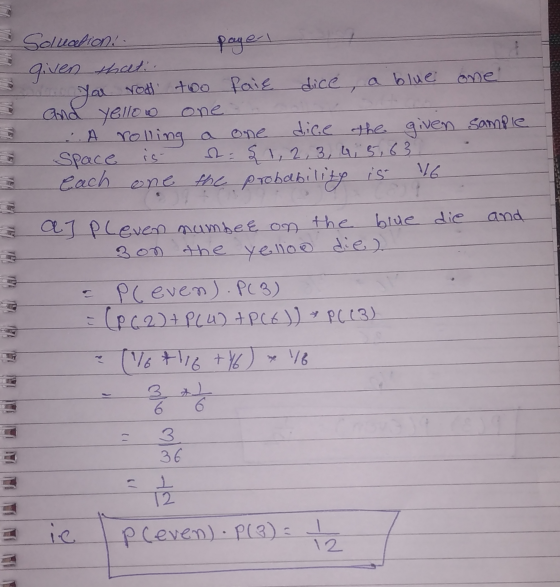
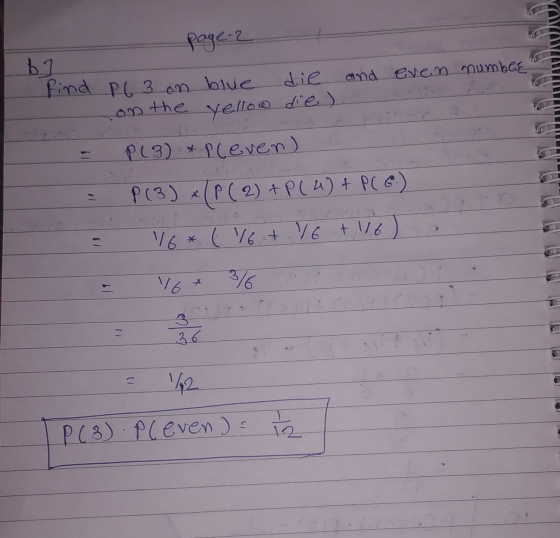
4. You roll two fair dice, a blue one and a yellow one. a. Find P(even...
You roll two dice, one is red and one is blue. a.) Are the outcomes independent?...
You roll two dice, one is red and one is blue. a.) Are the outcomes independent? Why or why not? b.) Find P (2 on red die). c.) Find P (4 on blue die). d.) Find P (2 on red die and 4 on blue die) e.) Find P (3 on red die and 6 on blue die) f.) Find P (2 on red die and 4 on blue die) or (3 on red die and 6 on blue die).
You roll two fair dice, one green and one red. (a) Are the outcomes on the dice independ...
You roll two fair dice, one green and one red. (a) Are the outcomes on the dice independent? Yes No (b) Find P(5 on green die and 3 on red die). (Enter your answer as a fraction.) 2 (c) Find P(3 on green die and 5 on red die). (Enter your answer as a fraction.) 3 (d) Find P((5 on green die and 3 on red die) or (3 on green die and 5 on red die)). (Enter your answer...
|-/4 POINTS BBUNDERSTAT12 4.2.017.MI. You roll two fair dice, one green and one red. (a) Are...
 |-/4 POINTS BBUNDERSTAT12 4.2.017.MI. You roll two fair dice, one green and one red. (a) Are the outcomes on the dice Independent? Yes No (b) Find P3 on green die and 5 on reddie). (Enter your answer as a fraction.) (Enter your (c) Find P(5 on green die and 3 on red die). (Enter your answer as a fraction.) (d) Find PC(3 on green die and 5 on reddie) or (5 on green die and 3 on red die)). (Enter...
Suppose you roll two dice. Assume one is red and one is blue so that they...
Suppose you roll two dice. Assume one is red and one is blue so that they are distinguishable. Let A be the event "The sum of the two dice is 7." and B be the event "The red die is 4." and C be the event "The difference of the two dice is even." a.) Are A and B independent? Justify your answer. b.) Are B and C independent? Justify your answer. c.) Are A and C independent? Justify your...
Suppose you roll two fair 6-sided dice, and A is the event that both dice are even
Suppose you roll two fair 6-sided dice, and A is the event that both dice are even, and B is the event that the sum of the dice is 9 or more.Hint: 2.4, and the very first problem of this worksheet quiz.(a) Find P(A)(b) Find P(B)(c) Find P(A ∪ B)(d) Find P(Ac ∩ Bc)
Two fair dice, one blue and one red, are tossed, and the up face on each die is recorded
Two fair dice, one blue and one red, are tossed, and the up face on each die is recorded. Define the following events: E:{The sum of the numbers is even } F:{A6 on the blue die } Find the following probabilities:(a) P(E)=18 / 36(b) P(F)=4 / 36(c) P(E ∩ F)=Are events E and F independent?A. yesB. no
You roll two fair dice. Let E be the event that an even total shows on...
You roll two fair dice. Let E be the event that an even total shows on the dice. Let F be the event that a three shows on at least one of the dice. Find P(F) and P(F | E).A. P(F)=1/3, P(F | E)=5/18B. P(F)=11/36, P(F | E)=5/18C. P(F)=1/3, P(F | E)=1/13D. P(F)=11/36, P(F | E)=7/18
You roll two six-sided fair dice. a. Let A be the event that either a 4...
You roll two six-sided fair dice. a. Let A be the event that either a 4 or 5 is rolled first followed by an even number. P(A) = Round your answer to four decimal places. b. Let B be the event that the sum of the two dice is at most 5. P(B) = Round your answer to four decimal places. c. Are A and B mutually exclusive events? d. Are A and B independent events?
You have two fair 6-sided dice. One is red and the other is blue. When you roll them X=red-blue and Y=red+blue. a) Find the joint distribution of (X,Y). b) Find the covariance of X and Y
You have two fair 6-sided dice. One is red and the other is blue. When you roll them X=red-blue and Y=red+blue. a) Find the joint distribution of (X,Y). b) Find the covariance of X and Y
1) You roll 2 fair dice, a green one and a red one. a. What is...
1) You roll 2 fair dice, a green one and a red one. a. What is P(a 1 on green die and a three on red die)? b. What is P((one on green die and three on red die) or (three on green die and one on red die))? c. What is the probability of getting a sum of 11?
 |-/4 POINTS BBUNDERSTAT12 4.2.017.MI. You roll two fair dice, one green and one red. (a) Are the outcomes on the dice Independent? Yes No (b) Find P3 on green die and 5 on reddie). (Enter your answer as a fraction.) (Enter your (c) Find P(5 on green die and 3 on red die). (Enter your answer as a fraction.) (d) Find PC(3 on green die and 5 on reddie) or (5 on green die and 3 on red die)). (Enter...
Most questions answered within 3 hours.
-
Where is the error in this code sequence?
String s1 = "Hello";
String s2 = "ello";...
asked 10 months ago -
Financial data for Joel de Paris, Inc., for last year
follow:
Joel de Paris, Inc.
Balance...
asked 10 months ago -
Consider this reaction:
Al2(SO4)3 (aq)+ BaCl3
(aq) Al2Cl6 (aq)- +
3BaSO4(s) . What is the...
asked 10 months ago -
Suppose that Savneet is considering increasing her
recent random sample from 20 car rentals to 40...
asked 10 months ago -
Trucks arrive at an unloading terminal at an average rate of 120
per hour.
Trucks arrive...
asked 10 months ago -
Why are methanol and ethanol completely soluble in water while
octanol is not very little soluble....
asked 10 months ago -
A facilities manager at a university reads in a research report
that the mean amount of...
asked 10 months ago -
When the CuSO4 is rehydrated by adding water to the anhydrous
compound, is this an endothermic...
asked 10 months ago -
A ray of sunlight is passing from diamond into crown glass; the
angle of incidence is...
asked 10 months ago -
A block of mass 0.249 kg is placed on top of a light, vertical
spring of...
asked 10 months ago -
how do the kidneys compensate in the presences of acidosis
a) trigger hyperventilate
b) reserve acid...
asked 10 months ago -
Question 501 pts
The rental rate of capital to the firm increases. Which of the
following...
asked 10 months ago