Explain how you would determine the degree of polymerization using only NMR.
Explain how you would determine the degree of polymerization using only NMR.
Homework Answers
The degree of polymerization (DP) or number of repeating units
of a polymer is defined as the average number of
structural units per polymer chain.. From 1H NMR
spectrum,by comparing the proton peak intensity of a known moiety
(typically an end-group(s) with a known number of protons) to that
of the repeating chain unit of interest can give DP. An equation is
derived for calculating the value of DP, which is as follows.
We know that intensity or area of a proton signal in 1H NMR is proportional to amount of that species present in sample (number of molecules of that species times its molecular weight.) From here, we have

Rearranging for k,

Here, for a species i, ai is the area or intensity of the 1H NMR peak; ni is the number of repeating units; mi is the number of protons; and k is the constant, because number of molecules of that species is proportional to number of repeating units and molecular weight of that species is proportional to its number of protons.
Consider the 1H NMR signals of two different moieties x and y,
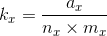
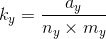
But, in a given polymer kx = ky , so
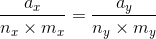
where ax is the area or intensity of the 1H NMR peak of moiety x; nx is the number of repeating units of moiety x; mx is the number of protons of moiety x; ay is the area or intensity of the 1H NMR peak of moiety y; ny is the number of repeating units of moiety y; and my is the number of protons of moiety y.
Rearranging nx,
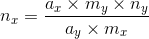
where nx can be used to assess the polymer’s DP or number of repeating units.
Consequently, Mn can be calculated by substituting for n

where n is the number of repeating units or DP; Mo is the molecular weight of one repeating unit, and Me is the combined molecular weight of the end-groups.
Example :
Consider the spectrum of MPEG-NH2. The protons of the methoxy (CH3O?) and amino (?NH2) end-groups resonated as a singlet and broad triplet, respectively, at 3.25 and 2.71 ppm (J = 5.6 Hz), whereas the prominent peak of the oxyethylene protons (?(OCH2CH2)n?) was centered at 3.52 ppm.
Determination of the Number of Repeating Units
To calculate the number of repeating units (n) in the MPEG-NH2 chain, the peak areas of CH3O– (OMe, ? 3.25) and ?(OCH2CH2)n– (OEt, ? 3.52) were obtained from the 1H NMR spectrum

= (133.1*3*1)/(0.9*4)
= 110.92  111.
111.
Add Answer to:
Explain how you would determine the degree of polymerization
using only NMR.
(a) Explain how you would distinguish the three isomers below using NMR spectroscopy
 (a) Explain how you would distinguish the three isomers below using NMR spectroscopy. Give specific examples of peaks, chemical shifts and splitting patterns that would illustrate the differences (b) Determine the structure of C8H14O from the NMR data below. (c) Draw the 1H-NMR spectrum you would expect for the following compounds. Show clearly the splitting pattern and the integration values.
Experiment 10-Spectroscopy Pre-Lab Fall 2019 1. Using only 'H-NMR, describe how you would distinguish between the...
 Experiment 10-Spectroscopy Pre-Lab Fall 2019 1. Using only 'H-NMR, describe how you would distinguish between the following compounds? (5 points) 2. Using only "C-NMR, describe how you would distinguish between the following compounds? (5 points)
5. pt) Using 'H NMR, how would you determine if you produced a Markovnikov or anti-Markovnikov...
 5. pt) Using 'H NMR, how would you determine if you produced a Markovnikov or anti-Markovnikov addition product for the following reaction: HCI
(1 point) Determine the degree of polymerization of polypropylene with a number-average molecular weight of 845000...
 (1 point) Determine the degree of polymerization of polypropylene with a number-average molecular weight of 845000 g/mol Degree of polymerization =
Experiment 10-Spectroscopy Pre-Lab Fall 2019 1. Using only 'H-NMR, describe how you would distinguish between t...
 Experiment 10-Spectroscopy Pre-Lab Fall 2019 1. Using only 'H-NMR, describe how you would distinguish between the following compounds? 5 points) ght oleh 2. Using only C-NMR, describe how you would distinguish between the following compounds? (5 points)
2. Explain briefly how you would distinguish each pair of compounds using 'H NMR spectroscopy. Include...
 2. Explain briefly how you would distinguish each pair of compounds using 'H NMR spectroscopy. Include number of signals or chemical shift or multiplicity in your explanation. 0 سعید (a) سیمل and احمد لم د مهم and and » ) ت o rin and nie
Please explain thank you!! How many peaks would you expect in the 1H-NMR for the compound...
 Please explain thank you!!
How many peaks would you expect in the 1H-NMR for the compound shown below?
Please explain thank you!!
How many peaks would you expect in the 1H-NMR for the compound shown below?
30) Using H NMR, how would you tell the two esters apart?
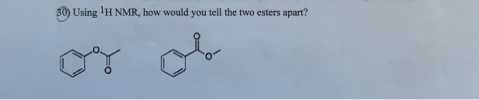 30) Using H NMR, how would you tell the two esters apart?
Explain how you would distinguish among the following three compounds, a) Using infrared spectroscopy and no...
 Explain how you would distinguish among the following three compounds, a) Using infrared spectroscopy and no other information b) Using proton NMR spectroscopy and no other information
How would you interpret these 1H-NMR spectrums to determine the shape of the molecule whose formula is C13H9NO3
 1. 2.
I am trying to learn how to interpret 1H-NMR for the two above
spectrums. How would you interpret these 1H-NMR spectrums to
determine the shape of the molecule whose formula is C13H9NO3?
1. 2.
I am trying to learn how to interpret 1H-NMR for the two above
spectrums. How would you interpret these 1H-NMR spectrums to
determine the shape of the molecule whose formula is C13H9NO3?
 Experiment 10-Spectroscopy Pre-Lab Fall 2019 1. Using only 'H-NMR, describe how you would distinguish between the following compounds? (5 points) 2. Using only "C-NMR, describe how you would distinguish between the following compounds? (5 points)
 5. pt) Using 'H NMR, how would you determine if you produced a Markovnikov or anti-Markovnikov addition product for the following reaction: HCI
 (1 point) Determine the degree of polymerization of polypropylene with a number-average molecular weight of 845000 g/mol Degree of polymerization =
 Experiment 10-Spectroscopy Pre-Lab Fall 2019 1. Using only 'H-NMR, describe how you would distinguish between the following compounds? 5 points) ght oleh 2. Using only C-NMR, describe how you would distinguish between the following compounds? (5 points)
 2. Explain briefly how you would distinguish each pair of compounds using 'H NMR spectroscopy. Include number of signals or chemical shift or multiplicity in your explanation. 0 سعید (a) سیمل and احمد لم د مهم and and » ) ت o rin and nie
 Please explain thank you!!
How many peaks would you expect in the 1H-NMR for the compound shown below?
Please explain thank you!!
How many peaks would you expect in the 1H-NMR for the compound shown below?
 30) Using H NMR, how would you tell the two esters apart?
 Explain how you would distinguish among the following three compounds, a) Using infrared spectroscopy and no other information b) Using proton NMR spectroscopy and no other information
 1. 2.
I am trying to learn how to interpret 1H-NMR for the two above
spectrums. How would you interpret these 1H-NMR spectrums to
determine the shape of the molecule whose formula is C13H9NO3?
1. 2.
I am trying to learn how to interpret 1H-NMR for the two above
spectrums. How would you interpret these 1H-NMR spectrums to
determine the shape of the molecule whose formula is C13H9NO3?
Most questions answered within 3 hours.
-
Where is the error in this code sequence?
String s1 = "Hello";
String s2 = "ello";...
asked 11 months ago -
Financial data for Joel de Paris, Inc., for last year
follow:
Joel de Paris, Inc.
Balance...
asked 11 months ago -
Consider this reaction:
Al2(SO4)3 (aq)+ BaCl3
(aq) Al2Cl6 (aq)- +
3BaSO4(s) . What is the...
asked 11 months ago -
Suppose that Savneet is considering increasing her
recent random sample from 20 car rentals to 40...
asked 11 months ago -
Trucks arrive at an unloading terminal at an average rate of 120
per hour.
Trucks arrive...
asked 11 months ago -
Why are methanol and ethanol completely soluble in water while
octanol is not very little soluble....
asked 11 months ago -
A facilities manager at a university reads in a research report
that the mean amount of...
asked 11 months ago -
When the CuSO4 is rehydrated by adding water to the anhydrous
compound, is this an endothermic...
asked 11 months ago -
A ray of sunlight is passing from diamond into crown glass; the
angle of incidence is...
asked 11 months ago -
A block of mass 0.249 kg is placed on top of a light, vertical
spring of...
asked 11 months ago -
how do the kidneys compensate in the presences of acidosis
a) trigger hyperventilate
b) reserve acid...
asked 11 months ago -
Question 501 pts
The rental rate of capital to the firm increases. Which of the
following...
asked 11 months ago