
Homework Answers
Add Answer to:
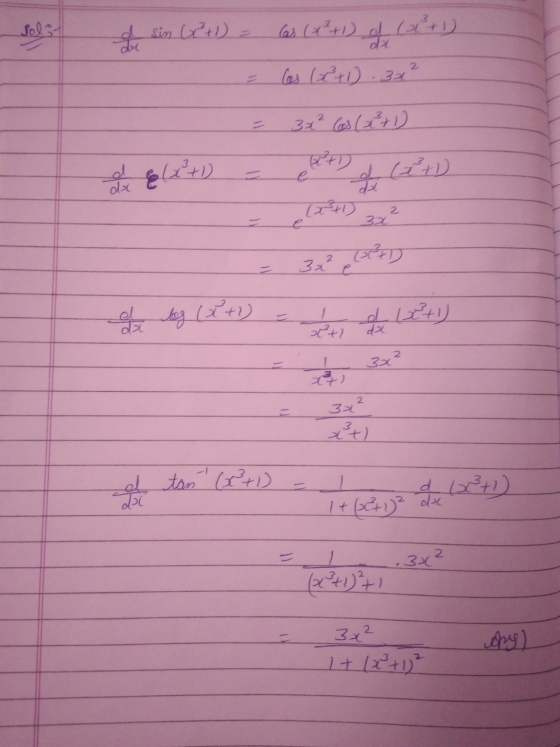
In the previous question we used the chain rule to calculate the derivative fog indirectly from...
Please answer all or do not answer. Thank you :) The Chain Rule and Directional Derivative:...
 Please answer all or do not answer. Thank you :)
The Chain Rule and Directional Derivative: (a) Calculate by the chain rule given F(x,y) = x2 + y’, x = eu+20, y=uv. ov Use the chain rule (chain rule required!) to evaluate the partial derivative. OG where G(x,y) = x2 - y2 ,x=e"cosv, y = e"sinv. ди (c) Find the directional derivative in the direction of v=<12,-5> at (2,2) for f(x, y) = exy_y? and also the directional derivative in...
Please answer all or do not answer. Thank you :)
The Chain Rule and Directional Derivative: (a) Calculate by the chain rule given F(x,y) = x2 + y’, x = eu+20, y=uv. ov Use the chain rule (chain rule required!) to evaluate the partial derivative. OG where G(x,y) = x2 - y2 ,x=e"cosv, y = e"sinv. ди (c) Find the directional derivative in the direction of v=<12,-5> at (2,2) for f(x, y) = exy_y? and also the directional derivative in...
Exercise 1. Do the following: (a) Write a statement defining the Chain Rule for the functions...
 Exercise 1. Do the following: (a) Write a statement defining the Chain Rule for the functions g: R" → Rm and f: RM + RP. Then describe how it works in a paragraph, assuming the reader is a classmate who has been following the course but missed the lecture on Properties of the Derivative. (b) Explain in detail how the Chain Rule you learned in Calculus I, (fog)(x) = f (g(2)).g'(x), is really just the special case of your statement...
1. The chain rule states for (fog)(x) = h(x), h'(x) = f'(g(x))g'(x). (i) Using the chain...
 1. The chain rule states for (fog)(x) = h(x), h'(x) = f'(g(x))g'(x). (i) Using the chain rule and that y = g(x) = f-1(x), prove the Inverse Function Theorem (F-1)'(x) = Fitu). Explain or justify each step in your proof. (ii) Write a few sentences about how f'(x) corresponds to (f-1)'(x) graphically. (iii) Let f(x) be a non-linear function. If possible, find a function f such that f(4) = 2, (4-1)'(2) = If this task is impossible, explain why.
Please indentify on the side which rule is being used and dont use the chain rule....
 Please indentify on the side which rule is being used and dont use
the chain rule.
Differentiate the following functions. Justify each step by indicating the derivative law(s) used. (15) (a) s(x)= 6x*–58x*++2020 (b) 8(x) = sin(x)cos(x) (c) r? +1 x-1
Please indentify on the side which rule is being used and dont use
the chain rule.
Differentiate the following functions. Justify each step by indicating the derivative law(s) used. (15) (a) s(x)= 6x*–58x*++2020 (b) 8(x) = sin(x)cos(x) (c) r? +1 x-1
Use the Fundamental Theorem of Calculus and the chain rule to find a derivative Question If...
 Use the Fundamental Theorem of Calculus and the chain rule to
find a derivative
Question
If F(x)=∫4x522ln(t2) dt, what is F′(x)? (Do not include "F′(x)="
in your answer.)
Sorry, that's incorrect. Try again?
Use the Fundamental Theorem of Calculus and the chain rule to find a derivative Question If F(x) = 1 2 dt, what is F' (2)? (Do not include "F'(x) ="in your answer.) In (t2) Sorry, that's incorrect. Try again? FEEDBACK VIEW ANSWER SUBMIT
Use the Fundamental Theorem of Calculus and the chain rule to
find a derivative
Question
If F(x)=∫4x522ln(t2) dt, what is F′(x)? (Do not include "F′(x)="
in your answer.)
Sorry, that's incorrect. Try again?
Use the Fundamental Theorem of Calculus and the chain rule to find a derivative Question If F(x) = 1 2 dt, what is F' (2)? (Do not include "F'(x) ="in your answer.) In (t2) Sorry, that's incorrect. Try again? FEEDBACK VIEW ANSWER SUBMIT
Find the derivative of the function. y sin-1(5x+ 1) Part 1 of 3 The function y - sin-1(5x + 1) is a composition, and...
 Find the derivative of the function. y sin-1(5x+ 1) Part 1 of 3 The function y - sin-1(5x + 1) is a composition, and so we must use the Chain Rule, given below, to find the derivative dx[f(g(x))) = f '(g(x))g'(x) For the given function sin 1(5x+ 1), the "inside" function is Sx + and the foutside" function is arcsin (a) Part 2 of 3 Recall that the derivative of y sin-1(x) is 1-(5x - 1)2
Find the derivative of...
Find the derivative of the function. y sin-1(5x+ 1) Part 1 of 3 The function y - sin-1(5x + 1) is a composition, and so we must use the Chain Rule, given below, to find the derivative dx[f(g(x))) = f '(g(x))g'(x) For the given function sin 1(5x+ 1), the "inside" function is Sx + and the foutside" function is arcsin (a) Part 2 of 3 Recall that the derivative of y sin-1(x) is 1-(5x - 1)2
Find the derivative of...
Use the chain rule to find the derivative of 4V50% + 6x8 Type your answer without...
 Use the chain rule to find the derivative of 4V50% + 6x8 Type your answer without fractional or negative exponents. Use sqrt(x) for Væ. If f(x) = 7 – x2 5 + x2 find: f'() = Evaluate the limit: 9x – 9 lim 2+1 x2 8x + 7 =
Use the Chain Rule and the fact that d (r)-L,o find the derivative of (b) Rewrite f(x) as a piecewise function not...
 Use the Chain Rule and the fact that d (r)-L,o find the derivative of (b) Rewrite f(x) as a piecewise function not involving the absolute value function. (c) Find the first and second derivatives of f(x),using your piecewise function. (d) Would you want to find" without the function's piecewise representation? 2. A square and a triangle are to be cut from a piece of fabric 1 metre square, as shown Find the length which minimises the removed area ar
Use...
Use the Chain Rule and the fact that d (r)-L,o find the derivative of (b) Rewrite f(x) as a piecewise function not involving the absolute value function. (c) Find the first and second derivatives of f(x),using your piecewise function. (d) Would you want to find" without the function's piecewise representation? 2. A square and a triangle are to be cut from a piece of fabric 1 metre square, as shown Find the length which minimises the removed area ar
Use...
6. [-12 Points] DETAILS SCALCET8 14.5.012. Use the Chain Rule to find Oz/os and Oz/t. z...
 6. [-12 Points] DETAILS SCALCET8 14.5.012. Use the Chain Rule to find Oz/os and Oz/t. z = tan(u/v), u = 6 + 9t, v = 9s - 6t дz as oz at Need Help? Read It Talk to a Tutor 7. [-13 Points] DETAILS SCALCET8 14.5.021. Use the Chain Rule to find the indicated partial derivatives. z = x4 + x2y, x = 5 + 2t - u, θz oz oz when s = 4, t = 3, u =...
Show your work and CIRCLE or BOX your final answer. No credit if work is not...
 Show your work and CIRCLE or BOX your final answer. No credit if work is not shown. Differentiate. 1) f(x) - 3x2 - 5x + 7 Basic Derivative Rules 1. (c)' = 0 2. Fix) + (x)] = f'(x) g'(x) 3. ) - 9(x)]* = f'() - g'(x) 4. Icf(x)]* = f'(x) 5. txx)-f(xlg'(x) + g(xY'x) f'(x)-f(x)g'(x) [g(x)] Derivatives of Trigonometric Functions sin(x) = cos(x) csc(x)=-csc(x)cot(x) * cos(x) = -sin(x) “sec(x) = sec(x) tan(x) tan(x) = sec (x) cot(x) =...
 Please answer all or do not answer. Thank you :)
The Chain Rule and Directional Derivative: (a) Calculate by the chain rule given F(x,y) = x2 + y’, x = eu+20, y=uv. ov Use the chain rule (chain rule required!) to evaluate the partial derivative. OG where G(x,y) = x2 - y2 ,x=e"cosv, y = e"sinv. ди (c) Find the directional derivative in the direction of v=<12,-5> at (2,2) for f(x, y) = exy_y? and also the directional derivative in...
Please answer all or do not answer. Thank you :)
The Chain Rule and Directional Derivative: (a) Calculate by the chain rule given F(x,y) = x2 + y’, x = eu+20, y=uv. ov Use the chain rule (chain rule required!) to evaluate the partial derivative. OG where G(x,y) = x2 - y2 ,x=e"cosv, y = e"sinv. ди (c) Find the directional derivative in the direction of v=<12,-5> at (2,2) for f(x, y) = exy_y? and also the directional derivative in...
 Exercise 1. Do the following: (a) Write a statement defining the Chain Rule for the functions g: R" → Rm and f: RM + RP. Then describe how it works in a paragraph, assuming the reader is a classmate who has been following the course but missed the lecture on Properties of the Derivative. (b) Explain in detail how the Chain Rule you learned in Calculus I, (fog)(x) = f (g(2)).g'(x), is really just the special case of your statement...
 1. The chain rule states for (fog)(x) = h(x), h'(x) = f'(g(x))g'(x). (i) Using the chain rule and that y = g(x) = f-1(x), prove the Inverse Function Theorem (F-1)'(x) = Fitu). Explain or justify each step in your proof. (ii) Write a few sentences about how f'(x) corresponds to (f-1)'(x) graphically. (iii) Let f(x) be a non-linear function. If possible, find a function f such that f(4) = 2, (4-1)'(2) = If this task is impossible, explain why.
 Please indentify on the side which rule is being used and dont use
the chain rule.
Differentiate the following functions. Justify each step by indicating the derivative law(s) used. (15) (a) s(x)= 6x*–58x*++2020 (b) 8(x) = sin(x)cos(x) (c) r? +1 x-1
Please indentify on the side which rule is being used and dont use
the chain rule.
Differentiate the following functions. Justify each step by indicating the derivative law(s) used. (15) (a) s(x)= 6x*–58x*++2020 (b) 8(x) = sin(x)cos(x) (c) r? +1 x-1
 Use the Fundamental Theorem of Calculus and the chain rule to
find a derivative
Question
If F(x)=∫4x522ln(t2) dt, what is F′(x)? (Do not include "F′(x)="
in your answer.)
Sorry, that's incorrect. Try again?
Use the Fundamental Theorem of Calculus and the chain rule to find a derivative Question If F(x) = 1 2 dt, what is F' (2)? (Do not include "F'(x) ="in your answer.) In (t2) Sorry, that's incorrect. Try again? FEEDBACK VIEW ANSWER SUBMIT
Use the Fundamental Theorem of Calculus and the chain rule to
find a derivative
Question
If F(x)=∫4x522ln(t2) dt, what is F′(x)? (Do not include "F′(x)="
in your answer.)
Sorry, that's incorrect. Try again?
Use the Fundamental Theorem of Calculus and the chain rule to find a derivative Question If F(x) = 1 2 dt, what is F' (2)? (Do not include "F'(x) ="in your answer.) In (t2) Sorry, that's incorrect. Try again? FEEDBACK VIEW ANSWER SUBMIT
 Find the derivative of the function. y sin-1(5x+ 1) Part 1 of 3 The function y - sin-1(5x + 1) is a composition, and so we must use the Chain Rule, given below, to find the derivative dx[f(g(x))) = f '(g(x))g'(x) For the given function sin 1(5x+ 1), the "inside" function is Sx + and the foutside" function is arcsin (a) Part 2 of 3 Recall that the derivative of y sin-1(x) is 1-(5x - 1)2
Find the derivative of...
Find the derivative of the function. y sin-1(5x+ 1) Part 1 of 3 The function y - sin-1(5x + 1) is a composition, and so we must use the Chain Rule, given below, to find the derivative dx[f(g(x))) = f '(g(x))g'(x) For the given function sin 1(5x+ 1), the "inside" function is Sx + and the foutside" function is arcsin (a) Part 2 of 3 Recall that the derivative of y sin-1(x) is 1-(5x - 1)2
Find the derivative of...
 Use the chain rule to find the derivative of 4V50% + 6x8 Type your answer without fractional or negative exponents. Use sqrt(x) for Væ. If f(x) = 7 – x2 5 + x2 find: f'() = Evaluate the limit: 9x – 9 lim 2+1 x2 8x + 7 =
 Use the Chain Rule and the fact that d (r)-L,o find the derivative of (b) Rewrite f(x) as a piecewise function not involving the absolute value function. (c) Find the first and second derivatives of f(x),using your piecewise function. (d) Would you want to find" without the function's piecewise representation? 2. A square and a triangle are to be cut from a piece of fabric 1 metre square, as shown Find the length which minimises the removed area ar
Use...
Use the Chain Rule and the fact that d (r)-L,o find the derivative of (b) Rewrite f(x) as a piecewise function not involving the absolute value function. (c) Find the first and second derivatives of f(x),using your piecewise function. (d) Would you want to find" without the function's piecewise representation? 2. A square and a triangle are to be cut from a piece of fabric 1 metre square, as shown Find the length which minimises the removed area ar
Use...
 6. [-12 Points] DETAILS SCALCET8 14.5.012. Use the Chain Rule to find Oz/os and Oz/t. z = tan(u/v), u = 6 + 9t, v = 9s - 6t дz as oz at Need Help? Read It Talk to a Tutor 7. [-13 Points] DETAILS SCALCET8 14.5.021. Use the Chain Rule to find the indicated partial derivatives. z = x4 + x2y, x = 5 + 2t - u, θz oz oz when s = 4, t = 3, u =...
 Show your work and CIRCLE or BOX your final answer. No credit if work is not shown. Differentiate. 1) f(x) - 3x2 - 5x + 7 Basic Derivative Rules 1. (c)' = 0 2. Fix) + (x)] = f'(x) g'(x) 3. ) - 9(x)]* = f'() - g'(x) 4. Icf(x)]* = f'(x) 5. txx)-f(xlg'(x) + g(xY'x) f'(x)-f(x)g'(x) [g(x)] Derivatives of Trigonometric Functions sin(x) = cos(x) csc(x)=-csc(x)cot(x) * cos(x) = -sin(x) “sec(x) = sec(x) tan(x) tan(x) = sec (x) cot(x) =...
Most questions answered within 3 hours.
-
Where is the error in this code sequence?
String s1 = "Hello";
String s2 = "ello";...
asked 10 months ago -
Financial data for Joel de Paris, Inc., for last year
follow:
Joel de Paris, Inc.
Balance...
asked 10 months ago -
Consider this reaction:
Al2(SO4)3 (aq)+ BaCl3
(aq) Al2Cl6 (aq)- +
3BaSO4(s) . What is the...
asked 10 months ago -
Suppose that Savneet is considering increasing her
recent random sample from 20 car rentals to 40...
asked 10 months ago -
Trucks arrive at an unloading terminal at an average rate of 120
per hour.
Trucks arrive...
asked 10 months ago -
Why are methanol and ethanol completely soluble in water while
octanol is not very little soluble....
asked 10 months ago -
A facilities manager at a university reads in a research report
that the mean amount of...
asked 10 months ago -
When the CuSO4 is rehydrated by adding water to the anhydrous
compound, is this an endothermic...
asked 10 months ago -
A ray of sunlight is passing from diamond into crown glass; the
angle of incidence is...
asked 10 months ago -
A block of mass 0.249 kg is placed on top of a light, vertical
spring of...
asked 10 months ago -
how do the kidneys compensate in the presences of acidosis
a) trigger hyperventilate
b) reserve acid...
asked 10 months ago -
Question 501 pts
The rental rate of capital to the firm increases. Which of the
following...
asked 10 months ago