A block of mass m1 = 5.0 kg is released from a height of 5.0 m...
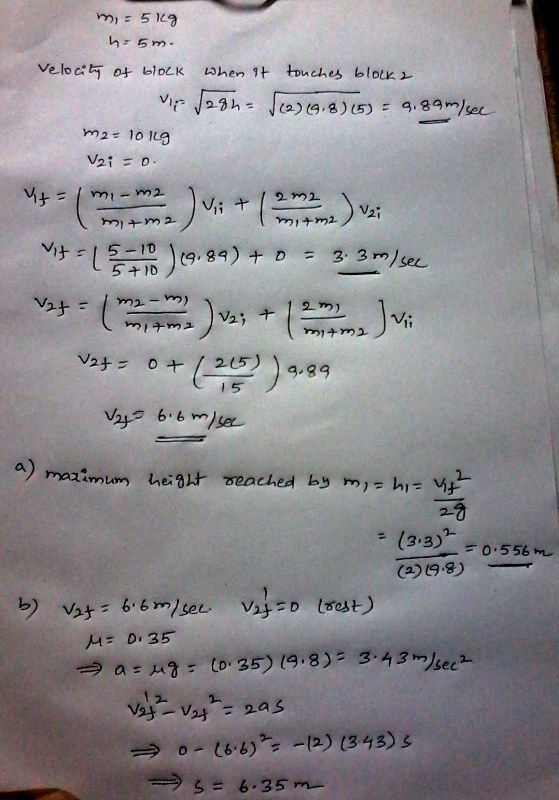
A block of mass m1 = 5.0 kg is released from a height of 5.0 m
(point A) down a smooth, curved ramp. It
makes an elastc headdon collision with a block of mass m2 = 10 kg
that is initally at rest.
(a) What is the maximum height reached by m1 afer the
collision?
(b) Afer the collision, m2 glides smoothly untl it hits a rough
patch and eventually comes to a stop.
What is the length of the rough patch if the coefcient of kinetc
fricton between m2 and the rough
patch is 0.350?
Homework Answers
3.0 kg block slides down a frictionless ramp of height 3.0 meters starting from rest. it then tra...
 3.0 kg block slides down a frictionless ramp of height 3.0
meters starting from rest. it then traverses a 2.0 metter rough
patch with a coefficient of kinetic friction 0.35 It then gets to a
smooth area where it compresses a horizontal spring of spring
constant 50 n/m.
Please help me Solve the rest of the physics problem
The answers to part A is x= 1.64 meters and part b is 1.58
meters
Problem 1 A 3.0 kg block slides...
3.0 kg block slides down a frictionless ramp of height 3.0
meters starting from rest. it then traverses a 2.0 metter rough
patch with a coefficient of kinetic friction 0.35 It then gets to a
smooth area where it compresses a horizontal spring of spring
constant 50 n/m.
Please help me Solve the rest of the physics problem
The answers to part A is x= 1.64 meters and part b is 1.58
meters
Problem 1 A 3.0 kg block slides...
Block 1 of mass m1 slides from rest along a frictionless ramp from an unknown height...
Block 1 of mass m1 slides from rest along a frictionless ramp from an unknown height h and then collides with stationary block 2, which has mass m2 = 3m1 . The collision is an elastic one. After the collision, block 2 slides into a friction-filled region where the coefficient of kinetic friction is 0.5 and comes to a stop through a distance d = 10 m in that region. (a) What is the height h? (b) What is the...
A 3.0 kg block slides down a frictionless wedge of height of 3.0 meters starting from...
A 3.0 kg block slides down a frictionless wedge of height of 3.0 meters starting from rest. It then traverses a 2.0 meter rough patch with a coefficient of kinetic friction 0.35. It then gets to a smooth area where it compresses a horizontal spring of spring constant 50 N/m. a. How much is the spring compressed when the mass briefly comes to a stop? b. How high up the ramp does the mass make it when it makes it...
In the figure, block 1 of mass m1 slides from rest along a frictionless ramp from...
 In the figure, block 1 of mass m1 slides from rest along a
frictionless ramp from height h = 3.2 m and then collides with
stationary block 2, which has mass m2 = 3m1. After the collision,
block 2 slides into a region where the coefficient of kinetic
friction ?k is 0.2 and comes to a stop in distance d within that
region. What is the value of distance d if the collision is (a)
elastic and (b) completely inelastic?
In the figure, block 1 of mass m1 slides from rest along a
frictionless ramp from height h = 3.2 m and then collides with
stationary block 2, which has mass m2 = 3m1. After the collision,
block 2 slides into a region where the coefficient of kinetic
friction ?k is 0.2 and comes to a stop in distance d within that
region. What is the value of distance d if the collision is (a)
elastic and (b) completely inelastic?
In the figure, block 1 of mass m1 slides from rest along a frictionless ramp from...
 In the figure, block 1 of mass m1 slides
from rest along a frictionless ramp from height h = 2.1 m
and then collides with stationary block 2, which has mass
m2 = 2m1. After the
collision, block 2 slides into a region where the coefficient of
kinetic friction μk is 0.1 and comes to a stop
in distance d within that region. What is the value of
distance d if the collision is (a)
elastic and (b) completely inelastic?
In the figure, block 1 of mass m1 slides
from rest along a frictionless ramp from height h = 2.1 m
and then collides with stationary block 2, which has mass
m2 = 2m1. After the
collision, block 2 slides into a region where the coefficient of
kinetic friction μk is 0.1 and comes to a stop
in distance d within that region. What is the value of
distance d if the collision is (a)
elastic and (b) completely inelastic?
In the figure, block 1 of mass m1 slides from rest along a frictionless ramp from...
In the figure, block 1 of mass m1 slides from rest along a frictionless ramp from height h = 2.4 m and then collides with stationary block 2, which has mass m2 = 2m1. After the collision, block 2 slides into a region where the coefficient of kinetic friction μk is 0.2 and comes to a stop in distance d within that region. What is the value of distance d if the collision is (a) elastic and (b) completely inelastic?
In the figure, block 1 of mass m1 slides from rest along a frictionless ramp from...
 In the figure, block 1 of mass m1 slides
from rest along a frictionless ramp from height h = 2.4 m
and then collides with stationary block 2, which has mass
m2 = 2m1. After the
collision, block 2 slides into a region where the coefficient of
kinetic friction μk is 0.2 and comes to a stop
in distance d within that region. What is the value of
distance d if the collision is (a)
elastic and (b) completely inelastic?...
In the figure, block 1 of mass m1 slides
from rest along a frictionless ramp from height h = 2.4 m
and then collides with stationary block 2, which has mass
m2 = 2m1. After the
collision, block 2 slides into a region where the coefficient of
kinetic friction μk is 0.2 and comes to a stop
in distance d within that region. What is the value of
distance d if the collision is (a)
elastic and (b) completely inelastic?...
Consider a frictionless track as shown in the figure below. A block of mass m1 = 5.65 kg is released from A
 Consider a frictionless track as shown in the figure below. A
block of mass m1 = 5.65
kg is released from A. It makes a
head-on elastic collision at B with a block of
mass m2 = 20.0
kg that is initially at rest. Calculate the maximum
height to which m1 rises after the
collision.Two masses are shown on a frictionless wooden track. The left
part of the track curves downward from left to right, starting from
an almost-vertical slope and then decreasing in...
Consider a frictionless track as shown in the figure below. A
block of mass m1 = 5.65
kg is released from A. It makes a
head-on elastic collision at B with a block of
mass m2 = 20.0
kg that is initially at rest. Calculate the maximum
height to which m1 rises after the
collision.Two masses are shown on a frictionless wooden track. The left
part of the track curves downward from left to right, starting from
an almost-vertical slope and then decreasing in...
4.[1pt] A block of mass m - 6.10 kg is released from rest at a height...
 4.[1pt] A block of mass m - 6.10 kg is released from rest at a height of H- 10.00 m on a curved frictionless ramp. At the foot of the ramp is a sring whose spring constant is k -455.0 N/m. What is the maximum compression of the spring, x? Answer: Submit All Answers 5.[lpt] After the spring reaches its maximum compression, it pushes the block backwards. What is the maximum height reached by the block? Answer: Submit All Answers
In the figure, block 1 of mass m1 slides from rest along a frictionless ramp from...
 In the figure, block 1 of mass m1 slides from rest along a frictionless ramp from height h-3.3 m and then collides with stationary block 2, which has mass m2 = 4m1 After the collision, block 2 slides into a region where the coefficient of kinetic frictionPr įs045 and comes to a stop nd stance d within that region. What is the value of distance d if the collision is (a) elastic and (b) completely inelastic? Frictionless (a) Number Unit...
 3.0 kg block slides down a frictionless ramp of height 3.0
meters starting from rest. it then traverses a 2.0 metter rough
patch with a coefficient of kinetic friction 0.35 It then gets to a
smooth area where it compresses a horizontal spring of spring
constant 50 n/m.
Please help me Solve the rest of the physics problem
The answers to part A is x= 1.64 meters and part b is 1.58
meters
Problem 1 A 3.0 kg block slides...
3.0 kg block slides down a frictionless ramp of height 3.0
meters starting from rest. it then traverses a 2.0 metter rough
patch with a coefficient of kinetic friction 0.35 It then gets to a
smooth area where it compresses a horizontal spring of spring
constant 50 n/m.
Please help me Solve the rest of the physics problem
The answers to part A is x= 1.64 meters and part b is 1.58
meters
Problem 1 A 3.0 kg block slides...
 In the figure, block 1 of mass m1 slides from rest along a
frictionless ramp from height h = 3.2 m and then collides with
stationary block 2, which has mass m2 = 3m1. After the collision,
block 2 slides into a region where the coefficient of kinetic
friction ?k is 0.2 and comes to a stop in distance d within that
region. What is the value of distance d if the collision is (a)
elastic and (b) completely inelastic?
In the figure, block 1 of mass m1 slides from rest along a
frictionless ramp from height h = 3.2 m and then collides with
stationary block 2, which has mass m2 = 3m1. After the collision,
block 2 slides into a region where the coefficient of kinetic
friction ?k is 0.2 and comes to a stop in distance d within that
region. What is the value of distance d if the collision is (a)
elastic and (b) completely inelastic?
 In the figure, block 1 of mass m1 slides
from rest along a frictionless ramp from height h = 2.1 m
and then collides with stationary block 2, which has mass
m2 = 2m1. After the
collision, block 2 slides into a region where the coefficient of
kinetic friction μk is 0.1 and comes to a stop
in distance d within that region. What is the value of
distance d if the collision is (a)
elastic and (b) completely inelastic?
In the figure, block 1 of mass m1 slides
from rest along a frictionless ramp from height h = 2.1 m
and then collides with stationary block 2, which has mass
m2 = 2m1. After the
collision, block 2 slides into a region where the coefficient of
kinetic friction μk is 0.1 and comes to a stop
in distance d within that region. What is the value of
distance d if the collision is (a)
elastic and (b) completely inelastic?
 In the figure, block 1 of mass m1 slides
from rest along a frictionless ramp from height h = 2.4 m
and then collides with stationary block 2, which has mass
m2 = 2m1. After the
collision, block 2 slides into a region where the coefficient of
kinetic friction μk is 0.2 and comes to a stop
in distance d within that region. What is the value of
distance d if the collision is (a)
elastic and (b) completely inelastic?...
In the figure, block 1 of mass m1 slides
from rest along a frictionless ramp from height h = 2.4 m
and then collides with stationary block 2, which has mass
m2 = 2m1. After the
collision, block 2 slides into a region where the coefficient of
kinetic friction μk is 0.2 and comes to a stop
in distance d within that region. What is the value of
distance d if the collision is (a)
elastic and (b) completely inelastic?...
 Consider a frictionless track as shown in the figure below. A
block of mass m1 = 5.65
kg is released from A. It makes a
head-on elastic collision at B with a block of
mass m2 = 20.0
kg that is initially at rest. Calculate the maximum
height to which m1 rises after the
collision.Two masses are shown on a frictionless wooden track. The left
part of the track curves downward from left to right, starting from
an almost-vertical slope and then decreasing in...
Consider a frictionless track as shown in the figure below. A
block of mass m1 = 5.65
kg is released from A. It makes a
head-on elastic collision at B with a block of
mass m2 = 20.0
kg that is initially at rest. Calculate the maximum
height to which m1 rises after the
collision.Two masses are shown on a frictionless wooden track. The left
part of the track curves downward from left to right, starting from
an almost-vertical slope and then decreasing in...
 4.[1pt] A block of mass m - 6.10 kg is released from rest at a height of H- 10.00 m on a curved frictionless ramp. At the foot of the ramp is a sring whose spring constant is k -455.0 N/m. What is the maximum compression of the spring, x? Answer: Submit All Answers 5.[lpt] After the spring reaches its maximum compression, it pushes the block backwards. What is the maximum height reached by the block? Answer: Submit All Answers
 In the figure, block 1 of mass m1 slides from rest along a frictionless ramp from height h-3.3 m and then collides with stationary block 2, which has mass m2 = 4m1 After the collision, block 2 slides into a region where the coefficient of kinetic frictionPr įs045 and comes to a stop nd stance d within that region. What is the value of distance d if the collision is (a) elastic and (b) completely inelastic? Frictionless (a) Number Unit...
Most questions answered within 3 hours.
-
Where is the error in this code sequence?
String s1 = "Hello";
String s2 = "ello";...
asked 11 months ago -
Financial data for Joel de Paris, Inc., for last year
follow:
Joel de Paris, Inc.
Balance...
asked 11 months ago -
Consider this reaction:
Al2(SO4)3 (aq)+ BaCl3
(aq) Al2Cl6 (aq)- +
3BaSO4(s) . What is the...
asked 11 months ago -
Suppose that Savneet is considering increasing her
recent random sample from 20 car rentals to 40...
asked 11 months ago -
Trucks arrive at an unloading terminal at an average rate of 120
per hour.
Trucks arrive...
asked 11 months ago -
Why are methanol and ethanol completely soluble in water while
octanol is not very little soluble....
asked 11 months ago -
A facilities manager at a university reads in a research report
that the mean amount of...
asked 11 months ago -
When the CuSO4 is rehydrated by adding water to the anhydrous
compound, is this an endothermic...
asked 11 months ago -
A ray of sunlight is passing from diamond into crown glass; the
angle of incidence is...
asked 11 months ago -
A block of mass 0.249 kg is placed on top of a light, vertical
spring of...
asked 11 months ago -
how do the kidneys compensate in the presences of acidosis
a) trigger hyperventilate
b) reserve acid...
asked 11 months ago -
Question 501 pts
The rental rate of capital to the firm increases. Which of the
following...
asked 11 months ago