


Homework Answers
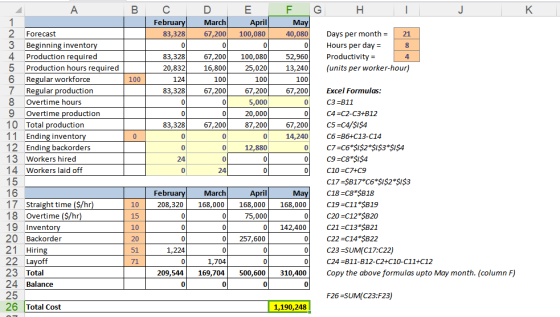
Solution is generated using Excel Solver as follows:
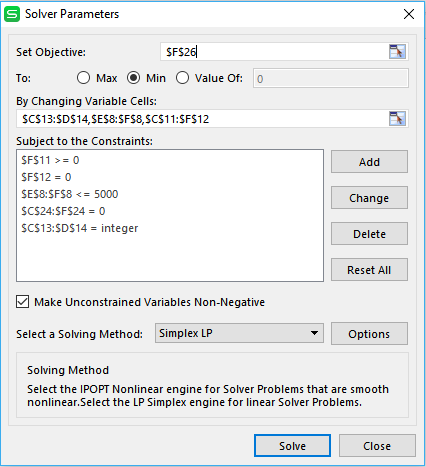
Solver parameters:
After creating the excel model using the given formulas and data, and entering the solver parameters, Click Solve button to generate optimal solution:
EXCEL FORMULAS:
| Excel Formulas: |
| C3 =B11 |
| C4 =C2-C3+B12 |
| C5 =C4/$I$4 |
| C6 =B6+C13-C14 |
| C7 =C6*$I$2*$I$3*$I$4 |
| C9 =C8*$I$4 |
| C10 =C7+C9 |
| C17 =$B17*C6*$I$2*$I$3 |
| C18 =C8*$B18 |
| C19 =C11*$B19 |
| C20 =C12*$B20 |
| C21 =C13*$B21 |
| C22 =C14*$B22 |
| C23 =SUM(C17:C22) |
| C24 =B11-B12-C2+C10-C11+C12 |
| Copy the above formulas upto May month. (column F) |
| F26 =SUM(C23:F23) |
Total cost = $ 1,190,248
Add Answer to:
Plan production for a four-month period: February through May. For February and March, you should produce...
Plan production for a four-month period: February through May. For February and March, you should produce...
Plan production for a four-month period: February through May. For February and March, you should produce to exact demand forecast. For April and May, you should use overtime and inventory with a stable workforce; stable means that the number of workers needed for March will be held constant through May. However, government constraints put a maximum of 5,000 hours of overtime labor per month in April and May (zero overtime in February and March). If demand exceeds supply, then backorders...
Problem 8-8 Plan production for a four-month period: February through May. For February and March, you...
 Problem 8-8 Plan production for a four-month period: February through May. For February and March, you should produce to exact demand forecast. For April and May, you should use overtime and inventory with a stable workforce; stable means that the number of workers needed for March will be held constant through May. However, government constraints put a maximum of 5,000 hours of overtime labor per month in April and May (zero overtime in February and March). If demand exceeds supply,...
Plan production for the next year. The demand forecast is: spring, 19,500; summer, 9,400; fall, 15,000;...
 Plan production for the next year. The demand forecast is: spring, 19,500; summer, 9,400; fall, 15,000; winter, 18,800. At the beginning of spring, you have 66 workers and 990 units in inventory. The union contract specifies that you may lay off workers only once a year, at the beginning of summer. Also, you may hire new workers only at the end of summer to begin regular work in the fall. The number of workers laid off at the beginning of...
Develop a production schedule to produce the exact production requirements by varying the workforce size for...
 Develop a production schedule to produce the exact production requirements by varying the workforce size for the following problem The monthly forecasts for Product X for January February, and March 1010, 1510 and 1180 respectively. Safety stock policy recommends that half of the forecast for that month be defined as safety stock. There are 22 working days in January, 19 in February, and 21 in March. Beginning inventory is 530 units Manufacturing cost is $180 por unit, storage cost is...
Problem 8-14 (Algo) Develop a production schedule to produce the exact production requirements by varying the...
 Problem 8-14 (Algo) Develop a production schedule to produce the exact production requirements by varying the workforce size for the following problem. The monthly forecasts for Product X for January, February, and March are 1,010, 1,540, and 1,180, respectively. Safety stock policy recommends that half of the forecast for that month be defined as safety stock. There are 22 working days in January, 19 in February and 21 in March. Beginning inventory is 530 units. Manufacturing cost is $180 per...
Develop a production plan and calculate the annual cost for a firm whose demand forecast is...
Develop a production plan and calculate the annual cost for a firm whose demand forecast is fall, 11,000; winter, 7,700; spring, 6,700; summer, 13,000. Inventory at the beginning of fall is 550 units. At the beginning of fall you currently have 30 workers, but you plan to hire temporary workers at the beginning of summer and lay them off at the end of summer. In addition, you have negotiated with the union an option to use the regular workforce on...
Develop a production plan and calculate the annual cost for a firm whose demand forecast is...
Develop a production plan and calculate the annual cost for a firm whose demand forecast is fall, 10,500; winter, 8,000; spring, 7,000; summer, 12,500. Inventory at the beginning of fall is 525 units. At the beginning of fall you currently have 35 workers, but you plan to hire temporary workers at the beginning of summer and lay them off at the end of summer. In addition, you have negotiated with the union an option to use the regular workforce on...
Problem 8-7 Develop a production plan and calculate the annual cost for a firm whose demand...
 Problem 8-7 Develop a production plan and calculate the annual cost for a firm whose demand forecast is fall, 10,700; winter, 8,300; spring, 6,900; summer, 12,700. Inventory at the beginning of fall is 535 units. At the beginning of fall you currently have 35 workers, but you plan to hire temporary workers at the beginning of summer and lay them off at the end of summer. In addition, you have negotiated with the union an option to use the regular...
Complete the level production plan, using the following information. The only costs you need to consider...
 Complete the level production plan, using the following information. The only costs you need to consider here are layoff, hiring, and inventory costs. If you complete the plan correctly, your hiring, layoff, and inventory costs should match those given here. E: Click the icon to view the costs table. Click the icon to view the forecasted sales. Fill in the production plan table below (enter your responses rounded to the nearest whole number). Month Forecasted sales Sales in worker hours...
Refrigeration Corp. needs an aggregate plan for January through June for its refrigerator production. The company...
Refrigeration Corp. needs an aggregate plan for January through June for its refrigerator production. The company has developed the following data: a) Plan A: Vary the workforce so that production meets the forecasted demand (maintain inventory at 250 units). Bell had eight employees on staff in December. Part-time labor is available. Complete the following table (enter your responses as whole numbers). Costs Holding cost $8/ refrigerator/ month Subcontracting $80/ refrigerator Regular-time labor $12/ hour Overtime labor $18/ hour for hours...
 Problem 8-8 Plan production for a four-month period: February through May. For February and March, you should produce to exact demand forecast. For April and May, you should use overtime and inventory with a stable workforce; stable means that the number of workers needed for March will be held constant through May. However, government constraints put a maximum of 5,000 hours of overtime labor per month in April and May (zero overtime in February and March). If demand exceeds supply,...
 Plan production for the next year. The demand forecast is: spring, 19,500; summer, 9,400; fall, 15,000; winter, 18,800. At the beginning of spring, you have 66 workers and 990 units in inventory. The union contract specifies that you may lay off workers only once a year, at the beginning of summer. Also, you may hire new workers only at the end of summer to begin regular work in the fall. The number of workers laid off at the beginning of...
 Develop a production schedule to produce the exact production requirements by varying the workforce size for the following problem The monthly forecasts for Product X for January February, and March 1010, 1510 and 1180 respectively. Safety stock policy recommends that half of the forecast for that month be defined as safety stock. There are 22 working days in January, 19 in February, and 21 in March. Beginning inventory is 530 units Manufacturing cost is $180 por unit, storage cost is...
 Problem 8-14 (Algo) Develop a production schedule to produce the exact production requirements by varying the workforce size for the following problem. The monthly forecasts for Product X for January, February, and March are 1,010, 1,540, and 1,180, respectively. Safety stock policy recommends that half of the forecast for that month be defined as safety stock. There are 22 working days in January, 19 in February and 21 in March. Beginning inventory is 530 units. Manufacturing cost is $180 per...
 Problem 8-7 Develop a production plan and calculate the annual cost for a firm whose demand forecast is fall, 10,700; winter, 8,300; spring, 6,900; summer, 12,700. Inventory at the beginning of fall is 535 units. At the beginning of fall you currently have 35 workers, but you plan to hire temporary workers at the beginning of summer and lay them off at the end of summer. In addition, you have negotiated with the union an option to use the regular...
 Complete the level production plan, using the following information. The only costs you need to consider here are layoff, hiring, and inventory costs. If you complete the plan correctly, your hiring, layoff, and inventory costs should match those given here. E: Click the icon to view the costs table. Click the icon to view the forecasted sales. Fill in the production plan table below (enter your responses rounded to the nearest whole number). Month Forecasted sales Sales in worker hours...
Most questions answered within 3 hours.
-
Where is the error in this code sequence?
String s1 = "Hello";
String s2 = "ello";...
asked 11 months ago -
Financial data for Joel de Paris, Inc., for last year
follow:
Joel de Paris, Inc.
Balance...
asked 11 months ago -
Consider this reaction:
Al2(SO4)3 (aq)+ BaCl3
(aq) Al2Cl6 (aq)- +
3BaSO4(s) . What is the...
asked 11 months ago -
Suppose that Savneet is considering increasing her
recent random sample from 20 car rentals to 40...
asked 11 months ago -
Trucks arrive at an unloading terminal at an average rate of 120
per hour.
Trucks arrive...
asked 11 months ago -
Why are methanol and ethanol completely soluble in water while
octanol is not very little soluble....
asked 11 months ago -
A facilities manager at a university reads in a research report
that the mean amount of...
asked 11 months ago -
When the CuSO4 is rehydrated by adding water to the anhydrous
compound, is this an endothermic...
asked 11 months ago -
A ray of sunlight is passing from diamond into crown glass; the
angle of incidence is...
asked 11 months ago -
A block of mass 0.249 kg is placed on top of a light, vertical
spring of...
asked 11 months ago -
how do the kidneys compensate in the presences of acidosis
a) trigger hyperventilate
b) reserve acid...
asked 11 months ago -
Question 501 pts
The rental rate of capital to the firm increases. Which of the
following...
asked 11 months ago