

Homework Answers
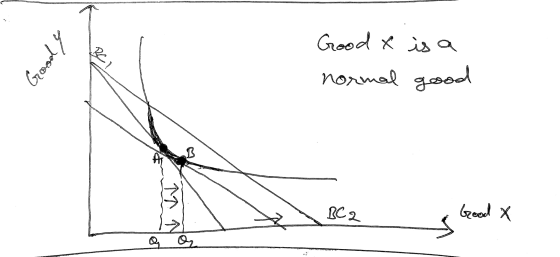
As shown in diagram we know that quantity demanded for good x increased when it's price falls. And this is a characteristic of normal goods in other words when price of a normal good decreased it quantity demanded will increase.
So we can conclude that good X is a normal good
Add Answer to:
2. Identifying normal, inferior, and Giffen goods The green line BC, on the following graph represents...
Good Y Good X The diagram above shows a budget constraint on Good X and Good...
 Good Y Good X The diagram above shows a budget constraint on Good X and Good Y. Point A is the original optimal bundle. Suppose Good X is an inferior good and the price of Good Y increases, draw the new budget constraint. Would the income effect increase or decrease the consumption on Good Y? Would the substitution effect increase or decrease the consumption on Good Y? If the substitution effect is larger than the income effect, indicate the new...
8. Normal and inferior goods Alyssa enjoys going to the theater to see plays, and she...
 8. Normal and inferior goods Alyssa enjoys going to the theater to see plays, and she also enjoys going to rock concerts. The following diagram shows two of Alyssa's indifference curves for going to plays and concerts. With Alyssa's initial budget constraint (BC), she chose to go to two concerts and six plays per month (point x). Then her budget constraint shifted to BC2, and she chose to go to five concerts and five plays per month (point Y). PLAYS...
1. Problems 22-1 A college student has two options for meals: eating at the dining hall...
 1. Problems 22-1 A college student has two options for meals: eating at the dining hall for $5 per meal, or eating a package of Cup O' Soup for $2.50 per meal. Her weekly food budget is $100. Assume that she spends equal amounts on both goods. On the following graph, use the green line (triangle symbol) to draw the college student's budget constraint. Then use the black point (plus symbol) to indicate the initial optimum in this case. Initial...
9. Income and substitution effects Carlos and Deborah Azinian live in Detroit and enjoy going out...
 9. Income and substitution effects Carlos and Deborah Azinian live in Detroit and enjoy going out to fancy restaurants for dinner and to diners for breakfast. On the following diagram, the purple curves 11 and 12 represent two of their indifference curves for fancy dinners and diner breakfasts. They have $1,000 per month available to spend on eating out. The price of a diner breakfast is always $10. Each labeled point represents the tangency between a budget constraint and the...
9. Income and substitution effects Larry and Megan Stein live in Detroit and enjoy going out...
 9. Income and substitution effects Larry and Megan Stein live in Detroit and enjoy going out to fancy restaurants for dinner and to diners for breakfast. On the following diagram, the purple curves 11 and 12 represent two of their indifference curves for fancy dinners and diner breakfasts. They have $1,000 per month available to spend on eating out. The price of a diner breakfast is always $10. Each labeled point represents the tangency between a budget constraint and the...
Maria enjoys eating bagels and scones. The following graph displays one of Maria's indifference curves (11),...
 Maria enjoys eating bagels and scones. The following graph displays one of Maria's indifference curves (11), which shows her preference for bagels and scones each month. SCONES -- + -- -- 8 10 14 BAGELS Complete the following table by determining Maria's marginal rate of substitution (MRS) between the two points listed in each row. (Note: Although Che MRS is technically always negative, enter a positive number in the following table since it asks for the amount of scones per...
Homework (Ch 21) 9. Income and substitution effects Andrew and Beth Trimble live in Philadelphia and...
 Homework (Ch 21) 9. Income and substitution effects Andrew and Beth Trimble live in Philadelphia and enjoy going out to fancy restaurants for dinner and to diners for breakfast. On the following diagram, the purple curves I, and I, represent two of their indifference curves for fancy dinners and diner breakfasts. They have $1,000 per month available to spend on eating out. The price of a diner breakfast is always $10. Each labeled point represents the tangency between a budget...
1. (24 total points) Suppose a consumer’s utility function is given by U(X,Y) = X1/2*Y1/2. Also,...
1. (24 total points) Suppose a consumer’s utility function is given by U(X,Y) = X1/2*Y1/2. Also, the consumer has $72 to spend, and the price of Good X, PX = $4. Let Good Y be a composite good whose price is PY = $1. So on the Y-axis, we are graphing the amount of money that the consumer has available to spend on all other goods for any given value of X. a) (2 points) How much X and Y...
3. Ramon has $100 to spend on apples and bananas. The price of apples is $4...
 3. Ramon has $100 to spend on apples and bananas. The price of apples is $4 a pound and the price of bananas is $2 a pound. The graph below represents Ramon's budget line with his consumption of apples on the Y-axis and his consumption of bananas on the X-axis. Homework 2: Problem Set 2 Apples (pounds) BL1 Bananas (pounds) (a) On the graph above: Add the intercepts of BL . Assuming that Ramon chooses to purchase 20 pounds of...
A consumer has the utility function U(X, Y) = (X + 2)(Y + 4). Her income is...
A consumer has the utility function U(X, Y) = (X + 2)(Y + 4). Her income is $100, the price of X is $4, and the price of Y is $5. In order to maximize utility subject to her budget constraint, how many units of X and Y will our consumer choose to purchase? Sketch a budget line – indifference curve diagram illustrating this optimum. Label this optimum A. Suppose the price of X increases to $8, while income and the price...
 Good Y Good X The diagram above shows a budget constraint on Good X and Good Y. Point A is the original optimal bundle. Suppose Good X is an inferior good and the price of Good Y increases, draw the new budget constraint. Would the income effect increase or decrease the consumption on Good Y? Would the substitution effect increase or decrease the consumption on Good Y? If the substitution effect is larger than the income effect, indicate the new...
 8. Normal and inferior goods Alyssa enjoys going to the theater to see plays, and she also enjoys going to rock concerts. The following diagram shows two of Alyssa's indifference curves for going to plays and concerts. With Alyssa's initial budget constraint (BC), she chose to go to two concerts and six plays per month (point x). Then her budget constraint shifted to BC2, and she chose to go to five concerts and five plays per month (point Y). PLAYS...
 1. Problems 22-1 A college student has two options for meals: eating at the dining hall for $5 per meal, or eating a package of Cup O' Soup for $2.50 per meal. Her weekly food budget is $100. Assume that she spends equal amounts on both goods. On the following graph, use the green line (triangle symbol) to draw the college student's budget constraint. Then use the black point (plus symbol) to indicate the initial optimum in this case. Initial...
 9. Income and substitution effects Carlos and Deborah Azinian live in Detroit and enjoy going out to fancy restaurants for dinner and to diners for breakfast. On the following diagram, the purple curves 11 and 12 represent two of their indifference curves for fancy dinners and diner breakfasts. They have $1,000 per month available to spend on eating out. The price of a diner breakfast is always $10. Each labeled point represents the tangency between a budget constraint and the...
 9. Income and substitution effects Larry and Megan Stein live in Detroit and enjoy going out to fancy restaurants for dinner and to diners for breakfast. On the following diagram, the purple curves 11 and 12 represent two of their indifference curves for fancy dinners and diner breakfasts. They have $1,000 per month available to spend on eating out. The price of a diner breakfast is always $10. Each labeled point represents the tangency between a budget constraint and the...
 Maria enjoys eating bagels and scones. The following graph displays one of Maria's indifference curves (11), which shows her preference for bagels and scones each month. SCONES -- + -- -- 8 10 14 BAGELS Complete the following table by determining Maria's marginal rate of substitution (MRS) between the two points listed in each row. (Note: Although Che MRS is technically always negative, enter a positive number in the following table since it asks for the amount of scones per...
 Homework (Ch 21) 9. Income and substitution effects Andrew and Beth Trimble live in Philadelphia and enjoy going out to fancy restaurants for dinner and to diners for breakfast. On the following diagram, the purple curves I, and I, represent two of their indifference curves for fancy dinners and diner breakfasts. They have $1,000 per month available to spend on eating out. The price of a diner breakfast is always $10. Each labeled point represents the tangency between a budget...
 3. Ramon has $100 to spend on apples and bananas. The price of apples is $4 a pound and the price of bananas is $2 a pound. The graph below represents Ramon's budget line with his consumption of apples on the Y-axis and his consumption of bananas on the X-axis. Homework 2: Problem Set 2 Apples (pounds) BL1 Bananas (pounds) (a) On the graph above: Add the intercepts of BL . Assuming that Ramon chooses to purchase 20 pounds of...
Most questions answered within 3 hours.
-
Where is the error in this code sequence?
String s1 = "Hello";
String s2 = "ello";...
asked 10 months ago -
Financial data for Joel de Paris, Inc., for last year
follow:
Joel de Paris, Inc.
Balance...
asked 10 months ago -
Consider this reaction:
Al2(SO4)3 (aq)+ BaCl3
(aq) Al2Cl6 (aq)- +
3BaSO4(s) . What is the...
asked 10 months ago -
Suppose that Savneet is considering increasing her
recent random sample from 20 car rentals to 40...
asked 10 months ago -
Trucks arrive at an unloading terminal at an average rate of 120
per hour.
Trucks arrive...
asked 10 months ago -
Why are methanol and ethanol completely soluble in water while
octanol is not very little soluble....
asked 10 months ago -
A facilities manager at a university reads in a research report
that the mean amount of...
asked 10 months ago -
When the CuSO4 is rehydrated by adding water to the anhydrous
compound, is this an endothermic...
asked 10 months ago -
A ray of sunlight is passing from diamond into crown glass; the
angle of incidence is...
asked 10 months ago -
A block of mass 0.249 kg is placed on top of a light, vertical
spring of...
asked 10 months ago -
how do the kidneys compensate in the presences of acidosis
a) trigger hyperventilate
b) reserve acid...
asked 10 months ago -
Question 501 pts
The rental rate of capital to the firm increases. Which of the
following...
asked 10 months ago