
Homework Answers

Add Answer to:
A 75 kg person is crouching with his weight evenly distributed on both tiptoes. The forces...
Consider the equilibrium of a foot for a crouching 220-lb person. The force through the Achilles...
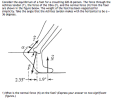 Consider the equilibrium of a foot for a crouching 220-lb person. The force through the Achilles tendon (T), the force of the tibia (F), and the normal force (N) from the floor are shown in the figure below. The weight of the foot has been neglected for simplicity. Take the angle that the Achilles tendon makes with the horizontal to be a 36 degrees 2.35" 1.9 What is the normal force (N) on the foot? (Express your answer to two...
An ACL patient is doing leg extensions to strengthen his quadriceps muscles. With no additional weight...
 An ACL patient is doing leg extensions to strengthen his quadriceps muscles. With no additional weight added, the patient's lower leg (shank+foot) has a mass of 6.25 kg. The center of mass of the lower leg segment is located 32 cm from the axis of rotation of the knee joint. The leg is flexed 25 degree down from horizontal. The quadriceps muscle acts through the patellar tendon, which inserts 5 cm from the axis of rotation of the knee joint...
A person is doing leg flexion/extension exercises from a sitting position in order to strengthen the...
 A person is doing leg flexion/extension exercises from a sitting
position in order to strengthen the person's quadracept muscles.
The forces acting in the lower leg are illustrated in the figures
below.
W0 is the weight of the boot, W1 = 160 N
is the weight of the person's lower leg, FM is the
magnitude of the force exerted by the quadricepts muscle on the
tibia (shinbone) through the patellar tendon, and FJ is
the force due to the tibiofemoral...
A person is doing leg flexion/extension exercises from a sitting
position in order to strengthen the person's quadracept muscles.
The forces acting in the lower leg are illustrated in the figures
below.
W0 is the weight of the boot, W1 = 160 N
is the weight of the person's lower leg, FM is the
magnitude of the force exerted by the quadricepts muscle on the
tibia (shinbone) through the patellar tendon, and FJ is
the force due to the tibiofemoral...
To understand the two most common procedures for finding torques when the forces and displacements are all in one plan...
 To understand the two most
common procedures for finding torques when the forces and
displacements are all in one plane: the moment arm method and the
tangential force method. The purpose of this problem is to give you
further practice finding torques in two-dimensional situations. In
this case it is overkill to use the full cross product definition
of the torque because the only nonzero component of the torque is
the component perpendicular to the plane containing the problem.
There...
To understand the two most
common procedures for finding torques when the forces and
displacements are all in one plane: the moment arm method and the
tangential force method. The purpose of this problem is to give you
further practice finding torques in two-dimensional situations. In
this case it is overkill to use the full cross product definition
of the torque because the only nonzero component of the torque is
the component perpendicular to the plane containing the problem.
There...
 Consider the equilibrium of a foot for a crouching 220-lb person. The force through the Achilles tendon (T), the force of the tibia (F), and the normal force (N) from the floor are shown in the figure below. The weight of the foot has been neglected for simplicity. Take the angle that the Achilles tendon makes with the horizontal to be a 36 degrees 2.35" 1.9 What is the normal force (N) on the foot? (Express your answer to two...
 An ACL patient is doing leg extensions to strengthen his quadriceps muscles. With no additional weight added, the patient's lower leg (shank+foot) has a mass of 6.25 kg. The center of mass of the lower leg segment is located 32 cm from the axis of rotation of the knee joint. The leg is flexed 25 degree down from horizontal. The quadriceps muscle acts through the patellar tendon, which inserts 5 cm from the axis of rotation of the knee joint...
 A person is doing leg flexion/extension exercises from a sitting
position in order to strengthen the person's quadracept muscles.
The forces acting in the lower leg are illustrated in the figures
below.
W0 is the weight of the boot, W1 = 160 N
is the weight of the person's lower leg, FM is the
magnitude of the force exerted by the quadricepts muscle on the
tibia (shinbone) through the patellar tendon, and FJ is
the force due to the tibiofemoral...
A person is doing leg flexion/extension exercises from a sitting
position in order to strengthen the person's quadracept muscles.
The forces acting in the lower leg are illustrated in the figures
below.
W0 is the weight of the boot, W1 = 160 N
is the weight of the person's lower leg, FM is the
magnitude of the force exerted by the quadricepts muscle on the
tibia (shinbone) through the patellar tendon, and FJ is
the force due to the tibiofemoral...
 To understand the two most
common procedures for finding torques when the forces and
displacements are all in one plane: the moment arm method and the
tangential force method. The purpose of this problem is to give you
further practice finding torques in two-dimensional situations. In
this case it is overkill to use the full cross product definition
of the torque because the only nonzero component of the torque is
the component perpendicular to the plane containing the problem.
There...
To understand the two most
common procedures for finding torques when the forces and
displacements are all in one plane: the moment arm method and the
tangential force method. The purpose of this problem is to give you
further practice finding torques in two-dimensional situations. In
this case it is overkill to use the full cross product definition
of the torque because the only nonzero component of the torque is
the component perpendicular to the plane containing the problem.
There...
Most questions answered within 3 hours.
-
Where is the error in this code sequence?
String s1 = "Hello";
String s2 = "ello";...
asked 10 months ago -
Financial data for Joel de Paris, Inc., for last year
follow:
Joel de Paris, Inc.
Balance...
asked 10 months ago -
Consider this reaction:
Al2(SO4)3 (aq)+ BaCl3
(aq) Al2Cl6 (aq)- +
3BaSO4(s) . What is the...
asked 10 months ago -
Suppose that Savneet is considering increasing her
recent random sample from 20 car rentals to 40...
asked 10 months ago -
Trucks arrive at an unloading terminal at an average rate of 120
per hour.
Trucks arrive...
asked 10 months ago -
Why are methanol and ethanol completely soluble in water while
octanol is not very little soluble....
asked 10 months ago -
A facilities manager at a university reads in a research report
that the mean amount of...
asked 10 months ago -
When the CuSO4 is rehydrated by adding water to the anhydrous
compound, is this an endothermic...
asked 10 months ago -
A ray of sunlight is passing from diamond into crown glass; the
angle of incidence is...
asked 10 months ago -
A block of mass 0.249 kg is placed on top of a light, vertical
spring of...
asked 10 months ago -
how do the kidneys compensate in the presences of acidosis
a) trigger hyperventilate
b) reserve acid...
asked 10 months ago -
Question 501 pts
The rental rate of capital to the firm increases. Which of the
following...
asked 10 months ago