
Homework Answers
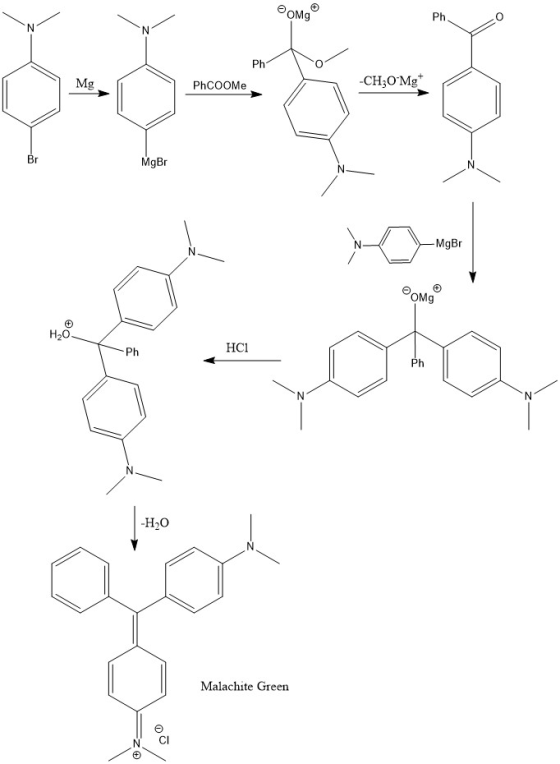
1. Malachite green is synthesised from methyl benzoate by treating the latter with the Grignard reagent prepared from 4-bromo-N,N-dimethylaniline. The mechanism of the reaction in detail is given below.
Add Answer to:
Write the mechanism for the formation of Malachite Green from methyl benzoate. Be sure to show...
Please answer this question. In both Malachite Green and Crystal Violet, the positive charge may be...
 Please answer this question.
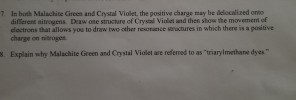
In both Malachite Green and Crystal Violet, the positive charge may be delocalized onto different nitrogens. Draw one structure of Crystal Violet and then show the movement of electrons that allows you to draw two other resonance structures in which there is a positive charge on nitrogen. 7. 8. Explain why Malachite Green and Crystal Violet are referred to as "triarylmethane dyes."
Please answer this question.
In both Malachite Green and Crystal Violet, the positive charge may be delocalized onto different nitrogens. Draw one structure of Crystal Violet and then show the movement of electrons that allows you to draw two other resonance structures in which there is a positive charge on nitrogen. 7. 8. Explain why Malachite Green and Crystal Violet are referred to as "triarylmethane dyes."
The purpose of this experiment of this experiment is to create Malachite green or crystal violet...
The purpose of this experiment of this experiment is to create Malachite green or crystal violet by first preparing a Gringard reagent, and then reacting it with methyl benzoate. The Gringard reagent was formed from 4-bromo-N,N-dimethylaniline. In the second part of the lab we reacted the Gringard reagent with diethyl carbonate to form crystal violet. Why would submitting a NMR sample of your dye solution (not the pure dye compound itself) be unlikely to provide a useful spectrum?
What is the reaction drawn out for the synthesis of malachite green and crystal violet using...
What is the reaction drawn out for the synthesis of malachite green and crystal violet using methyl benzoate for malachite green and diethyl carbonate? grignard reagent was 4-bromo-n-n-dimethyl aniline magnesium bromide, also please show reaction of forming this reagent using 4-bromo-n-n-dimethylaniline, anhydrous tetrohydrofuran and magnesium turnings.
1. Choose one of the two dyes prepared from this lab and write out its complete...
 1. Choose one of the two dyes prepared from this lab and write out its complete mechanism. Assume the Grignard reagent has already been formed. 2. (a) What would happen to the color of your dye if you added sodium hydroxide to the solution until the pH reached 10? Why? (b) Show a mechanism from this reaction. For malachite green: Weigh 0.105 g of methyl benzoate into a small clean vial. Add 1 mL anhydrous tetrohydrofuran to the vial. For...
1. Write a reaction mechanism for the reaction of methyl benzoate with excess phenyl magnesium bromide....
1. Write a reaction mechanism for the reaction of methyl benzoate with excess phenyl magnesium bromide. 2. The reaction equation for Gringard’sr reactions of a single Grignard reagent with a ketone (benzophenone), an ester (methyl benzoate) and a carbonate (diethyl carbonate
can you please answer both of these questions. the dyes are crystal violet and malachite green...
 can you please answer both of these questions. the dyes are
crystal violet and malachite green
Choose one of the two dyes prepared from this lab and write out its complete mechanism, Assume the Grignard reagent has already been formed (a) What would happen to the color of your dye if you added sodium hydroxide to the solution until the pH reached 10? Why? (b) Show a mechanism from this reaction. 1. 2.
can you please answer both of these questions. the dyes are
crystal violet and malachite green
Choose one of the two dyes prepared from this lab and write out its complete mechanism, Assume the Grignard reagent has already been formed (a) What would happen to the color of your dye if you added sodium hydroxide to the solution until the pH reached 10? Why? (b) Show a mechanism from this reaction. 1. 2.
Write a mechanism for the nitration of methyl benzoate (major product only) Include formation of the...
Write a mechanism for the nitration of methyl benzoate (major product only) Include formation of the electrophile from the reaction of nitric acid with sulfuric acid. Only one resonance structure is needed for the intermediate in the EAS portion of the mechanism
Write a reaction mechanism to show how the major mononitrated product forms when protonated methyl benzoate...
Write a reaction mechanism to show how the major mononitrated product forms when protonated methyl benzoate (a nucleophile) combines with nitronium ion (an electrophile). Use the curved-arrow formalism. Show all lone pairs and formal charges.
1. Write the mechanism for the synthesis reaction for Nitration of Methyl Benzoate C₆H₅CO₂CH₃ + HONO₂...
1. Write the mechanism for the synthesis reaction for Nitration of Methyl Benzoate C₆H₅CO₂CH₃ + HONO₂ --------> C8H7NO4 H₂ O Methylbenzoate + Nitric Acid (H₂ SO4 ) Methyl m-nitrobenzoate water Write the complete mechanism for the reaction. Be sure to use expanded structural formulas for all chemical species. Include all bonds, non-bonding electrons, formal charges, and electron-flow arrows. DO NOT use bond-line formulas, but rather explicitly show atomic symbols. For this mechanism, show the individual resonance contributors for the arenium...
• Use the curved-arrow notation to draw the mechanism for the formation of 2-methyl-2-hexanol from n-butylmagnesium...
• Use the curved-arrow notation to draw the mechanism for the formation of 2-methyl-2-hexanol from n-butylmagnesium bromide. • Discuss, using the mechanism, why it is important to use anhydrous diethyl ether in this reaction. • Describe how you would purify the final product by distillation. What obstacles would you run into?
 Please answer this question.
In both Malachite Green and Crystal Violet, the positive charge may be delocalized onto different nitrogens. Draw one structure of Crystal Violet and then show the movement of electrons that allows you to draw two other resonance structures in which there is a positive charge on nitrogen. 7. 8. Explain why Malachite Green and Crystal Violet are referred to as "triarylmethane dyes."
Please answer this question.
In both Malachite Green and Crystal Violet, the positive charge may be delocalized onto different nitrogens. Draw one structure of Crystal Violet and then show the movement of electrons that allows you to draw two other resonance structures in which there is a positive charge on nitrogen. 7. 8. Explain why Malachite Green and Crystal Violet are referred to as "triarylmethane dyes."
 1. Choose one of the two dyes prepared from this lab and write out its complete mechanism. Assume the Grignard reagent has already been formed. 2. (a) What would happen to the color of your dye if you added sodium hydroxide to the solution until the pH reached 10? Why? (b) Show a mechanism from this reaction. For malachite green: Weigh 0.105 g of methyl benzoate into a small clean vial. Add 1 mL anhydrous tetrohydrofuran to the vial. For...
 can you please answer both of these questions. the dyes are
crystal violet and malachite green
Choose one of the two dyes prepared from this lab and write out its complete mechanism, Assume the Grignard reagent has already been formed (a) What would happen to the color of your dye if you added sodium hydroxide to the solution until the pH reached 10? Why? (b) Show a mechanism from this reaction. 1. 2.
can you please answer both of these questions. the dyes are
crystal violet and malachite green
Choose one of the two dyes prepared from this lab and write out its complete mechanism, Assume the Grignard reagent has already been formed (a) What would happen to the color of your dye if you added sodium hydroxide to the solution until the pH reached 10? Why? (b) Show a mechanism from this reaction. 1. 2.
Most questions answered within 3 hours.
-
Where is the error in this code sequence?
String s1 = "Hello";
String s2 = "ello";...
asked 10 months ago -
Financial data for Joel de Paris, Inc., for last year
follow:
Joel de Paris, Inc.
Balance...
asked 10 months ago -
Consider this reaction:
Al2(SO4)3 (aq)+ BaCl3
(aq) Al2Cl6 (aq)- +
3BaSO4(s) . What is the...
asked 10 months ago -
Suppose that Savneet is considering increasing her
recent random sample from 20 car rentals to 40...
asked 10 months ago -
Trucks arrive at an unloading terminal at an average rate of 120
per hour.
Trucks arrive...
asked 10 months ago -
Why are methanol and ethanol completely soluble in water while
octanol is not very little soluble....
asked 10 months ago -
A facilities manager at a university reads in a research report
that the mean amount of...
asked 10 months ago -
When the CuSO4 is rehydrated by adding water to the anhydrous
compound, is this an endothermic...
asked 10 months ago -
A ray of sunlight is passing from diamond into crown glass; the
angle of incidence is...
asked 10 months ago -
A block of mass 0.249 kg is placed on top of a light, vertical
spring of...
asked 10 months ago -
how do the kidneys compensate in the presences of acidosis
a) trigger hyperventilate
b) reserve acid...
asked 10 months ago -
Question 501 pts
The rental rate of capital to the firm increases. Which of the
following...
asked 10 months ago