
Homework Answers
Add Answer to:
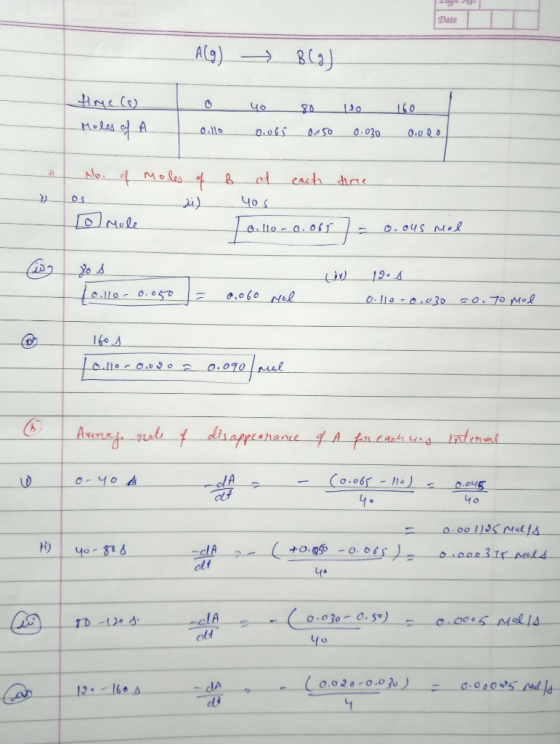
19. + -10.11 points 0/4 Submissions Used My Notes A flask is charged with 0.110 mol...
5. -/0.1 points 0/4 Submissions Used A flask is charged with 0.150 mol of A and...
 5. -/0.1 points 0/4 Submissions Used A flask is charged with 0.150 mol of A and allowed to react to form B according to the following hypothetical gas-phase reaction. A(g) → (9) The following data are collected. times (s) moles of A 0 0.150 40 0.071 80 0.041 120 0.032 160 0.021 (a) Calculate the number of moles of B at each time in the table. Os mol 40 s 80 s mol 120 s 160 s (b) Calculate the...
A flask is charged with 0.120 mol of A and allowed to react to form B...
 A flask is charged with 0.120 mol of A and allowed to react to
form B according to the following hypothetical gas-phase
reaction.
A(g) B(g)
The following data are collected.
times (s)
0
40
80
120
160
moles of A
0.120
0.062
0.041
0.033
0.019
(a) Calculate the number of moles of B at each time in the
table.
0 s
_mol
40 s
_mol
80 s
_mol
_120 s
mol
160 s
_mol
(b) Calculate the average rate of...
A flask is charged with 0.120 mol of A and allowed to react to
form B according to the following hypothetical gas-phase
reaction.
A(g) B(g)
The following data are collected.
times (s)
0
40
80
120
160
moles of A
0.120
0.062
0.041
0.033
0.019
(a) Calculate the number of moles of B at each time in the
table.
0 s
_mol
40 s
_mol
80 s
_mol
_120 s
mol
160 s
_mol
(b) Calculate the average rate of...
Part 1.) A flask is charged with 0.110 mol of A and allowed to react to...
 Part 1.)
A flask is charged with 0.110 mol of A and allowed to react to
form B according to the following hypothetical gas-phase
reaction.
A(g) B(g)
The following data are collected.
times
(s)
0
40
80
120
160
moles of
A
0.110
0.070
0.043
0.032
0.024
(a) Calculate the number of moles of B at each time in the
table.
0 s
__ mol
40 s
__ mol
80 s
__ mol
120 s
__ mol
160 s
__...
Part 1.)
A flask is charged with 0.110 mol of A and allowed to react to
form B according to the following hypothetical gas-phase
reaction.
A(g) B(g)
The following data are collected.
times
(s)
0
40
80
120
160
moles of
A
0.110
0.070
0.043
0.032
0.024
(a) Calculate the number of moles of B at each time in the
table.
0 s
__ mol
40 s
__ mol
80 s
__ mol
120 s
__ mol
160 s
__...
A flask is charged with 0.124 mol of A and allowed to react to form B...
 A flask is charged with 0.124 mol of A and allowed
to react to form B according to the reaction A(g)
B(g). The following data are obtained
for A as the reaction proceeds:
The average rate of disappearance of A between 20.0 s and 40.0 s
is ________ mol/s
Select one:
A. 1.4 × 10⁻³
B. 7.1 × 10⁻³
C. 8.5 × 10⁻⁴
D. 1.7 × 10⁻³
E. 590
Time (S) 0.0 10.0 20.0 30.0 40.0 Moles of A 0.124...
A flask is charged with 0.124 mol of A and allowed
to react to form B according to the reaction A(g)
B(g). The following data are obtained
for A as the reaction proceeds:
The average rate of disappearance of A between 20.0 s and 40.0 s
is ________ mol/s
Select one:
A. 1.4 × 10⁻³
B. 7.1 × 10⁻³
C. 8.5 × 10⁻⁴
D. 1.7 × 10⁻³
E. 590
Time (S) 0.0 10.0 20.0 30.0 40.0 Moles of A 0.124...
please show work. i need to know how to do this for a test A flask...
 please show work. i need to know how to do this for a
test
A flask is charged with 0.124 mol of A and allowed to react to form B according to the reaction A(g) →B(g). The following data are obtained for [A] as the reaction proceeds: Time (s) 0.00 10.0- 20.0 30.0 40.0 Moles of A 0.124 0.110 0.088 0.073 0.054 The average rate of disappearance of A between 10 s and 20 s is mol/s. ect Answer 2.2...
please show work. i need to know how to do this for a
test
A flask is charged with 0.124 mol of A and allowed to react to form B according to the reaction A(g) →B(g). The following data are obtained for [A] as the reaction proceeds: Time (s) 0.00 10.0- 20.0 30.0 40.0 Moles of A 0.124 0.110 0.088 0.073 0.054 The average rate of disappearance of A between 10 s and 20 s is mol/s. ect Answer 2.2...
A flask is charged with 2.78 mol of A and allowed to react to form B...
 A flask is charged with 2.78 mol of A and allowed to react to form B according to the reaction A(g) →B(g). The following data are obtained for [A] as the reaction proceeds: Time (s) mols of A 0.0 2.78 10.0 2.43 20.0 2.18 30.0 2.02 40.0 1.89 50.0 1.70 60.0 1.58 The average rate of disappearance of A for the first 30s is _ mol/s. *Please report 2 significant figures. Numbers only, no unit. No scientific notation. The value...
10. 0/4 Submissions Used -/0.09 points A mixture of 0.01270 mol of CH4, 0.01129 mol of...
 10. 0/4 Submissions Used -/0.09 points A mixture of 0.01270 mol of CH4, 0.01129 mol of H2S, 0.02016 mol of CS2, and 0.02436 mol of H2 is placed in a 1.0-L steel pressure vessel at 3625 K. The following equilibrium is established: 1 CH4(g)2 H2S(g)1CS2 (g ) +4 H2(g) At equilibrium 0.002399 mol of H25 is found in the reaction mixture (a) Calculate the equilibrium partial pressures of CH4, H25, CS2, and H2 Peq(CH4) Peq(H2S) Peq(CS2) Peq(H2) (b) Calculate Kp...
26. -/0.1 points 0/4 Submissions Used My Note A buffer solution contains 0.71 mol of hydrogen...
 26. -/0.1 points 0/4 Submissions Used My Note A buffer solution contains 0.71 mol of hydrogen peroxide (HOOH) and 0.41 mol of sodium hydrogen peroxide (NaOH) in 7.60 L. The Ka of hydrogen peroxide (HOOH) is ka = 2.4e-12. (a) What is the pH of this buffer? pH = (b) What is the pH of the buffer after the addition of 0.36 mol of NaOH? (assume no volume change) pH = (c) What is the pH of the original buffer...
0-4 points Notos Ask Your To 7· SorPSET9 23P030. 0/5 Submissions Used Three charged particles are...
 0-4 points Notos Ask Your To 7· SorPSET9 23P030. 0/5 Submissions Used Three charged particles are at the coners of an equilateral triangle as shown in the figure below. (Let q - 3.00 uc, and L - 0.350 m.) 7.00 60.0 4.00 C (a) Calculate the electric field at the position of charge q due to the 7.00-HC and -4.00-UC charges kN/c j (b) Use your answer to part (a) to determine the force on charge q mN Need Help?...
 5. -/0.1 points 0/4 Submissions Used A flask is charged with 0.150 mol of A and allowed to react to form B according to the following hypothetical gas-phase reaction. A(g) → (9) The following data are collected. times (s) moles of A 0 0.150 40 0.071 80 0.041 120 0.032 160 0.021 (a) Calculate the number of moles of B at each time in the table. Os mol 40 s 80 s mol 120 s 160 s (b) Calculate the...
 A flask is charged with 0.120 mol of A and allowed to react to
form B according to the following hypothetical gas-phase
reaction.
A(g) B(g)
The following data are collected.
times (s)
0
40
80
120
160
moles of A
0.120
0.062
0.041
0.033
0.019
(a) Calculate the number of moles of B at each time in the
table.
0 s
_mol
40 s
_mol
80 s
_mol
_120 s
mol
160 s
_mol
(b) Calculate the average rate of...
A flask is charged with 0.120 mol of A and allowed to react to
form B according to the following hypothetical gas-phase
reaction.
A(g) B(g)
The following data are collected.
times (s)
0
40
80
120
160
moles of A
0.120
0.062
0.041
0.033
0.019
(a) Calculate the number of moles of B at each time in the
table.
0 s
_mol
40 s
_mol
80 s
_mol
_120 s
mol
160 s
_mol
(b) Calculate the average rate of...
 Part 1.)
A flask is charged with 0.110 mol of A and allowed to react to
form B according to the following hypothetical gas-phase
reaction.
A(g) B(g)
The following data are collected.
times
(s)
0
40
80
120
160
moles of
A
0.110
0.070
0.043
0.032
0.024
(a) Calculate the number of moles of B at each time in the
table.
0 s
__ mol
40 s
__ mol
80 s
__ mol
120 s
__ mol
160 s
__...
Part 1.)
A flask is charged with 0.110 mol of A and allowed to react to
form B according to the following hypothetical gas-phase
reaction.
A(g) B(g)
The following data are collected.
times
(s)
0
40
80
120
160
moles of
A
0.110
0.070
0.043
0.032
0.024
(a) Calculate the number of moles of B at each time in the
table.
0 s
__ mol
40 s
__ mol
80 s
__ mol
120 s
__ mol
160 s
__...
 A flask is charged with 0.124 mol of A and allowed
to react to form B according to the reaction A(g)
B(g). The following data are obtained
for A as the reaction proceeds:
The average rate of disappearance of A between 20.0 s and 40.0 s
is ________ mol/s
Select one:
A. 1.4 × 10⁻³
B. 7.1 × 10⁻³
C. 8.5 × 10⁻⁴
D. 1.7 × 10⁻³
E. 590
Time (S) 0.0 10.0 20.0 30.0 40.0 Moles of A 0.124...
A flask is charged with 0.124 mol of A and allowed
to react to form B according to the reaction A(g)
B(g). The following data are obtained
for A as the reaction proceeds:
The average rate of disappearance of A between 20.0 s and 40.0 s
is ________ mol/s
Select one:
A. 1.4 × 10⁻³
B. 7.1 × 10⁻³
C. 8.5 × 10⁻⁴
D. 1.7 × 10⁻³
E. 590
Time (S) 0.0 10.0 20.0 30.0 40.0 Moles of A 0.124...
 please show work. i need to know how to do this for a
test
A flask is charged with 0.124 mol of A and allowed to react to form B according to the reaction A(g) →B(g). The following data are obtained for [A] as the reaction proceeds: Time (s) 0.00 10.0- 20.0 30.0 40.0 Moles of A 0.124 0.110 0.088 0.073 0.054 The average rate of disappearance of A between 10 s and 20 s is mol/s. ect Answer 2.2...
please show work. i need to know how to do this for a
test
A flask is charged with 0.124 mol of A and allowed to react to form B according to the reaction A(g) →B(g). The following data are obtained for [A] as the reaction proceeds: Time (s) 0.00 10.0- 20.0 30.0 40.0 Moles of A 0.124 0.110 0.088 0.073 0.054 The average rate of disappearance of A between 10 s and 20 s is mol/s. ect Answer 2.2...
 A flask is charged with 2.78 mol of A and allowed to react to form B according to the reaction A(g) →B(g). The following data are obtained for [A] as the reaction proceeds: Time (s) mols of A 0.0 2.78 10.0 2.43 20.0 2.18 30.0 2.02 40.0 1.89 50.0 1.70 60.0 1.58 The average rate of disappearance of A for the first 30s is _ mol/s. *Please report 2 significant figures. Numbers only, no unit. No scientific notation. The value...
 10. 0/4 Submissions Used -/0.09 points A mixture of 0.01270 mol of CH4, 0.01129 mol of H2S, 0.02016 mol of CS2, and 0.02436 mol of H2 is placed in a 1.0-L steel pressure vessel at 3625 K. The following equilibrium is established: 1 CH4(g)2 H2S(g)1CS2 (g ) +4 H2(g) At equilibrium 0.002399 mol of H25 is found in the reaction mixture (a) Calculate the equilibrium partial pressures of CH4, H25, CS2, and H2 Peq(CH4) Peq(H2S) Peq(CS2) Peq(H2) (b) Calculate Kp...
 26. -/0.1 points 0/4 Submissions Used My Note A buffer solution contains 0.71 mol of hydrogen peroxide (HOOH) and 0.41 mol of sodium hydrogen peroxide (NaOH) in 7.60 L. The Ka of hydrogen peroxide (HOOH) is ka = 2.4e-12. (a) What is the pH of this buffer? pH = (b) What is the pH of the buffer after the addition of 0.36 mol of NaOH? (assume no volume change) pH = (c) What is the pH of the original buffer...
 0-4 points Notos Ask Your To 7· SorPSET9 23P030. 0/5 Submissions Used Three charged particles are at the coners of an equilateral triangle as shown in the figure below. (Let q - 3.00 uc, and L - 0.350 m.) 7.00 60.0 4.00 C (a) Calculate the electric field at the position of charge q due to the 7.00-HC and -4.00-UC charges kN/c j (b) Use your answer to part (a) to determine the force on charge q mN Need Help?...
Most questions answered within 3 hours.
-
Where is the error in this code sequence?
String s1 = "Hello";
String s2 = "ello";...
asked 10 months ago -
Financial data for Joel de Paris, Inc., for last year
follow:
Joel de Paris, Inc.
Balance...
asked 10 months ago -
Consider this reaction:
Al2(SO4)3 (aq)+ BaCl3
(aq) Al2Cl6 (aq)- +
3BaSO4(s) . What is the...
asked 10 months ago -
Suppose that Savneet is considering increasing her
recent random sample from 20 car rentals to 40...
asked 10 months ago -
Trucks arrive at an unloading terminal at an average rate of 120
per hour.
Trucks arrive...
asked 10 months ago -
Why are methanol and ethanol completely soluble in water while
octanol is not very little soluble....
asked 10 months ago -
A facilities manager at a university reads in a research report
that the mean amount of...
asked 10 months ago -
When the CuSO4 is rehydrated by adding water to the anhydrous
compound, is this an endothermic...
asked 10 months ago -
A ray of sunlight is passing from diamond into crown glass; the
angle of incidence is...
asked 10 months ago -
A block of mass 0.249 kg is placed on top of a light, vertical
spring of...
asked 10 months ago -
how do the kidneys compensate in the presences of acidosis
a) trigger hyperventilate
b) reserve acid...
asked 10 months ago -
Question 501 pts
The rental rate of capital to the firm increases. Which of the
following...
asked 10 months ago