
Homework Answers
Add Answer to:
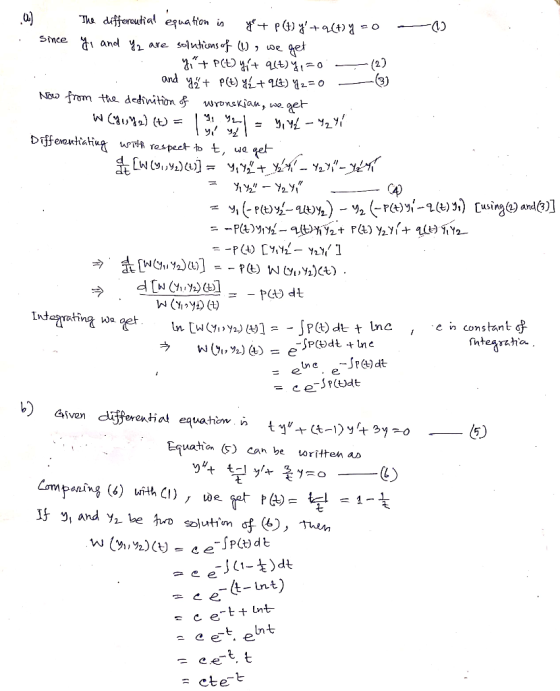
Bonus (Abel's formula) a) Show that if y1 and y2 are solutions to the differential equation...
For the differential equation in) pin -1) + ... + Polly with solutions ....Yo Abel's formula...
 For the differential equation in) pin -1) + ... + Polly with solutions ....Yo Abel's formula for the Wronskian is Wy ... (t) = cel ot Consider the equation (4) - y 0 . (a) Use Abel's formula from above to find the Wronskian of a fundamental set of solutions of the given equation. (Use as the constant mentioned in Abel's formula.) w(t) ce el cost, and sint. (b) Determine the Wronskian of the solutions d Wel, e, cost, sin...
If y is a known nonvanishing solution of y" p(t)y + q(t)y 0, then a second...
 If y is a known nonvanishing solution of y" p(t)y + q(t)y 0, then a second solution y2 satisfies 2 У1? where W(y1, y2) is the Wronskian of y1 and y2. To determine y2, use Abel's formula, W(y1, Y2)(t) =C.eJP(t) dt, where C is certain constant that depends on y1 and y2, but not on t. Use the method above o find a second independent solution of the given equation. (х — 1)у" - ху" + у %3D 0, x>...
Consider the ordinary differential equation: t2y" + 3ty' +y = 0. 1 (3 points) e) Use...
 Consider the ordinary differential equation: t2y" + 3ty' +y = 0. 1 (3 points) e) Use Abel's formula to find the Wronskian of any two solutions of this equation and W[y1,y2](t). What do you observe? compare it to = t1 and y2(t) = t-1 nt represent a fundamental set of solu f) (2 points) Determine if y1 (t) tions (2 points) Find the general solution of t2y" +3ty' +y = 0. g) Solve the initial value problem t2y" + 3ty/...
A) Assume that y1(c) t and y2)te are solutions of the differential equation t2y_ t(t + 2))" + t(t...
 a) Assume that y1(c) t and y2)te are solutions of the differential equation t2y_ t(t + 2))" + t(t + 2)y-0, t > 0 Do y1(t) and y2() form a fundamental set of solutions of the O.D.E.? C) State the general solution for this O.D.E.
a) Assume that y1(c) t and y2)te are solutions of the differential equation t2y_ t(t + 2))" + t(t + 2)y-0, t > 0 Do y1(t) and y2() form a fundamental set of solutions of...
a) Assume that y1(c) t and y2)te are solutions of the differential equation t2y_ t(t + 2))" + t(t + 2)y-0, t > 0 Do y1(t) and y2() form a fundamental set of solutions of the O.D.E.? C) State the general solution for this O.D.E.
a) Assume that y1(c) t and y2)te are solutions of the differential equation t2y_ t(t + 2))" + t(t + 2)y-0, t > 0 Do y1(t) and y2() form a fundamental set of solutions of...
find Y1=, Y2=, and W(t)= (1 point) Find the function yi of t which is the...
 find Y1=, Y2=, and W(t)=
(1 point) Find the function yi of t which is the solution of 25y" – 40y' + 12y = 0 y(0) = 1, yf(0) = 0. with initial conditions Yi = Find the function y2 of t which is the solution of 25y" – 40y' + 12y = 0 with initial conditions Y2 = Find the Wronskian W(t) = W(y1, y2). W(t) = Remark: You can find W by direct computation and use Abel's theorem...
find Y1=, Y2=, and W(t)=
(1 point) Find the function yi of t which is the solution of 25y" – 40y' + 12y = 0 y(0) = 1, yf(0) = 0. with initial conditions Yi = Find the function y2 of t which is the solution of 25y" – 40y' + 12y = 0 with initial conditions Y2 = Find the Wronskian W(t) = W(y1, y2). W(t) = Remark: You can find W by direct computation and use Abel's theorem...
Consider the differential equation, L[y] = y'' + p(t)y' + q(t)y = 0, (1) whose coefficients...
 Consider the differential
equation, L[y] = y'' + p(t)y' + q(t)y = 0, (1) whose coefficients p
and q are continuous on some open interval I. Choose some point t0
in I. Let y1 be the solution of equation (1) that also satisfies
the initial conditions y(t0) = 1, y'(t0) = 0, and let y2 be the
solution of equation (1) that satisfies the initial conditions
y(t0) = 0, y'(t0) = 1. Then y1 and y2 form a fundamental set...
Consider the differential
equation, L[y] = y'' + p(t)y' + q(t)y = 0, (1) whose coefficients p
and q are continuous on some open interval I. Choose some point t0
in I. Let y1 be the solution of equation (1) that also satisfies
the initial conditions y(t0) = 1, y'(t0) = 0, and let y2 be the
solution of equation (1) that satisfies the initial conditions
y(t0) = 0, y'(t0) = 1. Then y1 and y2 form a fundamental set...
Please prove this solution and explain why y2 can be taken as (x^2)(y1) Problem 2. Find the general solution of the equation Note that one of two linearly independent solutions is yi(r) -e. Solution....
 Please prove this solution and explain why y2 can be taken as
(x^2)(y1)
Problem 2. Find the general solution of the equation Note that one of two linearly independent solutions is yi(r) -e. Solution. Using Abel's formula, we get the following relations for the Wronskian dW pi dW 2r1 On the other hand, Comparing these two expression for W(x), we can take y2 :- r2yı. Correspondingly, the general solution is
Problem 2. Find the general solution of the equation Note...
Please prove this solution and explain why y2 can be taken as
(x^2)(y1)
Problem 2. Find the general solution of the equation Note that one of two linearly independent solutions is yi(r) -e. Solution. Using Abel's formula, we get the following relations for the Wronskian dW pi dW 2r1 On the other hand, Comparing these two expression for W(x), we can take y2 :- r2yı. Correspondingly, the general solution is
Problem 2. Find the general solution of the equation Note...
(1 point) It can be shown that yı = e-4x and y2 = xe-4x are solutions...
 (1 point) It can be shown that yı = e-4x and y2 = xe-4x are solutions to the differential equation y + 8y +16y=0 on the interval (-00, 00). Find the Wronskian of yn y (Note the order matters) W(y1, y2) = Do the functions yn y form a fundamental set on (-00,00)? Answer should be yes or no
if y1(t) and y2(t) are two solutions of the differential equation y^2-y'+y=0 then for any constants...
if y1(t) and y2(t) are two solutions of the differential equation y^2-y'+y=0 then for any constants c1 and c2 c1y1(t)+c2y2(t) is also a solution true or false and why
17. Another way to check if y1, y2 are linearly INDEPENDENT in an interval I is:...
 17. Another way to check if y1, y2 are linearly INDEPENDENT in
an interval I is:
for all I
for all I
does not exist for all I
d. none of the above
18. If y1 is a solution of the equation y "+ P (x) y '+ Q (x) y
= 0, a second solution would be y2 (x) = u (x) y1 (x) where u (x)
it is:
d. all of the above
19. The following set...
17. Another way to check if y1, y2 are linearly INDEPENDENT in
an interval I is:
for all I
for all I
does not exist for all I
d. none of the above
18. If y1 is a solution of the equation y "+ P (x) y '+ Q (x) y
= 0, a second solution would be y2 (x) = u (x) y1 (x) where u (x)
it is:
d. all of the above
19. The following set...
 For the differential equation in) pin -1) + ... + Polly with solutions ....Yo Abel's formula for the Wronskian is Wy ... (t) = cel ot Consider the equation (4) - y 0 . (a) Use Abel's formula from above to find the Wronskian of a fundamental set of solutions of the given equation. (Use as the constant mentioned in Abel's formula.) w(t) ce el cost, and sint. (b) Determine the Wronskian of the solutions d Wel, e, cost, sin...
 If y is a known nonvanishing solution of y" p(t)y + q(t)y 0, then a second solution y2 satisfies 2 У1? where W(y1, y2) is the Wronskian of y1 and y2. To determine y2, use Abel's formula, W(y1, Y2)(t) =C.eJP(t) dt, where C is certain constant that depends on y1 and y2, but not on t. Use the method above o find a second independent solution of the given equation. (х — 1)у" - ху" + у %3D 0, x>...
 Consider the ordinary differential equation: t2y" + 3ty' +y = 0. 1 (3 points) e) Use Abel's formula to find the Wronskian of any two solutions of this equation and W[y1,y2](t). What do you observe? compare it to = t1 and y2(t) = t-1 nt represent a fundamental set of solu f) (2 points) Determine if y1 (t) tions (2 points) Find the general solution of t2y" +3ty' +y = 0. g) Solve the initial value problem t2y" + 3ty/...
 a) Assume that y1(c) t and y2)te are solutions of the differential equation t2y_ t(t + 2))" + t(t + 2)y-0, t > 0 Do y1(t) and y2() form a fundamental set of solutions of the O.D.E.? C) State the general solution for this O.D.E.
a) Assume that y1(c) t and y2)te are solutions of the differential equation t2y_ t(t + 2))" + t(t + 2)y-0, t > 0 Do y1(t) and y2() form a fundamental set of solutions of...
a) Assume that y1(c) t and y2)te are solutions of the differential equation t2y_ t(t + 2))" + t(t + 2)y-0, t > 0 Do y1(t) and y2() form a fundamental set of solutions of the O.D.E.? C) State the general solution for this O.D.E.
a) Assume that y1(c) t and y2)te are solutions of the differential equation t2y_ t(t + 2))" + t(t + 2)y-0, t > 0 Do y1(t) and y2() form a fundamental set of solutions of...
 find Y1=, Y2=, and W(t)=
(1 point) Find the function yi of t which is the solution of 25y" – 40y' + 12y = 0 y(0) = 1, yf(0) = 0. with initial conditions Yi = Find the function y2 of t which is the solution of 25y" – 40y' + 12y = 0 with initial conditions Y2 = Find the Wronskian W(t) = W(y1, y2). W(t) = Remark: You can find W by direct computation and use Abel's theorem...
find Y1=, Y2=, and W(t)=
(1 point) Find the function yi of t which is the solution of 25y" – 40y' + 12y = 0 y(0) = 1, yf(0) = 0. with initial conditions Yi = Find the function y2 of t which is the solution of 25y" – 40y' + 12y = 0 with initial conditions Y2 = Find the Wronskian W(t) = W(y1, y2). W(t) = Remark: You can find W by direct computation and use Abel's theorem...
 Consider the differential
equation, L[y] = y'' + p(t)y' + q(t)y = 0, (1) whose coefficients p
and q are continuous on some open interval I. Choose some point t0
in I. Let y1 be the solution of equation (1) that also satisfies
the initial conditions y(t0) = 1, y'(t0) = 0, and let y2 be the
solution of equation (1) that satisfies the initial conditions
y(t0) = 0, y'(t0) = 1. Then y1 and y2 form a fundamental set...
Consider the differential
equation, L[y] = y'' + p(t)y' + q(t)y = 0, (1) whose coefficients p
and q are continuous on some open interval I. Choose some point t0
in I. Let y1 be the solution of equation (1) that also satisfies
the initial conditions y(t0) = 1, y'(t0) = 0, and let y2 be the
solution of equation (1) that satisfies the initial conditions
y(t0) = 0, y'(t0) = 1. Then y1 and y2 form a fundamental set...
 Please prove this solution and explain why y2 can be taken as
(x^2)(y1)
Problem 2. Find the general solution of the equation Note that one of two linearly independent solutions is yi(r) -e. Solution. Using Abel's formula, we get the following relations for the Wronskian dW pi dW 2r1 On the other hand, Comparing these two expression for W(x), we can take y2 :- r2yı. Correspondingly, the general solution is
Problem 2. Find the general solution of the equation Note...
Please prove this solution and explain why y2 can be taken as
(x^2)(y1)
Problem 2. Find the general solution of the equation Note that one of two linearly independent solutions is yi(r) -e. Solution. Using Abel's formula, we get the following relations for the Wronskian dW pi dW 2r1 On the other hand, Comparing these two expression for W(x), we can take y2 :- r2yı. Correspondingly, the general solution is
Problem 2. Find the general solution of the equation Note...
 (1 point) It can be shown that yı = e-4x and y2 = xe-4x are solutions to the differential equation y + 8y +16y=0 on the interval (-00, 00). Find the Wronskian of yn y (Note the order matters) W(y1, y2) = Do the functions yn y form a fundamental set on (-00,00)? Answer should be yes or no
 17. Another way to check if y1, y2 are linearly INDEPENDENT in
an interval I is:
for all I
for all I
does not exist for all I
d. none of the above
18. If y1 is a solution of the equation y "+ P (x) y '+ Q (x) y
= 0, a second solution would be y2 (x) = u (x) y1 (x) where u (x)
it is:
d. all of the above
19. The following set...
17. Another way to check if y1, y2 are linearly INDEPENDENT in
an interval I is:
for all I
for all I
does not exist for all I
d. none of the above
18. If y1 is a solution of the equation y "+ P (x) y '+ Q (x) y
= 0, a second solution would be y2 (x) = u (x) y1 (x) where u (x)
it is:
d. all of the above
19. The following set...
Most questions answered within 3 hours.
-
Where is the error in this code sequence?
String s1 = "Hello";
String s2 = "ello";...
asked 11 months ago -
Financial data for Joel de Paris, Inc., for last year
follow:
Joel de Paris, Inc.
Balance...
asked 11 months ago -
Consider this reaction:
Al2(SO4)3 (aq)+ BaCl3
(aq) Al2Cl6 (aq)- +
3BaSO4(s) . What is the...
asked 11 months ago -
Suppose that Savneet is considering increasing her
recent random sample from 20 car rentals to 40...
asked 11 months ago -
Trucks arrive at an unloading terminal at an average rate of 120
per hour.
Trucks arrive...
asked 11 months ago -
Why are methanol and ethanol completely soluble in water while
octanol is not very little soluble....
asked 11 months ago -
A facilities manager at a university reads in a research report
that the mean amount of...
asked 11 months ago -
When the CuSO4 is rehydrated by adding water to the anhydrous
compound, is this an endothermic...
asked 11 months ago -
A ray of sunlight is passing from diamond into crown glass; the
angle of incidence is...
asked 11 months ago -
A block of mass 0.249 kg is placed on top of a light, vertical
spring of...
asked 11 months ago -
how do the kidneys compensate in the presences of acidosis
a) trigger hyperventilate
b) reserve acid...
asked 11 months ago -
Question 501 pts
The rental rate of capital to the firm increases. Which of the
following...
asked 11 months ago