
Homework Answers
Add Answer to:
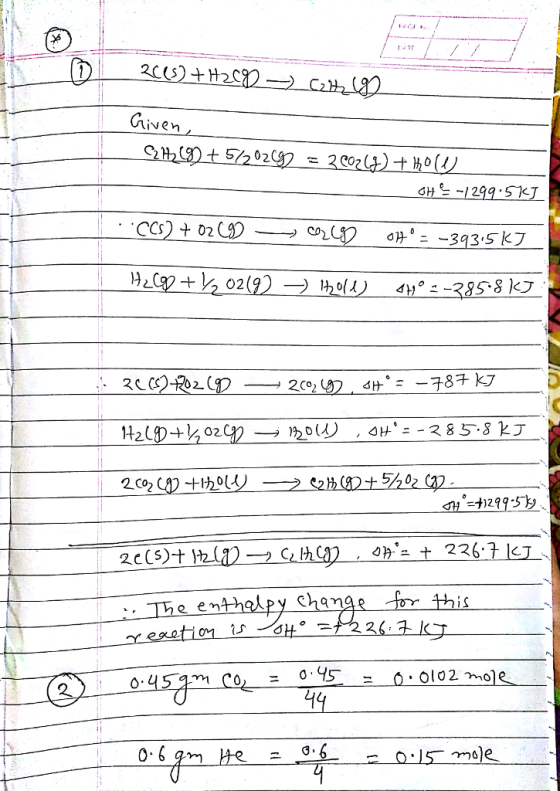
1. Calculate the change in enthalpy for this reaction: 2C(s) + H2(g) → C2H2(g) Given the...
Calculate the enthalpy of the following reaction: C (s) + 2 H2 (g) --> CH4 (g)...
Calculate the enthalpy of the following reaction: C (s) + 2 H2 (g) --> CH4 (g) Given: C (s) + O2 (g) --> CO2 ΔH = -393 kJ H2 + 1⁄2O2 --> H2O. ΔH = -286 kJ CH4 + 2O2 --> CO2 + 2H2O ΔH = -892 kJ
a) Use Hess's law to calculate the enthalpy change for the reaction: 3C(s) + 4H2(g) +...
a) Use Hess's law to calculate the enthalpy change for the reaction: 3C(s) + 4H2(g) + ½O2(g) → C3H8O(l) Given the following thermochemical equations: 2C3H8O(l) + 9O2(g) → 6CO2(g) + 8H2O(l) ΔH = -4042.6 kJ/mol C(s) + O2(g) → CO2(g) ΔH = -393.51 kJ/mol H2(g) + ½O2(g) → H2O(l) ΔH = -285.83 kJ/mol (in kJ/mol) A: -267.7 B: -302.6 C: -341.9 D: -386.3 E: -436.5 F: -493.3 G: -557.4 H: -629.9 b) Define if the following statement is an endothermic process or exothermic...
Calculate the enthalpy change for the reaction C (graphite) + 2 H2 (g) + ½ O2...
Calculate the enthalpy change for the reaction C (graphite) + 2 H2 (g) + ½ O2 (g) → CH3OH (ℓ) Using the following information: C (graphite) + O2 (g) → CO2 (g) ΔHf° = –393.5 kJ H2 (g) + ½ O2 (g) → H2O (ℓ) ΔHf° = –285.8 kJ CH3OH (ℓ) + 3/2 O2 (g) → CO2 (g) + 2 H2O (ℓ) ΔHrxn° = –726.4 kJ a. –238.7 kJ b. 1691.5 kJ c. –1691.5 kJ d. 47.1 kJ e. –47.1...
Calculate the enthalpy change for the reaction NO(g) + O(g) → NO2(g)
Calculate the enthalpy change for the reaction NO(g) + O(g) → NO2(g) from the following data NO(g) + O3(9) → NO2(g) + O2(g) ΔH=-198.9 kJ/mol O3(g) → 1.5O26(g) ΔH=-142.3 kJ/mol O2(g) → 2O(g) ΔH = 495.0 kJ/mol A. 153.8 kJ B. 190.9 kJ C.-551.6 kJ D.-304.1 kJ E. 438.4 kJ
Part A Calculate the enthalpy of the reaction 2NO(g)+O2(g)→2NO2(g) given the following reactions and enthalpies of fo...
Part A Calculate the enthalpy of the reaction 2NO(g)+O2(g)→2NO2(g) given the following reactions and enthalpies of formation: 12N2(g)+O2(g)→NO2(g), ΔH∘A=33.2 kJ 12N2(g)+12O2(g)→NO(g), ΔH∘B=90.2 kJ Express your answer with the appropriate units. Part B Calculate the enthalpy of the reaction 4B(s)+3O2(g)→2B2O3(s) given the following pertinent information: B2O3(s)+3H2O(g)→3O2(g)+B2H6(g), ΔH∘A=+2035 kJ 2B(s)+3H2(g)→B2H6(g), ΔH∘B=+36 kJ H2(g)+12O2(g)→H2O(l), ΔH∘C=−285 kJ H2O(l)→H2O(g), ΔH∘D=+44 kJ Express your answer with the appropriate units.
Calculate ΔHrxn for the following reaction: 5 C (s) + 6 H2 (g) → C5H12 (l)...
Calculate ΔHrxn for the following reaction: 5 C (s) + 6 H2 (g) → C5H12 (l) Use the following reactions and given ΔH′s. C5H12 (l) + 8 O2 (g) → 5 CO2 (g) + 6 H2O (g), ΔH= -3244.8 kJ C (s) + O2 (g) → CO2 (g), ΔH= -393.5 kJ 2 H2 (g) + O2 (g) → 2 H2O (g), ΔH = -483.5 kJ
Calculate the enthalpy of the reaction 4B(s)+3O2(g)→2B2O3(s) given the following pertinent information: B2O3(s)+3H2O(...
Calculate the enthalpy of the reaction 4B(s)+3O2(g)→2B2O3(s) given the following pertinent information: B2O3(s)+3H2O(g)→3O2(g)+B2H6(g), ΔH∘A=+2035 kJ 2B(s)+3H2(g)→B2H6(g), ΔH∘B=+36 kJ H2(g)+12O2(g)→H2O(l), ΔH∘C=−285 kJ H2O(l)→H2O(g), ΔH∘D=+44 kJ
Calculate the enthalpy of the reaction: 2 NO(g) + O2(g) --> 2 NO2(g) given the following...
Calculate the enthalpy of the reaction: 2 NO(g) + O2(g) --> 2 NO2(g) given the following reactions and enthalpies of formation: 1/2 N2(g) + O2(g) → NO2(g), ΔH = 33.2 kJ 1/2 N2(g) + 1/2 O2(g) → NO(g), ΔH = 90.2 kJ
Part A - Calculating an Enthalpy of Reaction from Enthalpies of Formation Calculate the enthalpy change...
Part A - Calculating an Enthalpy of Reaction from Enthalpies of Formation Calculate the enthalpy change for the reaction: 2 H2O2(l) → 2 H2O(l) + O2(g) using enthalpies of formation: ΔH∘f[H2O2]ΔH∘f[H2O]==−187.8 kJ/mol−285.8 kJ/mol Calculate the enthalpy change for the reaction: using enthalpies of formation: Multiple choice answers below: -98.0 kJ -196.0 kJ +98.0 kJ +196.0 kJ
Using standard heats of formation, calculate the standard enthalpy change for the following reaction. H2(g) +...
 Using standard heats of formation, calculate the standard enthalpy change for the following reaction. H2(g) + Cl2(g)—>2HCI(g) ANSWER: kJ Using standard heats of formation, calculate the standard enthalpy change for the following reaction. 2H20(1)——2H2(g) + O2(g) ANSWER: kJ
 Using standard heats of formation, calculate the standard enthalpy change for the following reaction. H2(g) + Cl2(g)—>2HCI(g) ANSWER: kJ Using standard heats of formation, calculate the standard enthalpy change for the following reaction. 2H20(1)——2H2(g) + O2(g) ANSWER: kJ
Most questions answered within 3 hours.
-
Where is the error in this code sequence?
String s1 = "Hello";
String s2 = "ello";...
asked 10 months ago -
Financial data for Joel de Paris, Inc., for last year
follow:
Joel de Paris, Inc.
Balance...
asked 10 months ago -
Consider this reaction:
Al2(SO4)3 (aq)+ BaCl3
(aq) Al2Cl6 (aq)- +
3BaSO4(s) . What is the...
asked 10 months ago -
Suppose that Savneet is considering increasing her
recent random sample from 20 car rentals to 40...
asked 10 months ago -
Trucks arrive at an unloading terminal at an average rate of 120
per hour.
Trucks arrive...
asked 10 months ago -
Why are methanol and ethanol completely soluble in water while
octanol is not very little soluble....
asked 10 months ago -
A facilities manager at a university reads in a research report
that the mean amount of...
asked 10 months ago -
When the CuSO4 is rehydrated by adding water to the anhydrous
compound, is this an endothermic...
asked 10 months ago -
A ray of sunlight is passing from diamond into crown glass; the
angle of incidence is...
asked 10 months ago -
A block of mass 0.249 kg is placed on top of a light, vertical
spring of...
asked 10 months ago -
how do the kidneys compensate in the presences of acidosis
a) trigger hyperventilate
b) reserve acid...
asked 10 months ago -
Question 501 pts
The rental rate of capital to the firm increases. Which of the
following...
asked 10 months ago