
Homework Answers
PART A
The curve C is defined by the vector r(t) which is:

To compute the lenght of the curve C, use the following line integral:
![\int_{c}f(x(t),y(t),z(t))\sqrt{\left [ x^{'}(t) \right ]^2+\left [ y^{'}(t) \right ]^2+\left [ z^{'}(t) \right ]^2}dt](http://img.homeworklib.com/questions/e0448210-4e3b-11eb-95ee-1d399861a40a.png?x-oss-process=image/resize,w_560)
Determine the first derivative of r(t), like follows:
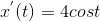


By substituting the corresponding values, the line integral is:
![\int_{0}^{2\pi}<4sint,-4cost,0>\sqrt{\left [ 4cost\right ]^2+\left [ 4sint \right ]^2+\left [ 0 \right ]^2}dt](http://img.homeworklib.com/questions/e1b4dd00-4e3b-11eb-b31c-d58634bfa2b1.png?x-oss-process=image/resize,w_560)


Note: Remember the following trigonometric identity.

So,
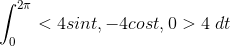
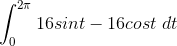
![\left [-16cost-16sint \right ]_{0}^{2\pi}](http://img.homeworklib.com/questions/e3a7dce0-4e3b-11eb-a8cc-8b9bec8c7e7f.png?x-oss-process=image/resize,w_560)


Therefore, the line integral for the function r(t) equals cero.

PART B
To parametrize the curve C with respect to are length, follow the steps:

Calculate the magnitude of r'(t) like follows:
![|\vec{r^{'}}(t)|=\sqrt{\left [ 4cost\right ]^2+\left [ 4sint \right ]^2+\left [ 0 \right ]^2}](http://img.homeworklib.com/questions/e576b610-4e3b-11eb-bb37-5f4fd6aa06a8.png?x-oss-process=image/resize,w_560)

![s(t)=\int_{0}^{t}4dt= 4\left [t \right ]_{0}^{t}](http://img.homeworklib.com/questions/e6266b80-4e3b-11eb-9fed-8bf56eca82dd.png?x-oss-process=image/resize,w_560)

Now, solve for t in terms of s.

Finally, substitute the value of t in the vector r(t).

PART C
In order to determine the curvature of the function use the following expression:
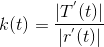
Where,
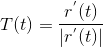
Therefore, first calculate the value of T(t):


Now, the first derivate of T(t) is:

Then, determine the maginitude of T'(t):

Finally, the value of the curvature is:

Add Answer to:
3. (12 points) Consider the curve C defined by r(t) = (4 sint, -4 cost,0) with...
3. (12 points) Consider the curve C defined by r(t) = (4 sint, -4 cost,0) with...
 3. (12 points) Consider the curve C defined by r(t) = (4 sint, -4 cost,0) with t € (0,2) (a) Compute the length of the curve C. (b) Parametrize f(t) with respect to arc length measured from t=0. (c) Determine the curvature of C.
12. Let a curve be defined parametrically by x(1) = 3cost, y(t) = 3 sint, z(1)-...
 12. Let a curve be defined parametrically by x(1) = 3cost, y(t) = 3 sint, z(1)- 21. a) Find the equation of the tangent line to the curve att b) Find the curvature of the curve att
(a) Sketch the curve r(t) = (e cost, e sint) in R2 and compute its are...
 (a) Sketch the curve r(t) = (e cost, e sint) in R2 and compute its are length for 0 < t < 87. For the sketch, use of software is acceptable, but the graph should be drawn by hand and the right features should be present.] (b) The vector v makes an angle of with the positive -axis. Write the vector v in component form. Furthermore, write the equation of the line lt') passing through the origin with direction vector...
3. Let C be the curve r(t) = < sint, cost, t>,0 sts 1/2. Evaluate the...
 3. Let C be the curve r(t) = < sint, cost, t>,0 sts 1/2. Evaluate the line integral S ry ryds. 1/V2. 1/2, V2, 0,
12. Consider the curve given by ř(t) (3 cos(t),4t, 3 sin(t) (a) Which of the images below is the plot of the curve? IV 20 50 (a) Compute the arc length of the curve from t = 0 to t = 3. (b) Find...
 12. Consider the curve given by ř(t) (3 cos(t),4t, 3 sin(t) (a) Which of the images below is the plot of the curve? IV 20 50 (a) Compute the arc length of the curve from t = 0 to t = 3. (b) Find the unit tangent vector T(t). (c) Compute the curvature of the curve at any value of t.
12. Consider the curve given by ř(t) (3 cos(t),4t, 3 sin(t) (a) Which of the images below is the...
12. Consider the curve given by ř(t) (3 cos(t),4t, 3 sin(t) (a) Which of the images below is the plot of the curve? IV 20 50 (a) Compute the arc length of the curve from t = 0 to t = 3. (b) Find the unit tangent vector T(t). (c) Compute the curvature of the curve at any value of t.
12. Consider the curve given by ř(t) (3 cos(t),4t, 3 sin(t) (a) Which of the images below is the...
(22 - y2 + 2)ds, here C is the curve r(t) = (3 cost, 3 sint,...
 (22 - y2 + 2)ds, here C is the curve r(t) = (3 cost, 3 sint, 4t) with 0 <t<2.
Question 8 value 9p Show that the curve ที่(t-(2 + V2 cost, 1-sint, 3 + sin t , t e R lies at the...
 I have no idea how to go about this question.
Question 8 value 9p Show that the curve ที่(t-(2 + V2 cost, 1-sint, 3 + sin t , t e R lies at the intersection of a sphere and a plane. Find the curvature at an arbitrary point on the curve.
Question 8 value 9p Show that the curve ที่(t-(2 + V2 cost, 1-sint, 3 + sin t , t e R lies at the intersection of a sphere and...
I have no idea how to go about this question.
Question 8 value 9p Show that the curve ที่(t-(2 + V2 cost, 1-sint, 3 + sin t , t e R lies at the intersection of a sphere and a plane. Find the curvature at an arbitrary point on the curve.
Question 8 value 9p Show that the curve ที่(t-(2 + V2 cost, 1-sint, 3 + sin t , t e R lies at the intersection of a sphere and...
Question 6 14 pts Consider the curve C defined by the parametric equations: x f(t) y=...
 Question 6 14 pts Consider the curve C defined by the parametric equations: x f(t) y= g(t) = sint -t costt (d) Which picture shows the curve C? Recall the curve C is defined by : x= f(t) cos t g(t) = sint - t y 20 20 10 10F 0 -10 -10 -20 -20 -20 10 -20 10 C 20 -10 0 10 (i) (ii) X 20 20 10 10 0 0 10 -10 -20 -20h -20 10 -20...
2. Consider the curve C defined by <3cos t, 3 sin t> (a) Graph the curve C, choose a point on C, and draw the...
 2. Consider the curve C defined by <3cos t, 3 sin t> (a) Graph the curve C, choose a point on C, and draw the unit tangent vector and the unit normal vector at that point. (b) Graph a curve that has half the curvature at each point as the curve C.
2. Consider the curve C defined by (a) Graph the curve C, choose a point on C, and draw the unit tangent vector and the unit normal vector...
2. Consider the curve C defined by <3cos t, 3 sin t> (a) Graph the curve C, choose a point on C, and draw the unit tangent vector and the unit normal vector at that point. (b) Graph a curve that has half the curvature at each point as the curve C.
2. Consider the curve C defined by (a) Graph the curve C, choose a point on C, and draw the unit tangent vector and the unit normal vector...
(d) Which picture shows the curve C? Recall the curve C is defined by x f(t)...
 (d) Which picture shows the curve C? Recall the curve C is defined by x f(t) cost t yg(t) sint - t 2아 2아 10 10 0 0 -10 -10 -2아 -20 20 10 20 -20 10 -20 -10 0 -10 (i) (ii) X X 2아 20 1아 1아 아 0 -10 -10 -20 -2아 10 20 -20 -10 10 20 -20 -10 0 0 (iv) (iii) X X (e) Find an equation for the tangent line at the point...
 3. (12 points) Consider the curve C defined by r(t) = (4 sint, -4 cost,0) with t € (0,2) (a) Compute the length of the curve C. (b) Parametrize f(t) with respect to arc length measured from t=0. (c) Determine the curvature of C.
 12. Let a curve be defined parametrically by x(1) = 3cost, y(t) = 3 sint, z(1)- 21. a) Find the equation of the tangent line to the curve att b) Find the curvature of the curve att
 (a) Sketch the curve r(t) = (e cost, e sint) in R2 and compute its are length for 0 < t < 87. For the sketch, use of software is acceptable, but the graph should be drawn by hand and the right features should be present.] (b) The vector v makes an angle of with the positive -axis. Write the vector v in component form. Furthermore, write the equation of the line lt') passing through the origin with direction vector...
 3. Let C be the curve r(t) = < sint, cost, t>,0 sts 1/2. Evaluate the line integral S ry ryds. 1/V2. 1/2, V2, 0,
 12. Consider the curve given by ř(t) (3 cos(t),4t, 3 sin(t) (a) Which of the images below is the plot of the curve? IV 20 50 (a) Compute the arc length of the curve from t = 0 to t = 3. (b) Find the unit tangent vector T(t). (c) Compute the curvature of the curve at any value of t.
12. Consider the curve given by ř(t) (3 cos(t),4t, 3 sin(t) (a) Which of the images below is the...
12. Consider the curve given by ř(t) (3 cos(t),4t, 3 sin(t) (a) Which of the images below is the plot of the curve? IV 20 50 (a) Compute the arc length of the curve from t = 0 to t = 3. (b) Find the unit tangent vector T(t). (c) Compute the curvature of the curve at any value of t.
12. Consider the curve given by ř(t) (3 cos(t),4t, 3 sin(t) (a) Which of the images below is the...
 (22 - y2 + 2)ds, here C is the curve r(t) = (3 cost, 3 sint, 4t) with 0 <t<2.
 I have no idea how to go about this question.
Question 8 value 9p Show that the curve ที่(t-(2 + V2 cost, 1-sint, 3 + sin t , t e R lies at the intersection of a sphere and a plane. Find the curvature at an arbitrary point on the curve.
Question 8 value 9p Show that the curve ที่(t-(2 + V2 cost, 1-sint, 3 + sin t , t e R lies at the intersection of a sphere and...
I have no idea how to go about this question.
Question 8 value 9p Show that the curve ที่(t-(2 + V2 cost, 1-sint, 3 + sin t , t e R lies at the intersection of a sphere and a plane. Find the curvature at an arbitrary point on the curve.
Question 8 value 9p Show that the curve ที่(t-(2 + V2 cost, 1-sint, 3 + sin t , t e R lies at the intersection of a sphere and...
 Question 6 14 pts Consider the curve C defined by the parametric equations: x f(t) y= g(t) = sint -t costt (d) Which picture shows the curve C? Recall the curve C is defined by : x= f(t) cos t g(t) = sint - t y 20 20 10 10F 0 -10 -10 -20 -20 -20 10 -20 10 C 20 -10 0 10 (i) (ii) X 20 20 10 10 0 0 10 -10 -20 -20h -20 10 -20...
 2. Consider the curve C defined by <3cos t, 3 sin t> (a) Graph the curve C, choose a point on C, and draw the unit tangent vector and the unit normal vector at that point. (b) Graph a curve that has half the curvature at each point as the curve C.
2. Consider the curve C defined by (a) Graph the curve C, choose a point on C, and draw the unit tangent vector and the unit normal vector...
2. Consider the curve C defined by <3cos t, 3 sin t> (a) Graph the curve C, choose a point on C, and draw the unit tangent vector and the unit normal vector at that point. (b) Graph a curve that has half the curvature at each point as the curve C.
2. Consider the curve C defined by (a) Graph the curve C, choose a point on C, and draw the unit tangent vector and the unit normal vector...
 (d) Which picture shows the curve C? Recall the curve C is defined by x f(t) cost t yg(t) sint - t 2아 2아 10 10 0 0 -10 -10 -2아 -20 20 10 20 -20 10 -20 -10 0 -10 (i) (ii) X X 2아 20 1아 1아 아 0 -10 -10 -20 -2아 10 20 -20 -10 10 20 -20 -10 0 0 (iv) (iii) X X (e) Find an equation for the tangent line at the point...
Most questions answered within 3 hours.
-
Where is the error in this code sequence?
String s1 = "Hello";
String s2 = "ello";...
asked 10 months ago -
Financial data for Joel de Paris, Inc., for last year
follow:
Joel de Paris, Inc.
Balance...
asked 10 months ago -
Consider this reaction:
Al2(SO4)3 (aq)+ BaCl3
(aq) Al2Cl6 (aq)- +
3BaSO4(s) . What is the...
asked 10 months ago -
Suppose that Savneet is considering increasing her
recent random sample from 20 car rentals to 40...
asked 10 months ago -
Trucks arrive at an unloading terminal at an average rate of 120
per hour.
Trucks arrive...
asked 10 months ago -
Why are methanol and ethanol completely soluble in water while
octanol is not very little soluble....
asked 10 months ago -
A facilities manager at a university reads in a research report
that the mean amount of...
asked 10 months ago -
When the CuSO4 is rehydrated by adding water to the anhydrous
compound, is this an endothermic...
asked 10 months ago -
A ray of sunlight is passing from diamond into crown glass; the
angle of incidence is...
asked 10 months ago -
A block of mass 0.249 kg is placed on top of a light, vertical
spring of...
asked 10 months ago -
how do the kidneys compensate in the presences of acidosis
a) trigger hyperventilate
b) reserve acid...
asked 10 months ago -
Question 501 pts
The rental rate of capital to the firm increases. Which of the
following...
asked 10 months ago