
Homework Answers
Answer
a. Quantity 170 Price 30
At equilibrium Supply quantity = Demand Quantity
Qd=Qs
or,200-P=20+5P
or,P=30
200 - 30 = 170 = Q
b. A social loss of 6 per cigarette will shift the supply curve
the new supply curve will be Q=20+5P-6=14+5P
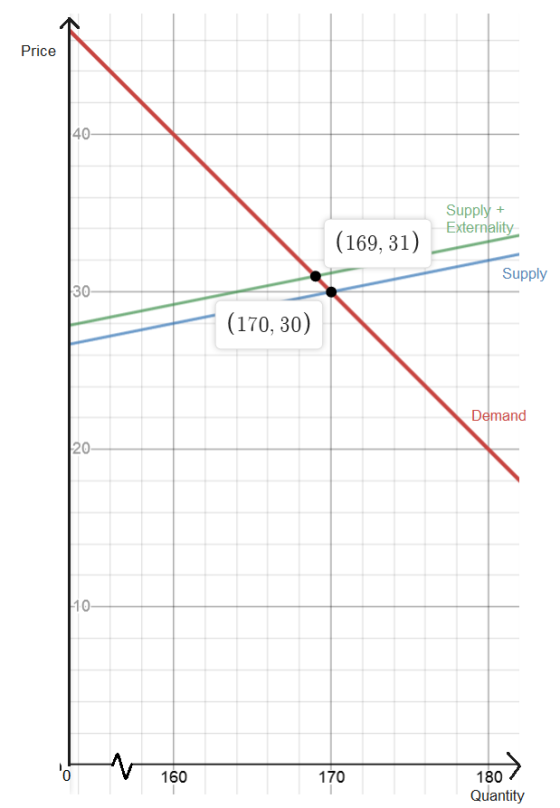
The supply curve should be the green curve here, but instead its the blue curve.
c.. Quantity 169 Price 31
At socially efficient scenario
14+5P=200-P
thus P=31
200-31=169=Q
d.
Policy 1 :Price Ceiling at P =31
This will shift the price up and lower the quantity
Policy 2: Impose a per unit tax increase of $1
This will shift the price up and lower the quantity
(Please consider giving an upvote if you find it useful)
Price 40 + Supply Externality (169, 31) Supply 30 (170, 30) Demand 120 10 o 160 170 180 Quantity
Add Answer to:
Consider the market for cigarettes where the market demand is given by Q”(P) = 200 –...
3. The demand in a market is Q (P) 150-3P. The supply in the market is...
 3. The demand in a market is Q (P) 150-3P. The supply in the market is QS(P)- 3P- 30 (a) Find the competitive equilibrium in the market (P*, Q*) (b) Determine the levels of Consumer, Producer and Total Surplus in the competitive equilibrium (c) Consumption of the good leads to a negative externality. The external marginal benefit function is mbeQw . Draw a graph that shows the Demand, Supply and the Social Marginal Benefits. where measures units consumed in the...
The demand for cigarettes is given by P = 500 – 2Q. Cigarettes are manufactured at...
The demand for cigarettes is given by P = 500 – 2Q. Cigarettes are manufactured at a constant marginal cost of 50 and sold in a competitive market. a. What is the quantity of cigarettes sold in equilibrium? b. If cigarettes generate a marginal external cost of MEC = 0.1Q, what is the socially optimal level of cigarettes? c. Draw a diagram illustrating the private and social MC curves and the demand curve. Point out the private market quantity, the...
In a market, demand is given by P = 100 − Q and the (private) marginal...
In a market, demand is given by P = 100 − Q and the (private) marginal cost of production for the aggregation of all firms (the industry supply curve) is given by MC = Q. Pollution by the industry creates external damages given by the (constant) marginal external cost curve MEC = 30. (a) Calculate the output and price of if the industry operates under competitive conditions without regulation. (b) Calculate the socially efficient price and output of the industry...
We are considering a market with marginal cost of P=100+2Q and a demand of P=500-2Q. Use...
We are considering a market with marginal cost of P=100+2Q and a demand of P=500-2Q. Use that information to answer the following questions. a. Find the market equilibrium (price and quantity in the market). b. Find producer and consumer surplus. c. Now imagine production of this good created a negative externality of 1$ per unit of output. Find the socially optimal outcome (price and quantity) taking this externality into account. d. Find consumer and producer surplus at the socially efficient...
1. For each of the following situations draw the Demand and Supply for a competitive market....
 1. For each of the following situations draw the Demand and Supply for a competitive market. Show the Social Marginal Benefit and Social Marginal Cost curves and explain whether the presence of the externality leads to a competitive market equilibrium with too much or too little production relative to the socially optimal outcome. (a) A negative externality associated with production. (b) A negative externality associated with consumption (c) A positive externality associated with consumption. 2. Consider a downward-sloping market demand...
Suppose the market demand for cigarettes is given in the following table. Suppose further that smoking...
 Suppose the market demand for cigarettes is given in the following table. Suppose further that smoking creates external costs valued at $0.50 per pack. Graph the social and market demand curves and answer two questions about the market and socially optimal quantities. Quantity Price (5 per pack) (packs per day) 56.50 6.00 7 a. Graph the social and market demand curves Instructions: Use the tools provided Ds' ond DM to draw the social demand (Ds) and market demand (DM) curves...
Question 3. Externality and Market Power, 30 points) Consider an electricity market. Assume that the demand...
 Question 3. Externality and Market Power, 30 points) Consider an electricity market. Assume that the demand for electricity is P = 40 - Q amd the cost of producing electivity is C(q) = 20+ 0.50Q2. We assume that the production of electiricity may lead to emission to the society. We assume that each unit of production creates an externality. which amounts to 10 (per unit of production). 1. Derive a socially efficient amount of production. 2. Derive an equilibrium quantity...
Consider a competitive (C) market for ‘hamburger combos’ (hamburger, fries, and a drink) at a fast...
Consider a competitive (C) market for ‘hamburger combos’ (hamburger, fries, and a drink) at a fast food restaurant with the following aggregate demand (PD) and aggregate supply (PS) relationships: PD = 30 − 0.5QD PS = 10 + 0.5QS a)Suppose that a negative pollution externality in ‘hamburger combos’ exists result- ing from the health damages of air pollution produced in the production process. Calculate the socially efficient equilibrium price (P ∗ ) and output (Q∗ ) given that the socially...
4. In a market for dry cleaning, the inverse market demand function is given by P=160-10...
 4. In a market for dry cleaning, the inverse market demand function is given by P=160-10 and the (private) marginal cost of production for the aggregation of all dry dleaning firms is given by MC- 10+1Q. Finally, the pollution generated by the dry cleaning process creates external damages given by the marginal external cost curve MEC 1Q Calculate the output and price of dry cleaning if it is produced under competitive cond tions without regulation. The competitive equilbrium quanity is...
The market demand for a good is given by P = 250 – 0.5Q, where P...
The market demand for a good is given by P = 250 – 0.5Q, where P is the price ($ per unit) and Q is the quantity demanded (units). The market supply is given by P = 20 + 0.5Q. Each unit of the good produced generates a positive externality given by MV = 80 – 0.1Q, where MV is the marginal value ($ per unit) the third party receives as an externality and Q is the quantity of the...
 3. The demand in a market is Q (P) 150-3P. The supply in the market is QS(P)- 3P- 30 (a) Find the competitive equilibrium in the market (P*, Q*) (b) Determine the levels of Consumer, Producer and Total Surplus in the competitive equilibrium (c) Consumption of the good leads to a negative externality. The external marginal benefit function is mbeQw . Draw a graph that shows the Demand, Supply and the Social Marginal Benefits. where measures units consumed in the...
 1. For each of the following situations draw the Demand and Supply for a competitive market. Show the Social Marginal Benefit and Social Marginal Cost curves and explain whether the presence of the externality leads to a competitive market equilibrium with too much or too little production relative to the socially optimal outcome. (a) A negative externality associated with production. (b) A negative externality associated with consumption (c) A positive externality associated with consumption. 2. Consider a downward-sloping market demand...
 Suppose the market demand for cigarettes is given in the following table. Suppose further that smoking creates external costs valued at $0.50 per pack. Graph the social and market demand curves and answer two questions about the market and socially optimal quantities. Quantity Price (5 per pack) (packs per day) 56.50 6.00 7 a. Graph the social and market demand curves Instructions: Use the tools provided Ds' ond DM to draw the social demand (Ds) and market demand (DM) curves...
 Question 3. Externality and Market Power, 30 points) Consider an electricity market. Assume that the demand for electricity is P = 40 - Q amd the cost of producing electivity is C(q) = 20+ 0.50Q2. We assume that the production of electiricity may lead to emission to the society. We assume that each unit of production creates an externality. which amounts to 10 (per unit of production). 1. Derive a socially efficient amount of production. 2. Derive an equilibrium quantity...
 4. In a market for dry cleaning, the inverse market demand function is given by P=160-10 and the (private) marginal cost of production for the aggregation of all dry dleaning firms is given by MC- 10+1Q. Finally, the pollution generated by the dry cleaning process creates external damages given by the marginal external cost curve MEC 1Q Calculate the output and price of dry cleaning if it is produced under competitive cond tions without regulation. The competitive equilbrium quanity is...
Most questions answered within 3 hours.
-
Where is the error in this code sequence?
String s1 = "Hello";
String s2 = "ello";...
asked 10 months ago -
Financial data for Joel de Paris, Inc., for last year
follow:
Joel de Paris, Inc.
Balance...
asked 10 months ago -
Consider this reaction:
Al2(SO4)3 (aq)+ BaCl3
(aq) Al2Cl6 (aq)- +
3BaSO4(s) . What is the...
asked 10 months ago -
Suppose that Savneet is considering increasing her
recent random sample from 20 car rentals to 40...
asked 10 months ago -
Trucks arrive at an unloading terminal at an average rate of 120
per hour.
Trucks arrive...
asked 10 months ago -
Why are methanol and ethanol completely soluble in water while
octanol is not very little soluble....
asked 10 months ago -
A facilities manager at a university reads in a research report
that the mean amount of...
asked 10 months ago -
When the CuSO4 is rehydrated by adding water to the anhydrous
compound, is this an endothermic...
asked 10 months ago -
A ray of sunlight is passing from diamond into crown glass; the
angle of incidence is...
asked 10 months ago -
A block of mass 0.249 kg is placed on top of a light, vertical
spring of...
asked 10 months ago -
how do the kidneys compensate in the presences of acidosis
a) trigger hyperventilate
b) reserve acid...
asked 10 months ago -
Question 501 pts
The rental rate of capital to the firm increases. Which of the
following...
asked 10 months ago