
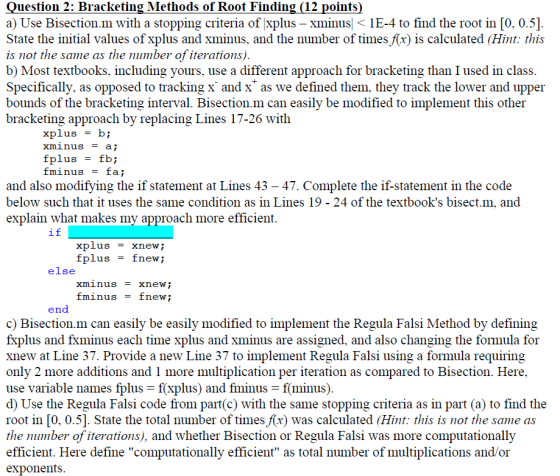
% Bisection.m Lines of code 17-26 and 43-47 are bold
% This code finds the root of a function f(x) in the interval [a, b] using the Bisection method
%
% It uses f.m to define f(x), and assumes f(x) is continuous
% It requires specification of a, b and the maximum error
% It defines error using |f(xnew)|
% Define inputs for problem
a=0; %Defines lower limit of initial bracketing interval
b=1; %Defines upper limit of initial bracketing interval
errmax = 1E-4; %Defines maximum error
%Get function values associated with initial interval endpoints
fa = f(a); %get function value at a
fb = f(b); %get function value at b
% Let MATLAB figure out which end point is "plus" and which is "minus"
if fa>0 & fb<0
xplus = a;
xminus = b;
elseif fa <0 & fb>0
xplus = b;
xminus = a;
else
'Not a valid bracketing interval'
return
end
iter = 0; %Initialize iteration counter (not required, but for interest)
err = 1; %Initial value of err is set large to ensure enter loop.
while err > errmax %Iteration loop
%Increase iteration counter
iter=iter+1;
%Get xnew using Bisection
xnew = (xplus + xminus)/2;
%Get f(xnew)
fnew = f(xnew);
%Adjust bracketing interval based on sign of f(xnew)
if fnew > 0
xplus = xnew;
else
xminus = xnew;
end
err = abs(fnew); %This is the error metric for this example.
end
'Root is'
xnew
iter
......................................................................................NEW CODE...............................................................
%Textbooks bisect.m lines of code 19 – 24 are Bold
function bisect(f,a,b,tol,n)
% Bisection method for solving the nonlinear
%equation f(x)=0.
a0=a;
b0=b;
iter=0;
u=feval(f,a);
v=feval(f,b);
c=(a+b)*0.5;
err=abs(b-a)*0.5;
disp('_____________________________________________________________________')
disp(' iter a b c f(c) |b-a|/2 ')
disp('_____________________________________________________________________')
fprintf('\n')
if (u*v<=0)
while (err>tol)&(iter<=n)
w=feval(f,c);
fprintf('%2.0f %10.4f %10.4f %12.6f %10.6f %10.6f\n',iter,a,b,c,w,err)
if (w*u<0)
b=c;v=w;
end
if (w*u>0)
a=c;u=w;
end
iter=iter+1;
c=(a+b)*0.5;
err=abs(b-a)*0.5;
end
if (iter>n)
disp(' Method failed to converge')
end
else
disp(' The method cannot be applied f(a)f(b)>0')
end
% Plot f(x) in the interval [a,b].
fplot(f, [a0 b0])
xlabel('x');ylabel('f(x)');
grid
Homework Answers
PART A)
MATLAB CODE call bisect.m function
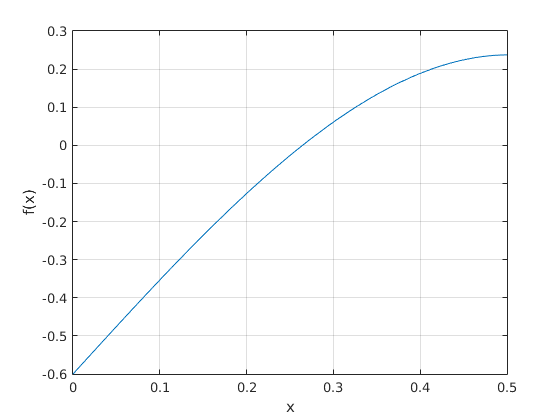
f = @(x) -3.3*x.^3+2.5*x-0.6;
a =0;
b = 0.5;
tol = 1E-4;
n=21;
bisect(f,b,a,tol,n);
OUTPUT
_____________________________________________________________________
iter
a
b
c
f(c) |b-a|/2
_____________________________________________________________________
0
0.5000
0.0000 0.250000
-0.026562 0.250000
1
0.5000
0.2500 0.375000
0.163477 0.125000
2
0.3750
0.2500 0.312500
0.080542 0.062500
3
0.3125
0.2500 0.281250
0.029709 0.031250
4
0.2812
0.2500 0.265625
0.002215 0.015625
5
0.2656
0.2500 0.257812
-0.012018 0.007812
6
0.2656
0.2578 0.261719
-0.004862 0.003906
7
0.2656
0.2617 0.263672
-0.001313 0.001953
8
0.2656
0.2637 0.264648
0.000453 0.000977
9
0.2646
0.2637 0.264160
-0.000429 0.000488
10
0.2646
0.2642 0.264404
0.000012 0.000244
11
0.2644
0.2642 0.264282
-0.000209 0.000122
ANSWER
Initial xminus = 0 and initial xplus =0.5
f(x) is calculated 14 times
PART B)
Modified Bisection.m function
%Textbooks bisect.m lines of code 19 – 24 are Bold
function bisect(f,a,b,tol,n)
% Bisection method for solving the nonlinear
%equation f(x)=0.
fa = feval(f,a);
fb = feval(f,b);
if(fa>0 && fb <0)
xplus = a;
xminus = b;
elseif(fa<0&&fb>0)
xplus = b;
xminus = a;
else
fprintf('Not a valid bracketing
interval\n');
return
end
iter=0;
xnew=(xplus+xminus)*0.5;
err=abs(xplus-xminus)*0.5;
disp('_____________________________________________________________________')
disp(' iter
xminus
xplus
xnew
f(xnew) |xplus-xminus|/2 ')
disp('_____________________________________________________________________')
fprintf('\n')
while ((err>tol)&&(iter<=n))
fnew=feval(f,xnew);
fprintf('%2.0f %10.4f %10.4f %12.6f %10.6f
%10.6f\n',iter,xminus,xplus,xnew,fnew,err)
if(fnew>0)
xplus=xnew;
else
xminus=xnew;
end
iter=iter+1;
xnew=(xplus+xminus)*0.5;
err=abs(xplus-xminus)*0.5;
end
if (iter>n)
disp(' Method failed to converge')
end
end
FUNCTION CALL
f = @(x) -3.3*x.^3+2.5*x-0.6;
a =0;
b = 0.5;
tol = 1E-4;
n=21;
bisect(f,b,a,tol,n);
OUTPUT
_____________________________________________________________________
iter xminus
xplus
xnew
f(xnew) |xplus-xminus|/2
_____________________________________________________________________
0
0.0000
0.5000 0.250000
-0.026562 0.250000
1
0.2500
0.5000 0.375000
0.163477 0.125000
2
0.2500
0.3750 0.312500
0.080542 0.062500
3
0.2500
0.3125 0.281250
0.029709 0.031250
4
0.2500
0.2812 0.265625
0.002215 0.015625
5
0.2500
0.2656 0.257812
-0.012018 0.007812
6
0.2578
0.2656 0.261719
-0.004862 0.003906
7
0.2617
0.2656 0.263672
-0.001313 0.001953
8
0.2637
0.2656 0.264648
0.000453 0.000977
9
0.2637
0.2646 0.264160
-0.000429 0.000488
10
0.2642
0.2646 0.264404
0.000012 0.000244
11
0.2642
0.2644 0.264282
-0.000209 0.000122
Part C)
function regularfalsi(f,a,b,tol,n)
% The secant method for solving the nonlinear
% equation f(x)=0.
iter=0;
u=feval(f,a);
v=feval(f,b);
err=abs(b-a);
disp('______________________________________________________________')
disp('iter
xn
f(xn) f(xn+1)-f(xn)
|xn+1-xn|')
disp('______________________________________________________________')
fprintf('%2.0f %12.6f %12.6f\n',iter,a,u)
fprintf('%2.0f %12.6f %12.6f %12.6f
%12.6f\n',iter,b,v,v-u,err)
while (err>tol)&(iter<=n)&((v-u)~=0)
x=(v*a-u*b)/(v-u);
a=b;
u=v;
b=x;
v=feval(f,b);
err=abs(b-a);
iter=iter+1;
fprintf('%2.0f %12.6f %12.6f %12.6f
%12.6f\n',iter,b,v,v-u,err)
end
if ((v-u)==0)
disp(' Division by zero')
end
if (iter>n)
disp(' Method failed to
converge')
end
Part D)
Bisection.m modified to regulafalsi.m
f = @(x) -3.3*x.^3+2.5*x-0.6;
a =0;
b = 0.5;
tol = 1E-4;
n=21;
regulafalsi(f,b,a,tol,n);
OUTPUT
______________________________________________________________
iter
xn
f(xn) f(xn+1)-f(xn)
|xn+1-xn|
______________________________________________________________
0
0.500000 0.237500
0 0.000000
-0.600000
-0.837500 0.500000
1
0.358209
0.143844
0.743844 0.358209
2
0.288939
0.042743
-0.101101 0.069270
3 0.259653
-0.008637
-0.051381 0.029286
4
0.264576
0.000322
0.008959 0.004923
5
0.264399
0.000002
-0.000320 0.000177
6 0.264398
-0.000000
-0.000002 0.000001
ANSWER
f(x) is calculated 8 times
In general Bisection method take more time to converge to the root, but it have less number of poerations in the loop as compared to ragula falsi method
Add Answer to:
% Bisection.m Lines of code 17-26 and 43-47 are bold
% This code finds the root...
I need help creating program for the Test_Bisection pseudocode. I need to find a root for...
 I need help creating program for the Test_Bisection pseudocode.
I need to find a root for each function f and g and get the output
below.
Pseudocode Now let's construct pseudocode to carry out this procedure. We shall not try to create a piece of high-quality software with many "bells and whistles,” but we write the pseudocode in the form of a procedure for general use. This allows the reader an opportunity to review how a main program and one...
I need help creating program for the Test_Bisection pseudocode.
I need to find a root for each function f and g and get the output
below.
Pseudocode Now let's construct pseudocode to carry out this procedure. We shall not try to create a piece of high-quality software with many "bells and whistles,” but we write the pseudocode in the form of a procedure for general use. This allows the reader an opportunity to review how a main program and one...
45-3. Modify the code used in Example 4 to find the root only at f(x)<0.01 using...
 45-3. Modify the code used in Example 4 to find the root only at f(x)<0.01 using Newton-Rephson Method without showing any iteration. Also find the root of equation, f(x) = x 9-3x -10, take initial guess, Xo=2 العقدة College of 9:05 mybb.qu.edu.ca Numerical Methods (Lab.) GENG 300 Summer 2020 5.1.2 Open Methods - Newton-Raphson Method f(x) *1+1 = x; - Matlab Code Example:4 function mynewtraph.t1.x0,-) XXO for ilin x - x - x)/1 x) disp 1 x) <0.01 break end...
Looking for Muller Method MatLab coding for these following equations: This is the code I currently...
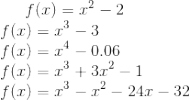 Looking for Muller Method MatLab coding for these following
equations:
This is the code I currently have but is not working
fun = @(x) x.^2-2;
x1 = 0;
x2 = 1;
tol = 0.0001;
kmax = 100;
function [x, y] = Muller(fun, x1, x2, tol, kmax)
x(1) = x1;
x(2) = x2;
x(3) = (x(2)+x(1))/2;
y(1) = feval(fun, x1);
y(2) = feval(fun, x2);
y(3) = feval(fun, x(3));
c(1) = (y(2)-y(1))/(x(2)-x(1));
for k = 3 : kmax
c(k-1) = (y(k)-y(k-1))/(x(k)-x(k-1));
d(k-2)...
Looking for Muller Method MatLab coding for these following
equations:
This is the code I currently have but is not working
fun = @(x) x.^2-2;
x1 = 0;
x2 = 1;
tol = 0.0001;
kmax = 100;
function [x, y] = Muller(fun, x1, x2, tol, kmax)
x(1) = x1;
x(2) = x2;
x(3) = (x(2)+x(1))/2;
y(1) = feval(fun, x1);
y(2) = feval(fun, x2);
y(3) = feval(fun, x(3));
c(1) = (y(2)-y(1))/(x(2)-x(1));
for k = 3 : kmax
c(k-1) = (y(k)-y(k-1))/(x(k)-x(k-1));
d(k-2)...
Matlab problem using newton raphson to find square root of number
Need help modifying my Matlab script below (myscript calculates the square root of a number. using a Newton-Raphson method with 1 as the initial guess, calculates true and estimated error, and shows each iteration).-I need to create three new functions each of which should be called in the main script. These functions are needed to replace code that is currently in my script shown below.-I need to create these functions:A function to find f(x)A function to find f '(x) ?A...
clearvars close all clc tol = 0.0001; % this is the tolerance for root identification xold...
 clearvars
close all
clc
tol = 0.0001; % this is the tolerance for root identification
xold = 0.5; % this is the initial guess
test = 1; % this simply ensures we have a test value to enter the loop below.
%If we don't preallocate this, MATLAB will error when it trys to start the
%while loop below
k = 1; %this is the iteration counter. Similar to "test" we need to preallocate it
%to allow the while loop to...
clearvars
close all
clc
tol = 0.0001; % this is the tolerance for root identification
xold = 0.5; % this is the initial guess
test = 1; % this simply ensures we have a test value to enter the loop below.
%If we don't preallocate this, MATLAB will error when it trys to start the
%while loop below
k = 1; %this is the iteration counter. Similar to "test" we need to preallocate it
%to allow the while loop to...
5.1.2 Open Methods - Newton-Raphson Method Xi+1= xi – FOTO Matlab Code Example:4 function mynewtraph (f,...
 5.1.2 Open Methods - Newton-Raphson Method Xi+1= xi – FOTO Matlab Code Example:4 function mynewtraph (f, f1,x0,n) Xx0; for ilin x = x - f(x)/f1(x); disp (li if f(x) <0.01 f(x))) break end end end Matlab Code from Chapra function [root, ea, iter)=newtraph (func,dfunc, xr, es,maxit,varargin) newtraph: Newton-Raphson root location zeroes 8 [root, ea, iter)-newtraph (func, dfunc, xr, es,maxit,pl,p2, ...): $uses Newton-Raphson method to find the root of fune input: func- name of function 8dfunc = name of derivative of...
I'm working on the newton's method on matlab, could someone help me and show what two...
I'm working on the newton's method on matlab, could someone help me and show what two lines are needed to be added in the codes in order to make this function work? function sample_newton(f, xc, tol, max_iter) % sample_newton(f, xc, tol, max_iter) % finds a root of the given function f over the interval [a, b] using Newton-Raphson method % IN: % f - the target function to find a root of % function handle with two outputs, f(x), f'(x)...
need the MATLAB code to solve for percentage error at the 5th iteration given the following...
 need the MATLAB code to solve for percentage error at the 5th
iteration given the following Newton-Raphson code
Using the MATLAB code finline(X13-x^2-18); dfeinline(3*x"2-2#x'); e?100 count=0; xi=0.5; while (ea>01); count = count 1 ; xil - xi - f(xi)/df(xi); ea = 100 * abs((xi 1-xi)/xi 1 ); disp([count xil.xi, ea]); xi=xi 1 ; If ea is the error defined in percentage, the value of the error (ea) at 5th iteration (i.e., count-5) is closest or equal to hoices 51% 54%...
need the MATLAB code to solve for percentage error at the 5th
iteration given the following Newton-Raphson code
Using the MATLAB code finline(X13-x^2-18); dfeinline(3*x"2-2#x'); e?100 count=0; xi=0.5; while (ea>01); count = count 1 ; xil - xi - f(xi)/df(xi); ea = 100 * abs((xi 1-xi)/xi 1 ); disp([count xil.xi, ea]); xi=xi 1 ; If ea is the error defined in percentage, the value of the error (ea) at 5th iteration (i.e., count-5) is closest or equal to hoices 51% 54%...
The function should starts as: function [x,fs,k]=Newton1(x0) % enter your code here end >> ...
 The function should starts as:
function [x,fs,k]=Newton1(x0)
% enter your code here
end
>> [x,f,k]=Newton1(0) x = 1.1641, f = -1.6653e-16, k =
7
>> [x,f,k]=Newton1(0.1) x = 0.1972, f = 1.1102e-16, k =
5
>> [x,f,k]=Newton1(1.5) x = 1.3111, f = -1.1102e-16, k =
6
>> [x,f,k]=Newton1(2) Warning iteration diverged, x =
2.8808, f = -0.5624, k = 1000
Let the mathematical function f(x) be defined as: f(x) = exp(-0.5x) cos(5x)-0.5 , x 〉 0...
The function should starts as:
function [x,fs,k]=Newton1(x0)
% enter your code here
end
>> [x,f,k]=Newton1(0) x = 1.1641, f = -1.6653e-16, k =
7
>> [x,f,k]=Newton1(0.1) x = 0.1972, f = 1.1102e-16, k =
5
>> [x,f,k]=Newton1(1.5) x = 1.3111, f = -1.1102e-16, k =
6
>> [x,f,k]=Newton1(2) Warning iteration diverged, x =
2.8808, f = -0.5624, k = 1000
Let the mathematical function f(x) be defined as: f(x) = exp(-0.5x) cos(5x)-0.5 , x 〉 0...
THE CODE NEEDS TO BE ON MATLAB 2. Exercise (a) Let's write a script file that...
 THE CODE NEEDS TO BE ON MATLAB
2. Exercise (a) Let's write a script file that calculates exp(2) by a Maclaurin series using a while loop exp x )=-+-+-+-+ The while loop should add each of the series terms. The program error as defined below is smaller than 0.01. Error is the exact value (i.e. exp(2)), minus the approximate value (i.e., the current series sum) should exit the loop when the absolute absolute error-lexact-approx Use fprintf within the loop such...
THE CODE NEEDS TO BE ON MATLAB
2. Exercise (a) Let's write a script file that calculates exp(2) by a Maclaurin series using a while loop exp x )=-+-+-+-+ The while loop should add each of the series terms. The program error as defined below is smaller than 0.01. Error is the exact value (i.e. exp(2)), minus the approximate value (i.e., the current series sum) should exit the loop when the absolute absolute error-lexact-approx Use fprintf within the loop such...
 I need help creating program for the Test_Bisection pseudocode.
I need to find a root for each function f and g and get the output
below.
Pseudocode Now let's construct pseudocode to carry out this procedure. We shall not try to create a piece of high-quality software with many "bells and whistles,” but we write the pseudocode in the form of a procedure for general use. This allows the reader an opportunity to review how a main program and one...
I need help creating program for the Test_Bisection pseudocode.
I need to find a root for each function f and g and get the output
below.
Pseudocode Now let's construct pseudocode to carry out this procedure. We shall not try to create a piece of high-quality software with many "bells and whistles,” but we write the pseudocode in the form of a procedure for general use. This allows the reader an opportunity to review how a main program and one...
 45-3. Modify the code used in Example 4 to find the root only at f(x)<0.01 using Newton-Rephson Method without showing any iteration. Also find the root of equation, f(x) = x 9-3x -10, take initial guess, Xo=2 العقدة College of 9:05 mybb.qu.edu.ca Numerical Methods (Lab.) GENG 300 Summer 2020 5.1.2 Open Methods - Newton-Raphson Method f(x) *1+1 = x; - Matlab Code Example:4 function mynewtraph.t1.x0,-) XXO for ilin x - x - x)/1 x) disp 1 x) <0.01 break end...
 Looking for Muller Method MatLab coding for these following
equations:
This is the code I currently have but is not working
fun = @(x) x.^2-2;
x1 = 0;
x2 = 1;
tol = 0.0001;
kmax = 100;
function [x, y] = Muller(fun, x1, x2, tol, kmax)
x(1) = x1;
x(2) = x2;
x(3) = (x(2)+x(1))/2;
y(1) = feval(fun, x1);
y(2) = feval(fun, x2);
y(3) = feval(fun, x(3));
c(1) = (y(2)-y(1))/(x(2)-x(1));
for k = 3 : kmax
c(k-1) = (y(k)-y(k-1))/(x(k)-x(k-1));
d(k-2)...
Looking for Muller Method MatLab coding for these following
equations:
This is the code I currently have but is not working
fun = @(x) x.^2-2;
x1 = 0;
x2 = 1;
tol = 0.0001;
kmax = 100;
function [x, y] = Muller(fun, x1, x2, tol, kmax)
x(1) = x1;
x(2) = x2;
x(3) = (x(2)+x(1))/2;
y(1) = feval(fun, x1);
y(2) = feval(fun, x2);
y(3) = feval(fun, x(3));
c(1) = (y(2)-y(1))/(x(2)-x(1));
for k = 3 : kmax
c(k-1) = (y(k)-y(k-1))/(x(k)-x(k-1));
d(k-2)...
 clearvars
close all
clc
tol = 0.0001; % this is the tolerance for root identification
xold = 0.5; % this is the initial guess
test = 1; % this simply ensures we have a test value to enter the loop below.
%If we don't preallocate this, MATLAB will error when it trys to start the
%while loop below
k = 1; %this is the iteration counter. Similar to "test" we need to preallocate it
%to allow the while loop to...
clearvars
close all
clc
tol = 0.0001; % this is the tolerance for root identification
xold = 0.5; % this is the initial guess
test = 1; % this simply ensures we have a test value to enter the loop below.
%If we don't preallocate this, MATLAB will error when it trys to start the
%while loop below
k = 1; %this is the iteration counter. Similar to "test" we need to preallocate it
%to allow the while loop to...
 5.1.2 Open Methods - Newton-Raphson Method Xi+1= xi – FOTO Matlab Code Example:4 function mynewtraph (f, f1,x0,n) Xx0; for ilin x = x - f(x)/f1(x); disp (li if f(x) <0.01 f(x))) break end end end Matlab Code from Chapra function [root, ea, iter)=newtraph (func,dfunc, xr, es,maxit,varargin) newtraph: Newton-Raphson root location zeroes 8 [root, ea, iter)-newtraph (func, dfunc, xr, es,maxit,pl,p2, ...): $uses Newton-Raphson method to find the root of fune input: func- name of function 8dfunc = name of derivative of...
 need the MATLAB code to solve for percentage error at the 5th
iteration given the following Newton-Raphson code
Using the MATLAB code finline(X13-x^2-18); dfeinline(3*x"2-2#x'); e?100 count=0; xi=0.5; while (ea>01); count = count 1 ; xil - xi - f(xi)/df(xi); ea = 100 * abs((xi 1-xi)/xi 1 ); disp([count xil.xi, ea]); xi=xi 1 ; If ea is the error defined in percentage, the value of the error (ea) at 5th iteration (i.e., count-5) is closest or equal to hoices 51% 54%...
need the MATLAB code to solve for percentage error at the 5th
iteration given the following Newton-Raphson code
Using the MATLAB code finline(X13-x^2-18); dfeinline(3*x"2-2#x'); e?100 count=0; xi=0.5; while (ea>01); count = count 1 ; xil - xi - f(xi)/df(xi); ea = 100 * abs((xi 1-xi)/xi 1 ); disp([count xil.xi, ea]); xi=xi 1 ; If ea is the error defined in percentage, the value of the error (ea) at 5th iteration (i.e., count-5) is closest or equal to hoices 51% 54%...
 The function should starts as:
function [x,fs,k]=Newton1(x0)
% enter your code here
end
>> [x,f,k]=Newton1(0) x = 1.1641, f = -1.6653e-16, k =
7
>> [x,f,k]=Newton1(0.1) x = 0.1972, f = 1.1102e-16, k =
5
>> [x,f,k]=Newton1(1.5) x = 1.3111, f = -1.1102e-16, k =
6
>> [x,f,k]=Newton1(2) Warning iteration diverged, x =
2.8808, f = -0.5624, k = 1000
Let the mathematical function f(x) be defined as: f(x) = exp(-0.5x) cos(5x)-0.5 , x 〉 0...
The function should starts as:
function [x,fs,k]=Newton1(x0)
% enter your code here
end
>> [x,f,k]=Newton1(0) x = 1.1641, f = -1.6653e-16, k =
7
>> [x,f,k]=Newton1(0.1) x = 0.1972, f = 1.1102e-16, k =
5
>> [x,f,k]=Newton1(1.5) x = 1.3111, f = -1.1102e-16, k =
6
>> [x,f,k]=Newton1(2) Warning iteration diverged, x =
2.8808, f = -0.5624, k = 1000
Let the mathematical function f(x) be defined as: f(x) = exp(-0.5x) cos(5x)-0.5 , x 〉 0...
 THE CODE NEEDS TO BE ON MATLAB
2. Exercise (a) Let's write a script file that calculates exp(2) by a Maclaurin series using a while loop exp x )=-+-+-+-+ The while loop should add each of the series terms. The program error as defined below is smaller than 0.01. Error is the exact value (i.e. exp(2)), minus the approximate value (i.e., the current series sum) should exit the loop when the absolute absolute error-lexact-approx Use fprintf within the loop such...
THE CODE NEEDS TO BE ON MATLAB
2. Exercise (a) Let's write a script file that calculates exp(2) by a Maclaurin series using a while loop exp x )=-+-+-+-+ The while loop should add each of the series terms. The program error as defined below is smaller than 0.01. Error is the exact value (i.e. exp(2)), minus the approximate value (i.e., the current series sum) should exit the loop when the absolute absolute error-lexact-approx Use fprintf within the loop such...
Most questions answered within 3 hours.
-
Where is the error in this code sequence?
String s1 = "Hello";
String s2 = "ello";...
asked 10 months ago -
Financial data for Joel de Paris, Inc., for last year
follow:
Joel de Paris, Inc.
Balance...
asked 10 months ago -
Consider this reaction:
Al2(SO4)3 (aq)+ BaCl3
(aq) Al2Cl6 (aq)- +
3BaSO4(s) . What is the...
asked 10 months ago -
Suppose that Savneet is considering increasing her
recent random sample from 20 car rentals to 40...
asked 10 months ago -
Trucks arrive at an unloading terminal at an average rate of 120
per hour.
Trucks arrive...
asked 10 months ago -
Why are methanol and ethanol completely soluble in water while
octanol is not very little soluble....
asked 10 months ago -
A facilities manager at a university reads in a research report
that the mean amount of...
asked 10 months ago -
When the CuSO4 is rehydrated by adding water to the anhydrous
compound, is this an endothermic...
asked 10 months ago -
A ray of sunlight is passing from diamond into crown glass; the
angle of incidence is...
asked 10 months ago -
A block of mass 0.249 kg is placed on top of a light, vertical
spring of...
asked 10 months ago -
how do the kidneys compensate in the presences of acidosis
a) trigger hyperventilate
b) reserve acid...
asked 10 months ago -
Question 501 pts
The rental rate of capital to the firm increases. Which of the
following...
asked 10 months ago