
Homework Answers
Thanks for asking
Add Answer to:
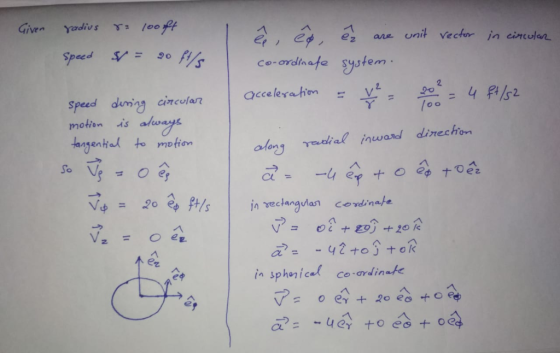
of the motion Prob. 3 A Bison champion athlete is rounding a curve of radius 100...
A car is rounding a flat, unbanked curve of constant radius, with constant speed. The direction...
 A car is rounding a flat, unbanked curve of constant radius, with constant speed. The direction of the force of friction is in the direction opposite the velocity in the direction of the velocity towards the center of the curve radially outward Question 2 3 pts Two identical boxes are on the same rough horizontal surface. Box 1 is pushed by a horizontal force and is moving to the right at constant speed. Box 2 is pushed by a different...
HINT: this problem is about using different coordinate systems to solve kinematics problems! D 4. As...
 HINT: this problem is about using different coordinate systems to solve kinematics problems! D 4. As rod OA rotates, pin P moves along the curve BCD with a constant speed of 3 m/s (in the counterclockwise direction). The equation for this curve is r = 2/(1+cose). Solve the following for the point shown, when 0 = 1/6 (radians). 0 1m B a) Find dr/dt and do/dt, and express the velocity vector in polar coordinates. b) Find the polar unit vectors...
7. Do the projectile motion General Motion with Unit Vectors and Components An object undergoes the...
 7. Do the projectile motion
General Motion with Unit Vectors and Components An object undergoes the following consecutive displacements: s (2i +3j +5k)m,s2 (6i- 9j + 2k)m, and s3 (10i 8j -k)m. a) Find the resultant displacement in terms of unit vectors and components. b) State the magnitude of the resultant displacement. 2. Suppose a hiker travels 5 km southwest from their camp. Then, the hiker travels 2 km 75° north of east. a) Find the displacement of the hiker...
7. Do the projectile motion
General Motion with Unit Vectors and Components An object undergoes the following consecutive displacements: s (2i +3j +5k)m,s2 (6i- 9j + 2k)m, and s3 (10i 8j -k)m. a) Find the resultant displacement in terms of unit vectors and components. b) State the magnitude of the resultant displacement. 2. Suppose a hiker travels 5 km southwest from their camp. Then, the hiker travels 2 km 75° north of east. a) Find the displacement of the hiker...
The car travels along the circular curve having a radius r = 400 ft. At the...
The car travels along the circular curve having a radius r = 400 ft. At the instant shown, its angular rate of rotation is θ˙ = 0.025 rad/s, which is decreasing at the rate θ¨ = -0.008 rad/s2. Part A Part complete Determine the radial component of the car's velocity at this instant. Express your answer with the appropriate units. -- SubmitPrevious AnswersRequest Answer Incorrect; Try Again; 5 attempts remaining Part B Part complete Determine the transverse component of the...
2. General Motion with Unit Vectors and Components An object undergoes the following consecutive displacements: s...
 2.
General Motion with Unit Vectors and Components An object undergoes the following consecutive displacements: s (2i +3j +5k)m,s2 (6i-91+ 2krn, and s,-(10i + 8j-km a) Find the resultant displacement in terms of unit vectors and components. b) State the magnitude of the resultant displacement. 2. Suppose a hiker travels 5 km southwest from their camp. Then, the hiker travels 2 km 75° north of east. a) Find the displacement of the hiker form their camp. b) If the hiker...
2.
General Motion with Unit Vectors and Components An object undergoes the following consecutive displacements: s (2i +3j +5k)m,s2 (6i-91+ 2krn, and s,-(10i + 8j-km a) Find the resultant displacement in terms of unit vectors and components. b) State the magnitude of the resultant displacement. 2. Suppose a hiker travels 5 km southwest from their camp. Then, the hiker travels 2 km 75° north of east. a) Find the displacement of the hiker form their camp. b) If the hiker...
7. General Motion with Unit Vectors and Components An object undergoes the following consecutive displacements: s...
 7.
General Motion with Unit Vectors and Components An object undergoes the following consecutive displacements: s (2i +3j +5k)m,s2 (6i- 9j + 2k)m, and s3 (10i 8j -k)m. a) Find the resultant displacement in terms of unit vectors and components. b) State the magnitude of the resultant displacement. 2. Suppose a hiker travels 5 km southwest from their camp. Then, the hiker travels 2 km 75° north of east. a) Find the displacement of the hiker form their camp. b)...
7.
General Motion with Unit Vectors and Components An object undergoes the following consecutive displacements: s (2i +3j +5k)m,s2 (6i- 9j + 2k)m, and s3 (10i 8j -k)m. a) Find the resultant displacement in terms of unit vectors and components. b) State the magnitude of the resultant displacement. 2. Suppose a hiker travels 5 km southwest from their camp. Then, the hiker travels 2 km 75° north of east. a) Find the displacement of the hiker form their camp. b)...
6. General Motion with Unit Vectors and Components An object undergoes the following consecutive displacements: s...
 6.
General Motion with Unit Vectors and Components An object undergoes the following consecutive displacements: s (2i +3j +5k)m,s2 (6i- 9j + 2k)m, and s3 (10i 8j -k)m. a) Find the resultant displacement in terms of unit vectors and components. b) State the magnitude of the resultant displacement. 2. Suppose a hiker travels 5 km southwest from their camp. Then, the hiker travels 2 km 75° north of east. a) Find the displacement of the hiker form their camp. b)...
6.
General Motion with Unit Vectors and Components An object undergoes the following consecutive displacements: s (2i +3j +5k)m,s2 (6i- 9j + 2k)m, and s3 (10i 8j -k)m. a) Find the resultant displacement in terms of unit vectors and components. b) State the magnitude of the resultant displacement. 2. Suppose a hiker travels 5 km southwest from their camp. Then, the hiker travels 2 km 75° north of east. a) Find the displacement of the hiker form their camp. b)...
5. General Motion with Unit Vectors and Components An object undergoes the following consecutive displacements: s...
 5.
General Motion with Unit Vectors and Components An object undergoes the following consecutive displacements: s (2i +3j +5k)m,s2 (6i- 9j + 2k)m, and s3 (10i 8j -k)m. a) Find the resultant displacement in terms of unit vectors and components. b) State the magnitude of the resultant displacement. 2. Suppose a hiker travels 5 km southwest from their camp. Then, the hiker travels 2 km 75° north of east. a) Find the displacement of the hiker form their camp. b)...
5.
General Motion with Unit Vectors and Components An object undergoes the following consecutive displacements: s (2i +3j +5k)m,s2 (6i- 9j + 2k)m, and s3 (10i 8j -k)m. a) Find the resultant displacement in terms of unit vectors and components. b) State the magnitude of the resultant displacement. 2. Suppose a hiker travels 5 km southwest from their camp. Then, the hiker travels 2 km 75° north of east. a) Find the displacement of the hiker form their camp. b)...
4. General Motion with Unit Vectors and Components An object undergoes the following consecutive displacements: s...
 4.
General Motion with Unit Vectors and Components An object undergoes the following consecutive displacements: s (2i +3j +5k)m,s2 (6i- 9j + 2k)m, and s3 (10i 8j -k)m. a) Find the resultant displacement in terms of unit vectors and components. b) State the magnitude of the resultant displacement. 2. Suppose a hiker travels 5 km southwest from their camp. Then, the hiker travels 2 km 75° north of east. a) Find the displacement of the hiker form their camp. b)...
4.
General Motion with Unit Vectors and Components An object undergoes the following consecutive displacements: s (2i +3j +5k)m,s2 (6i- 9j + 2k)m, and s3 (10i 8j -k)m. a) Find the resultant displacement in terms of unit vectors and components. b) State the magnitude of the resultant displacement. 2. Suppose a hiker travels 5 km southwest from their camp. Then, the hiker travels 2 km 75° north of east. a) Find the displacement of the hiker form their camp. b)...
Please help! :) Discussion #3 1. Consider the motion of an object that can be treated...
 Please help! :)
Discussion #3 1. Consider the motion of an object that can be treated as a point particle and is traveling counter-clockwise in a circle of radius R. This motion can (and will for the purposes of these discussion activities) be described and analyzed using a Cartesian (x-y) coordinate system with a spatial origin at the center of the particle's circular trajectory (the physical path its motion traces out in space). (a) Draw a diagram of the position...
Please help! :)
Discussion #3 1. Consider the motion of an object that can be treated as a point particle and is traveling counter-clockwise in a circle of radius R. This motion can (and will for the purposes of these discussion activities) be described and analyzed using a Cartesian (x-y) coordinate system with a spatial origin at the center of the particle's circular trajectory (the physical path its motion traces out in space). (a) Draw a diagram of the position...
 A car is rounding a flat, unbanked curve of constant radius, with constant speed. The direction of the force of friction is in the direction opposite the velocity in the direction of the velocity towards the center of the curve radially outward Question 2 3 pts Two identical boxes are on the same rough horizontal surface. Box 1 is pushed by a horizontal force and is moving to the right at constant speed. Box 2 is pushed by a different...
 HINT: this problem is about using different coordinate systems to solve kinematics problems! D 4. As rod OA rotates, pin P moves along the curve BCD with a constant speed of 3 m/s (in the counterclockwise direction). The equation for this curve is r = 2/(1+cose). Solve the following for the point shown, when 0 = 1/6 (radians). 0 1m B a) Find dr/dt and do/dt, and express the velocity vector in polar coordinates. b) Find the polar unit vectors...
 7. Do the projectile motion
General Motion with Unit Vectors and Components An object undergoes the following consecutive displacements: s (2i +3j +5k)m,s2 (6i- 9j + 2k)m, and s3 (10i 8j -k)m. a) Find the resultant displacement in terms of unit vectors and components. b) State the magnitude of the resultant displacement. 2. Suppose a hiker travels 5 km southwest from their camp. Then, the hiker travels 2 km 75° north of east. a) Find the displacement of the hiker...
7. Do the projectile motion
General Motion with Unit Vectors and Components An object undergoes the following consecutive displacements: s (2i +3j +5k)m,s2 (6i- 9j + 2k)m, and s3 (10i 8j -k)m. a) Find the resultant displacement in terms of unit vectors and components. b) State the magnitude of the resultant displacement. 2. Suppose a hiker travels 5 km southwest from their camp. Then, the hiker travels 2 km 75° north of east. a) Find the displacement of the hiker...
 2.
General Motion with Unit Vectors and Components An object undergoes the following consecutive displacements: s (2i +3j +5k)m,s2 (6i-91+ 2krn, and s,-(10i + 8j-km a) Find the resultant displacement in terms of unit vectors and components. b) State the magnitude of the resultant displacement. 2. Suppose a hiker travels 5 km southwest from their camp. Then, the hiker travels 2 km 75° north of east. a) Find the displacement of the hiker form their camp. b) If the hiker...
2.
General Motion with Unit Vectors and Components An object undergoes the following consecutive displacements: s (2i +3j +5k)m,s2 (6i-91+ 2krn, and s,-(10i + 8j-km a) Find the resultant displacement in terms of unit vectors and components. b) State the magnitude of the resultant displacement. 2. Suppose a hiker travels 5 km southwest from their camp. Then, the hiker travels 2 km 75° north of east. a) Find the displacement of the hiker form their camp. b) If the hiker...
 7.
General Motion with Unit Vectors and Components An object undergoes the following consecutive displacements: s (2i +3j +5k)m,s2 (6i- 9j + 2k)m, and s3 (10i 8j -k)m. a) Find the resultant displacement in terms of unit vectors and components. b) State the magnitude of the resultant displacement. 2. Suppose a hiker travels 5 km southwest from their camp. Then, the hiker travels 2 km 75° north of east. a) Find the displacement of the hiker form their camp. b)...
7.
General Motion with Unit Vectors and Components An object undergoes the following consecutive displacements: s (2i +3j +5k)m,s2 (6i- 9j + 2k)m, and s3 (10i 8j -k)m. a) Find the resultant displacement in terms of unit vectors and components. b) State the magnitude of the resultant displacement. 2. Suppose a hiker travels 5 km southwest from their camp. Then, the hiker travels 2 km 75° north of east. a) Find the displacement of the hiker form their camp. b)...
 6.
General Motion with Unit Vectors and Components An object undergoes the following consecutive displacements: s (2i +3j +5k)m,s2 (6i- 9j + 2k)m, and s3 (10i 8j -k)m. a) Find the resultant displacement in terms of unit vectors and components. b) State the magnitude of the resultant displacement. 2. Suppose a hiker travels 5 km southwest from their camp. Then, the hiker travels 2 km 75° north of east. a) Find the displacement of the hiker form their camp. b)...
6.
General Motion with Unit Vectors and Components An object undergoes the following consecutive displacements: s (2i +3j +5k)m,s2 (6i- 9j + 2k)m, and s3 (10i 8j -k)m. a) Find the resultant displacement in terms of unit vectors and components. b) State the magnitude of the resultant displacement. 2. Suppose a hiker travels 5 km southwest from their camp. Then, the hiker travels 2 km 75° north of east. a) Find the displacement of the hiker form their camp. b)...
 5.
General Motion with Unit Vectors and Components An object undergoes the following consecutive displacements: s (2i +3j +5k)m,s2 (6i- 9j + 2k)m, and s3 (10i 8j -k)m. a) Find the resultant displacement in terms of unit vectors and components. b) State the magnitude of the resultant displacement. 2. Suppose a hiker travels 5 km southwest from their camp. Then, the hiker travels 2 km 75° north of east. a) Find the displacement of the hiker form their camp. b)...
5.
General Motion with Unit Vectors and Components An object undergoes the following consecutive displacements: s (2i +3j +5k)m,s2 (6i- 9j + 2k)m, and s3 (10i 8j -k)m. a) Find the resultant displacement in terms of unit vectors and components. b) State the magnitude of the resultant displacement. 2. Suppose a hiker travels 5 km southwest from their camp. Then, the hiker travels 2 km 75° north of east. a) Find the displacement of the hiker form their camp. b)...
 4.
General Motion with Unit Vectors and Components An object undergoes the following consecutive displacements: s (2i +3j +5k)m,s2 (6i- 9j + 2k)m, and s3 (10i 8j -k)m. a) Find the resultant displacement in terms of unit vectors and components. b) State the magnitude of the resultant displacement. 2. Suppose a hiker travels 5 km southwest from their camp. Then, the hiker travels 2 km 75° north of east. a) Find the displacement of the hiker form their camp. b)...
4.
General Motion with Unit Vectors and Components An object undergoes the following consecutive displacements: s (2i +3j +5k)m,s2 (6i- 9j + 2k)m, and s3 (10i 8j -k)m. a) Find the resultant displacement in terms of unit vectors and components. b) State the magnitude of the resultant displacement. 2. Suppose a hiker travels 5 km southwest from their camp. Then, the hiker travels 2 km 75° north of east. a) Find the displacement of the hiker form their camp. b)...
 Please help! :)
Discussion #3 1. Consider the motion of an object that can be treated as a point particle and is traveling counter-clockwise in a circle of radius R. This motion can (and will for the purposes of these discussion activities) be described and analyzed using a Cartesian (x-y) coordinate system with a spatial origin at the center of the particle's circular trajectory (the physical path its motion traces out in space). (a) Draw a diagram of the position...
Please help! :)
Discussion #3 1. Consider the motion of an object that can be treated as a point particle and is traveling counter-clockwise in a circle of radius R. This motion can (and will for the purposes of these discussion activities) be described and analyzed using a Cartesian (x-y) coordinate system with a spatial origin at the center of the particle's circular trajectory (the physical path its motion traces out in space). (a) Draw a diagram of the position...
Most questions answered within 3 hours.
-
Where is the error in this code sequence?
String s1 = "Hello";
String s2 = "ello";...
asked 11 months ago -
Financial data for Joel de Paris, Inc., for last year
follow:
Joel de Paris, Inc.
Balance...
asked 11 months ago -
Consider this reaction:
Al2(SO4)3 (aq)+ BaCl3
(aq) Al2Cl6 (aq)- +
3BaSO4(s) . What is the...
asked 11 months ago -
Suppose that Savneet is considering increasing her
recent random sample from 20 car rentals to 40...
asked 11 months ago -
Trucks arrive at an unloading terminal at an average rate of 120
per hour.
Trucks arrive...
asked 11 months ago -
Why are methanol and ethanol completely soluble in water while
octanol is not very little soluble....
asked 11 months ago -
A facilities manager at a university reads in a research report
that the mean amount of...
asked 11 months ago -
When the CuSO4 is rehydrated by adding water to the anhydrous
compound, is this an endothermic...
asked 11 months ago -
A ray of sunlight is passing from diamond into crown glass; the
angle of incidence is...
asked 11 months ago -
A block of mass 0.249 kg is placed on top of a light, vertical
spring of...
asked 11 months ago -
how do the kidneys compensate in the presences of acidosis
a) trigger hyperventilate
b) reserve acid...
asked 11 months ago -
Question 501 pts
The rental rate of capital to the firm increases. Which of the
following...
asked 11 months ago