
Homework Answers

Add Answer to:
5. Use the Gram-Schmidt process to find an orthonor- mal basis of the subspace of R5...
4. Use the Gram-Schmidt Process to find an orthonormal basis for the subspace of R5 defined...
 4. Use the Gram-Schmidt Process to find an orthonormal basis for the subspace of R5 defined by 2 S-span 0 2
Use the Gram-Schmidt process to find an orthonormal basis for the subspace spanned by uz =...
 Use the Gram-Schmidt process to find an orthonormal basis for the subspace spanned by uz = (1,1,1,1)", u2 = (-1,4,4, -1)", and uz = (4, -2,2,0)".
3. Use the Gram-Schmidt process to find an orthonormal basis for the subspace of R' spanned...
 3. Use the Gram-Schmidt process to find an orthonormal basis for the subspace of R' spanned by the vectors u; = (1,0,0,0), 12 = (1,1,0,0), uz = (0,1,1,1).
Use the Gram-Schmidt process to find an or- thonormal basis for the subspace of R4 spanned...
 Use the Gram-Schmidt process to find an or- thonormal basis for the subspace of R4 spanned by Xi = (4, 2, 2, 1)", X2 (2,0, 0, 2)", X3 = (1,1, -1, 1). Let A = (x1 X2 X3) and b = (1, 2, 3,1)7. Factor A into a product QR, where Q has an orthonormal set of column vectors and R is up- per triangular. Solve the least squares problem Ax = b.
for the subspace of R4 consisting of 4. Use the Gram-Schmidt process to find an orthonormal...
 for the subspace of R4 consisting of 4. Use the Gram-Schmidt process to find an orthonormal basis all vectors of the form ſal a + b [b+c] 5. Use the Gram-Schmidt process to find an orthonormal basis of the column space of the matrix [1-1 1 67 2 -1 3 1 A=4 1 91 [3 2 8 5 6. (a) Use the Gram-Schmidt process to find an orthonormal basis S = (P1, P2, P3) for P2, the vector space of...
The given set is a basis for a subspace W. Use the Gram-Schmidt process to produce...
 The given set is a basis for a subspace W. Use the Gram-Schmidt process to produce an orthogonal basis for W. 8 11 2 - 7 An orthogonal basis for W is { }. (Type a vector or list of vectors. Use a comma to separate vectors as needed.)
The set is a basis for a subspace W. Use the Gram-Schmidt process to produce an...
 The set is a basis for a subspace W. Use the Gram-Schmidt process to produce an orthogonal basis for W. Assume the vectors are in the order X, and x2 The orthogonal basis produced using the Gram-Schmidt process for Wis. (Use a somma to separato vectors as needed.)
(1 point) Let 12 6 Use the Gram-Schmidt process to determine an orthonormal basis for the...
 (1 point) Let 12 6 Use the Gram-Schmidt process to determine an orthonormal basis for the subspace of R4 spanned by ř and ý.
The given vectors form a basis for a subspace W of ℝ3. Apply the Gram-Schmidt Process...
The given vectors form a basis for a subspace W of ℝ3. Apply the Gram-Schmidt Process to obtain an orthogonal basis for W. (Use the Gram-Schmidt Process found here to calculate your answer.) x1 = 1 1 0 , x2 = 3 4 1
Problem 2 A Use Gram-Schmidt orthogonalization to modify {1, 2,2} into an orthonor- mal basis of...
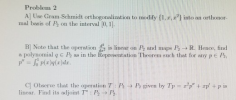 Problem 2 A Use Gram-Schmidt orthogonalization to modify {1, 2,2} into an orthonor- mal basis of P, on the interval [0, 1]. B) Note that the operation is linear on P and maps P. R. Hence, find a polynomial qe as in the Representation Theorem such that for any pe P, p" = lo p(x)q(r)da. C) Observe that the operation T linear. Find its adjoint T : P P P P given by Tp = rºp" + Ip' + p...
 4. Use the Gram-Schmidt Process to find an orthonormal basis for the subspace of R5 defined by 2 S-span 0 2
 Use the Gram-Schmidt process to find an orthonormal basis for the subspace spanned by uz = (1,1,1,1)", u2 = (-1,4,4, -1)", and uz = (4, -2,2,0)".
 3. Use the Gram-Schmidt process to find an orthonormal basis for the subspace of R' spanned by the vectors u; = (1,0,0,0), 12 = (1,1,0,0), uz = (0,1,1,1).
 Use the Gram-Schmidt process to find an or- thonormal basis for the subspace of R4 spanned by Xi = (4, 2, 2, 1)", X2 (2,0, 0, 2)", X3 = (1,1, -1, 1). Let A = (x1 X2 X3) and b = (1, 2, 3,1)7. Factor A into a product QR, where Q has an orthonormal set of column vectors and R is up- per triangular. Solve the least squares problem Ax = b.
 for the subspace of R4 consisting of 4. Use the Gram-Schmidt process to find an orthonormal basis all vectors of the form ſal a + b [b+c] 5. Use the Gram-Schmidt process to find an orthonormal basis of the column space of the matrix [1-1 1 67 2 -1 3 1 A=4 1 91 [3 2 8 5 6. (a) Use the Gram-Schmidt process to find an orthonormal basis S = (P1, P2, P3) for P2, the vector space of...
 The given set is a basis for a subspace W. Use the Gram-Schmidt process to produce an orthogonal basis for W. 8 11 2 - 7 An orthogonal basis for W is { }. (Type a vector or list of vectors. Use a comma to separate vectors as needed.)
 The set is a basis for a subspace W. Use the Gram-Schmidt process to produce an orthogonal basis for W. Assume the vectors are in the order X, and x2 The orthogonal basis produced using the Gram-Schmidt process for Wis. (Use a somma to separato vectors as needed.)
 (1 point) Let 12 6 Use the Gram-Schmidt process to determine an orthonormal basis for the subspace of R4 spanned by ř and ý.
 Problem 2 A Use Gram-Schmidt orthogonalization to modify {1, 2,2} into an orthonor- mal basis of P, on the interval [0, 1]. B) Note that the operation is linear on P and maps P. R. Hence, find a polynomial qe as in the Representation Theorem such that for any pe P, p" = lo p(x)q(r)da. C) Observe that the operation T linear. Find its adjoint T : P P P P given by Tp = rºp" + Ip' + p...
Most questions answered within 3 hours.
-
Where is the error in this code sequence?
String s1 = "Hello";
String s2 = "ello";...
asked 11 months ago -
Financial data for Joel de Paris, Inc., for last year
follow:
Joel de Paris, Inc.
Balance...
asked 11 months ago -
Consider this reaction:
Al2(SO4)3 (aq)+ BaCl3
(aq) Al2Cl6 (aq)- +
3BaSO4(s) . What is the...
asked 11 months ago -
Suppose that Savneet is considering increasing her
recent random sample from 20 car rentals to 40...
asked 11 months ago -
Trucks arrive at an unloading terminal at an average rate of 120
per hour.
Trucks arrive...
asked 11 months ago -
Why are methanol and ethanol completely soluble in water while
octanol is not very little soluble....
asked 11 months ago -
A facilities manager at a university reads in a research report
that the mean amount of...
asked 11 months ago -
When the CuSO4 is rehydrated by adding water to the anhydrous
compound, is this an endothermic...
asked 11 months ago -
A ray of sunlight is passing from diamond into crown glass; the
angle of incidence is...
asked 11 months ago -
A block of mass 0.249 kg is placed on top of a light, vertical
spring of...
asked 11 months ago -
how do the kidneys compensate in the presences of acidosis
a) trigger hyperventilate
b) reserve acid...
asked 11 months ago -
Question 501 pts
The rental rate of capital to the firm increases. Which of the
following...
asked 11 months ago