
Homework Answers
![2 gain for omnidirectional antennail- c radiation along one beam dosection either it is vertical on horisontal] gain = tolog](http://img.homeworklib.com/questions/1a7d0150-4ed6-11eb-bb62-abaebe8463b6.png?x-oss-process=image/resize,w_560)
Add Answer to:
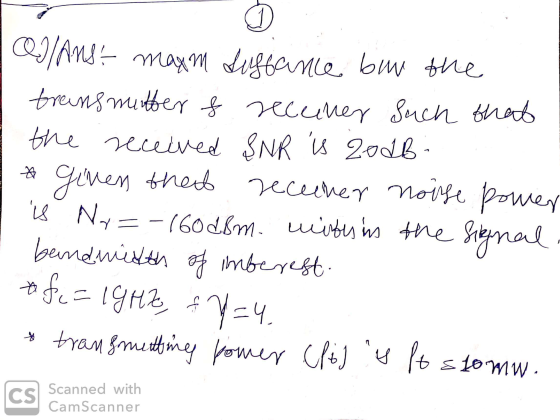
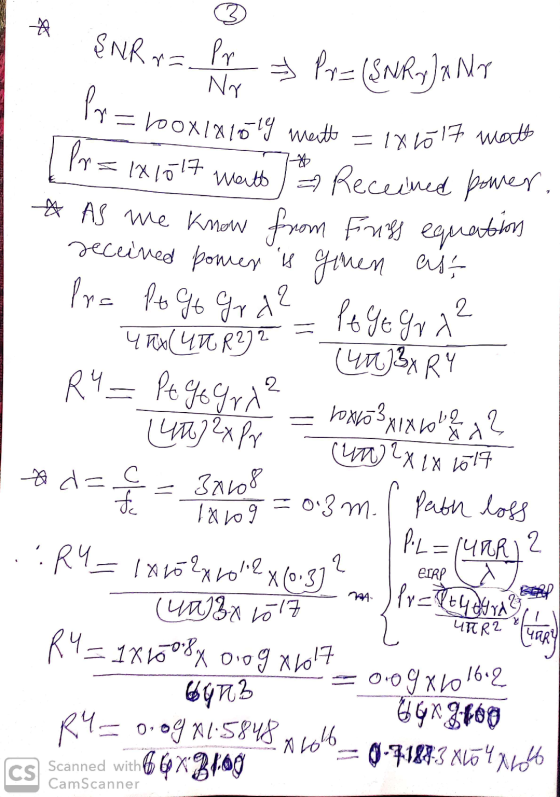
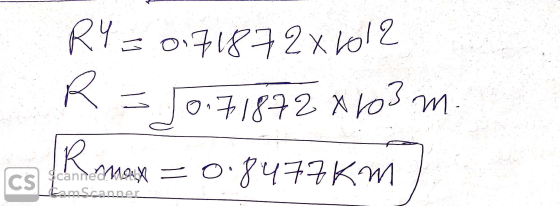
Consider a receiver with noise power -160dBm within the signal bandwidth of interest. Assume a simplified...
Calculate the maximum allowable path loss in dB between a radio transmitter and a receiver for...
 Calculate the maximum allowable path loss in dB between a radio transmitter and a receiver for the following transmission parameters. Assume the free space propagation loss condition. Transmitter's power: 10 Watt. Minimum required SNR (Signal to Noise Ratio) at the receiver: 5 dB. . Transmission channel bandwidth: 25 kHz. Noise power density No-0.8 x 10⁻⁹ W/Hz .Transmitting and receiving antenna gains are 1 dBi and 2 dBi respectively
Problem 3 A receiver has a bandwidth of 1 MHz and a noise figure of 10...
 Problem 3 A receiver has a bandwidth of 1 MHz and a noise figure of 10 dB. The receiver sensitivity is -90 dBm. The Boltzmann constant is k=1.38x10⁻²³ Joule/deg K, and the room temperature is 300 deg Kelvin. a) What is the ratio of the SNR at the input to the receiver (computed over the bandwidth of interest) to the SNR at the output of the receiver? b) What is the noise power at output of the receiver? c) Find...
8 8.6-4 For a DSB-SC system with a channel noise PSD of Sn() 10-12 and a baseband signal of bandw...
 8 8.6-4 For a DSB-SC system with a channel noise PSD of Sn() 10-12 and a baseband signal of bandwidth 5 kHz, the receiver output SNR is required to be at least 47 dB. The receiver is as shown in Fig. 8.30. (a) What must be the signal power Si received at the receiver input? (b) What is the receiver output noise power No? (c) What is the minimum transmitted power Sr if the channel transfer function is He)10-3 over...
3. The quality of a received signal is often characterized by the signal-to-noise-ratio (SNR), which is...
 3. The quality of a received signal is often characterized by the signal-to-noise-ratio (SNR), which is defined as SNR 10 log As you might expect from this Signal power in watts KTB definition, the unit of SNR is decibels (dB). The term in the denominator is the noise power, and it is generally specified as an effective noise temperature T multiplied by the product of Boltzmann's constant (K) and the bandwidth (B) of the signal in Hz. Generally we like...
(a) Under the free-space path-loss model, find the transmit power required to obtain a received power...
(a) Under the free-space path-loss model, find the transmit power required to obtain a received power of 10dBm for a wireless system with isotropic antennas (Gl = 1) and a carrier frequency f = 5GHz, assuming a distance d = 10m. (b) Show that, under free-space path-loss model, doubling the distance attenuates the power received by approximately 6dB.
Solve the multi-task problem: The LEO cellular satellite communication system requires the forward link (from satellite...
Solve the multi-task problem: The LEO cellular satellite communication system requires the forward link (from satellite to the earth mobile) signal-to-noise ratio (SNR) in the output of the earth station receiver to be 17dB. The link has the following specifications: Operation frequency f = 6 GHz Receiver antenna gain (earth station), Gr = 0 dB Transmitter antenna gain (satellite), Gt = 3 dB Distance to satellite, d = 1000 km Bandwidth of the receiver, B = 2 MHz Noise...
Problem 3 (25 points) Consider the set of empirical measurements of Pr/Pt given in the table syst...
 Problem 3 (25 points) Consider the set of empirical measurements of Pr/Pt given in the table system at 2.5 G㎐ below for an indoor a) Find th e path loss exponent (y) that minimizes the MSE between the simplified and the empirical dB power measurements, assuming that do-1 m and K is determined from the free space path loss formula at this do. b) Find the received power at 50 m for the simplified path loss model with this path...
Consider the satellite relay link with the following parameters. Downlink EIRP of the satellite: 55 dBW...
 Consider the satellite relay link with the following parameters. Downlink EIRP of the satellite: 55 dBW Transmit frequency: Receiver noise temperature:700 K Receiver antenna gain Transmitter- receiver distance: 41,000 km System bandwidth: Total system losses (margin): 3 dB 2 GHz 0 dB 50 kHz (a) Find the received signal power in dBW (b) Find the receiver noise level in dBW (c) Calculate the signal-to-noise ratio at the receiver in dB
As a communications system engineer, you are asked to setup a communication system to serve a distance of 100m using an access point transmitting signals with power 20dBm at the frequency 2.4GHz. The...
 As a communications system engineer, you are asked to setup a communication system to serve a distance of 100m using an access point transmitting signals with power 20dBm at the frequency 2.4GHz. The antennas used at the transmitter and receiver side have the gains shown in the picture below. The coaxial cables used to interface the systems to the antennas have losses shown in the picture below What is the received signal power in dBm at the input of the...
:Consider a cellular system operating at 2.4GHz where propagation follows simplified path loss with γ =...
:Consider a cellular system operating at 2.4GHz where propagation follows simplified path loss with γ = 3, d0 = 1 and K = −30dB, and with variations about this pathloss due to log-normal shadowing with σ = 4dB. Suppose that for acceptable voice quality an SNR ratio of 40dBm is required at the mobile. Assume the base station transmits at 0dB and the receiver noise in the bandwidth of interest is −50dB. a) Find the maximum cell size such that...
 Calculate the maximum allowable path loss in dB between a radio transmitter and a receiver for the following transmission parameters. Assume the free space propagation loss condition. Transmitter's power: 10 Watt. Minimum required SNR (Signal to Noise Ratio) at the receiver: 5 dB. . Transmission channel bandwidth: 25 kHz. Noise power density No-0.8 x 10⁻⁹ W/Hz .Transmitting and receiving antenna gains are 1 dBi and 2 dBi respectively
 Problem 3 A receiver has a bandwidth of 1 MHz and a noise figure of 10 dB. The receiver sensitivity is -90 dBm. The Boltzmann constant is k=1.38x10⁻²³ Joule/deg K, and the room temperature is 300 deg Kelvin. a) What is the ratio of the SNR at the input to the receiver (computed over the bandwidth of interest) to the SNR at the output of the receiver? b) What is the noise power at output of the receiver? c) Find...
 8 8.6-4 For a DSB-SC system with a channel noise PSD of Sn() 10-12 and a baseband signal of bandwidth 5 kHz, the receiver output SNR is required to be at least 47 dB. The receiver is as shown in Fig. 8.30. (a) What must be the signal power Si received at the receiver input? (b) What is the receiver output noise power No? (c) What is the minimum transmitted power Sr if the channel transfer function is He)10-3 over...
 3. The quality of a received signal is often characterized by the signal-to-noise-ratio (SNR), which is defined as SNR 10 log As you might expect from this Signal power in watts KTB definition, the unit of SNR is decibels (dB). The term in the denominator is the noise power, and it is generally specified as an effective noise temperature T multiplied by the product of Boltzmann's constant (K) and the bandwidth (B) of the signal in Hz. Generally we like...
 Problem 3 (25 points) Consider the set of empirical measurements of Pr/Pt given in the table system at 2.5 G㎐ below for an indoor a) Find th e path loss exponent (y) that minimizes the MSE between the simplified and the empirical dB power measurements, assuming that do-1 m and K is determined from the free space path loss formula at this do. b) Find the received power at 50 m for the simplified path loss model with this path...
 Consider the satellite relay link with the following parameters. Downlink EIRP of the satellite: 55 dBW Transmit frequency: Receiver noise temperature:700 K Receiver antenna gain Transmitter- receiver distance: 41,000 km System bandwidth: Total system losses (margin): 3 dB 2 GHz 0 dB 50 kHz (a) Find the received signal power in dBW (b) Find the receiver noise level in dBW (c) Calculate the signal-to-noise ratio at the receiver in dB
 As a communications system engineer, you are asked to setup a communication system to serve a distance of 100m using an access point transmitting signals with power 20dBm at the frequency 2.4GHz. The antennas used at the transmitter and receiver side have the gains shown in the picture below. The coaxial cables used to interface the systems to the antennas have losses shown in the picture below What is the received signal power in dBm at the input of the...
Most questions answered within 3 hours.
-
Where is the error in this code sequence?
String s1 = "Hello";
String s2 = "ello";...
asked 11 months ago -
Financial data for Joel de Paris, Inc., for last year
follow:
Joel de Paris, Inc.
Balance...
asked 11 months ago -
Consider this reaction:
Al2(SO4)3 (aq)+ BaCl3
(aq) Al2Cl6 (aq)- +
3BaSO4(s) . What is the...
asked 11 months ago -
Suppose that Savneet is considering increasing her
recent random sample from 20 car rentals to 40...
asked 11 months ago -
Trucks arrive at an unloading terminal at an average rate of 120
per hour.
Trucks arrive...
asked 11 months ago -
Why are methanol and ethanol completely soluble in water while
octanol is not very little soluble....
asked 11 months ago -
A facilities manager at a university reads in a research report
that the mean amount of...
asked 11 months ago -
When the CuSO4 is rehydrated by adding water to the anhydrous
compound, is this an endothermic...
asked 11 months ago -
A ray of sunlight is passing from diamond into crown glass; the
angle of incidence is...
asked 11 months ago -
A block of mass 0.249 kg is placed on top of a light, vertical
spring of...
asked 11 months ago -
how do the kidneys compensate in the presences of acidosis
a) trigger hyperventilate
b) reserve acid...
asked 11 months ago -
Question 501 pts
The rental rate of capital to the firm increases. Which of the
following...
asked 11 months ago