Data Structures: Abstraction and Design Using Java Elliot B. Koffman; Paul A. T. Wolfgang ch 5...
Data Structures: Abstraction and Design Using Java Elliot B. Koffman; Paul A. T. Wolfgang ch 5 review questions 5 and 7
5. For Towers of Hanoi, show the output string that would be created by the method call showMoves(3, 'R', 'M', 'L'). Also, show the sequence of method calls.
7. Write a recursive method that will dispense change for a given amount of money. The method will display all combinations of quarters, dimes, nickels, and pennies that equal the desired amount.
Homework Answers
5.
class TowersOfHanoi
{
static void showMoves(int n, char r, char m, char
l)
{
if(n>0)
{
showMoves(n-1,r,l,m);
System.out.println("Move "+ n + " disk from " + r + " to " +
m);
showMoves(n-1,l,m,r);
}
}
public static void main (String[] args)
{
showMoves(3, 'R', 'M', 'L');
}
}
Output Strings:
Move 1 disk from R to M
Move 2 disk from R to L
Move 1 disk from M to L
Move 3 disk from R to M
Move 1 disk from L to R
Move 2 disk from L to M
Move 1 disk from R to M
Sequence of method calling:
class TowersOfHanoi
{
static void showMoves(int n, char r, char m, char
l)
{
if(n>0)
{
System.out.println("showMoves(" + (n-1) + ", " + r + ", " + l + ",
" + m + ")");
showMoves(n-1,r,l,m);
// System.out.println("Move "+ n + " disk from " + r + " to " +
m);
System.out.println("showMoves(" + (n-1) + ", " + l + ", " + m + ",
" +r + ")");
showMoves(n-1,l,m,r);
}
}
public static void main (String[] args)
{
showMoves(3, 'R', 'M', 'L');
}
}
Output of method calling sequence (without the moves):
showMoves(2, r, l, m)
showMoves(1, r, m, l)
showMoves(0, r, l, m)
showMoves(0, l, m, r)
showMoves(1, m, l, r)
showMoves(0, m, r, l)
showMoves(0, r, l, m)
showMoves(2, l, m, r)
showMoves(1, l, r, m)
showMoves(0, l, m, r)
showMoves(0, m, r, l)
showMoves(1, r, m, l)
showMoves(0, r, l, m)
showMoves(0, l, m, r)
7.
import java.util.*;
class Change
{
static ArrayList<int[]> combos = new
ArrayList<int[]>();
//method to genarate different combinations of
changes
static void change(int amount, int q, int d, int n,
int p)
{
// base condition
if (q * 25 + d * 10 + n * 5 + p > amount) return;
//write the combination
writeCombo(q, d, n, p);
/*check if penny greater than or
equal to 5 then increase nickel
* by one and decrease penny by 5
*/
if (p >= 5) change(amount, q, d, n + 1, p - 5);
/*check if penny greater than or equal to 10 then
increase dime
* by one and decrease penny by 10
*/
if (p >= 10) change(amount, q, d + 1, n, p - 10);
/*check if penny greater than or equal to 25 then increase
quarter
* by one and decrease penny by 25
*/
if (p >= 25) change(amount, q + 1, d, n, p - 25);
}
//method to write the combination
static void writeCombo(int q, int d, int n, int p)
{
int[] newCombo = { q, d, n, p };
for (int[] combo : combos)
{
if (Arrays.equals(newCombo, combo))
return; // this combination already stored
}
combos.add(newCombo);
}
//main method
public static void main (String[] args)
{
//create object of Scanner
class
Scanner sc = new
Scanner(System.in);
System.out.print("Enter any amount
in cents: ");
//read the amount in cents
int amount = sc.nextInt();
//call the change() method
change(amount, 0, 0, 0,
amount);
System.out.println("\nAll possible
combinations for " + amount + " cents:");
//display all the combinations
for (int[] a : combos)
{
System.out.println(a[0] + " Quarter\t" + a[1] + " Dime\t" + a[2] +
" Nickel\t" + a[3] + " Penny");
}
}
}
Output:
Enter any amount in cents: 49
All possible combinations for 49 cents:
0 Quarter 0 Dime 0 Nickel 49 Penny
0 Quarter 0 Dime 1 Nickel 44 Penny
0 Quarter 0 Dime 2 Nickel 39 Penny
0 Quarter 0 Dime 3 Nickel 34 Penny
0 Quarter 0 Dime 4 Nickel 29 Penny
0 Quarter 0 Dime 5 Nickel 24 Penny
0 Quarter 0 Dime 6 Nickel 19 Penny
0 Quarter 0 Dime 7 Nickel 14 Penny
0 Quarter 0 Dime 8 Nickel 9 Penny
0 Quarter 0 Dime 9 Nickel 4 Penny
0 Quarter 1 Dime 7 Nickel 4 Penny
0 Quarter 1 Dime 6 Nickel 9 Penny
0 Quarter 1 Dime 5 Nickel 14 Penny
0 Quarter 2 Dime 5 Nickel 4 Penny
0 Quarter 1 Dime 4 Nickel 19 Penny
0 Quarter 2 Dime 4 Nickel 9 Penny
1 Quarter 0 Dime 4 Nickel 4 Penny
0 Quarter 1 Dime 3 Nickel 24 Penny
0 Quarter 2 Dime 3 Nickel 14 Penny
0 Quarter 3 Dime 3 Nickel 4 Penny
1 Quarter 0 Dime 3 Nickel 9 Penny
0 Quarter 1 Dime 2 Nickel 29 Penny
0 Quarter 2 Dime 2 Nickel 19 Penny
0 Quarter 3 Dime 2 Nickel 9 Penny
1 Quarter 1 Dime 2 Nickel 4 Penny
1 Quarter 0 Dime 2 Nickel 14 Penny
0 Quarter 1 Dime 1 Nickel 34 Penny
0 Quarter 2 Dime 1 Nickel 24 Penny
0 Quarter 3 Dime 1 Nickel 14 Penny
0 Quarter 4 Dime 1 Nickel 4 Penny
1 Quarter 1 Dime 1 Nickel 9 Penny
1 Quarter 0 Dime 1 Nickel 19 Penny
0 Quarter 1 Dime 0 Nickel 39 Penny
0 Quarter 2 Dime 0 Nickel 29 Penny
0 Quarter 3 Dime 0 Nickel 19 Penny
0 Quarter 4 Dime 0 Nickel 9 Penny
1 Quarter 2 Dime 0 Nickel 4 Penny
1 Quarter 1 Dime 0 Nickel 14 Penny
1 Quarter 0 Dime 0 Nickel 24 Penny
Add Answer to:
Data Structures: Abstraction and Design Using Java Elliot B.
Koffman; Paul A. T. Wolfgang ch 5...
Resource: Ch. 5, "Recursion", of Data Structures: Abstraction and Design Using Java, Exercises for Section 5.6...
Resource: Ch. 5, "Recursion", of Data Structures: Abstraction and Design Using Java, Exercises for Section 5.6 Complete the following Review Questions within the "Exercises for Sections 5.6" subsection in Section 5.6, "Backtracking" of Ch. 5, "Recursion" in Data Structures: Abstraction and Design Using Java Review Question #7 For the maze path found in Figure 5.19, explain why cells (3, 4), (2, 5), (3, 5), and (4, 5) were never visited and why cells (5, 1) and (3, 0) through (9,...
Resource: Ch. 10, "Graphs", of Data Structures: Abstraction and Design Using Java, Exercises for Section 10.4;...
 Resource: Ch. 10, "Graphs", of Data
Structures: Abstraction and Design Using Java, Exercises for
Section 10.4; Self-Check #1
Complete the Self-Check Question #1 within
"Exercises for Sections 10.4" subsection in Section 10.4,
"Traversals of Graphs" of Ch. 10, "Graphs" in Data Structures:
Abstraction and Design Using Java.
Document the breadth-first search trees in the
Self-Check question.
Submit the assignment to the Assignment Files
tab.
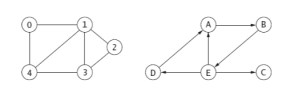
4. Show the breadth-first search trees for the following
graphs.
2 1 3 0 4
Resource: Ch. 10, "Graphs", of Data
Structures: Abstraction and Design Using Java, Exercises for
Section 10.4; Self-Check #1
Complete the Self-Check Question #1 within
"Exercises for Sections 10.4" subsection in Section 10.4,
"Traversals of Graphs" of Ch. 10, "Graphs" in Data Structures:
Abstraction and Design Using Java.
Document the breadth-first search trees in the
Self-Check question.
Submit the assignment to the Assignment Files
tab.
4. Show the breadth-first search trees for the following
graphs.
2 1 3 0 4
Can you please help me with creating this Java Code using the following pseudocode? Make Change C...
Can you please help me with creating this Java Code using the following pseudocode? Make Change Calculator (100 points + 5 ex.cr.) 2019 In this program (closely related to the change calculator done as the prior assignment) you will make “change for a dollar” using the most efficient set of coins possible. In Part A you will give the fewest quarters, dimes, nickels, and pennies possible (i.e., without regard to any ‘limits’ on coin counts), but in Part B you...
This needs to be done in Java using Using Multiple Generic Data Structures – LinkedList and Array...
 this needs to be done in Java using Using
Multiple Generic Data Structures – LinkedList and ArrayList
In this assignment, you will write a system to manage email
address lists (ostensibly so that you could send emails to a list
which has a name – which would send an email to each of the
addresses in the list – although we will not actually implement
sending emails. Displaying the list will simulate being
able to send the emails). We will...
this needs to be done in Java using Using
Multiple Generic Data Structures – LinkedList and ArrayList
In this assignment, you will write a system to manage email
address lists (ostensibly so that you could send emails to a list
which has a name – which would send an email to each of the
addresses in the list – although we will not actually implement
sending emails. Displaying the list will simulate being
able to send the emails). We will...
Question from Object-Oriented Data Structures Using Java 4th Edition Chapter 5 Question 30 Add the following...
Question from Object-Oriented Data Structures Using Java 4th Edition Chapter 5 Question 30 Add the following methods to the LinkedCollection class, and create a test driver for each to show that they work correctly. Code each of these methods by accessing the internal variables of the LinkedCollection, not by calling the previously defined methods of the class.String toString() creates and returns a string that correctly represents the current collection. 1. Such a method could prove useful for testing and debugging...
 Resource: Ch. 10, "Graphs", of Data
Structures: Abstraction and Design Using Java, Exercises for
Section 10.4; Self-Check #1
Complete the Self-Check Question #1 within
"Exercises for Sections 10.4" subsection in Section 10.4,
"Traversals of Graphs" of Ch. 10, "Graphs" in Data Structures:
Abstraction and Design Using Java.
Document the breadth-first search trees in the
Self-Check question.
Submit the assignment to the Assignment Files
tab.
4. Show the breadth-first search trees for the following
graphs.
2 1 3 0 4
Resource: Ch. 10, "Graphs", of Data
Structures: Abstraction and Design Using Java, Exercises for
Section 10.4; Self-Check #1
Complete the Self-Check Question #1 within
"Exercises for Sections 10.4" subsection in Section 10.4,
"Traversals of Graphs" of Ch. 10, "Graphs" in Data Structures:
Abstraction and Design Using Java.
Document the breadth-first search trees in the
Self-Check question.
Submit the assignment to the Assignment Files
tab.
4. Show the breadth-first search trees for the following
graphs.
2 1 3 0 4
 this needs to be done in Java using Using
Multiple Generic Data Structures – LinkedList and ArrayList
In this assignment, you will write a system to manage email
address lists (ostensibly so that you could send emails to a list
which has a name – which would send an email to each of the
addresses in the list – although we will not actually implement
sending emails. Displaying the list will simulate being
able to send the emails). We will...
this needs to be done in Java using Using
Multiple Generic Data Structures – LinkedList and ArrayList
In this assignment, you will write a system to manage email
address lists (ostensibly so that you could send emails to a list
which has a name – which would send an email to each of the
addresses in the list – although we will not actually implement
sending emails. Displaying the list will simulate being
able to send the emails). We will...
Most questions answered within 3 hours.
-
Where is the error in this code sequence?
String s1 = "Hello";
String s2 = "ello";...
asked 10 months ago -
Financial data for Joel de Paris, Inc., for last year
follow:
Joel de Paris, Inc.
Balance...
asked 10 months ago -
Consider this reaction:
Al2(SO4)3 (aq)+ BaCl3
(aq) Al2Cl6 (aq)- +
3BaSO4(s) . What is the...
asked 10 months ago -
Suppose that Savneet is considering increasing her
recent random sample from 20 car rentals to 40...
asked 10 months ago -
Trucks arrive at an unloading terminal at an average rate of 120
per hour.
Trucks arrive...
asked 10 months ago -
Why are methanol and ethanol completely soluble in water while
octanol is not very little soluble....
asked 10 months ago -
A facilities manager at a university reads in a research report
that the mean amount of...
asked 10 months ago -
When the CuSO4 is rehydrated by adding water to the anhydrous
compound, is this an endothermic...
asked 10 months ago -
A ray of sunlight is passing from diamond into crown glass; the
angle of incidence is...
asked 10 months ago -
A block of mass 0.249 kg is placed on top of a light, vertical
spring of...
asked 10 months ago -
how do the kidneys compensate in the presences of acidosis
a) trigger hyperventilate
b) reserve acid...
asked 10 months ago -
Question 501 pts
The rental rate of capital to the firm increases. Which of the
following...
asked 10 months ago