
Homework Answers
![Deon & Ero ] nem clim new n hti = 1 : lan-ele tno, no let Exo be any number | | = -0 By alche median property & Ero 7 KEN <k](http://img.homeworklib.com/questions/b1e5b360-4f14-11eb-be38-d571311bb880.png?x-oss-process=image/resize,w_560)
![from (an-] << < € 3 | 9n-1) <ē tinak. The linet of the sequence is 1](http://img.homeworklib.com/questions/b2686ef0-4f14-11eb-b5af-f7fd22783438.png?x-oss-process=image/resize,w_560)
(3) Prove that the sequence fn (x(max10,z - n))2 does not converge uniformly on IR, but converges...
 (3) Prove that the sequence fn (x(max10,z - n))2 does not converge uniformly on IR, but converges uniformly on compact subsets of R
(3) Prove that the sequence fn (x(max10,z - n))2 does not converge uniformly on IR, but converges uniformly on compact subsets of R
(3) Prove that the sequence fn (x(max10,z - n))2 does not converge uniformly on IR, but converges uniformly on compact subsets of R
Topic: CONVERGENCE 2.1.3 Let {an} be a sequence. Prove that if the sequence {\anſ} converges to...
 Topic: CONVERGENCE
2.1.3 Let {an} be a sequence. Prove that if the sequence {\anſ} converges to 0, then {an} also converges to 0.
Topic: CONVERGENCE
2.1.3 Let {an} be a sequence. Prove that if the sequence {\anſ} converges to 0, then {an} also converges to 0.
Prove that a sequence of random variables X1, X2, ... converges in probability to a constant...
 Prove that a sequence of random variables X1, X2, ... converges in
probability to a constant μ if and only if it also converges in
distribution to μ.
5. Prove that a sequence of random variables X1, X2,... converges in probability to a constant p if and only if it also converges in distribution to u.
Prove that a sequence of random variables X1, X2, ... converges in
probability to a constant μ if and only if it also converges in
distribution to μ.
5. Prove that a sequence of random variables X1, X2,... converges in probability to a constant p if and only if it also converges in distribution to u.
7. For each of the following, prove that the sequence {a,) converges and find the limit....
 7. For each of the following, prove that the sequence {a,) converges and find the limit. 2. Qn+1 = (2a, + 5). a, = 2 b. a -1 = V2an, a, = 3 *c. Qn+1 = V2a, + 3. a, - 1 d. 2n+1 = V2a, + 3, a, = 4
3. Show that the sequence of functions 72 k23k defined on , l converges uniformly to...
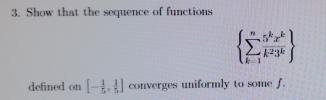 3. Show that the sequence of functions 72 k23k defined on , l converges uniformly to some f.
Exercise 3. Suppose that |2 < 2. Prove that the series converges absolutely.
 Exercise 3. Suppose that |2 < 2. Prove that the series converges absolutely.
3) Let (an)2- be a sequence of real numbers such that lim inf lanl 0. Prove...
 3) Let (an)2- be a sequence of real numbers such that lim inf lanl 0. Prove that there exists a subsequence (mi)2-1 such that Σ . an, converges に1
Problem 3. Prove or give a counter example 1. If an converges to a real limit...
 Problem 3. Prove or give a counter example 1. If an converges to a real limit then limn700 (m)" = 0. 2. If an is a positive sequence satisfying limn+ ()" = 0 then it con- verges.
0. l-18 SCALCET8 11.1.507.XP.MI. Determine whether the sequence converges or diverges. If it converges, find the...
 0. l-18 SCALCET8 11.1.507.XP.MI. Determine whether the sequence converges or diverges. If it converges, find the limit. (If an answer does not exist, enter DNE.) 2n+2 5n lim an
Tamo . Suppose that a sequence of functions fn converges pointwise to a function f on...
 Tamo . Suppose that a sequence of functions fn converges pointwise to a function f on a set E, but there exists a sequence of points In E E such that \fn(2n) – f(2n) > for some strictly positive l. Then fn does not converge uniformly to f on E. (You don't need to prove this here, but it should be clear why this is true.) Now let nar2 fn(L) = 2 +n323 Show that fn converges pointwise on [0,0]...
 (3) Prove that the sequence fn (x(max10,z - n))2 does not converge uniformly on IR, but converges uniformly on compact subsets of R
(3) Prove that the sequence fn (x(max10,z - n))2 does not converge uniformly on IR, but converges uniformly on compact subsets of R
(3) Prove that the sequence fn (x(max10,z - n))2 does not converge uniformly on IR, but converges uniformly on compact subsets of R
 Topic: CONVERGENCE
2.1.3 Let {an} be a sequence. Prove that if the sequence {\anſ} converges to 0, then {an} also converges to 0.
Topic: CONVERGENCE
2.1.3 Let {an} be a sequence. Prove that if the sequence {\anſ} converges to 0, then {an} also converges to 0.
 Prove that a sequence of random variables X1, X2, ... converges in
probability to a constant μ if and only if it also converges in
distribution to μ.
5. Prove that a sequence of random variables X1, X2,... converges in probability to a constant p if and only if it also converges in distribution to u.
Prove that a sequence of random variables X1, X2, ... converges in
probability to a constant μ if and only if it also converges in
distribution to μ.
5. Prove that a sequence of random variables X1, X2,... converges in probability to a constant p if and only if it also converges in distribution to u.
 7. For each of the following, prove that the sequence {a,) converges and find the limit. 2. Qn+1 = (2a, + 5). a, = 2 b. a -1 = V2an, a, = 3 *c. Qn+1 = V2a, + 3. a, - 1 d. 2n+1 = V2a, + 3, a, = 4
 3. Show that the sequence of functions 72 k23k defined on , l converges uniformly to some f.
 Exercise 3. Suppose that |2 < 2. Prove that the series converges absolutely.
 3) Let (an)2- be a sequence of real numbers such that lim inf lanl 0. Prove that there exists a subsequence (mi)2-1 such that Σ . an, converges に1
 Problem 3. Prove or give a counter example 1. If an converges to a real limit then limn700 (m)" = 0. 2. If an is a positive sequence satisfying limn+ ()" = 0 then it con- verges.
 0. l-18 SCALCET8 11.1.507.XP.MI. Determine whether the sequence converges or diverges. If it converges, find the limit. (If an answer does not exist, enter DNE.) 2n+2 5n lim an
 Tamo . Suppose that a sequence of functions fn converges pointwise to a function f on a set E, but there exists a sequence of points In E E such that \fn(2n) – f(2n) > for some strictly positive l. Then fn does not converge uniformly to f on E. (You don't need to prove this here, but it should be clear why this is true.) Now let nar2 fn(L) = 2 +n323 Show that fn converges pointwise on [0,0]...
Most questions answered within 3 hours.
-
Where is the error in this code sequence?
String s1 = "Hello";
String s2 = "ello";...
asked 10 months ago -
Financial data for Joel de Paris, Inc., for last year
follow:
Joel de Paris, Inc.
Balance...
asked 10 months ago -
Consider this reaction:
Al2(SO4)3 (aq)+ BaCl3
(aq) Al2Cl6 (aq)- +
3BaSO4(s) . What is the...
asked 10 months ago -
Suppose that Savneet is considering increasing her
recent random sample from 20 car rentals to 40...
asked 10 months ago -
Trucks arrive at an unloading terminal at an average rate of 120
per hour.
Trucks arrive...
asked 10 months ago -
Why are methanol and ethanol completely soluble in water while
octanol is not very little soluble....
asked 10 months ago -
A facilities manager at a university reads in a research report
that the mean amount of...
asked 10 months ago -
When the CuSO4 is rehydrated by adding water to the anhydrous
compound, is this an endothermic...
asked 10 months ago -
A ray of sunlight is passing from diamond into crown glass; the
angle of incidence is...
asked 10 months ago -
A block of mass 0.249 kg is placed on top of a light, vertical
spring of...
asked 10 months ago -
how do the kidneys compensate in the presences of acidosis
a) trigger hyperventilate
b) reserve acid...
asked 10 months ago -
Question 501 pts
The rental rate of capital to the firm increases. Which of the
following...
asked 10 months ago