answer all parts and show your work! thank you
Homework Answers
Add Answer to:
answer all parts and show your work! thank you
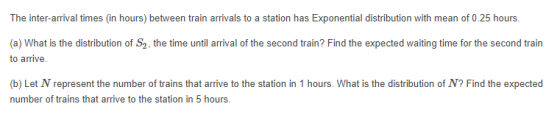
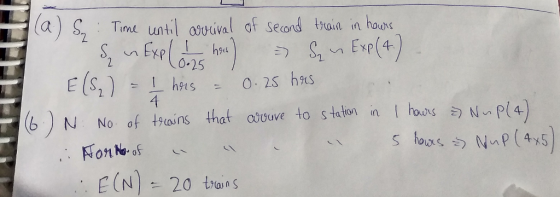
The inter-arrival times (in hours) between train...
10. The times between train arrivals at a certain train station is exponentially distributed with a...
 10. The times between train arrivals at a certain train station is exponentially distributed with a mean of 10 minutes. I arrived at the station while Dayer was already waiting for the train. If Dayer had already spent 8 minutes before I arrived, determine the following a. b. c· The average length of time I will wait until the next train arrives The probability that I will wait more than 5 minutes until the next train arrives The probability that...
Please answer all four parts of the question and show all work. Thank you! Given an...
Please answer all four parts of the question and show all work. Thank you! Given an arrival rate (lambda and in terms “so many arrivals per time unit) and an X, where X is defined on the same time unit as lambda, that is, if lambda is 20 per hour, then X is not 5 minutes, it is 5/60 of an hour). Prob (next arrival less than X) = 1- e-λX Autos arrive at a toll plaza at a rate...
Question 2 Customers arrive at the checkout counter (shown in the figure below) at random from 1 to 8 minutes apart. Each possible value of inter-arrival time has the same probability of occurren...
 Question 2 Customers arrive at the checkout counter (shown in the figure below) at random from 1 to 8 minutes apart. Each possible value of inter-arrival time has the same probability of occurrence, as shown in Table 2.6. The service times vary from 1 to 6 minutes with the probabilities shown in Table 2.7. Departure Arrival Checkout Counter Table 26 Distribution of TIme Between Amivals Time baweerm Arrivals Table 27 Service-Time Distribution Minutesy) Prohablity Service Tme 0.125 0.125 0.125 125...
SHOW ALL WORK! In a waiting line situation, arrivals occur at a rate of 2 per...
SHOW ALL WORK! In a waiting line situation, arrivals occur at a rate of 2 per minute, and the service times average 24 seconds. Assume the Poisson and exponential distributions. a. What is λ? What is μ? b. Find average number of units in the system. c. Find average time in the waiting line. d. Find probability that there is one person waiting. e. Find probability an arrival will have to wait.
Please show all work. Thank you! Assignment-07: Problem 1 Previous Problem Problem List Next Problem (8...
 Please show all work. Thank you!
Assignment-07: Problem 1 Previous Problem Problem List Next Problem (8 points) The wait time (after a scheduled arrival time) in minutes for a train to arrive is Uniformly distributed over the interval [0, 15]. You observe the wait time for the next 95 trains to arrive. Assume wait times are independent. Part a) What is the approximate probability (to 2 decimal places) that the sum of the 95 wait times you observed is between...
Please show all work. Thank you!
Assignment-07: Problem 1 Previous Problem Problem List Next Problem (8 points) The wait time (after a scheduled arrival time) in minutes for a train to arrive is Uniformly distributed over the interval [0, 15]. You observe the wait time for the next 95 trains to arrive. Assume wait times are independent. Part a) What is the approximate probability (to 2 decimal places) that the sum of the 95 wait times you observed is between...
The wait time (after a scheduled arrival time) in minutes for a train to arrive is Uniformly distributed over the interval [0, 12]. You observe the wait time for the next 100 trains to arrive. Assume wait times are independent
The wait time (after a scheduled arrival time) in minutes for a train to arrive is Uniformly distributed over the interval [0, 12]. You observe the wait time for the next 100 trains to arrive. Assume wait times are independent. Part a) What is the approximate probability (to 2 decimal places) that the sum of the 100 wait times you observed is between 565 and 669? Part b) What is the approximate probability (to 2 decimal places) that the average of the...
Consider a simple queuing system in which customers arrive randomly such that the time between successive...
Consider a simple queuing system in which customers arrive randomly such that the time between successive arrivals is exponentially distributed with a rate parameter l = 2.8 per minute. The service time, that is the time it takes to serve each customer is also Exponentially distributed with a rate parameter m = 3 per minute. Create a Matlab simulation to model the above queuing system by randomly sampling time between arrivals and service times from the Exponential Distribution. If a...
The times between parts arrive a manufacturing station is exponentially distributed with mean of 0.5 minute....
The times between parts arrive a manufacturing station is exponentially distributed with mean of 0.5 minute. What is the value of parameter? What is the median time between the parts arrive? What is the standard deviation? What is the 80th percentile? Find the probability of that more than 1 minute elapse between part arrivals. After manufacturing, computer disks are tested for errors. Let X be the number of errors detected on a randomly chosen disk. The following table presents the...
Please show steps on excel. Thank you. In a waiting line situation, arrivals occur around the...
Please show steps on excel. Thank you. In a waiting line situation, arrivals occur around the clock at a rate of six per day, and the service occurs at one every three hours. Assume the Poisson and exponential distributions. What are μ and λ ? Find probability of no units in the system. Find average number of units in the system. Find average time in the waiting line. Find probability that there is one person waiting.
Please show all work and steps. Any help will be appreciated and thank you for your...
 Please show all work and steps. Any help will be appreciated and
thank you for your time!
Train A's distance is not given.
Two trains of pass through the same intersection at different times. Knowing that Train B accelerates from rest at 100 m/min2 and reaches the crossing 10 min after Train A passed through. Determine the relative velocity of Train B with respect to Train A and the distance between the fronts of each train 2 min after Train...
Please show all work and steps. Any help will be appreciated and
thank you for your time!
Train A's distance is not given.
Two trains of pass through the same intersection at different times. Knowing that Train B accelerates from rest at 100 m/min2 and reaches the crossing 10 min after Train A passed through. Determine the relative velocity of Train B with respect to Train A and the distance between the fronts of each train 2 min after Train...
 10. The times between train arrivals at a certain train station is exponentially distributed with a mean of 10 minutes. I arrived at the station while Dayer was already waiting for the train. If Dayer had already spent 8 minutes before I arrived, determine the following a. b. c· The average length of time I will wait until the next train arrives The probability that I will wait more than 5 minutes until the next train arrives The probability that...
 Question 2 Customers arrive at the checkout counter (shown in the figure below) at random from 1 to 8 minutes apart. Each possible value of inter-arrival time has the same probability of occurrence, as shown in Table 2.6. The service times vary from 1 to 6 minutes with the probabilities shown in Table 2.7. Departure Arrival Checkout Counter Table 26 Distribution of TIme Between Amivals Time baweerm Arrivals Table 27 Service-Time Distribution Minutesy) Prohablity Service Tme 0.125 0.125 0.125 125...
 Please show all work. Thank you!
Assignment-07: Problem 1 Previous Problem Problem List Next Problem (8 points) The wait time (after a scheduled arrival time) in minutes for a train to arrive is Uniformly distributed over the interval [0, 15]. You observe the wait time for the next 95 trains to arrive. Assume wait times are independent. Part a) What is the approximate probability (to 2 decimal places) that the sum of the 95 wait times you observed is between...
Please show all work. Thank you!
Assignment-07: Problem 1 Previous Problem Problem List Next Problem (8 points) The wait time (after a scheduled arrival time) in minutes for a train to arrive is Uniformly distributed over the interval [0, 15]. You observe the wait time for the next 95 trains to arrive. Assume wait times are independent. Part a) What is the approximate probability (to 2 decimal places) that the sum of the 95 wait times you observed is between...
 Please show all work and steps. Any help will be appreciated and
thank you for your time!
Train A's distance is not given.
Two trains of pass through the same intersection at different times. Knowing that Train B accelerates from rest at 100 m/min2 and reaches the crossing 10 min after Train A passed through. Determine the relative velocity of Train B with respect to Train A and the distance between the fronts of each train 2 min after Train...
Please show all work and steps. Any help will be appreciated and
thank you for your time!
Train A's distance is not given.
Two trains of pass through the same intersection at different times. Knowing that Train B accelerates from rest at 100 m/min2 and reaches the crossing 10 min after Train A passed through. Determine the relative velocity of Train B with respect to Train A and the distance between the fronts of each train 2 min after Train...
Most questions answered within 3 hours.
-
Where is the error in this code sequence?
String s1 = "Hello";
String s2 = "ello";...
asked 11 months ago -
Financial data for Joel de Paris, Inc., for last year
follow:
Joel de Paris, Inc.
Balance...
asked 11 months ago -
Consider this reaction:
Al2(SO4)3 (aq)+ BaCl3
(aq) Al2Cl6 (aq)- +
3BaSO4(s) . What is the...
asked 11 months ago -
Suppose that Savneet is considering increasing her
recent random sample from 20 car rentals to 40...
asked 11 months ago -
Trucks arrive at an unloading terminal at an average rate of 120
per hour.
Trucks arrive...
asked 11 months ago -
Why are methanol and ethanol completely soluble in water while
octanol is not very little soluble....
asked 11 months ago -
A facilities manager at a university reads in a research report
that the mean amount of...
asked 11 months ago -
When the CuSO4 is rehydrated by adding water to the anhydrous
compound, is this an endothermic...
asked 11 months ago -
A ray of sunlight is passing from diamond into crown glass; the
angle of incidence is...
asked 11 months ago -
A block of mass 0.249 kg is placed on top of a light, vertical
spring of...
asked 11 months ago -
how do the kidneys compensate in the presences of acidosis
a) trigger hyperventilate
b) reserve acid...
asked 11 months ago -
Question 501 pts
The rental rate of capital to the firm increases. Which of the
following...
asked 11 months ago