
Homework Answers
1 gland of oral cavity
2 parotid gland
3 sub lingual gland
4 sub mandibular gland
5oral cavity
6 softpalate
7 tongue
8 oesophagus
9 pancreas
10 stomach
11 pancreatic duxt
12 liver
13 gall bladder
14 duodenum
15 common bile duct
16 large intestine
17 transverse colon
18 ascending colon
19 descending colon
20 small intestine
21 caecum
22 appendix
23 sigmoid colon
24 rectum

Roller coaster ride: A roller coaster is being designed that will accommodate 60 riders. The maximum...
 Roller coaster ride: A roller coaster is being designed that will accommodate 60 riders. The maximum weight the coaster can hold safely is 12,000 pounds. According to the National Health Statistics Reports, the weights of adult U.S. men have mean 190 pounds and standard deviation 64 pounds, and the weights of adult U.S. women have mean 166 pounds and standard deviation 73 pounds. Use the TI-84 Plus calculator. Part 1 of 3 (a) If 60 people are riding the coaster,...
Problem 1: Looping. The looping of a roller coaster has the radius R. The roller coaster...
 Problem 1: Looping. The looping of a roller coaster has the radius R. The roller coaster starts at rest in height H over the deepest point of the looping (as shown in the figure). Neglect friction and consider the roller coaster as a mass point of mass m. Q.1) Express the total energy of the body. The reference point for the potential energy is at the center of the loop. Q.2) Find the speed of the body at the top...
Frictionless Roller Coaster Problem
 In the figure, a frictionless roller coaster car of mass m = 811 kg tops the first hill with speed v0 = 18 m/s at height h = 43 m. What is the speed of the car at point B?
The figure shows a famous roller coaster ride. You can ignore friction. If the roller coaster...
 The figure shows a famous roller coaster ride. You can ignore friction. If the roller coaster leaves point Q with a speed of 15 m/s, what is its speed at the top of the 25-m peak? 27 m/s 41 m/s 32 m/s 22 m/s 62 m/s
A roller-coaster track has six semicircular "dips" with different radii of curvature. The same roller-coaster cart...
 A roller-coaster track has six semicircular "dips" with different
radii of curvature. The same roller-coaster cart rides through each
dip at a different speed.For the different values given for the radius of curvatureR and speed v,
rank the magnitude of the force of the roller-coaster track on the
cart at the bottom of each dip.A) R=60m v=16 m/s B) R=15m v= 8m/s C) R=30m v= 4m/s D) R=45m v=
4m/s E) 30m v= 16 m/s F) R= 15m v=12 m/s
A roller-coaster track has six semicircular "dips" with different
radii of curvature. The same roller-coaster cart rides through each
dip at a different speed.For the different values given for the radius of curvatureR and speed v,
rank the magnitude of the force of the roller-coaster track on the
cart at the bottom of each dip.A) R=60m v=16 m/s B) R=15m v= 8m/s C) R=30m v= 4m/s D) R=45m v=
4m/s E) 30m v= 16 m/s F) R= 15m v=12 m/s
20m Consider the image above that shows the trajectory of a roller coaster car. The roller...
 20m Consider the image above that shows the trajectory of a roller coaster car. The roller coaster car has a mass of 200kg and is released from rest at position A. 2. a. Find the velocity of the car at positions B, C, and D b. Determine the maximum possible radius of the circle such that the car will not lose contact with the track. C. Suppose a breaking force (F 10 newtons) is applied as the car traverses the...
A roller coaster track is set up so that the coaster starts from rest, falls, and...
 A roller coaster track is set up so that the coaster starts from
rest, falls, and proceeds to go through a loop according to the
picture. Ignore friction. The photogates can be used to determine
the velocity of the cart.
Using energy conservation, find the minimum height the cart must
start from in order to complete the loop.
Need some help working out these equation. Any help is really
appreciated!!
Track Car Photogate
A roller coaster track is set up so that the coaster starts from
rest, falls, and proceeds to go through a loop according to the
picture. Ignore friction. The photogates can be used to determine
the velocity of the cart.
Using energy conservation, find the minimum height the cart must
start from in order to complete the loop.
Need some help working out these equation. Any help is really
appreciated!!
Track Car Photogate
0.12 Roller coasters. The Roller Coaster Database (redb.com) contains lots of information about roller coasters all...
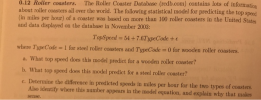 0.12 Roller coasters. The Roller Coaster Database (redb.com) contains lots of information about roller coasters all over the world. The following statistical model for predicting the top speed (in miles per hour) of a coaster was based on more than 100 roller coasters in the United States and data displayed on the database in November 2003: TopSpeed = 54 + 7.6TypeCode + E where TypeCode = 1 for steel roller coasters and TypeCode 0 for wooden roller coasters. a. What...
B c d A roller coaster cart and passengers has a capacity of 2,000Ag. The roller...
 B c d
A roller coaster cart and passengers has a capacity of 2,000Ag. The roller coaster needs to be designed such that the cart and passengers can make it around a loop that has a radius of 20m. At the top f the loop draw the Flee Body Diagram for the cart Write Newton's 2^nd Law equation(s) at the top of the loop. What condition is required for the cart to remain in contact with the track at the...
B c d
A roller coaster cart and passengers has a capacity of 2,000Ag. The roller coaster needs to be designed such that the cart and passengers can make it around a loop that has a radius of 20m. At the top f the loop draw the Flee Body Diagram for the cart Write Newton's 2^nd Law equation(s) at the top of the loop. What condition is required for the cart to remain in contact with the track at the...
 Roller coaster ride: A roller coaster is being designed that will accommodate 60 riders. The maximum weight the coaster can hold safely is 12,000 pounds. According to the National Health Statistics Reports, the weights of adult U.S. men have mean 190 pounds and standard deviation 64 pounds, and the weights of adult U.S. women have mean 166 pounds and standard deviation 73 pounds. Use the TI-84 Plus calculator. Part 1 of 3 (a) If 60 people are riding the coaster,...
 Problem 1: Looping. The looping of a roller coaster has the radius R. The roller coaster starts at rest in height H over the deepest point of the looping (as shown in the figure). Neglect friction and consider the roller coaster as a mass point of mass m. Q.1) Express the total energy of the body. The reference point for the potential energy is at the center of the loop. Q.2) Find the speed of the body at the top...
 The figure shows a famous roller coaster ride. You can ignore friction. If the roller coaster leaves point Q with a speed of 15 m/s, what is its speed at the top of the 25-m peak? 27 m/s 41 m/s 32 m/s 22 m/s 62 m/s
 A roller-coaster track has six semicircular "dips" with different
radii of curvature. The same roller-coaster cart rides through each
dip at a different speed.For the different values given for the radius of curvatureR and speed v,
rank the magnitude of the force of the roller-coaster track on the
cart at the bottom of each dip.A) R=60m v=16 m/s B) R=15m v= 8m/s C) R=30m v= 4m/s D) R=45m v=
4m/s E) 30m v= 16 m/s F) R= 15m v=12 m/s
A roller-coaster track has six semicircular "dips" with different
radii of curvature. The same roller-coaster cart rides through each
dip at a different speed.For the different values given for the radius of curvatureR and speed v,
rank the magnitude of the force of the roller-coaster track on the
cart at the bottom of each dip.A) R=60m v=16 m/s B) R=15m v= 8m/s C) R=30m v= 4m/s D) R=45m v=
4m/s E) 30m v= 16 m/s F) R= 15m v=12 m/s
 20m Consider the image above that shows the trajectory of a roller coaster car. The roller coaster car has a mass of 200kg and is released from rest at position A. 2. a. Find the velocity of the car at positions B, C, and D b. Determine the maximum possible radius of the circle such that the car will not lose contact with the track. C. Suppose a breaking force (F 10 newtons) is applied as the car traverses the...
 A roller coaster track is set up so that the coaster starts from
rest, falls, and proceeds to go through a loop according to the
picture. Ignore friction. The photogates can be used to determine
the velocity of the cart.
Using energy conservation, find the minimum height the cart must
start from in order to complete the loop.
Need some help working out these equation. Any help is really
appreciated!!
Track Car Photogate
A roller coaster track is set up so that the coaster starts from
rest, falls, and proceeds to go through a loop according to the
picture. Ignore friction. The photogates can be used to determine
the velocity of the cart.
Using energy conservation, find the minimum height the cart must
start from in order to complete the loop.
Need some help working out these equation. Any help is really
appreciated!!
Track Car Photogate
 0.12 Roller coasters. The Roller Coaster Database (redb.com) contains lots of information about roller coasters all over the world. The following statistical model for predicting the top speed (in miles per hour) of a coaster was based on more than 100 roller coasters in the United States and data displayed on the database in November 2003: TopSpeed = 54 + 7.6TypeCode + E where TypeCode = 1 for steel roller coasters and TypeCode 0 for wooden roller coasters. a. What...
 B c d
A roller coaster cart and passengers has a capacity of 2,000Ag. The roller coaster needs to be designed such that the cart and passengers can make it around a loop that has a radius of 20m. At the top f the loop draw the Flee Body Diagram for the cart Write Newton's 2^nd Law equation(s) at the top of the loop. What condition is required for the cart to remain in contact with the track at the...
B c d
A roller coaster cart and passengers has a capacity of 2,000Ag. The roller coaster needs to be designed such that the cart and passengers can make it around a loop that has a radius of 20m. At the top f the loop draw the Flee Body Diagram for the cart Write Newton's 2^nd Law equation(s) at the top of the loop. What condition is required for the cart to remain in contact with the track at the...
Most questions answered within 3 hours.
-
Where is the error in this code sequence?
String s1 = "Hello";
String s2 = "ello";...
asked 10 months ago -
Financial data for Joel de Paris, Inc., for last year
follow:
Joel de Paris, Inc.
Balance...
asked 10 months ago -
Consider this reaction:
Al2(SO4)3 (aq)+ BaCl3
(aq) Al2Cl6 (aq)- +
3BaSO4(s) . What is the...
asked 10 months ago -
Suppose that Savneet is considering increasing her
recent random sample from 20 car rentals to 40...
asked 10 months ago -
Trucks arrive at an unloading terminal at an average rate of 120
per hour.
Trucks arrive...
asked 10 months ago -
Why are methanol and ethanol completely soluble in water while
octanol is not very little soluble....
asked 10 months ago -
A facilities manager at a university reads in a research report
that the mean amount of...
asked 10 months ago -
When the CuSO4 is rehydrated by adding water to the anhydrous
compound, is this an endothermic...
asked 10 months ago -
A ray of sunlight is passing from diamond into crown glass; the
angle of incidence is...
asked 10 months ago -
A block of mass 0.249 kg is placed on top of a light, vertical
spring of...
asked 10 months ago -
how do the kidneys compensate in the presences of acidosis
a) trigger hyperventilate
b) reserve acid...
asked 10 months ago -
Question 501 pts
The rental rate of capital to the firm increases. Which of the
following...
asked 10 months ago