
Homework Answers
Add Answer to:
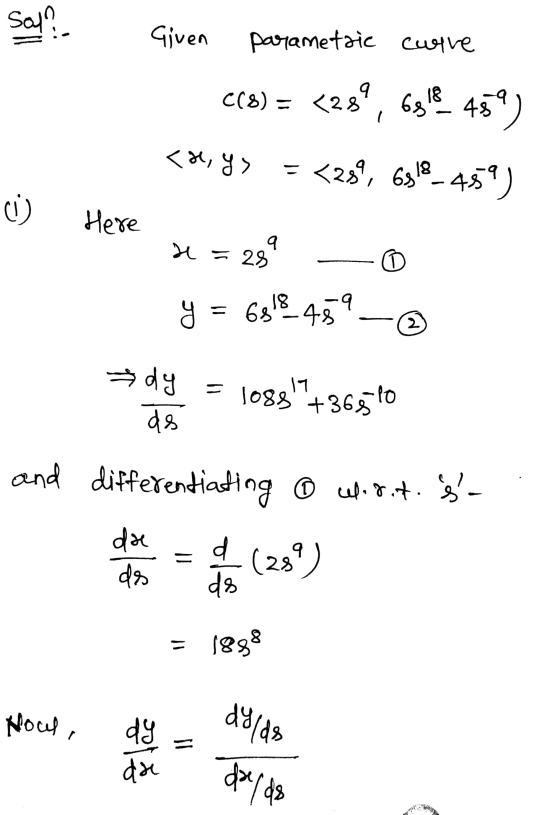
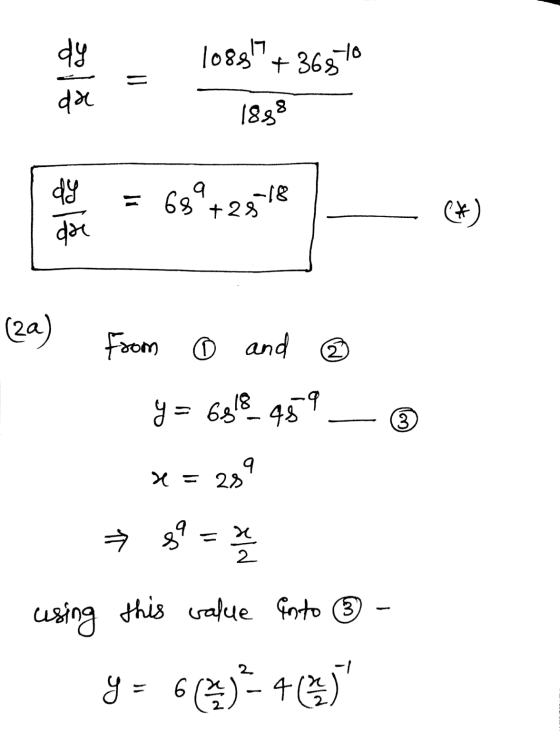
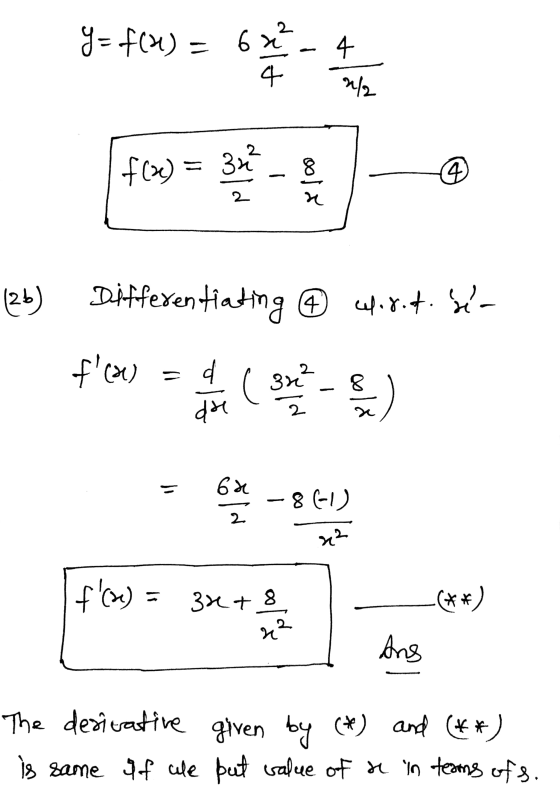
Consider the parametric curve c(s) = (28", 6s18 – 48). This problem asks you to find...
Let the curve C in the (x, y)-plane be given by the parametric equations x =...
 Let the curve C in the (x, y)-plane be given by the parametric equations x = e + 2, y = e2-1, tER. (a) Show that the point (3,0) belongs to the curve C. To which value of the parameter t does the point (3,0) correspond? (b) Find an expression for dy (dy/dt) without eliminating the parameter t, i.e., using de = (da/dt) (c) Using your result from part (b), find the value of at the point (3,0). (d) From...
7. (14,5) A particular parametric curve is given by x=1-3, y = 21 +3 for -2...
 7. (14,5) A particular parametric curve is given by x=1-3, y = 21 +3 for -2 515 3. Sketch the curve using arrows to indicate the direction in which the curve is traced as increases. Then eliminate the parameter / to find a Cartesian equation of the curve. 8. (10,4) Find the equation of the plane through the point (-5, 4, 2) and with normal vector-31 +4j - k. Give your answer in both the vector equation of a plane...
Solve C and D part please Sketch the curve represented by the parametric equations (indicate the...
 Solve C and D part please
Sketch the curve represented by the parametric equations (indicate the orientation of the curve), and write the corresponding rectangular equation by eliminating the parameter.(Can you name the curve?) (a) r = sin 0, y = cos, - SOST (b) x = 4 sect and y = 3 tant 3 3 (c) r=-1+ z sint and y = cost for -A <t <3 (d) x = cosht and y cosh 3t (no need to sketch...
Solve C and D part please
Sketch the curve represented by the parametric equations (indicate the orientation of the curve), and write the corresponding rectangular equation by eliminating the parameter.(Can you name the curve?) (a) r = sin 0, y = cos, - SOST (b) x = 4 sect and y = 3 tant 3 3 (c) r=-1+ z sint and y = cost for -A <t <3 (d) x = cosht and y cosh 3t (no need to sketch...
Please help me with these questions, show working. thankyou A space curve is defined by C: T(s) 2si+(5s2+4)j+(s+7)k. De...
 Please help me with these questions, show working. thankyou
A space curve is defined by C: T(s) 2si+(5s2+4)j+(s+7)k. Determine parametric equations for the tangent line to the space curve C at the point P: (2, 9, 8) Your answer should consist of three expressions for the Cartesian variables x, y and z in terms of the parameter t, using the correct syntax. For example: x 2+4*t, y 7-3*t, z 15+2*t Do not use decimal approximations all numbers should be entered...
Please help me with these questions, show working. thankyou
A space curve is defined by C: T(s) 2si+(5s2+4)j+(s+7)k. Determine parametric equations for the tangent line to the space curve C at the point P: (2, 9, 8) Your answer should consist of three expressions for the Cartesian variables x, y and z in terms of the parameter t, using the correct syntax. For example: x 2+4*t, y 7-3*t, z 15+2*t Do not use decimal approximations all numbers should be entered...
you can skip question 1 Sketch the graph of x(t) sin(2t), y(t) = (t + sin(2t))...
 you can skip question 1
Sketch the graph of x(t) sin(2t), y(t) = (t + sin(2t)) and find the coordinates of the points on the graph where the tangent is horizontal or vertical (please specify), then compute the second derivative and discuss the concavity of the graph. 1. Show that the surface area generated by rotating, about the polar axis, the graph of the curve 2. f(0),0 s asesbsnis S = 2nf(0)sin(0) J(50)) + (r°(®)*)de Find an equation, in both...
you can skip question 1
Sketch the graph of x(t) sin(2t), y(t) = (t + sin(2t)) and find the coordinates of the points on the graph where the tangent is horizontal or vertical (please specify), then compute the second derivative and discuss the concavity of the graph. 1. Show that the surface area generated by rotating, about the polar axis, the graph of the curve 2. f(0),0 s asesbsnis S = 2nf(0)sin(0) J(50)) + (r°(®)*)de Find an equation, in both...
1. Consider the parametric curve given below Find the values of θ where the tangent line to the curve is vertical. If you obtain more than one value, enter the largest value. If necessary, round to f...
 1. Consider the parametric curve given below Find the values of θ where the tangent line to the curve is vertical. If you obtain more than one value, enter the largest value. If necessary, round to four decimal places. Here again is the parametric curve from the previous problem. z-es s cose, y-ee-s sin θ, θ < 2π 0 Find the values of θ where the tangent line to the curve is-1. If you obtain more than one value, enter...
all a,b,c,d 1. Suppose C is simple closed curve in the plane given by the parametric equation and recall that the outward unit normal vector n to C is given by y(t r'(t) If g is a scalar field on...
 all a,b,c,d
1. Suppose C is simple closed curve in the plane given by the parametric equation and recall that the outward unit normal vector n to C is given by y(t r'(t) If g is a scalar field on C with gradient Vg, we define the normal derivative Dng by and we define the Laplacian, V2g, of g by For this problem, assume D and C satisfy the hypotheses of Green's Theorem and the appropriate partial derivatives of f...
all a,b,c,d
1. Suppose C is simple closed curve in the plane given by the parametric equation and recall that the outward unit normal vector n to C is given by y(t r'(t) If g is a scalar field on C with gradient Vg, we define the normal derivative Dng by and we define the Laplacian, V2g, of g by For this problem, assume D and C satisfy the hypotheses of Green's Theorem and the appropriate partial derivatives of f...
31. For both parts of this problem, the curve C = C1 + C2 + Cg...
 31. For both parts of this problem, the curve C = C1 + C2 + Cg consists of the three line segments Z 2 C:(0,0,0) + (0,1,0) C2: (0,1,0) + (0,1,2) C3: (0,1,2) + (3,1,2) X and F(x, y, z) = (7y - 22,7x + 2, -2x + y) 3 Note that F is conservative! 90 (a) Compute SF. dr one of the following ways: i. Parameterization of C ii. Fundamental Theorem of Line Integrals iii. Independence of Path Clearly...
1) Find in two different manners (two equations), the parametric equation of the curve C, the...
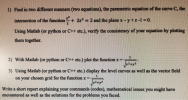 1) Find in two different manners (two equations), the parametric equation of the curve C, the intersection of the function + 2z? = 2 and the plane x -y+z-1=0. Using Matlab (or python or CH etc.), verify the consistency of your equation by plotting them together. 2) With Matlab (or python or CH etc.) plot the function z 3) Using Matlab (or python or C++ etc.) display the level curves as well as the vector field on your chosen grid...
-1-1 arctan n n" n!5* (c) Find the interval of convergence and radius of convergence for )0301 i )e-3r) (d) Use the geometric series to write the power series expansion for i. f(1)- 2-4r, cen...
 -1-1 arctan n n" n!5* (c) Find the interval of convergence and radius of convergence for )0301 i )e-3r) (d) Use the geometric series to write the power series expansion for i. f(1)- 2-4r, centered at a = 0. i.)4 centered at a-6. (e) Write the first 4 nonzero terms of the Maclaurin expansion for i, f(z) = z2 (e4-1) ii. /(x) = cos(3r)-2 sin(2x). (0) Use the Taylor Series definition to write the expansion for f(a)entered at (8) Use...
 Let the curve C in the (x, y)-plane be given by the parametric equations x = e + 2, y = e2-1, tER. (a) Show that the point (3,0) belongs to the curve C. To which value of the parameter t does the point (3,0) correspond? (b) Find an expression for dy (dy/dt) without eliminating the parameter t, i.e., using de = (da/dt) (c) Using your result from part (b), find the value of at the point (3,0). (d) From...
 7. (14,5) A particular parametric curve is given by x=1-3, y = 21 +3 for -2 515 3. Sketch the curve using arrows to indicate the direction in which the curve is traced as increases. Then eliminate the parameter / to find a Cartesian equation of the curve. 8. (10,4) Find the equation of the plane through the point (-5, 4, 2) and with normal vector-31 +4j - k. Give your answer in both the vector equation of a plane...
 Solve C and D part please
Sketch the curve represented by the parametric equations (indicate the orientation of the curve), and write the corresponding rectangular equation by eliminating the parameter.(Can you name the curve?) (a) r = sin 0, y = cos, - SOST (b) x = 4 sect and y = 3 tant 3 3 (c) r=-1+ z sint and y = cost for -A <t <3 (d) x = cosht and y cosh 3t (no need to sketch...
Solve C and D part please
Sketch the curve represented by the parametric equations (indicate the orientation of the curve), and write the corresponding rectangular equation by eliminating the parameter.(Can you name the curve?) (a) r = sin 0, y = cos, - SOST (b) x = 4 sect and y = 3 tant 3 3 (c) r=-1+ z sint and y = cost for -A <t <3 (d) x = cosht and y cosh 3t (no need to sketch...
 Please help me with these questions, show working. thankyou
A space curve is defined by C: T(s) 2si+(5s2+4)j+(s+7)k. Determine parametric equations for the tangent line to the space curve C at the point P: (2, 9, 8) Your answer should consist of three expressions for the Cartesian variables x, y and z in terms of the parameter t, using the correct syntax. For example: x 2+4*t, y 7-3*t, z 15+2*t Do not use decimal approximations all numbers should be entered...
Please help me with these questions, show working. thankyou
A space curve is defined by C: T(s) 2si+(5s2+4)j+(s+7)k. Determine parametric equations for the tangent line to the space curve C at the point P: (2, 9, 8) Your answer should consist of three expressions for the Cartesian variables x, y and z in terms of the parameter t, using the correct syntax. For example: x 2+4*t, y 7-3*t, z 15+2*t Do not use decimal approximations all numbers should be entered...
 you can skip question 1
Sketch the graph of x(t) sin(2t), y(t) = (t + sin(2t)) and find the coordinates of the points on the graph where the tangent is horizontal or vertical (please specify), then compute the second derivative and discuss the concavity of the graph. 1. Show that the surface area generated by rotating, about the polar axis, the graph of the curve 2. f(0),0 s asesbsnis S = 2nf(0)sin(0) J(50)) + (r°(®)*)de Find an equation, in both...
you can skip question 1
Sketch the graph of x(t) sin(2t), y(t) = (t + sin(2t)) and find the coordinates of the points on the graph where the tangent is horizontal or vertical (please specify), then compute the second derivative and discuss the concavity of the graph. 1. Show that the surface area generated by rotating, about the polar axis, the graph of the curve 2. f(0),0 s asesbsnis S = 2nf(0)sin(0) J(50)) + (r°(®)*)de Find an equation, in both...
 1. Consider the parametric curve given below Find the values of θ where the tangent line to the curve is vertical. If you obtain more than one value, enter the largest value. If necessary, round to four decimal places. Here again is the parametric curve from the previous problem. z-es s cose, y-ee-s sin θ, θ < 2π 0 Find the values of θ where the tangent line to the curve is-1. If you obtain more than one value, enter...
 all a,b,c,d
1. Suppose C is simple closed curve in the plane given by the parametric equation and recall that the outward unit normal vector n to C is given by y(t r'(t) If g is a scalar field on C with gradient Vg, we define the normal derivative Dng by and we define the Laplacian, V2g, of g by For this problem, assume D and C satisfy the hypotheses of Green's Theorem and the appropriate partial derivatives of f...
all a,b,c,d
1. Suppose C is simple closed curve in the plane given by the parametric equation and recall that the outward unit normal vector n to C is given by y(t r'(t) If g is a scalar field on C with gradient Vg, we define the normal derivative Dng by and we define the Laplacian, V2g, of g by For this problem, assume D and C satisfy the hypotheses of Green's Theorem and the appropriate partial derivatives of f...
 31. For both parts of this problem, the curve C = C1 + C2 + Cg consists of the three line segments Z 2 C:(0,0,0) + (0,1,0) C2: (0,1,0) + (0,1,2) C3: (0,1,2) + (3,1,2) X and F(x, y, z) = (7y - 22,7x + 2, -2x + y) 3 Note that F is conservative! 90 (a) Compute SF. dr one of the following ways: i. Parameterization of C ii. Fundamental Theorem of Line Integrals iii. Independence of Path Clearly...
 1) Find in two different manners (two equations), the parametric equation of the curve C, the intersection of the function + 2z? = 2 and the plane x -y+z-1=0. Using Matlab (or python or CH etc.), verify the consistency of your equation by plotting them together. 2) With Matlab (or python or CH etc.) plot the function z 3) Using Matlab (or python or C++ etc.) display the level curves as well as the vector field on your chosen grid...
 -1-1 arctan n n" n!5* (c) Find the interval of convergence and radius of convergence for )0301 i )e-3r) (d) Use the geometric series to write the power series expansion for i. f(1)- 2-4r, centered at a = 0. i.)4 centered at a-6. (e) Write the first 4 nonzero terms of the Maclaurin expansion for i, f(z) = z2 (e4-1) ii. /(x) = cos(3r)-2 sin(2x). (0) Use the Taylor Series definition to write the expansion for f(a)entered at (8) Use...
Most questions answered within 3 hours.
-
Where is the error in this code sequence?
String s1 = "Hello";
String s2 = "ello";...
asked 10 months ago -
Financial data for Joel de Paris, Inc., for last year
follow:
Joel de Paris, Inc.
Balance...
asked 10 months ago -
Consider this reaction:
Al2(SO4)3 (aq)+ BaCl3
(aq) Al2Cl6 (aq)- +
3BaSO4(s) . What is the...
asked 10 months ago -
Suppose that Savneet is considering increasing her
recent random sample from 20 car rentals to 40...
asked 10 months ago -
Trucks arrive at an unloading terminal at an average rate of 120
per hour.
Trucks arrive...
asked 10 months ago -
Why are methanol and ethanol completely soluble in water while
octanol is not very little soluble....
asked 10 months ago -
A facilities manager at a university reads in a research report
that the mean amount of...
asked 10 months ago -
When the CuSO4 is rehydrated by adding water to the anhydrous
compound, is this an endothermic...
asked 10 months ago -
A ray of sunlight is passing from diamond into crown glass; the
angle of incidence is...
asked 10 months ago -
A block of mass 0.249 kg is placed on top of a light, vertical
spring of...
asked 10 months ago -
how do the kidneys compensate in the presences of acidosis
a) trigger hyperventilate
b) reserve acid...
asked 10 months ago -
Question 501 pts
The rental rate of capital to the firm increases. Which of the
following...
asked 10 months ago