
Homework Answers
Add Answer to:
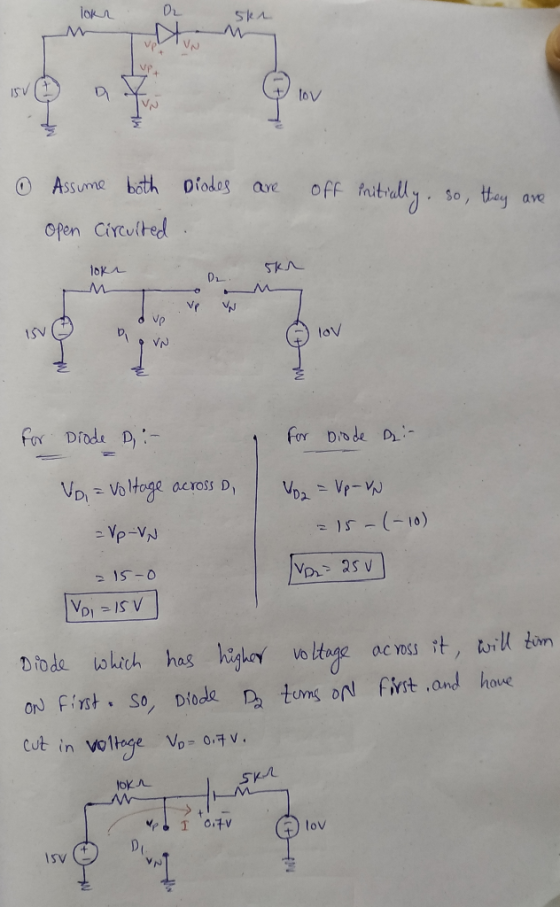
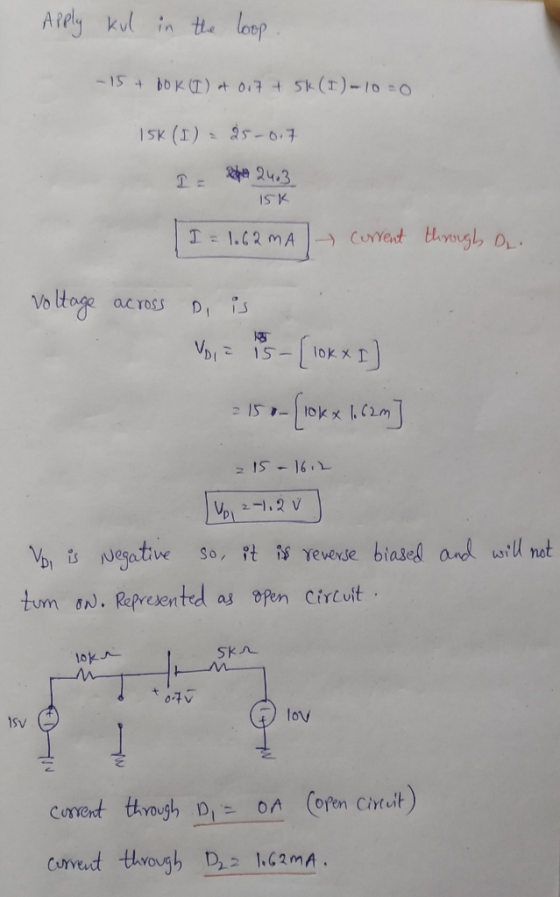
Use the constant voltage diode model (i.e. Vp=0.7 Volts) and calculate the current through each diode....
This is a Diode constant voltage model - clipping circuits Please explain steps as you solve....
 This is a Diode constant voltage model - clipping
circuits
Please explain steps as you solve. Thank you very much for
your help. please ask if there is anything not clear about the
problem
W (a) For the circuit shown below use the constant voltage diode model (Vp=0.7 V), and find the state of diodes D, and D2 (ie. ON or OFF) and determine the voltage and the current for each. 32k2 OV 5 mA 103=_ ; VD3= 104= ;...
This is a Diode constant voltage model - clipping
circuits
Please explain steps as you solve. Thank you very much for
your help. please ask if there is anything not clear about the
problem
W (a) For the circuit shown below use the constant voltage diode model (Vp=0.7 V), and find the state of diodes D, and D2 (ie. ON or OFF) and determine the voltage and the current for each. 32k2 OV 5 mA 103=_ ; VD3= 104= ;...
2. In the circuit below, the forward voltage for each diode is 0.7 volts. Vdc 5V, R 10000, Vac 2c...
 2. In the circuit below, the forward voltage for each diode is 0.7 volts. Vdc 5V, R 10000, Vac 2cos(wt) Volts A. Show that the diodes will always be in forward. B. Find the voltage across the diodes C. Find the current through the diodes. D1 D2 D3 + Vac Vdc
2. In the circuit below, the forward voltage for each diode is 0.7 volts. Vdc 5V, R 10000, Vac 2cos(wt) Volts A. Show that the diodes will always be...
2. In the circuit below, the forward voltage for each diode is 0.7 volts. Vdc 5V, R 10000, Vac 2cos(wt) Volts A. Show that the diodes will always be in forward. B. Find the voltage across the diodes C. Find the current through the diodes. D1 D2 D3 + Vac Vdc
2. In the circuit below, the forward voltage for each diode is 0.7 volts. Vdc 5V, R 10000, Vac 2cos(wt) Volts A. Show that the diodes will always be...
3. See the circuit shown in Figure 3. Assume the constant voltage drop model i.e. V;=...
 3. See the circuit shown in Figure 3. Assume the constant voltage drop model i.e. V;= 0.7 V) for the diode. If needed, reasonably assume diode parameters such as n. Vr, and I (a) When Vi = 3 V, V -3V, R = Rs. 2 k 2. R = R-1 kb, find the resulting diode voltage (Us), and diode current (60) (5 pts)
Answer with clear writing please 5. Consider an idealized diode with a reverse saturation current 0.01...
 Answer with clear writing please
5. Consider an idealized diode with a reverse saturation current 0.01 mA and an abrupt turn-on voltage of 0.7 V (assume no breakdown and operation away from the knee of the diode curve). For the circuit shown, both resistors are 100 Ω, the constant source is VP-7.0 V, and the time- dependent source is Vs 24 sin() V. Calculate (a) the peak positive voltage V and the associated current through the diode and (b) the...
Answer with clear writing please
5. Consider an idealized diode with a reverse saturation current 0.01 mA and an abrupt turn-on voltage of 0.7 V (assume no breakdown and operation away from the knee of the diode curve). For the circuit shown, both resistors are 100 Ω, the constant source is VP-7.0 V, and the time- dependent source is Vs 24 sin() V. Calculate (a) the peak positive voltage V and the associated current through the diode and (b) the...
The diode in the circuit below has a saturation current Is-10-13 A and n=1. Its ID-VD...
 The diode in the circuit below has a saturation current Is-10-13 A and n=1. Its ID-VD curve is illustrated below for your convenience. Problem 2 a) Using the graphical method, determine the value of R that would result in a diode current Ip -4mA. What is the resulting voltage Vp? b) With R as calculated above, a sinusoidal signal v, 100 sin(cot) mV is superimposed on the DC source. Draw the small signal model and find the output voltage across...
Exercise 18.20: Modify the circuit below by replacing R by a pair of diodes connected in parallef in opposite directions. For L+-L-12 V, R2-R-10 kQ, C = 0.1 μF and the diode voltage as a constant...
 Exercise 18.20: Modify the circuit below by replacing R by a pair of diodes connected in parallef in opposite directions. For L+-L-12 V, R2-R-10 kQ, C = 0.1 μF and the diode voltage as a constant denoted VD, find an expression for frequency as a function of Vp. fV 0.7 V at 25 with a TC of-2mV/PC, find the frequency at 0, 25°, 50° and 1009 Note that the output of this circuit can be sent to a remotely connected...
In the circuit shown below, calculate the current through each diode. Use the ideal diode model....
 In the circuit shown below, calculate the current through each diode. Use the ideal diode model. You must submit answer(s) to the exam question before other options can be enabled. Enter your answers in the text boxes and click on the Submit button. Please DO NOT USE THE BROWSER'S NAVIGATION BUTTONS (Back and Forward) in the Exam mode; it may lead to unpredictable results. To get a perfect score (100), the accuracy ofyour answer(s) must be 1% or better. Submit...
Use ohm's law to predict the current through R1 if the voltage is 10 volts. Verify...
Use ohm's law to predict the current through R1 if the voltage is 10 volts. Verify this using your circuit. Does the predicted value agree with the experimental one within the margin of error? Don't just answer yes or no, show your calculations using the range of values for R1.
(6) A blue LED with a forward voltage drop of 3.5V is to be energized from a 12 volt battery. To light the blue LED to ful brightness requires a current of 20 mA through the LED. The blue LED has a p...
 (6) A blue LED with a forward voltage drop of 3.5V is to be energized from a 12 volt battery. To light the blue LED to ful brightness requires a current of 20 mA through the LED. The blue LED has a peak inverse voltage rating of 5 V. i) Draw the circuit dingram of the arrangement you will use to light the LED to full brightness. (ii What is the value of the resistor you will use in your...
Circuits group exercise Analyze the circuit below, i.e. find the voltage across each resistor and the...
 Circuits group exercise Analyze the circuit below, i.e. find the voltage across each resistor and the current through each resistor as well as through the batteries. Finally find the power output of each resistor and of the circuit as a whole. Use the boxes below to show each step of simplification of the circuit using the rules on combining resistors in parallel and in series. (You may not need all four boxes.) Attach extra sheets showing your work. Where applicable,...
 This is a Diode constant voltage model - clipping
circuits
Please explain steps as you solve. Thank you very much for
your help. please ask if there is anything not clear about the
problem
W (a) For the circuit shown below use the constant voltage diode model (Vp=0.7 V), and find the state of diodes D, and D2 (ie. ON or OFF) and determine the voltage and the current for each. 32k2 OV 5 mA 103=_ ; VD3= 104= ;...
This is a Diode constant voltage model - clipping
circuits
Please explain steps as you solve. Thank you very much for
your help. please ask if there is anything not clear about the
problem
W (a) For the circuit shown below use the constant voltage diode model (Vp=0.7 V), and find the state of diodes D, and D2 (ie. ON or OFF) and determine the voltage and the current for each. 32k2 OV 5 mA 103=_ ; VD3= 104= ;...
 2. In the circuit below, the forward voltage for each diode is 0.7 volts. Vdc 5V, R 10000, Vac 2cos(wt) Volts A. Show that the diodes will always be in forward. B. Find the voltage across the diodes C. Find the current through the diodes. D1 D2 D3 + Vac Vdc
2. In the circuit below, the forward voltage for each diode is 0.7 volts. Vdc 5V, R 10000, Vac 2cos(wt) Volts A. Show that the diodes will always be...
2. In the circuit below, the forward voltage for each diode is 0.7 volts. Vdc 5V, R 10000, Vac 2cos(wt) Volts A. Show that the diodes will always be in forward. B. Find the voltage across the diodes C. Find the current through the diodes. D1 D2 D3 + Vac Vdc
2. In the circuit below, the forward voltage for each diode is 0.7 volts. Vdc 5V, R 10000, Vac 2cos(wt) Volts A. Show that the diodes will always be...
 3. See the circuit shown in Figure 3. Assume the constant voltage drop model i.e. V;= 0.7 V) for the diode. If needed, reasonably assume diode parameters such as n. Vr, and I (a) When Vi = 3 V, V -3V, R = Rs. 2 k 2. R = R-1 kb, find the resulting diode voltage (Us), and diode current (60) (5 pts)
 Answer with clear writing please
5. Consider an idealized diode with a reverse saturation current 0.01 mA and an abrupt turn-on voltage of 0.7 V (assume no breakdown and operation away from the knee of the diode curve). For the circuit shown, both resistors are 100 Ω, the constant source is VP-7.0 V, and the time- dependent source is Vs 24 sin() V. Calculate (a) the peak positive voltage V and the associated current through the diode and (b) the...
Answer with clear writing please
5. Consider an idealized diode with a reverse saturation current 0.01 mA and an abrupt turn-on voltage of 0.7 V (assume no breakdown and operation away from the knee of the diode curve). For the circuit shown, both resistors are 100 Ω, the constant source is VP-7.0 V, and the time- dependent source is Vs 24 sin() V. Calculate (a) the peak positive voltage V and the associated current through the diode and (b) the...
 The diode in the circuit below has a saturation current Is-10-13 A and n=1. Its ID-VD curve is illustrated below for your convenience. Problem 2 a) Using the graphical method, determine the value of R that would result in a diode current Ip -4mA. What is the resulting voltage Vp? b) With R as calculated above, a sinusoidal signal v, 100 sin(cot) mV is superimposed on the DC source. Draw the small signal model and find the output voltage across...
 Exercise 18.20: Modify the circuit below by replacing R by a pair of diodes connected in parallef in opposite directions. For L+-L-12 V, R2-R-10 kQ, C = 0.1 μF and the diode voltage as a constant denoted VD, find an expression for frequency as a function of Vp. fV 0.7 V at 25 with a TC of-2mV/PC, find the frequency at 0, 25°, 50° and 1009 Note that the output of this circuit can be sent to a remotely connected...
 In the circuit shown below, calculate the current through each diode. Use the ideal diode model. You must submit answer(s) to the exam question before other options can be enabled. Enter your answers in the text boxes and click on the Submit button. Please DO NOT USE THE BROWSER'S NAVIGATION BUTTONS (Back and Forward) in the Exam mode; it may lead to unpredictable results. To get a perfect score (100), the accuracy ofyour answer(s) must be 1% or better. Submit...
 (6) A blue LED with a forward voltage drop of 3.5V is to be energized from a 12 volt battery. To light the blue LED to ful brightness requires a current of 20 mA through the LED. The blue LED has a peak inverse voltage rating of 5 V. i) Draw the circuit dingram of the arrangement you will use to light the LED to full brightness. (ii What is the value of the resistor you will use in your...
 Circuits group exercise Analyze the circuit below, i.e. find the voltage across each resistor and the current through each resistor as well as through the batteries. Finally find the power output of each resistor and of the circuit as a whole. Use the boxes below to show each step of simplification of the circuit using the rules on combining resistors in parallel and in series. (You may not need all four boxes.) Attach extra sheets showing your work. Where applicable,...
Most questions answered within 3 hours.
-
Where is the error in this code sequence?
String s1 = "Hello";
String s2 = "ello";...
asked 10 months ago -
Financial data for Joel de Paris, Inc., for last year
follow:
Joel de Paris, Inc.
Balance...
asked 10 months ago -
Consider this reaction:
Al2(SO4)3 (aq)+ BaCl3
(aq) Al2Cl6 (aq)- +
3BaSO4(s) . What is the...
asked 10 months ago -
Suppose that Savneet is considering increasing her
recent random sample from 20 car rentals to 40...
asked 10 months ago -
Trucks arrive at an unloading terminal at an average rate of 120
per hour.
Trucks arrive...
asked 10 months ago -
Why are methanol and ethanol completely soluble in water while
octanol is not very little soluble....
asked 10 months ago -
A facilities manager at a university reads in a research report
that the mean amount of...
asked 10 months ago -
When the CuSO4 is rehydrated by adding water to the anhydrous
compound, is this an endothermic...
asked 10 months ago -
A ray of sunlight is passing from diamond into crown glass; the
angle of incidence is...
asked 10 months ago -
A block of mass 0.249 kg is placed on top of a light, vertical
spring of...
asked 10 months ago -
how do the kidneys compensate in the presences of acidosis
a) trigger hyperventilate
b) reserve acid...
asked 10 months ago -
Question 501 pts
The rental rate of capital to the firm increases. Which of the
following...
asked 10 months ago