Complete the reactions and balance. What type of reaction is it? Could be more than one....
Complete the
reactions and balance. What type of reaction is it? Could be more than one.
1. Ga + O2 yields
2. C5H12+ O2 yields
3. Al2O3 yields
4.H3PO4 + Cr(OH)3 yields
5. AgNO3 + Ni yields
6. Li2CO3 yields Lithium Oxide and Carbon Dioxide
Homework Answers

Add Answer to:
Complete the
reactions and balance. What type of reaction is it? Could be
more than one....
Write complete, balanced equations for each of the following reactions. If no reaction is predicted, enter...
Write complete, balanced equations for each of the following reactions. If no reaction is predicted, enter "no reaction": (a) Mg(OH)2(aq) + H3PO4(aq) → (b) HCl(aq) + NaOH(aq) → (c) H3PO4(aq) + Ca(OH)2(aq) → (d) Fe(s) + CuSO4(aq) → (e) AgNO3(aq) + Cu(s) → (f) C5H12(g) + O2(g) →
1. Complete and balance the following combustion reactions (10 pts) (Hint: the combustion of hydrocarbons involves...
1. Complete and balance the following combustion reactions (10 pts) (Hint: the combustion of hydrocarbons involves a reaction with oxygen and produces carbon dioxide and water) (i) ____ C5H12 (pentane) + ____ O2 ____ __________ + ____ ___________ (ii) ____ C6H12 (1-hexene) + ____ O2 ____ __________ + ____ ___________
Precipitation -- Complete and balance the following reactions 1. AgNO3 (aq) + K2CO3 (aq) ---------------> 2....
Precipitation -- Complete and balance the following reactions 1. AgNO3 (aq) + K2CO3 (aq) ---------------> 2. Cu(NO3)2 (aq) + K2CrO4 (aq) ------------> 3. Mg(C2H3O2)2 (aq) + Na3PO4 (aq) ------------> 4. Cr(NO3)3 (aq) + Na2S (aq) ------------> 5. NiCl2 (aq) + H3PO4 (aq) ------------>
Knowing that chemical reactions often are classified as more than one type of reaction, what type...
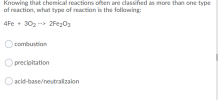 Knowing that chemical reactions often are classified as more than one type of reaction, what type of reaction is the following: 4Fe + 302 --> 2Fe2O3 combustion precipitation acid-base/neutralizaion
Write the products and balance the reactions and classify reaction type: 1. AlCl3 (aq) + Au...
Write the products and balance the reactions and classify reaction type: 1. AlCl3 (aq) + Au (s) -> 2. Cd(s) + CuBr3(aq) -> 3. Ca(OH)2(aq) + Li2SO4(aq) -> 4. SrCl2(aq) + AgNO3(aq) ->
The following reaction could be classified as which type of nucleophilic acyl substitution? More than one...
 The following reaction could be classified as which type of nucleophilic acyl substitution? More than one step might be needed, CH3CH2CHCHC-a CH3 CH3CH2CHCH2CH2-OH CH3 Select one: Grignard reaction. hydrolysis. carboxyllation reduction. alcoholysis. amoniolysis The reaction will not occur via nucleophilic acyl substitution.
Synthesis reactions occur between two elements and produce a compound 2. Complete and balance the following synthes...
 Synthesis reactions occur between two elements and produce a compound 2. Complete and balance the following synthesis reactions. Be sure to use the nomenclature rules when writing correct formulas for all products before balancing the equation a. Ni (s) + Cl2(g) → Nickel (II) chloride b. Zn (s) + Bra (1) ► c. Mg(s) + N2 (9) ► d. C(s) + S (s) → carbon disulfide e. Fe (s) + O2(g) → iron (III)oxide 3. Complete and balance the following...
1(10) Complete the following reactions. Label the major product if there is more than one product...
 1(10) Complete the following reactions. Label the major product if there is more than one product CH₃ CH₂ CH₂ CH3 have CH₃ CH₂ CH₂ + O₂ flames CH₃ CH₂ CH₂OH Na Bu, H₂SO4 (0) CH₃ CH₂OH Pele Cone. HBR CH₃CH₂ CH₂OH NaOH + OH- CH₂Cl alekoh CH₃ CH₂ CH CH3 a heat Br CH₂C-B + H₂O csta AgNO3 CH₃ CH CH3 + Ag+ OH H₃PO4 heat
Question 7a Which of the following compounds are soluble in water? More than one answer could...
Question 7a Which of the following compounds are soluble in water? More than one answer could be correct. 1. Lithium chloride 2. Ammonium hydroxide 3. Lead(II) sulfate 4. Mercury(I) iodide 0.8 points Question 7b Which of the following water soluble compounds will remain molecules in solution? More than one answer could be correct. 1. Ammonium chloride 2. Glucose (C6H12O6) 3. Carbon dioxide 4. Magnesium sulfate 0.8 points Question 7c Which of the following will completely dissociate into ions when dissolved...
Provide the missing reagents to complete the reactions below, more than one step may be required....
 Provide the missing reagents to
complete the reactions below, more than one step may be
required.
3. (8 pts) Provide the missing reagents to complete the reactions below, more than one step may be required. HO + OH но"
Provide the missing reagents to
complete the reactions below, more than one step may be
required.
3. (8 pts) Provide the missing reagents to complete the reactions below, more than one step may be required. HO + OH но"
 Knowing that chemical reactions often are classified as more than one type of reaction, what type of reaction is the following: 4Fe + 302 --> 2Fe2O3 combustion precipitation acid-base/neutralizaion
 The following reaction could be classified as which type of nucleophilic acyl substitution? More than one step might be needed, CH3CH2CHCHC-a CH3 CH3CH2CHCH2CH2-OH CH3 Select one: Grignard reaction. hydrolysis. carboxyllation reduction. alcoholysis. amoniolysis The reaction will not occur via nucleophilic acyl substitution.
 Synthesis reactions occur between two elements and produce a compound 2. Complete and balance the following synthesis reactions. Be sure to use the nomenclature rules when writing correct formulas for all products before balancing the equation a. Ni (s) + Cl2(g) → Nickel (II) chloride b. Zn (s) + Bra (1) ► c. Mg(s) + N2 (9) ► d. C(s) + S (s) → carbon disulfide e. Fe (s) + O2(g) → iron (III)oxide 3. Complete and balance the following...
 1(10) Complete the following reactions. Label the major product if there is more than one product CH₃ CH₂ CH₂ CH3 have CH₃ CH₂ CH₂ + O₂ flames CH₃ CH₂ CH₂OH Na Bu, H₂SO4 (0) CH₃ CH₂OH Pele Cone. HBR CH₃CH₂ CH₂OH NaOH + OH- CH₂Cl alekoh CH₃ CH₂ CH CH3 a heat Br CH₂C-B + H₂O csta AgNO3 CH₃ CH CH3 + Ag+ OH H₃PO4 heat
 Provide the missing reagents to
complete the reactions below, more than one step may be
required.
3. (8 pts) Provide the missing reagents to complete the reactions below, more than one step may be required. HO + OH но"
Provide the missing reagents to
complete the reactions below, more than one step may be
required.
3. (8 pts) Provide the missing reagents to complete the reactions below, more than one step may be required. HO + OH но"
Most questions answered within 3 hours.
-
Where is the error in this code sequence?
String s1 = "Hello";
String s2 = "ello";...
asked 10 months ago -
Financial data for Joel de Paris, Inc., for last year
follow:
Joel de Paris, Inc.
Balance...
asked 10 months ago -
Consider this reaction:
Al2(SO4)3 (aq)+ BaCl3
(aq) Al2Cl6 (aq)- +
3BaSO4(s) . What is the...
asked 10 months ago -
Suppose that Savneet is considering increasing her
recent random sample from 20 car rentals to 40...
asked 10 months ago -
Trucks arrive at an unloading terminal at an average rate of 120
per hour.
Trucks arrive...
asked 10 months ago -
Why are methanol and ethanol completely soluble in water while
octanol is not very little soluble....
asked 10 months ago -
A facilities manager at a university reads in a research report
that the mean amount of...
asked 10 months ago -
When the CuSO4 is rehydrated by adding water to the anhydrous
compound, is this an endothermic...
asked 10 months ago -
A ray of sunlight is passing from diamond into crown glass; the
angle of incidence is...
asked 10 months ago -
A block of mass 0.249 kg is placed on top of a light, vertical
spring of...
asked 10 months ago -
how do the kidneys compensate in the presences of acidosis
a) trigger hyperventilate
b) reserve acid...
asked 10 months ago -
Question 501 pts
The rental rate of capital to the firm increases. Which of the
following...
asked 10 months ago