


Homework Answers

Add Answer to:
(1 point) Let P = f( = 1150(1.059)' be the population of a community in year...
Let P = f(t) = 850(1.057)* be the population of a community in year t. (a)...
 Let P = f(t) = 850(1.057)* be the population of a community in year t. (a) Evaluate f(0) = (b) Evaluate f(10) = (retain at least 3 decimal places) (c) Which of these statements correctly explains the practical meaning of the value you found for f(10) in part (b)? (select all that apply if more than one is correct) A. What the population will be in 10 years. B. The growth rate per decade of the population. C. How long...
The population of a community is known to increase at a rate proportional to the number...
 The population of a community is known to increase at a rate proportional to the number of people present at time t. The initial population P. has doubled in 5 years. Suppose it is known that the population is 11,000 after 3 years. What was the initial population Po? (Round your answer to one decimal place.) Po= What will be the population in 10 years? (Round your answer to the nearest person.) persons How fast is the population growing at...
21² + 6 Ay The population, P, in thousands of a resort community is given 100...
 21² + 6 Ay The population, P, in thousands of a resort community is given 100 600t by P(t) = t20, where t is time, in months. 80-A a) Find the population at t= 0, 1, 3, and 8 months. .60 b) Find the horizontal asymptote of the graph and determine the 401 value that P(t) approaches as t goes to co? c) Explain the meaning of the answer to part (b) in terms of the 20- application 0 10...
(1 point) Steadia is an island which experienced approximately linear population growth from 1950 to 2000....
 (1 point) Steadia is an island which experienced approximately linear population growth from 1950 to 2000. On the other hand, Randomian has experienced some turmoil more recently and did not experience linear nor near-linear growth 1950 1960 1970 1980 1990 2000 Year Pop. of country A 6.9 8.6 10.2 11.9 13.9 15.7 Pop. of country B 8.7 10.9 13.5 15.3 14.7 22.6 a) The table above gives the population of these two countries, in millions. Does country A or country...
(1 point) P of a population P(t) is given in the figure above. By approximately P(t)...
 (1 point) P of a population P(t) is given in the figure above. By approximately P(t) A graph of the relative growth rate what percentage does the population change over the 9 year period? Answer: %. Clarification: As in Example 1 on page 290 of your textbook, first find factor by which the population has increased, i.e., K = P(9)/P(0), or equivalently, P(9) = Р(9) — Р(0) —D КР(0) KP(0). Then the amount of the increase itself is P(0) (K...
Population growth problems BIDE model: No.1 N, +(B + 1) - ( D Rates: b =...
 Population growth problems BIDE model: No.1 N, +(B + 1) - ( D Rates: b = B/N; d = D/N: E) Net growth rate: R = b-d Exponential growth (discrete): N, NR* where R = 1+b-d Intrinsic rate of increase: r = InR Exponential growth (continuous): N:Noe -or-dN/dt = IN Logistic growth 1. Suppose a species of fish in a lake is modeled by a logistic population model with relative growth rate ofr 0.3 per year and carrying capacity of...
Hello please assist me with this question. 1. Let the function f be defined by y...
Hello please assist me with this question. 1. Let the function f be defined by y = f(x), where x and f(x) are real numbers. Find f(2), f(−7), f(k), and f(k2 − 1). f(x) = 3 x − 5 2. Evaluate the expression. P(12, 2) · C(12, 2) 3. Find an equation in standard form of the parabola described. Vertex (8, 3); focus at (8, 10) 4. The population of Eagle River is growing exponentially according to the model P(t)...
The table shows the population P (in millions) of the United States from 1800 to 1870 where t rep...
 i need 13,14 and 15 please
The table shows the population P (in millions) of the United States from 1800 to 1870 where t represents the number of years since 1800. Source: U.S. Bureau of the Census 5.3 10 7.2 9.6 30 129 40 17.0 50 23.2 60 31.4 70 39.8 12. Use a graphing calculator to find an exponential growth model and a logistic growth model for the data. Then graph both models. 13. Use the models from part...
i need 13,14 and 15 please
The table shows the population P (in millions) of the United States from 1800 to 1870 where t represents the number of years since 1800. Source: U.S. Bureau of the Census 5.3 10 7.2 9.6 30 129 40 17.0 50 23.2 60 31.4 70 39.8 12. Use a graphing calculator to find an exponential growth model and a logistic growth model for the data. Then graph both models. 13. Use the models from part...
1. Suppose the graph below represents the population of minke whales where is the stock of...
 1. Suppose the graph below represents the population of minke whales where is the stock of whale population at time t, and F(X) is the net biological growth (births - natural death) in the population. (For those of you that are mathematically curious, the general logistic growth function is represent by a function of the form: F(X.) = gx:(1-)) Growth in Whale Populatuin (F(Xt)) o a. Minke Whale Population (tons) On the graph above mark the point that represents the...
10. For the following, circle the correct answer (a) (1 point) The derivative of f at a, written ...
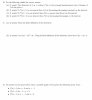 10. For the following, circle the correct answer (a) (1 point) The derivative of f at a, written f(a), is the (average/instantaneous) rate of change of f at the point a (b) (1 point) If f'(x) < 0 on an interval then f(x) İs (increasing/decreasing/constant) on the interval. (c) (1 point) If f"(x)0 on an interval then f(x) is concave (up/down) on the interval. (d) (1 point) If f"(x)< 0 on an interval then f'() is (increasing/decreasing) on the interval....
 Let P = f(t) = 850(1.057)* be the population of a community in year t. (a) Evaluate f(0) = (b) Evaluate f(10) = (retain at least 3 decimal places) (c) Which of these statements correctly explains the practical meaning of the value you found for f(10) in part (b)? (select all that apply if more than one is correct) A. What the population will be in 10 years. B. The growth rate per decade of the population. C. How long...
 The population of a community is known to increase at a rate proportional to the number of people present at time t. The initial population P. has doubled in 5 years. Suppose it is known that the population is 11,000 after 3 years. What was the initial population Po? (Round your answer to one decimal place.) Po= What will be the population in 10 years? (Round your answer to the nearest person.) persons How fast is the population growing at...
 21² + 6 Ay The population, P, in thousands of a resort community is given 100 600t by P(t) = t20, where t is time, in months. 80-A a) Find the population at t= 0, 1, 3, and 8 months. .60 b) Find the horizontal asymptote of the graph and determine the 401 value that P(t) approaches as t goes to co? c) Explain the meaning of the answer to part (b) in terms of the 20- application 0 10...
 (1 point) Steadia is an island which experienced approximately linear population growth from 1950 to 2000. On the other hand, Randomian has experienced some turmoil more recently and did not experience linear nor near-linear growth 1950 1960 1970 1980 1990 2000 Year Pop. of country A 6.9 8.6 10.2 11.9 13.9 15.7 Pop. of country B 8.7 10.9 13.5 15.3 14.7 22.6 a) The table above gives the population of these two countries, in millions. Does country A or country...
 (1 point) P of a population P(t) is given in the figure above. By approximately P(t) A graph of the relative growth rate what percentage does the population change over the 9 year period? Answer: %. Clarification: As in Example 1 on page 290 of your textbook, first find factor by which the population has increased, i.e., K = P(9)/P(0), or equivalently, P(9) = Р(9) — Р(0) —D КР(0) KP(0). Then the amount of the increase itself is P(0) (K...
 Population growth problems BIDE model: No.1 N, +(B + 1) - ( D Rates: b = B/N; d = D/N: E) Net growth rate: R = b-d Exponential growth (discrete): N, NR* where R = 1+b-d Intrinsic rate of increase: r = InR Exponential growth (continuous): N:Noe -or-dN/dt = IN Logistic growth 1. Suppose a species of fish in a lake is modeled by a logistic population model with relative growth rate ofr 0.3 per year and carrying capacity of...
 i need 13,14 and 15 please
The table shows the population P (in millions) of the United States from 1800 to 1870 where t represents the number of years since 1800. Source: U.S. Bureau of the Census 5.3 10 7.2 9.6 30 129 40 17.0 50 23.2 60 31.4 70 39.8 12. Use a graphing calculator to find an exponential growth model and a logistic growth model for the data. Then graph both models. 13. Use the models from part...
i need 13,14 and 15 please
The table shows the population P (in millions) of the United States from 1800 to 1870 where t represents the number of years since 1800. Source: U.S. Bureau of the Census 5.3 10 7.2 9.6 30 129 40 17.0 50 23.2 60 31.4 70 39.8 12. Use a graphing calculator to find an exponential growth model and a logistic growth model for the data. Then graph both models. 13. Use the models from part...
 1. Suppose the graph below represents the population of minke whales where is the stock of whale population at time t, and F(X) is the net biological growth (births - natural death) in the population. (For those of you that are mathematically curious, the general logistic growth function is represent by a function of the form: F(X.) = gx:(1-)) Growth in Whale Populatuin (F(Xt)) o a. Minke Whale Population (tons) On the graph above mark the point that represents the...
 10. For the following, circle the correct answer (a) (1 point) The derivative of f at a, written f(a), is the (average/instantaneous) rate of change of f at the point a (b) (1 point) If f'(x) < 0 on an interval then f(x) İs (increasing/decreasing/constant) on the interval. (c) (1 point) If f"(x)0 on an interval then f(x) is concave (up/down) on the interval. (d) (1 point) If f"(x)< 0 on an interval then f'() is (increasing/decreasing) on the interval....
Most questions answered within 3 hours.
-
Where is the error in this code sequence?
String s1 = "Hello";
String s2 = "ello";...
asked 11 months ago -
Financial data for Joel de Paris, Inc., for last year
follow:
Joel de Paris, Inc.
Balance...
asked 11 months ago -
Consider this reaction:
Al2(SO4)3 (aq)+ BaCl3
(aq) Al2Cl6 (aq)- +
3BaSO4(s) . What is the...
asked 11 months ago -
Suppose that Savneet is considering increasing her
recent random sample from 20 car rentals to 40...
asked 11 months ago -
Trucks arrive at an unloading terminal at an average rate of 120
per hour.
Trucks arrive...
asked 11 months ago -
Why are methanol and ethanol completely soluble in water while
octanol is not very little soluble....
asked 11 months ago -
A facilities manager at a university reads in a research report
that the mean amount of...
asked 11 months ago -
When the CuSO4 is rehydrated by adding water to the anhydrous
compound, is this an endothermic...
asked 11 months ago -
A ray of sunlight is passing from diamond into crown glass; the
angle of incidence is...
asked 11 months ago -
A block of mass 0.249 kg is placed on top of a light, vertical
spring of...
asked 11 months ago -
how do the kidneys compensate in the presences of acidosis
a) trigger hyperventilate
b) reserve acid...
asked 11 months ago -
Question 501 pts
The rental rate of capital to the firm increases. Which of the
following...
asked 11 months ago