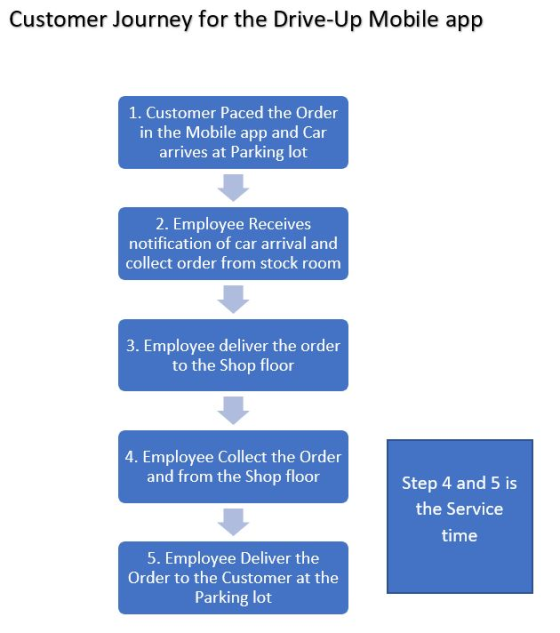
The process that we will be simulating is how an item goes from Target's stockroom/ backroom to the sales floor out to the customer in Target's new receiving model called "Drive Up." The beginning process will start out from the item being set in the stockroom, the employee will then have to become notified to push the item out onto the sales floor. After that first process of stockroom to sales floor we would then describe the procedure of the customer buying their item that is on the sales floor, which would be received by them in their car. The customer purchasing the item would start by buying the item on Target's app and pushing a notification to the employee. The employee would then set out the created order for the customer to receive at their car in the parking lot aka "Drive Up". The first arrival time data would be where the car pulls up to the parking lot. The service time data will be calculated once the target employee has grabbed the bag with the customer's items, and the service time will end once the bag was received by the customer.
Homework Answers
Add Answer to:
The process that we will be simulating is how an item goes from Target's stockroom
Question 2 A fast-food franchise is considering operating a drive-up window food-service operatio...
Question 2 A fast-food franchise is considering operating a drive-up window food-service operation. Assume that customer arrivals follow a Poisson probability distribution, with an arrival rate of 24 cars per hour, and that service times follow an exponential probability distribution. Arriving customers place orders at an intercom station at the back of the parking lot and then drive to the service window to pay for and receive their orders. The following three service alternatives are being considered: A single-channel operation...
Exercise 4.30 Draw a collaboration diagram for the following business process at MetalWorks. A build-to-order (BTO)...
Exercise 4.30 Draw a collaboration diagram for the following business process at MetalWorks. A build-to-order (BTO) process, also known as make-to-order process, is an order-to-cash process wheretheproducts tobesoldaremanufactured onthebasisofaconfirmedpurchase order. Inotherwords,themanufacturer doesnotmaintainanyready-to-ship productsintheir stock. Instead, the products are manufactured on demand when the customer orders them. Thisapproach isusedinthecontext ofcustomizedproducts, suchasmetallurgicalproducts, where customers often submit orders for products with very specific requirements. We consider a BTO process at a company called MetalWorks. The process starts when MetalWorks receives apurchase order (PO)...
Q1.a) Based on the business rules, you are expected to construct an Entity-Relationship (ER) diagram. The...
 Q1.a) Based on the business rules, you are expected to construct
an Entity-Relationship (ER) diagram. The ER diagram should include
entities, attributes (if there are less than three specified in the
business statements, please add some extra attributes), identifiers
and corresponding data types, the relationships among entities with
cardinality and associative entities.
.b) Extend Q1.a) to apply generalization/specialization
technique to construct an Enhanced-ER (EER) diagram. The EER
diagram should specify the complete (total) and disjoint
(mutuallyexclusive) constraints on the
generalization/specialization....
Q1.a) Based on the business rules, you are expected to construct
an Entity-Relationship (ER) diagram. The ER diagram should include
entities, attributes (if there are less than three specified in the
business statements, please add some extra attributes), identifiers
and corresponding data types, the relationships among entities with
cardinality and associative entities.
.b) Extend Q1.a) to apply generalization/specialization
technique to construct an Enhanced-ER (EER) diagram. The EER
diagram should specify the complete (total) and disjoint
(mutuallyexclusive) constraints on the
generalization/specialization....
Ellen 84 Which preventive, detective, and/or corrective controls would best mitigate the follow- ing threats? a....
 Ellen 84 Which preventive, detective, and/or corrective controls would best mitigate the follow- ing threats? a. An employee's laptop was stolen at the airport. The laptop contained personal in- formation about the company's customers that could potentially be used to commit identity theft. b. A salesperson successfully logged into the payroll system by guessing the payroll supervisor's password. c. A criminal remotely accessed a sensitive database using the authentication credentials (user ID and strong password) of an IT manager. At...
Use the five-step decision-making process discussed in Chapter 1 to analyze every one of the following...
Use the five-step decision-making process discussed in Chapter 1 to analyze every one of the following situations and recommend a course of action. You are a new salesperson at a large software manufacturing firm. It is three weeks from the end of the sales quarter and you and your sales manager are sitting pretty—you have both already met your sales quota for the quarter. In addition, you just closed another deal with a new customer for $100,000 of software and...
Have you ever wondered how many different ways there are to run a small restaurant? Delivering...
Have you ever wondered how many different ways there are to run a small restaurant? Delivering a sit down eating experience is a common process after all. In Japan it is fairly common to have a sushi restaurant that serves sushi on a conveyor belt! Interestingly, these sushi restaurants are typically very inexpensive. In Boston, there is usually at least one of these restaurants. For example, you could try Enso Sushi, but the sushi there is at least $2 per...
THE BIG D COMPANY The Big D Company of Dallas, Texas, was a family owned, conservatively...
THE BIG D COMPANY The Big D Company of Dallas, Texas, was a family owned, conservatively managed company. For over forty years the company enjoyed slow, steady growth in reaching its current employment level of just over 200. All expansions were financed entirely out of earnings. As the company grew, its operating procedures were periodically re-examined and modified to cope with the complex problems that accompany growth. The company developed, manufactured, and sold metering and flow control devices used in...
THE BIG D COMPANY The Big D Company of Dallas, Texas, was a family owned, conservatively...
THE BIG D COMPANY The Big D Company of Dallas, Texas, was a family owned, conservatively managed company. For over forty years the company enjoyed slow, steady growth in reaching its current employment level of just over 200. All expansions were financed entirely out of earnings. As the company grew, its operating procedures were periodically re-examined and modified to cope with the complex problems that accompany growth. The company developed, manufactured, and sold metering and flow control devices used in...
Chapter 14 Read Retention: Deciding to Act and answer questions 1 through 4. Thank you. Retention: Deciding to Act Wa...
 Chapter 14
Read Retention: Deciding to Act and answer questions 1 through
4. Thank you.
Retention: Deciding to Act Wally's Wonder Wash (WWW) is a full-service, high-tech, high-touch car wash company owned solely by Wally Wheelspoke. Located in a midwestern city of 200,000 people (with another 100,000 in suburbs and more rural towns throughout the county), WWW currently has four facilities within the city. Wally plans to add four more facilities within the city in the next two years, and...
Chapter 14
Read Retention: Deciding to Act and answer questions 1 through
4. Thank you.
Retention: Deciding to Act Wally's Wonder Wash (WWW) is a full-service, high-tech, high-touch car wash company owned solely by Wally Wheelspoke. Located in a midwestern city of 200,000 people (with another 100,000 in suburbs and more rural towns throughout the county), WWW currently has four facilities within the city. Wally plans to add four more facilities within the city in the next two years, and...
Part 1-Please answer the following essay questions 1. We discussed the advantages and disadvantag...
Part 1-Please answer the following essay questions 1. We discussed the advantages and disadvantages of internal recruiting, interviews and reference checks (and the entire hiring process). Please identify ONE disadvantage of each of these three activities -- and explain why you believe they are "disadvantages." 2. Choose ONE interview question listed below and answer it on paper as if it was being asked of you in a face-to-face interview. Please identify the Interview Question #. Details, details, details are necessary...
 Q1.a) Based on the business rules, you are expected to construct
an Entity-Relationship (ER) diagram. The ER diagram should include
entities, attributes (if there are less than three specified in the
business statements, please add some extra attributes), identifiers
and corresponding data types, the relationships among entities with
cardinality and associative entities.
.b) Extend Q1.a) to apply generalization/specialization
technique to construct an Enhanced-ER (EER) diagram. The EER
diagram should specify the complete (total) and disjoint
(mutuallyexclusive) constraints on the
generalization/specialization....
Q1.a) Based on the business rules, you are expected to construct
an Entity-Relationship (ER) diagram. The ER diagram should include
entities, attributes (if there are less than three specified in the
business statements, please add some extra attributes), identifiers
and corresponding data types, the relationships among entities with
cardinality and associative entities.
.b) Extend Q1.a) to apply generalization/specialization
technique to construct an Enhanced-ER (EER) diagram. The EER
diagram should specify the complete (total) and disjoint
(mutuallyexclusive) constraints on the
generalization/specialization....
 Ellen 84 Which preventive, detective, and/or corrective controls would best mitigate the follow- ing threats? a. An employee's laptop was stolen at the airport. The laptop contained personal in- formation about the company's customers that could potentially be used to commit identity theft. b. A salesperson successfully logged into the payroll system by guessing the payroll supervisor's password. c. A criminal remotely accessed a sensitive database using the authentication credentials (user ID and strong password) of an IT manager. At...
 Chapter 14
Read Retention: Deciding to Act and answer questions 1 through
4. Thank you.
Retention: Deciding to Act Wally's Wonder Wash (WWW) is a full-service, high-tech, high-touch car wash company owned solely by Wally Wheelspoke. Located in a midwestern city of 200,000 people (with another 100,000 in suburbs and more rural towns throughout the county), WWW currently has four facilities within the city. Wally plans to add four more facilities within the city in the next two years, and...
Chapter 14
Read Retention: Deciding to Act and answer questions 1 through
4. Thank you.
Retention: Deciding to Act Wally's Wonder Wash (WWW) is a full-service, high-tech, high-touch car wash company owned solely by Wally Wheelspoke. Located in a midwestern city of 200,000 people (with another 100,000 in suburbs and more rural towns throughout the county), WWW currently has four facilities within the city. Wally plans to add four more facilities within the city in the next two years, and...
Most questions answered within 3 hours.
-
Where is the error in this code sequence?
String s1 = "Hello";
String s2 = "ello";...
asked 10 months ago -
Financial data for Joel de Paris, Inc., for last year
follow:
Joel de Paris, Inc.
Balance...
asked 10 months ago -
Consider this reaction:
Al2(SO4)3 (aq)+ BaCl3
(aq) Al2Cl6 (aq)- +
3BaSO4(s) . What is the...
asked 10 months ago -
Suppose that Savneet is considering increasing her
recent random sample from 20 car rentals to 40...
asked 10 months ago -
Trucks arrive at an unloading terminal at an average rate of 120
per hour.
Trucks arrive...
asked 10 months ago -
Why are methanol and ethanol completely soluble in water while
octanol is not very little soluble....
asked 10 months ago -
A facilities manager at a university reads in a research report
that the mean amount of...
asked 10 months ago -
When the CuSO4 is rehydrated by adding water to the anhydrous
compound, is this an endothermic...
asked 10 months ago -
A ray of sunlight is passing from diamond into crown glass; the
angle of incidence is...
asked 10 months ago -
A block of mass 0.249 kg is placed on top of a light, vertical
spring of...
asked 10 months ago -
how do the kidneys compensate in the presences of acidosis
a) trigger hyperventilate
b) reserve acid...
asked 10 months ago -
Question 501 pts
The rental rate of capital to the firm increases. Which of the
following...
asked 10 months ago